 by Tom Gurney
Tom Gurney BSc (Hons) is an art history expert with over 20 years experience
Published on June 19, 2020 / Updated on November 6, 2026
Email: tomgurney1@gmail.com / Phone: +44 7429 011000
Introduction
The predella of Fra Angelico’s San Marco Altarpiece originally consisted of eight narrative scenes devoted to Saints Cosmas and Damian. Today those panels are dispersed across several museums. Only two remain at the Museo di San Marco. Others survive in Washington, Munich, Dublin, Paris and elsewhere. Seen separately, each scene can look like an independent miniature masterpiece. Originally, however, they formed one continuous narrative beneath the monumental high-altarpiece commissioned for the Medici-funded church of San Marco.
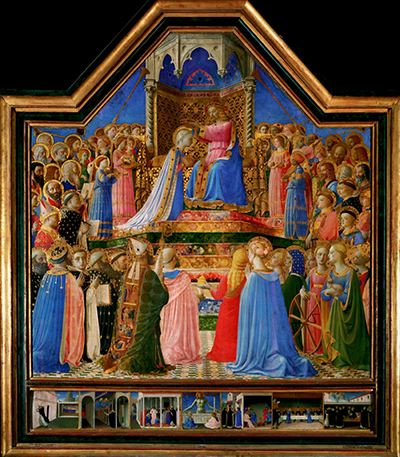
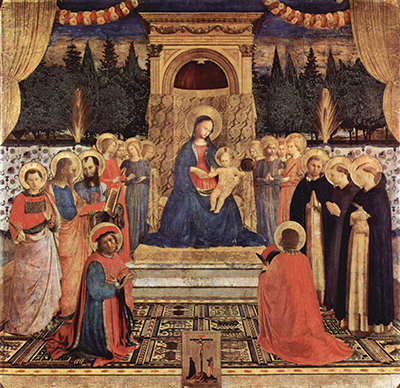
The Museo di San Marco describes the altarpiece as a wooden structure approximately three and a half metres high, formed from at least twenty-six paintings. The predella formed the narrative foundation of that enormous ensemble. Cosmas and Damian were not chosen accidentally. They were the principal Medici patron saints associated with the high altar. Their lives therefore turned family devotion into sacred story. The surviving National Gallery of Art panel The Healing of Palladia by Saint Cosmas and Saint Damian, dated about 1438–40, gives us one of the best-preserved fragments.
The NGA records its provenance on the high altar of San Marco from about 1440 until the later seventeenth century and explicitly identifies it as part of Angelico’s Cosmas and Damian predella. The wider cycle included healing, the moral problem of payment, persecution, miraculous survival and martyrdom. Read as a sequence, the predella becomes much more than a group of charming small panels. It is a narrative about what sacred service costs. [1]
At a Glance
- ArtistFra Angelico, with workshop context [1]
- Parent workSan Marco Altarpiece [1]
- Datec. 1438–43; individual NGA Palladia panel c. 1438–40 [2]
- Original locationhigh altar, church of San Marco, Florence [1]
- PatronsCosimo and Lorenzo de’ Medici [1]
- Predella structureeight scenes [1]
- SaintsCosmas and Damian [1]
- Saintly identityphysician saints, healers without payment, martyrs [1]
- Medici significanceprincipal family patron saints [1]
- Current statedispersed across multiple museums [5]
- At San Marco todaytwo original predella compartments [5]
- Major surviving sceneThe Healing of Palladia, National Gallery of Art, Washington [2]
- Core themeshealing, charity, money, persecution, miracle and martyrdom [1]
Contents
- Introduction
- Cosmas and Damian
- The Medici Connection
- Eight Scenes
- The Healing of Palladia
- Payment and Damian
- Before the Proconsul Lycias
- Beheading and Martyrdom
- Dispersal
- Why the Cosmas and Damian Predella Matters
Cosmas and Damian
Cosmas and Damian were traditionally understood as twin or brother physician saints. Their legends emphasised healing without accepting payment. This earned them the title anargyroi, often interpreted as “without silver”. That identity made them particularly powerful models of Christian charity. They possessed knowledge and skill. They used both without turning service into personal profit. Their stories therefore concern medicine, money and holiness simultaneously. [1]
The Medici Connection
Cosmas and Damian had exceptional significance for the Medici. The name Cosmas naturally resonated with Cosimo de’ Medici. The saints became important heavenly patrons for the family. This connection explains their central role at San Marco. The high altar was dedicated to Saint Mark and Saints Cosmas and Damian. The predella then narrated the Medici saints’ entire sacred identity beneath the principal image. [1]
The Medici did not need to insert large donor portraits into the central pala to make patronage visible. Saints could represent the family more appropriately. Cosmas and Damian translated Medici identity into Christian terms. Healing. Charity. Faith. Martyrdom. The predella made these associations narrative rather than merely symbolic. [1]
Eight Scenes
The Museo di San Marco confirms that eight stories of Cosmas and Damian originally formed the predella. This number matters because modern dispersal hides the original rhythm. A high-altarpiece viewer could read the saints’ lives sequentially across the base. The central sacred assembly above remained timeless. The predella below unfolded through time. [1]
Predellas are particularly suited to narrative. Their horizontal format encourages sequence. One scene leads to another. Angelico’s early training in illumination made him exceptionally skilled at compressing complex actions into small panels. The San Marco predella is one of the mature high points of that ability. [4]
The Healing of Palladia
The NGA panel shows Cosmas and Damian healing Palladia. The event occurs within a carefully designed domestic architecture. The patient lies in bed. The physician saints attend her. Additional figures occupy adjacent spaces. The panel combines sacred miracle with ordinary household detail. This is one reason Angelico’s predellas feel so vivid. Miracles occur in believable rooms. [2]
The architecture is perspectivally coherent. Openings divide the action. The viewer can read interior and exterior spaces clearly. This spatial organisation demonstrates Angelico’s mature Renaissance technique at miniature scale. The panel is small. Its world is not. [2]
The scene defines the saints through practical action. They heal a sick woman. Holiness is therefore not represented only through prayer or martyrdom. It takes the form of care. This would have made the saints especially meaningful in a culture where medicine, charity and religious institutions overlapped frequently. [1]
Payment and Damian
The Palladia legend develops into a moral problem when Damian accepts a gift or payment after healing. The saints were famous precisely for refusing money. The episode therefore creates tension. Why would one of the “moneyless” physicians accept compensation? Traditional accounts explain the action through Palladia’s insistence and Damian’s devotional motives. The narrative tests charity rather than simply celebrating it. [1]
The theme acquires additional resonance within a Medici-funded altarpiece. One of Florence’s great banking families chose saints famous for healing without payment. This should not be reduced to cynical irony. Patronal saints often represented ideal virtues. But the connection makes the predella unusually rich. Wealth is placed beside a narrative about service that should transcend profit. [1]
Before the Proconsul Lycias
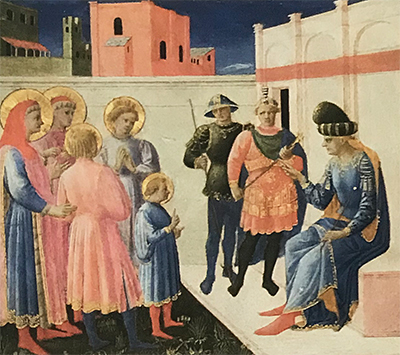
The saints are later brought before the Roman authority Lycias. The cycle shifts from healing to persecution. Their Christian identity becomes a public problem for political authority. This transition is structurally important. Charity leads to witness. Witness leads to confrontation. [1]
Traditional legend describes repeated failed attempts to kill Cosmas and Damian. They survive drowning. They survive fire. Other punishments fail. These miracles establish divine protection. Angelico uses the episodes to create visually dramatic scenes without losing clarity. [1]
The saints’ miraculous survival from burning provides one of the cycle’s most spectacular narratives. Flames become both physical threat and proof of divine intervention. The persecutors possess force. The saints possess another order of protection. [1]
Other episodes represent increasingly violent attempts to kill the saints and their companions. These scenes give the predella a rising dramatic intensity. The gentle healers introduced at the beginning are gradually transformed into martyrs. The sequence therefore builds moral identity through endurance. [1]
Beheading and Martyrdom
The saints ultimately die by execution. The finality of martyrdom contrasts with earlier miraculous escapes. Divine protection does not mean avoidance of death forever. The saints’ victory lies in fidelity rather than bodily survival. This is a fundamental logic of Christian martyr stories. [1]
The narrative also includes the aftermath of death and burial traditions. Burial converts martyrdom into memory. The saints become objects of cult. The story therefore explains why they can appear above within the timeless sacred court of the main altarpiece. [1]
This vertical relationship is one of the most important meanings of the original object. Below: the saints heal, suffer and die. Above: they stand eternally beside the Virgin and Child. The predella explains the pala. Historical action becomes heavenly status. [1]
Small Scale and Monumental Meaning
The predella panels are physically small. Their theological function is not. They explain the patron saints of one of Florence’s most important new high altars. Angelico therefore uses intimate narrative to support monumental liturgy. [4]
The NGA identifies The Healing of Palladia as tempera and oil on poplar. This mixed technique allowed crisp detail and rich colour. The material sophistication reinforces the idea that predella painting was not secondary workshop filler. These were carefully made objects. [2]
The panels were painted on poplar, a common Italian support. Their later separation from the main altarpiece exposed them to independent histories of sale, transport and framing. A predella that once functioned as one horizontal narrative became many collectible panels. [2]
Dispersal
The San Marco high-altarpiece was removed during later church renovation. The predella panels were eventually separated. By the eighteenth and nineteenth centuries they were recorded in different locations within or outside the convent. Some entered the Florentine art market. Others passed into foreign collections. The original sequence fragmented physically and intellectually. [3]
Historical records place several Angelico panels in the convent pharmacy before suppression. This is a fascinating intermediate stage. The predella had already ceased functioning on the high altar but remained within the institutional environment of San Marco. Only later did the pieces disperse more widely. [3]
The Palladia scene eventually passed through major European and American collections before entering the National Gallery of Art through the Samuel H. Kress Collection in 1952. Its provenance illustrates the international trade in detached Renaissance predella panels. What began as one component of a Florentine high altar became an individual American museum masterpiece. [3]
Scholarship has sometimes confused the San Marco Cosmas-and-Damian predella with another related series associated with the Annalena Altarpiece. The NGA explicitly warns about this problem. The two cycles differ in scale and workshop attribution. This is an important caution. Repeated saint subjects do not automatically belong to the same original object. [3]
Workshop Participation
Some Cosmas and Damian narratives associated with Angelico’s wider production involved assistants. The San Marco predella itself belongs securely to Angelico’s high-altarpiece programme, but modern attribution remains attentive to workshop practice. Large altarpieces were collaborative enterprises. Design and execution could be distributed. [4]
The predella is especially important for understanding Angelico’s perspective. Public buildings. Bedrooms. Courtyards. Streets. These spaces are constructed coherently within very small panels. Perspective therefore does not depend upon large fresco scale. Angelico can create convincing worlds only a few dozen centimetres wide. [4]
Narrative Clarity
Angelico’s scenes are easy to read because he controls architecture and gesture. Figures cluster around the key action. Secondary detail enriches without confusing. This balance helps explain why the Metropolitan Museum has described his predellas as among the most forward-looking works produced in fifteenth-century Florence. [4]
The medical identity of the saints also broadens Angelico’s sacred world. Holiness is not limited to monks, apostles or theologians. Professional skill can become holy when used as charity. The physicians therefore provide a distinctive model of Christian vocation. [1]
The Medici-Dominican context gives this model additional resonance. San Marco was not a hospital, but Florence’s religious and charitable institutions existed within overlapping networks of care. The saints’ popularity reflects a society in which illness was both medical and devotional reality. [1]
Why the Cosmas and Damian Predella Matters
The Cosmas and Damian predella matters because it restores narrative meaning to fragments now scattered across museums. Seen alone, The Healing of Palladia is a beautiful small painting. Seen within the original sequence, it becomes the opening phase of a much larger moral biography. The saints heal. Money creates a test. Political authority persecutes. Miracles intervene. Martyrdom completes witness. Above these scenes, the same saints stand eternally within the San Marco Altarpiece. The structure connects life with sanctity. The predella also reveals how Medici patronage operated.
Cosmas and Damian were family saints. Their stories allowed the patrons to associate themselves with ideals of healing, charity and faith. This did not turn the altarpiece into secular propaganda. It embedded family identity inside sacred narrative. Finally, the dispersed panels are exemplary Angelico works in their own right. They demonstrate perspective, domestic observation, colour and narrative economy at miniature scale. The original predella therefore deserves to be studied as one of the great narrative systems of the mature Fra Angelico. [1]
Frequently Asked Questions
Discussion
How does the dispersed Cosmas and Damian predella change when its panels are read again as one narrative foundation for the San Marco Altarpiece?
Reader Insights
How does the saints’ refusal of payment complicate their role within a Medici-funded high altar?
What does the movement from healing through persecution to martyrdom contribute to the main altarpiece above?
How should museums help viewers reconstruct the meaning of panels now dispersed across collections?
Join the Conversation
Share your reading of Fra Angelico’s Cosmas and Damian predella below.
References
- Direzione regionale Musei nazionali Toscana, institutional history of the San Marco Altarpiece and its eight Cosmas and Damian predella scenes. Direzione regionale Musei nazionali Toscana history and reconstruction of the San Marco Altarpiece.
- National Gallery of Art, Washington, Fra Angelico, The Healing of Palladia by Saint Cosmas and Saint Damian, c. 1438–40. National Gallery of Art object record for The Healing of Palladia.
- National Gallery of Art, provenance and scholarly notes on the San Marco predella. National Gallery of Art provenance and scholarly notes on the San Marco predella.
- Metropolitan Museum of Art, Fra Angelico exhibition and research on the innovative importance of predella painting. Metropolitan Museum of Art Fra Angelico exhibition research.
- Museo di San Marco, collection and altarpiece reconstruction resources. Museo di San Marco institutional collection page.
.jpg)
 Fra Angelico.jpg)