 by Tom Gurney
Tom Gurney BSc (Hons) is an art history expert with over 20 years experience
Published on June 19, 2020 / Updated on November 25, 2026
Email: tomgurney1@gmail.com / Phone: +44 7429 011000
The Daughters of Eve: Introduction
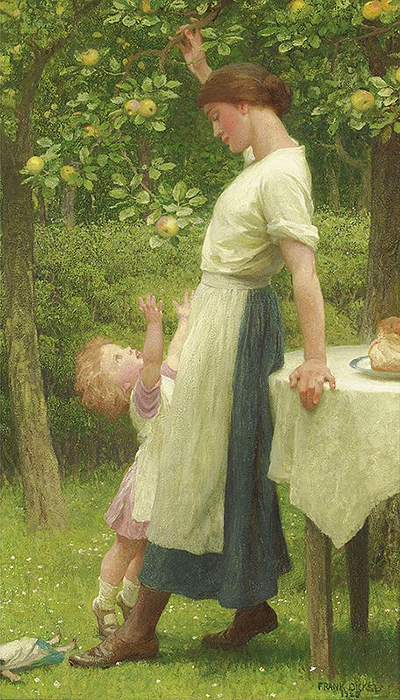
A child reaches for an apple while a young woman lowers a branch. Frank Dicksee builds The Daughters of Eve around the last few inches between the child’s fingers and the fruit. He painted the scene in oil in 1925 and exhibited it that year at the Royal Academy and in Liverpool. The title brings the Garden of Eden to mind, but the apron, table and loaf put the encounter firmly in the world of everyday life. [1] [2] [3]
At a Glance
- ArtistFrank Dicksee
- Date1925, signed and dated lower right
- MediumOil on canvas
- Dimensions88.9 × 54 cm
- ExhibitedRoyal Academy, London, 1925, no. 83, and Liverpool Autumn Exhibition, Walker Art Gallery, 1925, no. 940. [1] [2] [3]
This work across Frank Dicksee’s career
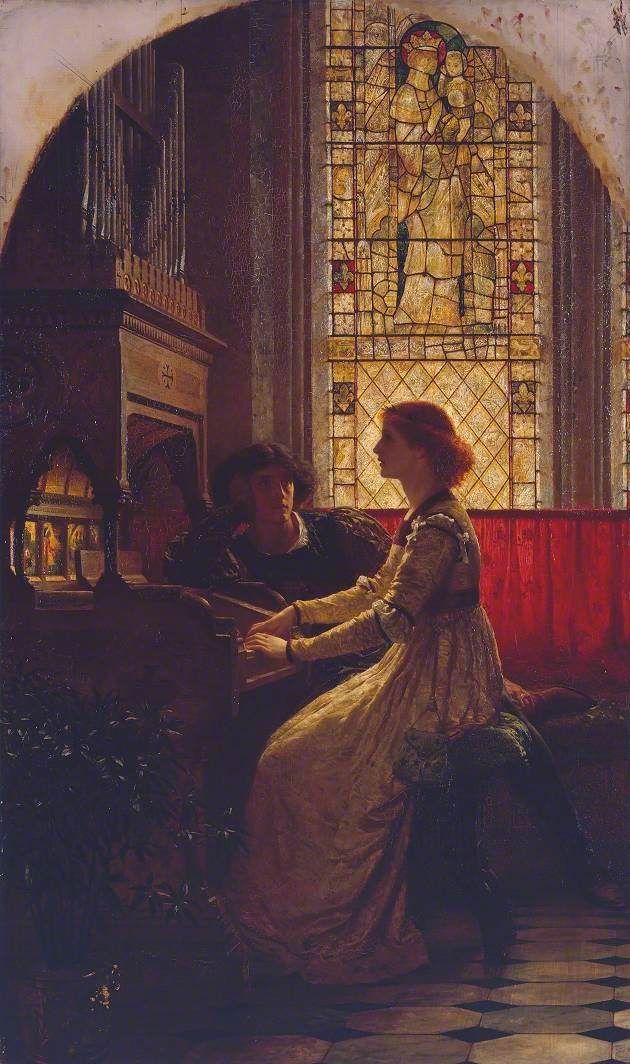
Harmony
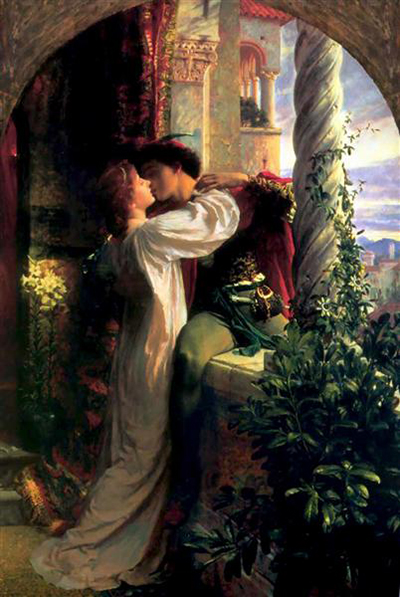
1877Romeo and Juliet
1884Chivalry
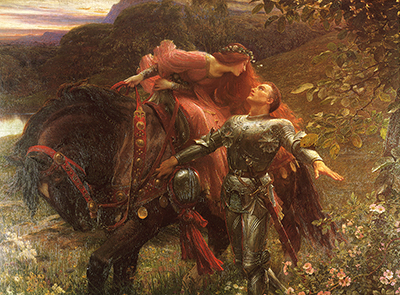
1885Startled
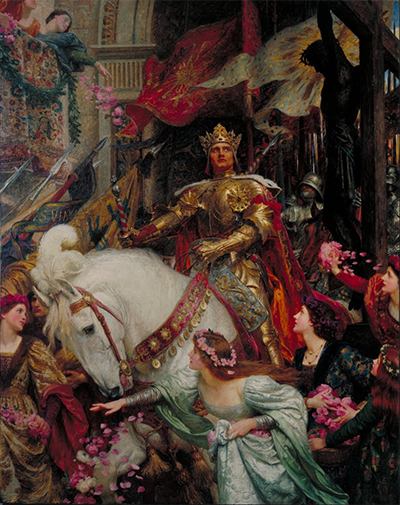
1892The Two Crowns
1900Contents
- Under the Apple Tree
- The Title and the Fruit
- The Oil and the Watercolour
- Beatrice Stuart
- At the Academy and After
Under the Apple Tree
The young woman stands at the centre of the narrow canvas. One hand is high in the foliage, its fingers closed around the branch, while the other rests on the corner of a table. Her head tips down towards the child. Below her, the child strains upwards, the small hands silhouetted against the green leaves and the pale apron. The composition depends on the difference in their heights. The branch is comfortable for the taller figure to hold, but even with both arms lifted the child has a little farther to go. Dicksee leaves the apple on the tree and lets the viewer imagine the instant when it will come loose. [1] [2]
Try following the young woman’s arms through the picture. They form a long diagonal from her raised hand above her head to the fingers hooked over the table edge. One boot projects to the left into the grass, below the arm extended towards the table. The position of her feet makes the reach feel balanced. It also gives the two figures different kinds of movement. The older figure is braced at several points, while the child leans in, elbows bent, chin tilted and fingers stretched. The tree trunks on either side give the curved gestures a firm setting. [1] [2]
The orchard extends into green behind them, but Dicksee gives the shallow foreground the feeling of a room. A white cloth hangs over the edge of the table and a loaf sits on a plate, partly cut off by the right edge of the canvas. Those cropped objects imply a meal continuing beyond what we see. On the opposite side, a doll lies in the grass among the small pale flowers. It sits near enough to the child’s feet for us to imagine how quickly her attention shifted. The laid table and the abandoned toy tell small stories about what happened just before the gesture that holds the picture together. [1] [2]
Look at the way the pale tones recur. The woman’s rolled sleeve, the apron and the tablecloth are easy to distinguish as separate textiles, yet together they carry the light down the canvas. Her dark blue skirt and the shaded trunks then give those passages definition. Above, the yellow apples break up a dense canopy in small, irregular clusters. Many of the marks in the background are relatively loose, while the folded edge of the child’s sleeve and the knuckles on the table read more clearly. Sotheby’s noted passages of thickly applied paint when it examined the canvas. The different degrees of finish put the emphasis on the reach itself, even in an orchard crowded with things to look at. [1] [2]
The Title and the Fruit
In Genesis, Eve takes the fruit of the tree of the knowledge of good and evil and shares it with Adam. The passage leaves the kind of fruit unnamed. Dicksee’s apple tree gives a familiar shape to that association while the painting supplies a very different set of circumstances. There is plenty of fruit, and the obstacle for the child is height. The young woman’s gesture makes sense as a small act of help. The title leaves room for a playful allusion, a more serious recollection of the biblical story, or both. The exact family relationship between the figures is unrecorded in the sale catalogues. [1] [2] [4]
There was a precedent on the walls of the Academy. George Dunlop Leslie exhibited his own The Daughters of Eve there in 1883. In Leslie’s canvas, three figures are at different stages of gathering and eating the apples. In the illustration published in Academy Notes that year, one girl stands on a chair to reach the branch, another holds out her apron and the smallest has already begun to eat. Sotheby’s suggested that Leslie might have influenced Dicksee. The shared title and orchard make the comparison worth pursuing, though the two artists organise the action differently. Dicksee tightens the scene around two figures and chooses the moment just before the child can take the fruit. The apron, spread to receive apples in Leslie’s picture, hangs straight down between the two figures in Dicksee’s. [1] [2] [5] [6]
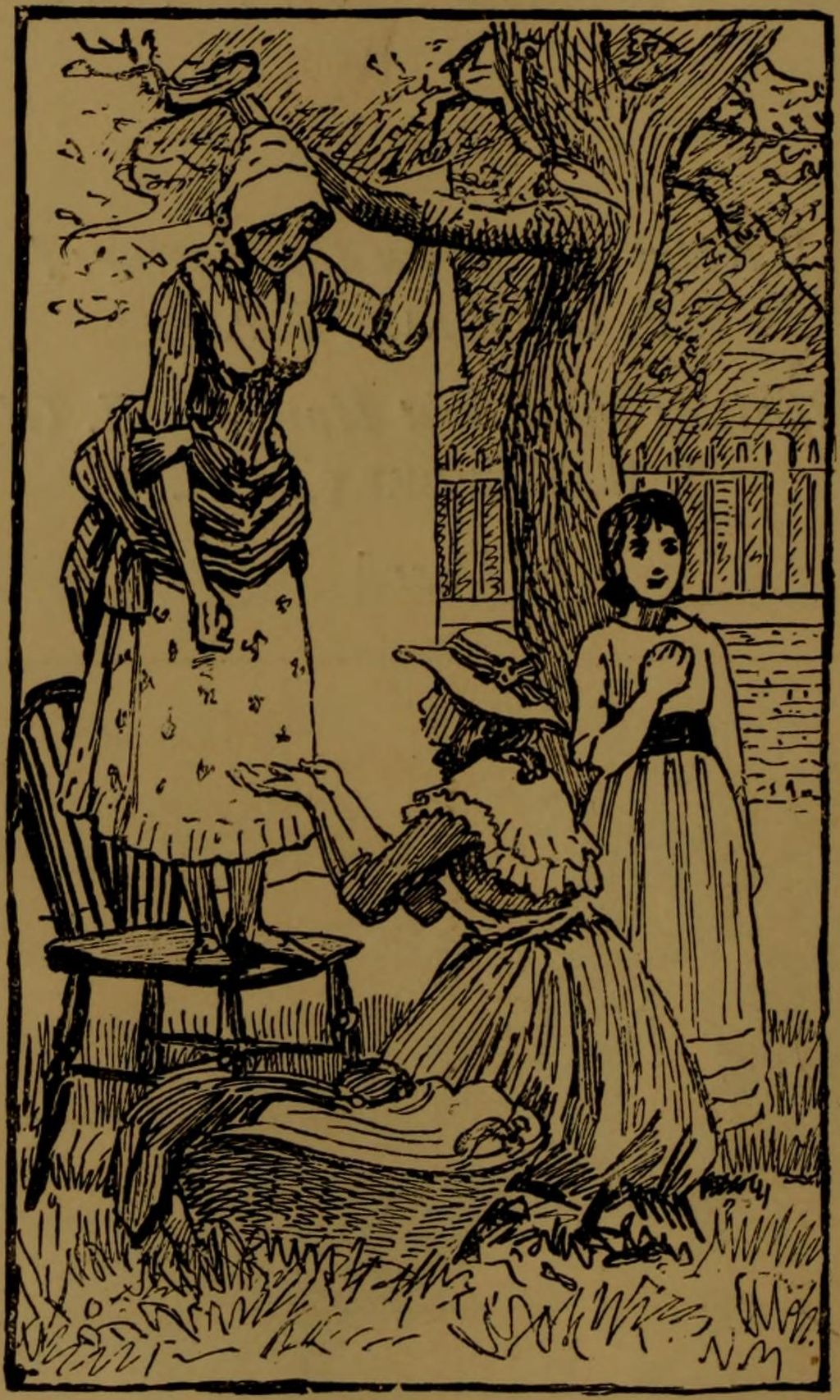
George Dunlop Leslie’s The Daughters of Eve, reproduced in Academy Notes, 1883, p. 32. Leslie exhibited this earlier painting under the same title. George Dunlop Leslie, The Daughters of Eve, reproduced in Henry Blackburn’s Academy Notes, 1883, p. 32. Image source. Public domain.
The Oil and the Watercolour
Dicksee had used nearly the same arrangement in a small watercolour catalogued as Out of Reach, Daughters of Eve, dated 1895. At about 28.6 × 17.8 cm, it could be held close enough to take in the whole design at once. The raised arm, the child coming up from below, and the table cropped at the right are already in place. In the watercolour reproduction, the child’s fingers sit against darker foliage, and a red-tinged apple above the hands stands out as a particular prize. The 1925 oil has a brighter stretch of grass under the figures, more yellow across the canopy and a greater expanse of pale cloth. In the larger picture the fruit takes a moment to pick out from the surrounding leaves. [1] [2] [7]
The 1925 canvas has two identifying marks. The lower-right corner bears Dicksee’s signature and date, and Christie’s transcribes a signed label on the stretcher that names the picture. The exhibition catalogue likewise lists it under the shorter form Daughters of Eve. Sotheby’s describes the oil as based on a small watercolour and traces that work to a 1927 exhibition and a 2006 Bonhams lot. It cites a favourable notice in The Times on 24 March 1927, page 12, for the work on paper. The close compositional match makes the 1895 watercolour a particularly useful comparison. Its identification with the specific sheet cited for the later exhibition and sale remains uncertain. [1] [2] [3] [7]
Beatrice Stuart
Sotheby’s and Christie’s identify the professional model Beatrice Stuart in their catalogue notes for the oil. Christie’s describes her as the principal model. In other images her name is the subject of the work itself. Bridgeman’s record for a Maas Gallery photograph identifies a 1912 pencil likeness by Dicksee. Its close profile gives the brow, nose and shape of the pinned hair much of the drawing’s character. In the orchard picture the tilted profile and gathered hair contribute to the direction of the figure’s gaze. The gesture and the child command so much of our attention that the young woman’s face is only one part of how Dicksee makes her presence felt. [1] [2] [8]
Stuart also sat for John Singer Sargent. The Smithsonian’s Catalog of American Portraits records a graphite and charcoal likeness of her by Sargent, dated about 1903–09 and mounted in an album. Sotheby’s also recounts an episode in which artists made drawings for an album of Stuart’s portraits. According to the sale note, Alfred Munnings added a light-hearted verse to one of his sketches, teasing other artists about their likenesses and approving of Dicksee’s. The anecdote records an artist comparing different versions of a familiar face. The whereabouts of the album described by Sotheby’s and the identity of Dicksee’s contribution remain open. [2] [9]
A further likeness shows how different one sitting could look from another. The National Gallery of Australia describes George Lambert’s pencil drawing Beatrice, made about 1913, with the face turned to one side, lips pressed together and the line of the neck taut. The glance seems to register something just beyond the page. In Dicksee’s orchard, we can follow the direction of the young woman’s gaze all the way to the child. Comparing the drawings with the oil makes a distinction between a named model and the role the painting asks a viewer to imagine. [1] [8] [10]
At the Academy and After
The 1925 Summer Exhibition was Dicksee’s first as president of the Royal Academy. In Gallery II, the orchard picture hung in a room of oils that also included a Provençal flock by Henry Herbert La Thangue. In Gallery III Dicksee showed a named portrait of Kathleen Bowne, daughter of Mrs Carpenter Gelshenen. A visitor crossing between the two rooms could see the artist treat the particular likeness of a named sitter and the shared action of two figures in the same exhibition. The distinction matters for the orchard scene. The title directs attention to the subject before any question about who posed for it. [3] [11] [12]
Later that year The Daughters of Eve appeared at the Walker Art Gallery’s Liverpool Autumn Exhibition. Sotheby’s reports that it sold for £500. Both auction catalogues cite a retrospective assessment in The Times on 18 October 1928, the day after Dicksee’s death. The paper praised the way the handling and sentiment held together. Seen from the orchard, that is a fairly exact description of the picture’s economy. Even the bright white tablecloth, which could have been a distraction, leads back to the fingers that brace the woman and make it possible for her to reach the branch. [1] [2] [12]
The sale catalogues trace the oil to Colonel J. R. Danson, whose executors offered it at Christie’s in July 1977. It appeared at Sotheby’s in April 1978 and was subsequently documented with Roy Miles in London. Sotheby’s catalogued it again in 2011 and Christie’s in 2015. The exhibition numbers, inscriptions and provenance tie those records to the canvas painted in 1925. [1] [2] [3]
Frank Dicksee artworks directory
Browse documented paintings, studies, illustration designs and prints. Where an article is available, the title opens it. Simon Toll’s catalogue
| Name | Date | Medium |
|---|---|---|
| A Love Story | 1882 | Painting |
| A Reverie | 1895 | Painting |
| An Offering | 1898 | Painting |
| Chivalry | 1885 | Painting |
| Dawn | 1897 | Painting |
| Elijah Confronting Ahab and Jezebel in Naboth’s Vineyard | By 1875 | Painting |
| Harmony | 1877 | Painting |
| Harmony, etching by Charles-Albert Waltner after Dicksee | 1880 | |
| Harmony, the smaller Towneley version | Late 1870s | Painting |
| Hesperia | 1887 | Painting |
| Hesperia, watercolour version | Late 1880s | Painting |
| Italian Coast from La Mortola | 1925 | Painting |
| La Belle Dame sans Merci | c. 1901 | Painting |
| Memories | 1886 | Painting |
| Paolo and Francesca | 1894 | Painting |
| Portrait of Camille Sutton Palmer | 1914 | Painting |
| Portrait of Elsa | 1927 | Painting |
| Portrait of the Duchess of Buckingham and Chandos | 1901 | Painting |
| Romeo and Juliet | 1884 | Painting |
| Romeo and Juliet, monochrome design on joined wood | c. 1880s | Painting |
| Sir Edmund William Gosse, collotype after Dicksee | 1912 | |
| Startled | 1892 | Painting |
| Study for Startled | Early 1890s | Drawing |
| The Confession | 1896 | Painting |
| The Crisis | 1891 | Painting |
| The Daughters of Eve | 1925 | Painting |
| The Embarkation | 1879 | Painting |
| The End of the Quest | 1921 | Painting |
| The Funeral of a Viking | 1893 | Painting |
| The House Builders | 1880 | Painting |
| The Magic Crystal | 1894 | Painting |
| The Passing of Arthur | 1889 | Painting |
| The Redemption of Tannhäuser | 1890 | Painting |
| The Symbol | 1881 | Painting |
| The Two Crowns | 1900 | Painting |
| Yseult | 1901 | Painting |
Discussion
Look again at the images and ideas explored in The Daughters of Eve. These editorial prompts invite your observations.
Reader Insights
Where does your eye come to rest first, and which detail brings it back to the space between the apple and the child’s fingers?
How does the title change the way you read the young woman’s gesture?
What makes the fruit easier to pick out in the watercolour or in the oil?
Join the Conversation
Which detail gives you the clearest sense of what will happen next in Dicksee’s orchard?
References
- Christie’s, The daughters of Eve, 3 December 2015, sale KEN10454, lot 62, pp. 60–61. View source.
- Sotheby’s, The Daughters of Eve, Victorian & Edwardian Art, 2011, sale L11132, lot 64. View source.
- Royal Academy of Arts, The Exhibition of the Royal Academy of Arts, 1925, Gallery II, p. 13, no. 83, and Gallery III, p. 16, no. 126. View source.
- Bible, Genesis 3:1–7, New Revised Standard Version Updated Edition. View source.
- Sotheby’s, George Dunlop Leslie, The Daughters of Eve, 2007, lot 13. View source.
- Henry Blackburn, ed., Academy Notes, 1883, p. 32, no. 305, Boston Public Library copy. View source.
- Chris Beetles Ltd / Bridgeman Images, Out of reach, daughters of Eve, 1895, watercolour, asset CBE26757. View source.
- The Maas Gallery / Bridgeman Images, Beatrice Stuart, 1912, pencil on paper, asset MAA199077. View source.
- Smithsonian National Portrait Gallery, John Singer Sargent, Beatrice Stuart, c.1903–09, Catalog of American Portraits, 1937.11(66r) FAM. View source.
- National Gallery of Australia, George Lambert, Beatrice, c.1913, George W. Lambert Retrospective: Heroes and Icons, no. 55. View source.
- Otago Daily Times, The Royal Academy, London correspondence, published 27 January 1925, p. 4. View source.
- Royal Academy of Arts, Sir Frank Dicksee PRA, artist and member record. View source.