 by Tom Gurney
Tom Gurney BSc (Hons) is an art history expert with over 20 years experience
Published on June 19, 2020 / Updated on November 25, 2026
Email: tomgurney1@gmail.com / Phone: +44 7429 011000
La Belle Dame sans Merci by Frank Dicksee: Introduction
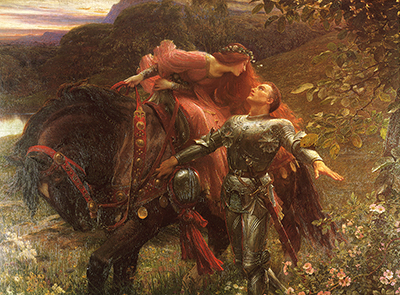
A woman in a rose-pink gown bends from the saddle towards a knight. He looks up with his arms spread and his face uncovered, as if a voice or a look has stopped him mid-stride. Frank Dicksee painted La Belle Dame sans Merci around 1901 and exhibited it at the Royal Academy in 1902. John Keats’s ballad tells what becomes of the knight. Dicksee takes us back to the ride, when the knight remembers having eyes for nothing else. [1] [2] [3]
Listen to Keats’s ballad
Hearing the knight tell his story gives the encounter a different pace.
Poetry In Voice / Les voix de la poésie. Amelia Druskis performs Keats’s poem. Watch on YouTube.
At a Glance
- ArtistFrank Dicksee
- DateCirca 1901
- MediumOil on canvas
- Dimensions137.2 × 188 cm (height × width)
- CollectionBristol Museum & Art Gallery, K328
- ExhibitionRoyal Academy, London, 1902, catalogue no. 13
- Literary sourceJohn Keats’s ballad La Belle Dame sans Merci, written in 1819 and first published in 1820. [1] [2] [3] [4] [5]
This work across Frank Dicksee’s career
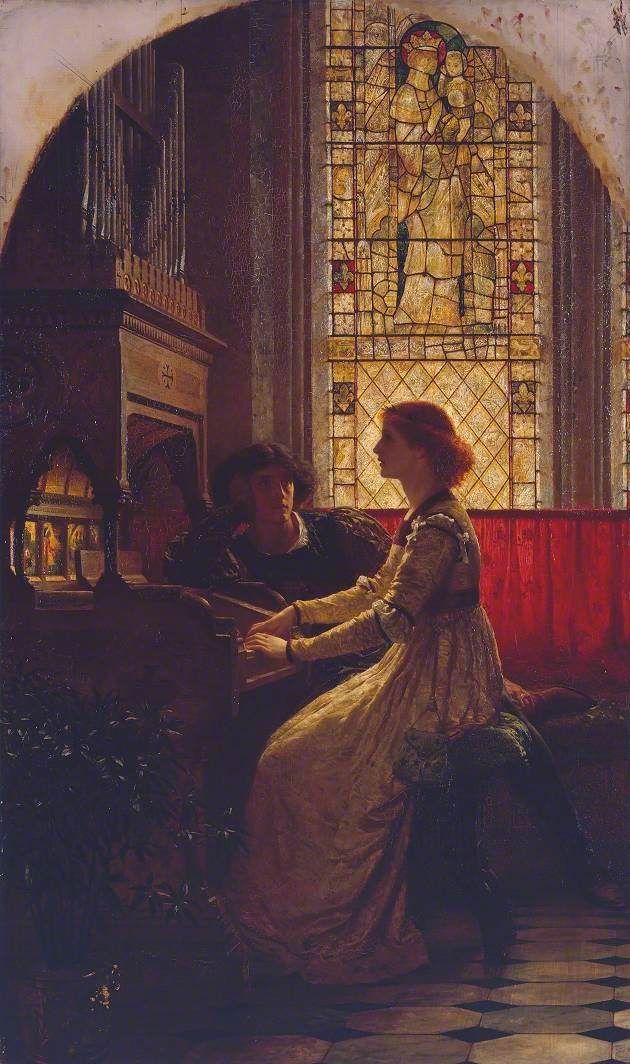
Harmony
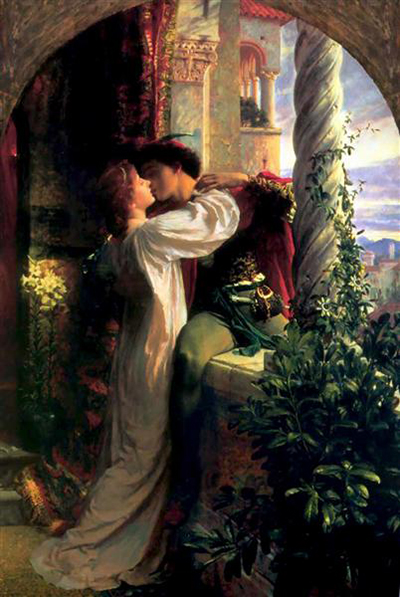
1877Romeo and Juliet
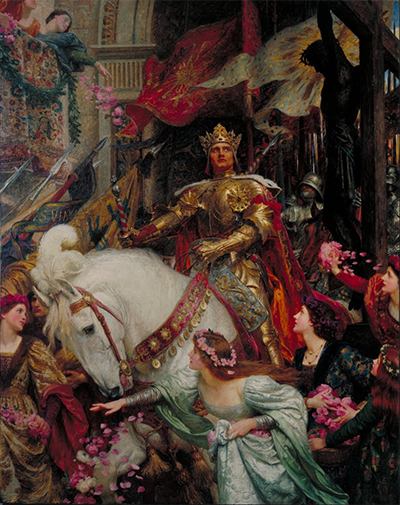
1884Chivalry
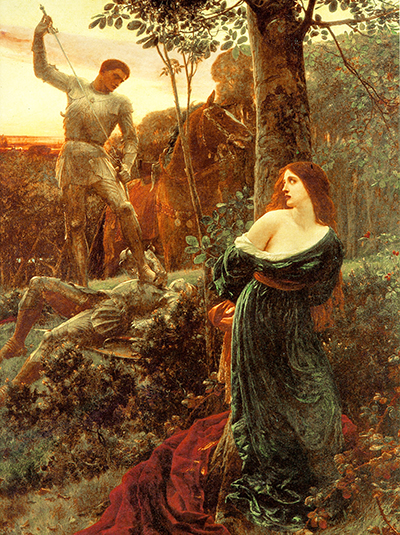
1885Startled
1892The Two Crowns
1900Contents
- The rider and the knight
- The part of Keats’s ballad Dicksee painted
- The French title and the fairy encounter
- Armour, fabric and the studies
- How other artists read the lady
- From the Academy walls to Bristol
- Annotated details
The rider and the knight
Dicksee makes us follow a series of bends. The horse lowers its head. The rider inclines from the waist and lets her hair fall towards the knight. He arches backwards just enough to meet her gaze. His open hands take up much of the width of the space between horse and tree, yet all his attention seems to settle on the few inches separating the two faces. Her face is in profile, his turned to the light. The open space between their mouths keeps the possibility of a kiss in suspense. [1] [2]
The horse takes up nearly half the canvas. Its lowered head and bent foreleg suggest a measured pace, and the brass-coloured bosses on the red harness lead the eye up to the rider’s hand on the reins. The knight’s helmet hangs below that hand beside the saddle. His sword remains at his hip. Even his nearer hand, which reaches back towards the horse, stays open. Dicksee gives him the equipment of a man accustomed to riding armed, and shows the rider holding the one piece of equipment that can guide the horse. [1] [2]
A narrow opening at the left gives a view across water to distant hills. There is a little warm light left in the sky above them, while the trees closer to us are already dark. On the right, the flowering branches and green leaves are close enough to overlap the knight’s outstretched arm. Their pink blossoms pick up the colour of the dress, just as smaller notes of red in the bridle and its tassels carry the warmth of the gown into the mass of the horse. The knight seems scarcely aware of the landscape, though Dicksee gives it much of the canvas. [1] [2]
One way to read the knight’s stance is as a surrender, the sense Bristol’s collection description suggests. His hands could also be opening in welcome or reaching for balance. The lady leans down while he strains upwards, so neither body is at rest. We can see the effort that brings the two figures together, but her lowered face gives little away about what she intends. The painting can feel tender at first and disquieting on a second look. [1] [2]
The part of Keats’s ballad Dicksee painted
Keats included the ballad in his journal letter to his brother George and sister-in-law Georgiana in April 1819. In that version a passer-by asks what ails a solitary knight. Harvest is over, the sedge has withered and the knight looks feverish. He remembers meeting the lady in a meadow, making her flower ornaments and setting her on his horse. She bends as she sings, and he remembers seeing nothing else through the day. She feeds him strange food and leads him to her grotto. There he falls asleep and dreams of pale kings, princes and warriors who tell him he is in her power. He wakes on the cold hillside, where the questioner finds him. [4]
The exhibition annual Royal Academy Pictures reproduced Dicksee’s painting in 1902 with the riding stanza beneath it, and its notes say that the exhibition catalogue used the same stanza. The annual takes the reader further into the story by printing the meeting and the dream in its notes. It calls the knight a man who has escaped with his life. Keats leaves him alive and still lingering on the hillside, where the final stanza returns to the desolate conditions of the first. Dicksee paints the recollected encounter before the grotto. The companion publication makes it possible for the spectator to see that encounter in the light of everything that follows. [3] [4]
The ballad first appeared in print on 10 May 1820 in Leigh Hunt’s The Indicator, under the spelling La Belle Dame Sans Mercy and signed “Caviare”. The opening addresses a “wretched wight”, meaning a wretched person, where the letter addresses a knight-at-arms. The magazine places the riding stanza before the one about making the garland, and its lovers slumber together at the grotto. In the letter she lulls the knight to sleep. The 1902 exhibition annual has the bending rider and her fairy song, which belong to both texts. Its account of the later scene, where she lulls the knight, follows the sequence familiar from the letter text. The annual shows what visitors were invited to read alongside the picture. Dicksee’s own reading copy remains unidentified. [3] [4] [5]
The narrator can question the knight’s condition. The lady’s words reach us only through the knight’s memory, and even he says she spoke in a strange language. The accusation against her comes from the figures in his dream. Dicksee has a different way of letting us sense the uncertainty. We can look at the woman as well as the knight, yet we can only infer her expression from a narrow view of her face. The whole tale turns on his recollection of a few moments of extraordinary attention. Dicksee gives one of those moments room to last. [1] [4] [5]
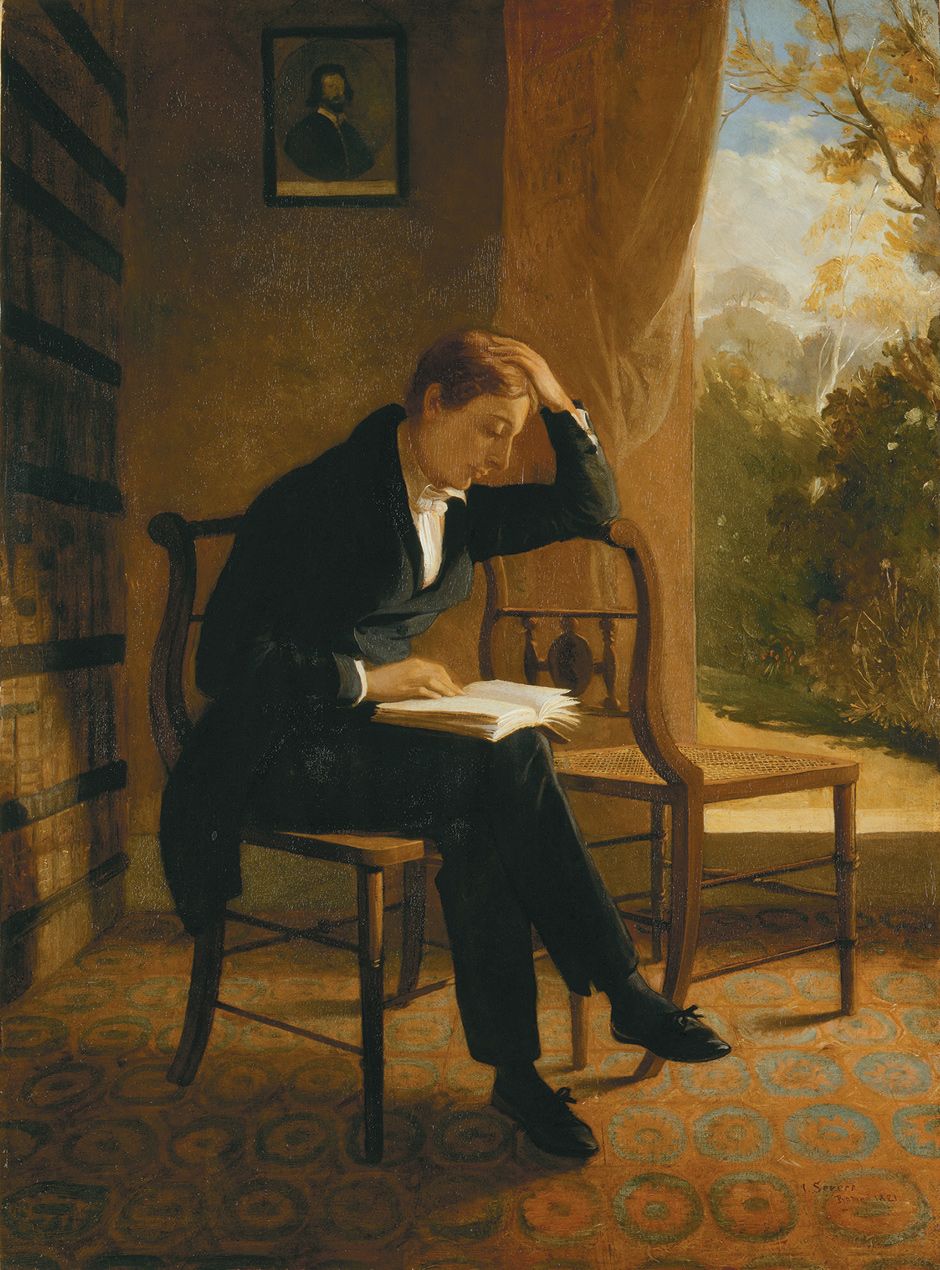
Joseph Severn’s portrait of John Keats. Image source. Public domain.
Annotated Details from La Belle Dame sans Merci
The numbered points identify visible features discussed in this article. Return from each detail to the numbered overview. The woman leans from a dark horse towards a knight among flowering plants. Image source. Public domain.
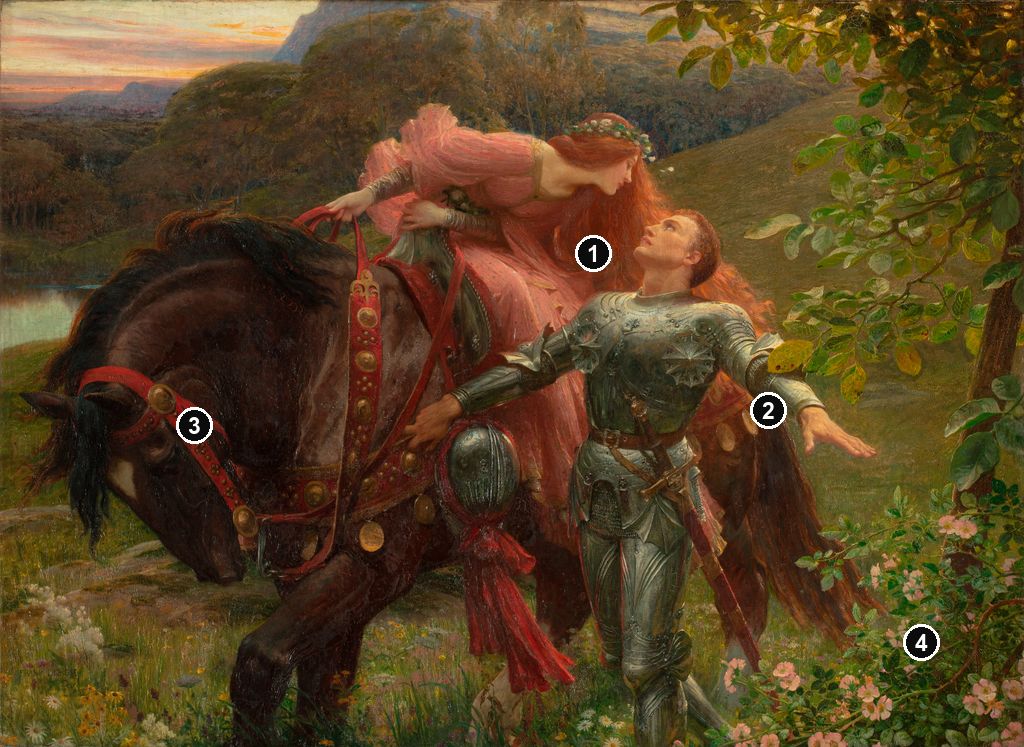
Details from LA BELLE DAME SANS MERCI
Compare the cropped details with the source images above. Notice how their colours, shapes and positions contribute to the larger compositions.
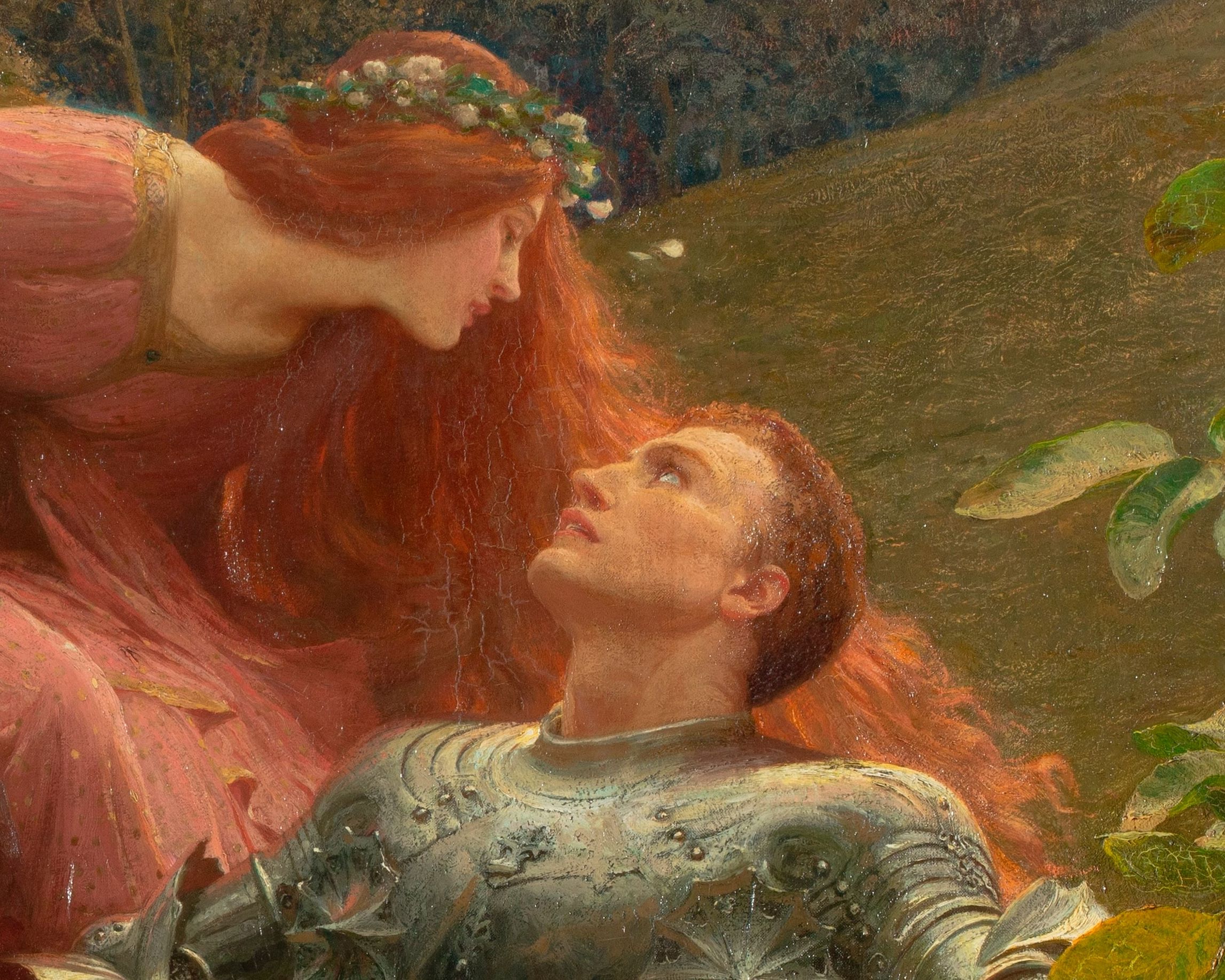
The meeting of faces
The woman leans across the saddle and the knight lifts his face. Their heads come close while their bodies remain separated by the horse.
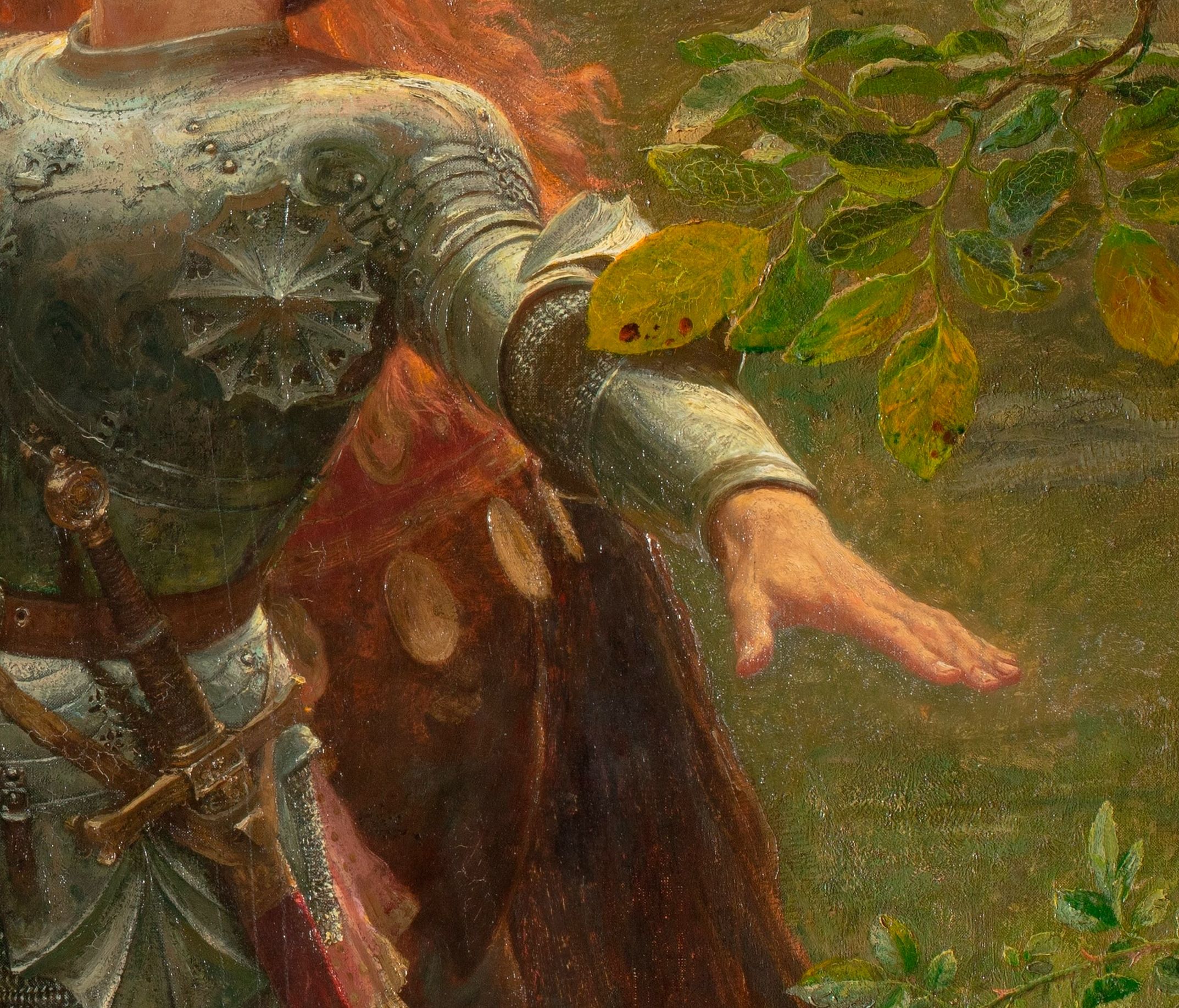
The knight’s open arm
The knight’s arm extends into the foliage. The gauntlet and polished steel give his sweeping movement weight.
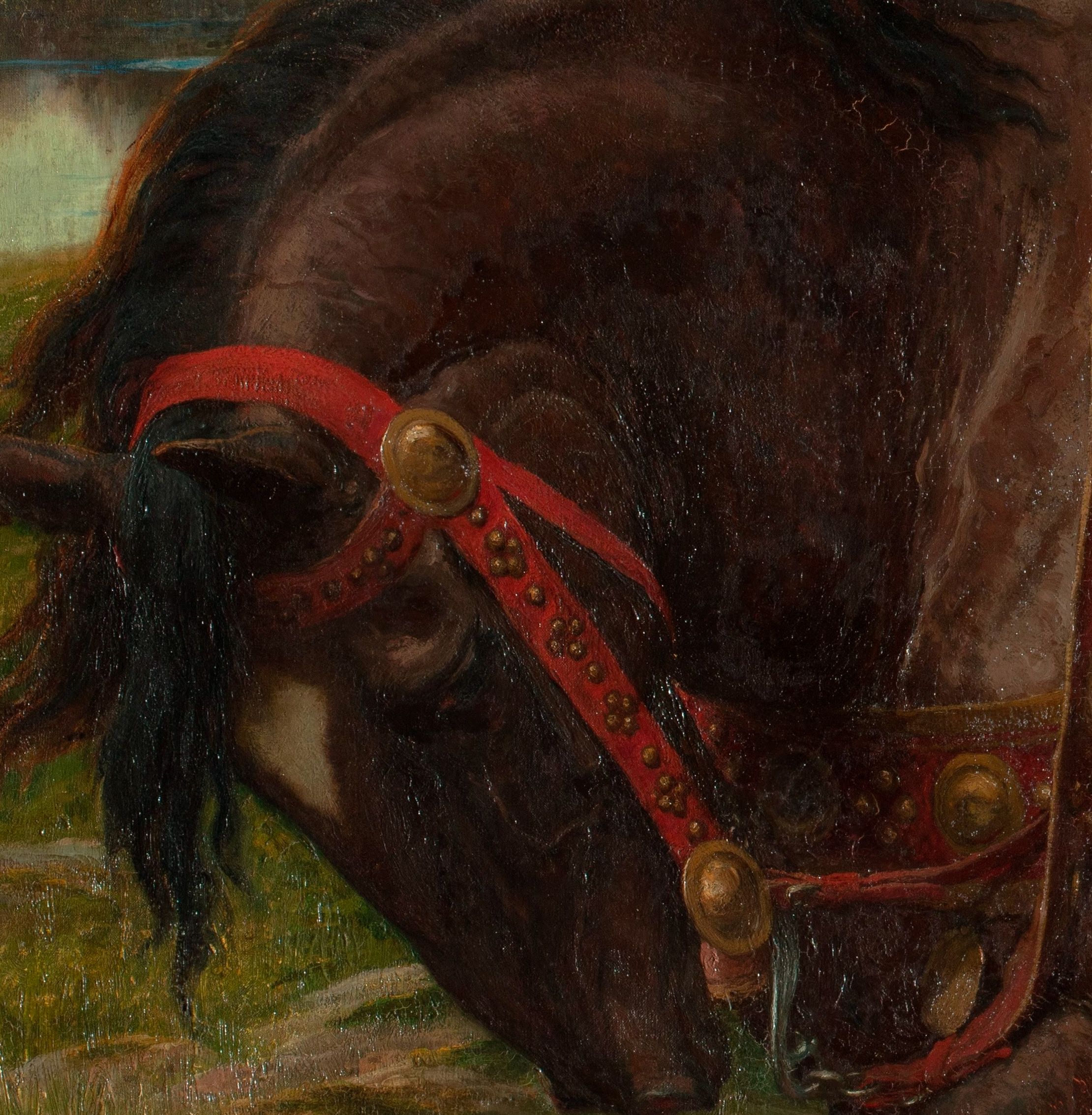
The horse and bridle
The horse lowers its head. Its red bridle picks up accents in the rider’s clothes and gives the animal a clear outline against the dark woodland.
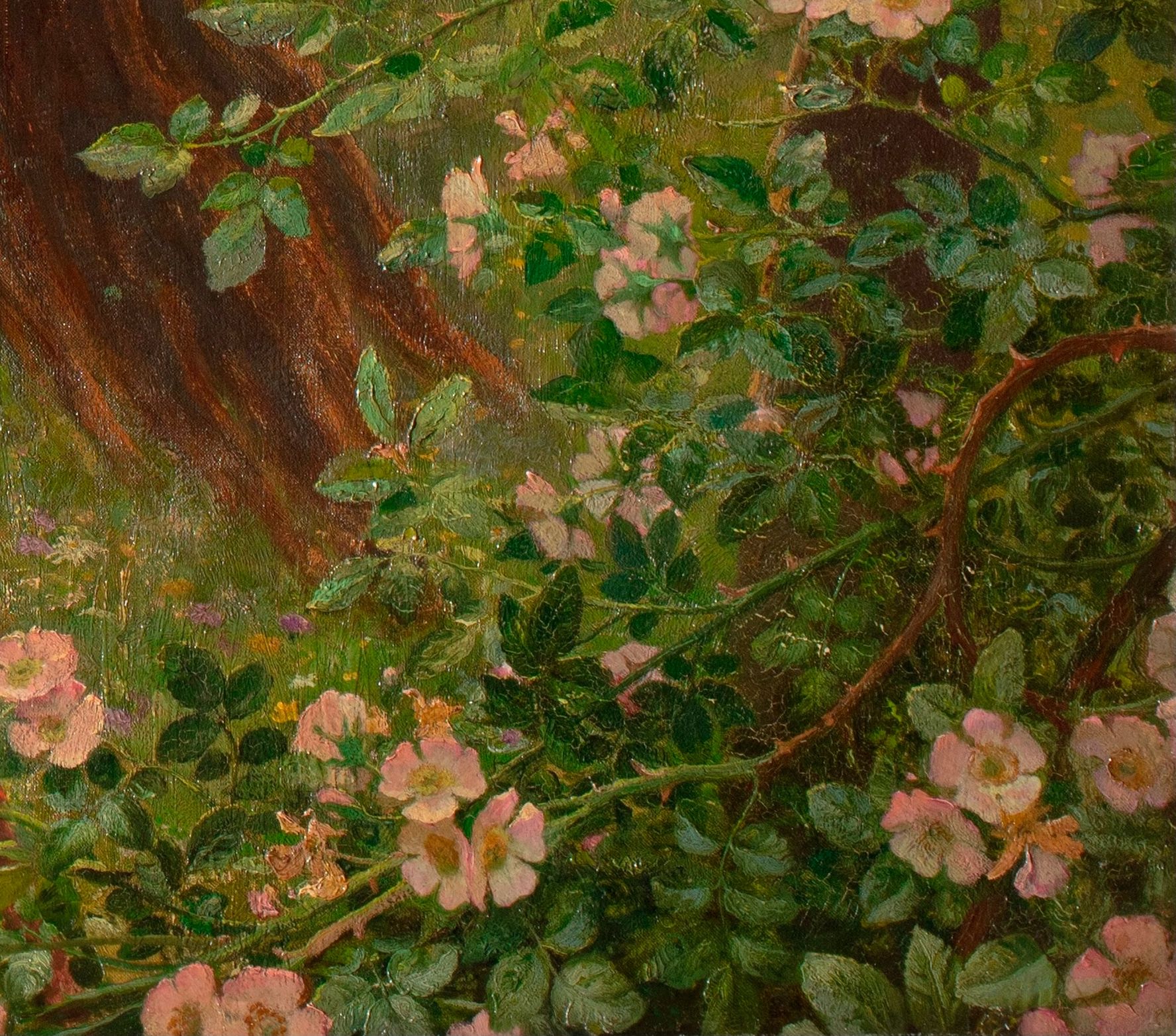
Flowers and foliage
Pink flowers fill the right foreground, below the branches that arc over the encounter. The density of vegetation helps keep the figures within one intimate space.
The French title and the fairy encounter
The title means ‘the beautiful lady without mercy’. Alain Chartier’s La Belle Dame sans mercy, dated 1424, gives it a medieval history. Chartier’s poem stages a dialogue in which a lady refuses a suitor. The first printing of Keats’s ballad introduced it by mentioning an English translation of Chartier’s poem that had circulated among works then attributed to Chaucer, and said that the title had suggested the new verses. That history helps explain the French words in an English ballad. Chartier’s lady argues her position in a debate about courtly love. Keats’s lady enters the story through the knight’s account, after the encounter has already cost him so much. [5] [6] [7]
The literary scholar Celia A. Delgado Mastral places Keats and Dicksee alongside the Spanish Romance de la infantina. In the version she discusses, a knight comes across a young woman in a tree combing hair so long it covers the oak. The woman’s position above him and her remarkable hair give the encounter something of the charged uncertainty Dicksee finds in the lady bending from the saddle. The setting and story belong to a separate tradition, and Delgado uses the comparison to identify a recurring type of encounter between a knight and a supernatural woman. The likeness is especially striking in a painting where the hair helps bridge the space between two people who have yet to touch. [1] [8]
Armour, fabric and the studies
The knight’s breastplate catches a dim, greenish light. Smaller, brighter edges pick out the points near his shoulders and the ridges above his knees. The articulated plates make sense as something a body can move in, and Dicksee uses those joints to show a torso and arms under strain. The lady’s dress gathers into folds that follow the bend of her shoulder. Where her hair overlaps the steel, the loose red strands make the sharp edges easier to see. These changes in texture give the figures distinct physical presences even where one almost disappears into the other. [1] [2] [9]
The Bowes Museum, which exhibited the Bristol painting on loan, reports armour specialist Tobias Capwell’s identification of the suit represented here and in Dicksee’s The Two Crowns with an example now in the Detroit Institute of Arts. Detroit dates the main components associated with the armourer Lorenz Helmschmid to around 1480 and records that a Munich armourer added several elements in the 1860s. The present suit thus has its own history of medieval craftsmanship and nineteenth-century reconstruction. In The Two Crowns the glittering harness belongs to a mounted prince. Here similar plate makes the knight’s bare hands and exposed face all the more conspicuous. [9] [10]
Two studies catalogued by Christie’s record different parts of the work. In the black-and-white chalk drawing on buff paper, the lady’s bare shoulder, lowered head and falling hair establish the line that will carry her forward in the painting. The separate watercolour study, worked over pencil and heightened with bodycolour and scratched highlights, is a small horizontal composition. Together they show how much there was to work out at two scales. The angle of one head is a problem in itself. It also has to hold its place beside a horse, a second figure and a landscape nearly two metres across in the final canvas. [1] [2] [11] [12]
How other artists read the lady
Elizabeth Siddal’s small graphite study of about 1855, in the Delaware Art Museum, brings two standing figures together in a few searching lines. An inscription on the reverse identifies it as an idea for the ballad. One face is lowered towards the other, while the more upright figure turns in profile and raises a hand. With almost no setting, the distance between those faces and the rise of the arm do most of the work. Siddal leaves both figures on foot, so the difference in height comes from the tilt of one body. In Dicksee’s picture the saddle has already raised the lady above her companion. [1] [13]
John William Waterhouse showed his own La Belle Dame sans Merci at the Royal Academy in 1893. In his tall canvas, now in the Hessisches Landesmuseum Darmstadt, the lady sits low in a wood and the knight stoops towards her. A strand of hair loops around his neck and she holds it in front of her. The device makes a visible bond between them, as a period loan catalogue observed when it described the hair wound around the armoured figure. It paired the picture with the encounter and the lady’s declaration of love. Dicksee’s broad composition gives the pair space to move and puts the reins in the lady’s hand. Waterhouse lets the forest and the gestures draw the two figures into an encounter at much closer quarters. [1] [14] [15]
Arthur Hughes chose a different way to bring the ballad’s danger into view in 1863. The lady inclines towards the knight, yet the shadowy faces of his predecessors appear among the trees. Robyn Cooper’s study for the National Gallery of Victoria also points out how the lady’s loosely clasped hands and matching bracelets can suggest confinement. Her reading gives a different weight to the flower ornaments that Keats’s knight makes. Dicksee leaves the warning figures outside the frame and sets flowers along the foreground, in reach of the knight’s open hand. Each choice changes how soon the spectator senses trouble. [1] [4] [16]
A 1902 enamel plaque by Fanny Bunn inverts Dicksee’s arrangement. In Katy Owen’s study of Birmingham artists, Bunn’s knight is still on horseback and visibly checks the reins. The lady stands her ground, looking up at him across a gap. The two artists give the costume and the horse very different roles. Bunn can suggest enchantment even with the lady separated from the armoured figure. In Dicksee, the knight and rider are so close that his bright torso overlaps her gown. [1] [17]
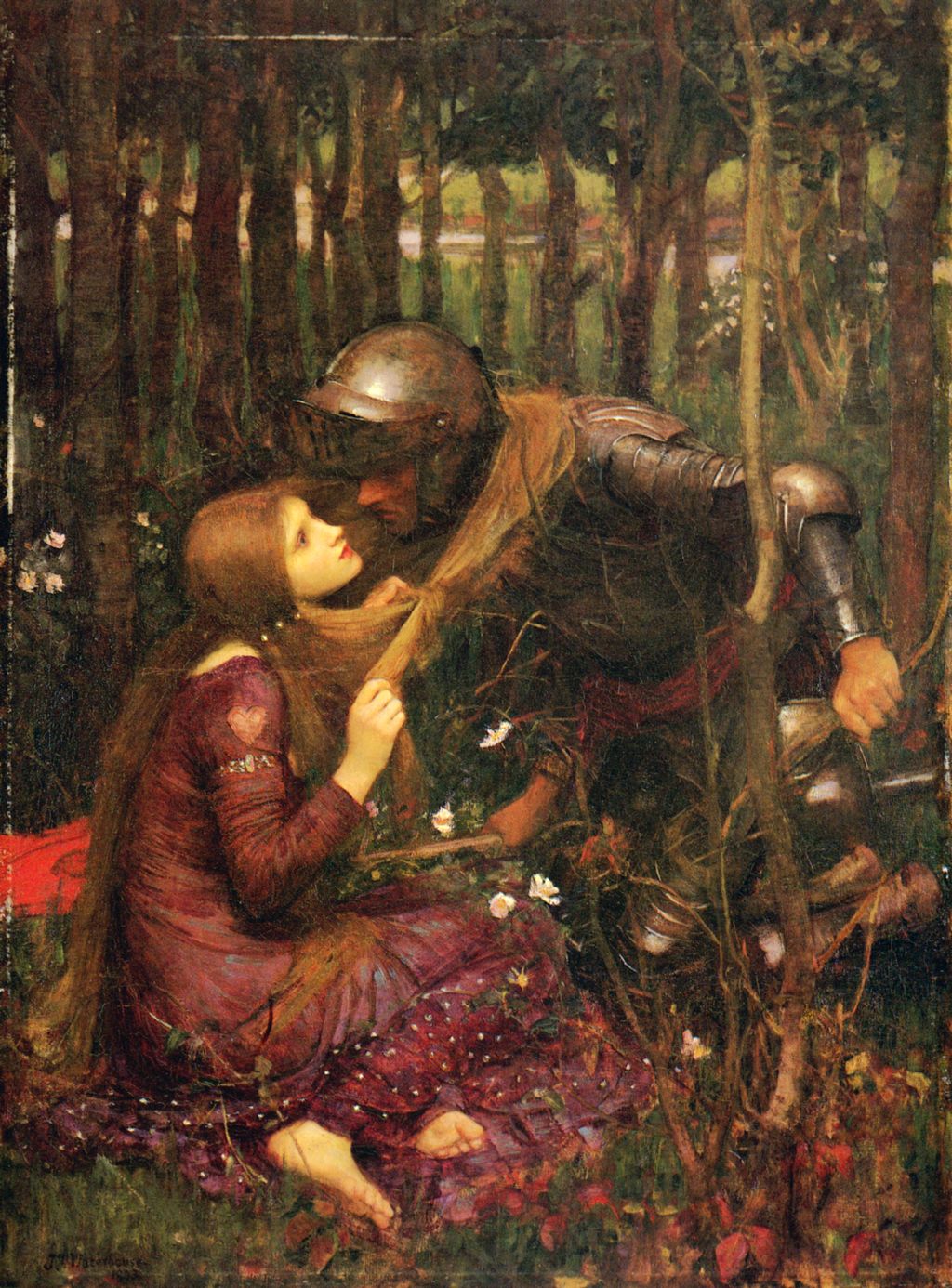
John William Waterhouse, La Belle Dame sans Merci. Image source. Public domain.
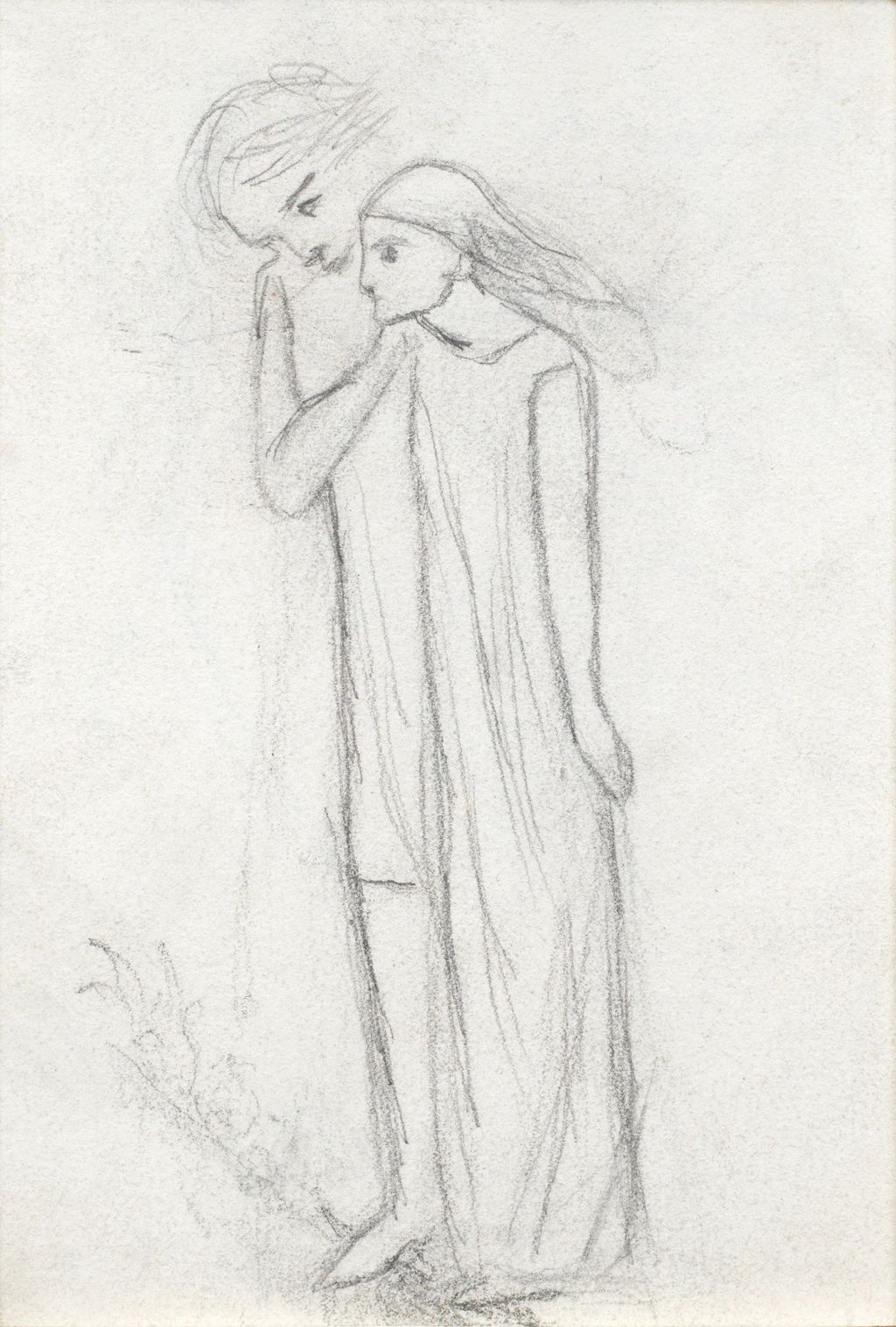
Elizabeth Siddal’s study for La Belle Dame sans Merci. Image source. Public domain.
From the Academy walls to Bristol
The painting’s reception in 1902 reflects a disagreement about how much a painter should show. A correspondent whose account appeared in the New Zealand Herald thought the subject familiar and praised Dicksee for treating it with charm. The reviewers quoted by art historian Dennis T. Lanigan responded less warmly. Roger Fry in The Athenaeum found Dicksee theatrical, and The Magazine of Art argued that the elaborate accessories gave the imagination little room. The complaint is especially revealing alongside the contemporary exhibition print. The painting puts the bright harness and the pink dress before us, while the accompanying lines tell of a knight whose attention excludes all those things. Some viewers enjoyed the abundance he overlooked. Others felt that it crowded out the strangeness of the ballad. [3] [18] [19]
The picture travelled after the Academy exhibition. The official 1904 St Louis exposition catalogue records it in the British oil-painting section as no. 60. In 1910 the British art catalogue for the Buenos Aires centenary exhibition lists it as no. 41 and once again prints the riding stanza, this time describing the lady’s sideways lean in wording closer to The Indicator. Mrs Yda Richardson gave the painting to Bristol in 1913. In Buenos Aires as in London, the catalogue gave visitors the words about the song. The painted gestures still left them to imagine how it sounded. [1] [3] [5] [20] [21]
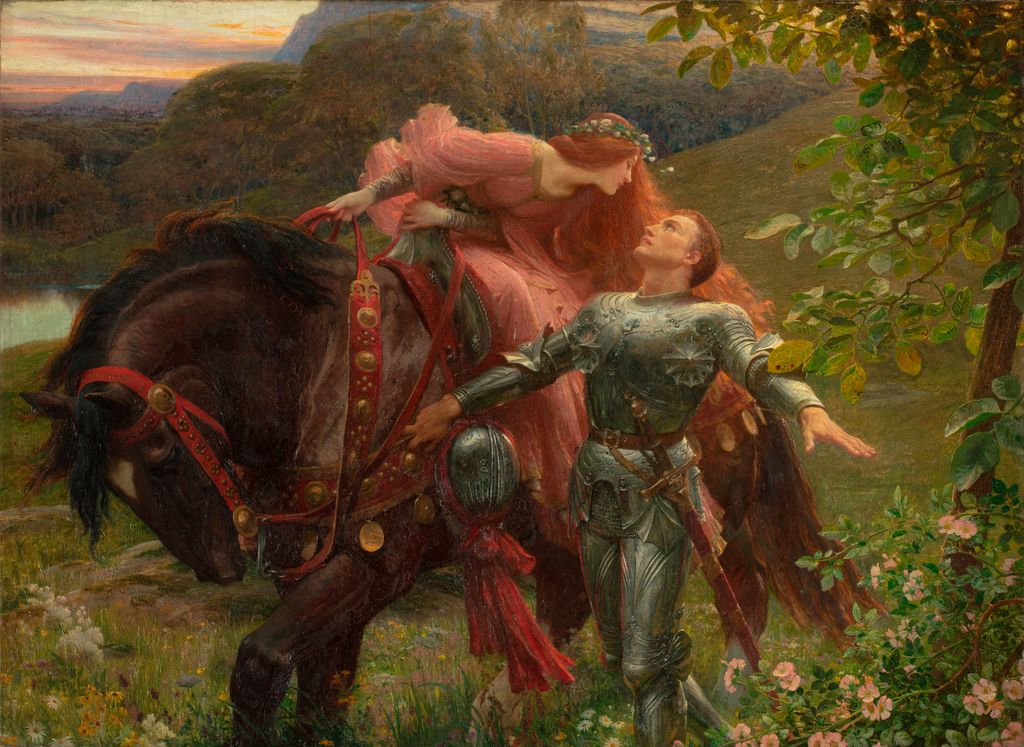
The Bristol canvas, K328. Dicksee sets the encounter at the edge of a wood. Image source. Public domain.
Frank Dicksee artworks directory
Browse documented paintings, studies, illustration designs and prints. Where an article is available, the title opens it. Simon Toll’s catalogue
| Name | Date | Medium |
|---|---|---|
| A Love Story | 1882 | Painting |
| A Reverie | 1895 | Painting |
| An Offering | 1898 | Painting |
| Chivalry | 1885 | Painting |
| Dawn | 1897 | Painting |
| Elijah Confronting Ahab and Jezebel in Naboth’s Vineyard | By 1875 | Painting |
| Harmony | 1877 | Painting |
| Harmony, etching by Charles-Albert Waltner after Dicksee | 1880 | |
| Harmony, the smaller Towneley version | Late 1870s | Painting |
| Hesperia | 1887 | Painting |
| Hesperia, watercolour version | Late 1880s | Painting |
| Italian Coast from La Mortola | 1925 | Painting |
| La Belle Dame sans Merci | c. 1901 | Painting |
| Memories | 1886 | Painting |
| Paolo and Francesca | 1894 | Painting |
| Portrait of Camille Sutton Palmer | 1914 | Painting |
| Portrait of Elsa | 1927 | Painting |
| Portrait of the Duchess of Buckingham and Chandos | 1901 | Painting |
| Romeo and Juliet | 1884 | Painting |
| Romeo and Juliet, monochrome design on joined wood | c. 1880s | Painting |
| Sir Edmund William Gosse, collotype after Dicksee | 1912 | |
| Startled | 1892 | Painting |
| Study for Startled | Early 1890s | Drawing |
| The Confession | 1896 | Painting |
| The Crisis | 1891 | Painting |
| The Daughters of Eve | 1925 | Painting |
| The Embarkation | 1879 | Painting |
| The End of the Quest | 1921 | Painting |
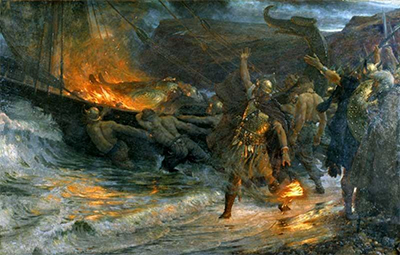
| The Funeral of a Viking | 1893 | Painting |
| The House Builders | 1880 | Painting |
| The Magic Crystal | 1894 | Painting |
| The Passing of Arthur | 1889 | Painting |
| The Redemption of Tannhäuser | 1890 | Painting |
| The Symbol | 1881 | Painting |
| The Two Crowns | 1900 | Painting |
| Yseult | 1901 | Painting |
Discussion
Look again at the images and ideas explored in La Belle Dame sans Merci by Frank Dicksee. These editorial prompts invite your observations.
Reader Insights
Where do they take your eye, and how does each hand affect your sense of what he is doing?
How does your reading change when you compare her place above the knight in Dicksee with her low position in Waterhouse?
Which detail near the water or the tree would you keep if the whole story had to be told in a tighter frame?
Join the Conversation
Look again at the space between the two faces and share the detail that makes the encounter feel tender or troubling to you.
References
- Bristol Museums, Frank Dicksee, La Belle Dame sans Merci, collection record 116167, accession K328. View source.
- Bristol Museums, Galleries & Archives, La Belle Dame sans Merci, museum image and object data, Google Arts & Culture. View source.
- Cassell and Company, Royal Academy Pictures, 1902, notes for exhibition no. 13 and plate on p. 115. View source.
- John Keats and the University of Victoria, La Belle Dame sans Merci, letter text and commentary in Mapping Keats’s Progress, 21 April 1819. View source.
- John Keats and Leigh Hunt, La Belle Dame Sans Mercy, The Indicator, 10 May 1820, pp. 246–248, with headnote and poem reproduced in Essays by Leigh Hunt, pp. 74–76. View source.
- Archives de littérature du Moyen Âge, Alain Chartier, La belle dame sans mercy, work record and historical editions. View source.
- Tatiana Clavier, Fortune de La Belle Dame sans mercy. Les mises en scène du débat entre les sexes dans les premiers imprimés (env. 1475–1535), Persée. View source.
- Celia A. Delgado Mastral, Las princesas de los videojuegos: algunos antecedentes pictóricos y literarios, pp. 91–92 and 97, Universitat de València. View source.
- The Bowes Museum, Pre-Raphaelite Knights in Shining Armour, section on Dicksee and the Gothic harness. View source.
- Detroit Institute of Arts, Armor in the Gothic Style, Lorenz Helmschmid, ca. 1485 and later, object record. View source.
- Christie’s, Frank Dicksee, Study for ‘La Belle Dame Sans Merci’, black and white chalk on buff paper, 12 December 2019. View source.
- Christie’s, Frank Dicksee, Study for ‘La Belle Dame sans Merci’, pencil, watercolour and bodycolour, 16 June 2010, lot 38. View source.
- Delaware Art Museum, Elizabeth Eleanor Siddal, Sketch for ‘La Belle Dame sans merci’, c. 1855, 2007-32. View source.
- Kilian Kohn, J. W. Waterhouse (1849–1917): Studien zur zeitgenössischen und aktuellen Rezeption, Universität Heidelberg, figure 1, p. 174. View source.
- A. G. Temple, Descriptive Catalogue of the Loan Collection of Pictures, Corporation of London Art Gallery, 1894, p. 100, no. 122. View source.
- Robyn Cooper, Arthur Hughes’s La Belle Dame sans merci and the femme fatale, National Gallery of Victoria. View source.
- Katy Owen, ‘Making an Exhibition of Herself’ – Women, Art and Birmingham, 1860–1920, University of Birmingham, pp. 25, 108–109. View source.
- New Zealand Herald, The Royal Academy Exhibition, 14 June 1902, Papers Past. View source.
- Dennis T. Lanigan, La Belle Dame Sans Merci by Sir Frank Dicksee, Victorian Web, transcriptions of The Athenaeum (10 May 1902, p. 599) and The Magazine of Art (1902, pp. 393–394). View source.
- Louisiana Purchase Exposition, Official Catalogue of Exhibitors, St Louis, 1904, Department B, British oil paintings, exhibit no. 60. View source.
- Buenos Aires Centenary Exhibition, Catalogue of the British Art Section, 1910, p. 16, no. 41. View source.