 by Tom Gurney
Tom Gurney BSc (Hons) is an art history expert with over 20 years experience
Published on June 19, 2020 / Updated on October 27, 2026
Email: tomgurney1@gmail.com / Phone: +44 7429 011000
Coast Scene: Introduction
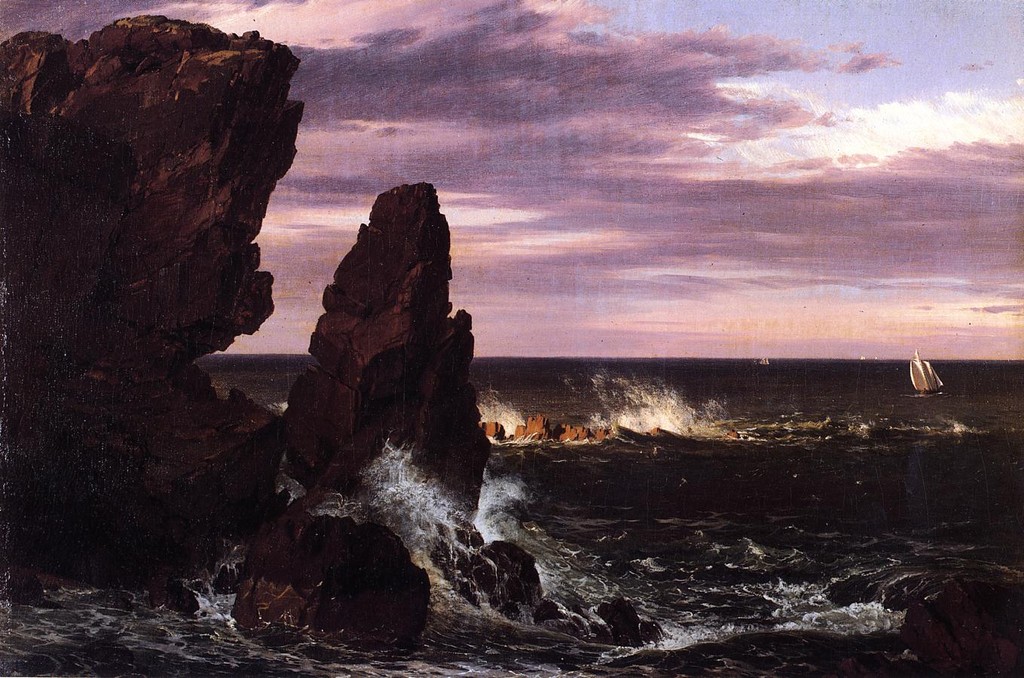
Jagged rocks rise above dark water in Frederic Edwin Church’s Coast Scene, while white surf breaks around their bases. Beyond this restless foreground, a sailboat crosses a more open expanse beneath pink and violet clouds. The 1852 oil painting measures 50.8 × 76.2 centimetres and was recorded in a private collection in the National Gallery of Art’s 1989 Church exhibition catalogue.[1]
The earlier canvas is also called Coast Scene, Mount Desert in Mnuchin Gallery’s Church & Rothko: Sublime exhibition record. Its date and dimensions distinguish it from Church’s larger 1863 painting bearing a similar title. Looking at the 1852 work reveals an early exploration of subjects that would occupy him repeatedly: the meeting of rock and water, changing light and the spectator’s position before a powerful landscape.[2]
At a Glance
- ArtistFrederic Edwin Church
- TitleCoast Scene
- Alternate title in later exhibition recordCoast Scene, Mount Desert
- Date1852
- MediumOil on canvas
- Dimensions50.8 × 76.2 cm; 20 × 30 inches
- Collection recordPrivate collection in the 1989 NGA catalogue
- Principal subjectsRocky shore, breaking waves, distant sails and coloured clouds
This work across Church’s career
Tamaca Palms
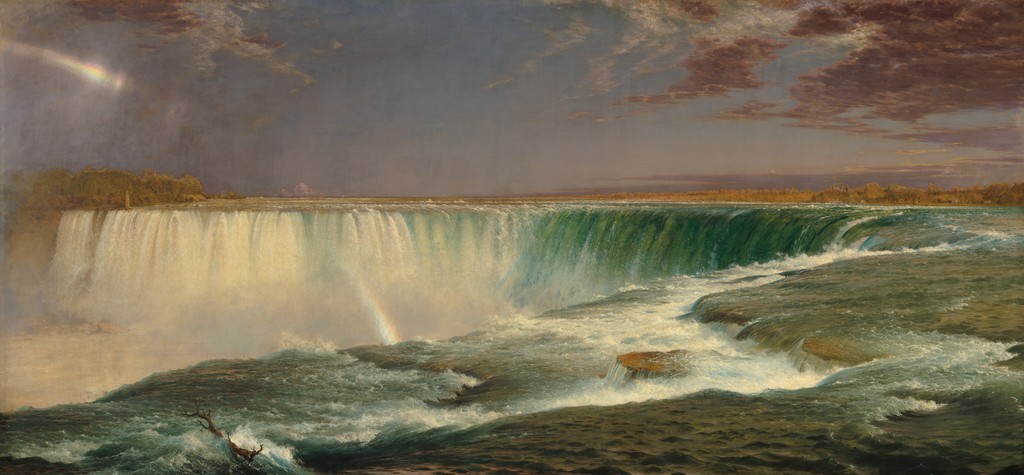
1854Niagara
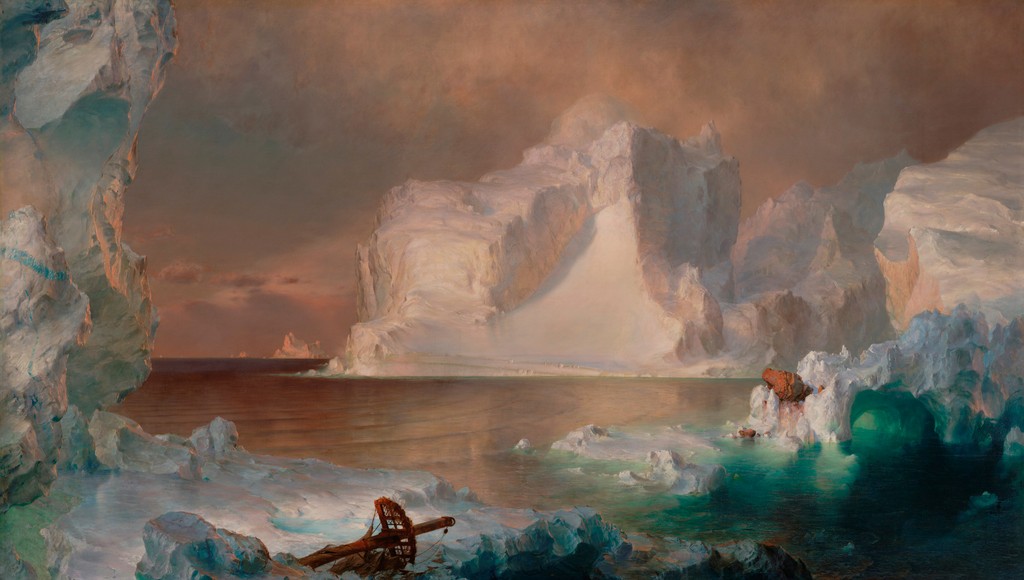
1857The Icebergs
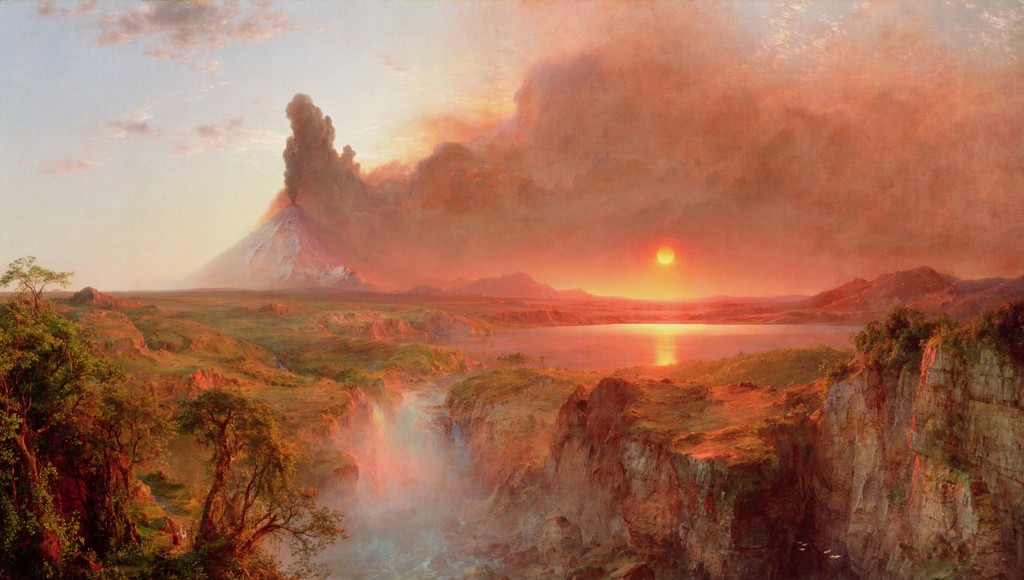
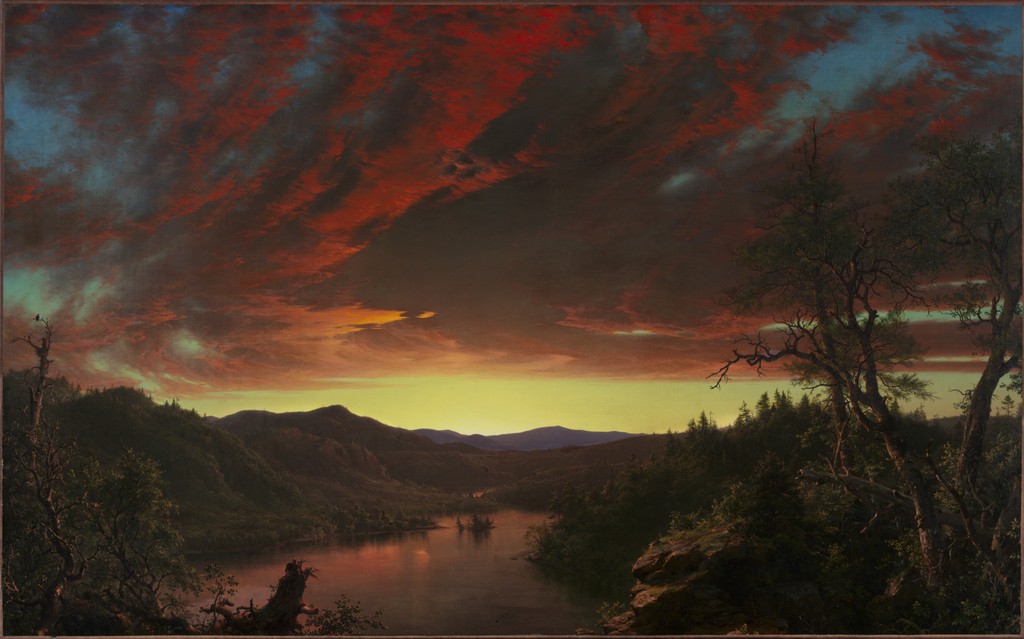
1861; foreground mast added between mid-1862 and early 1863Cotopaxi
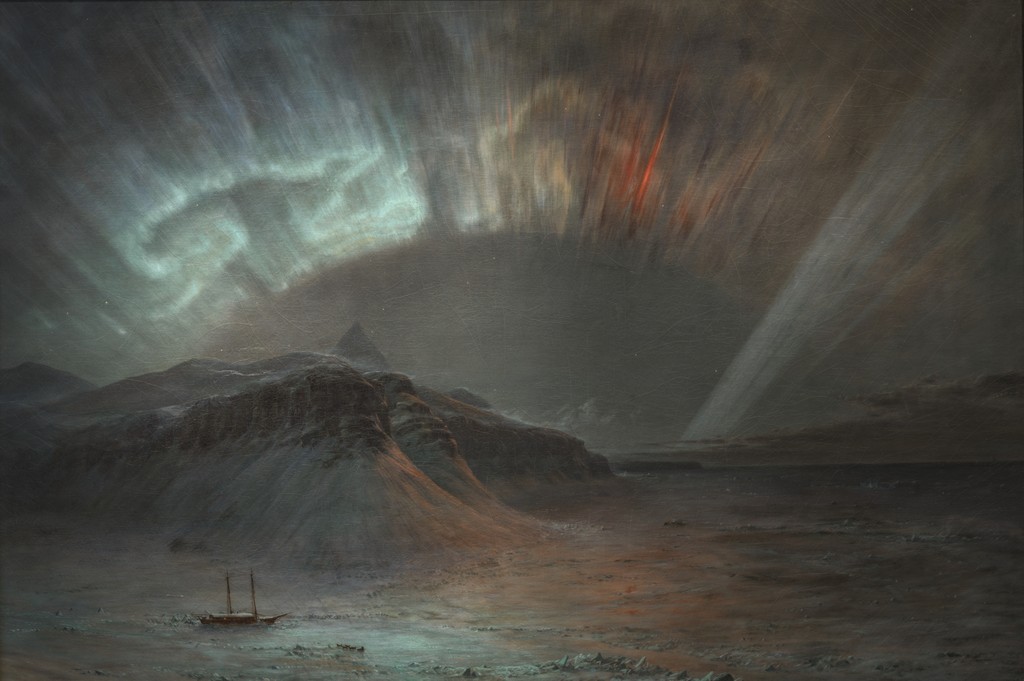
1862Aurora Borealis
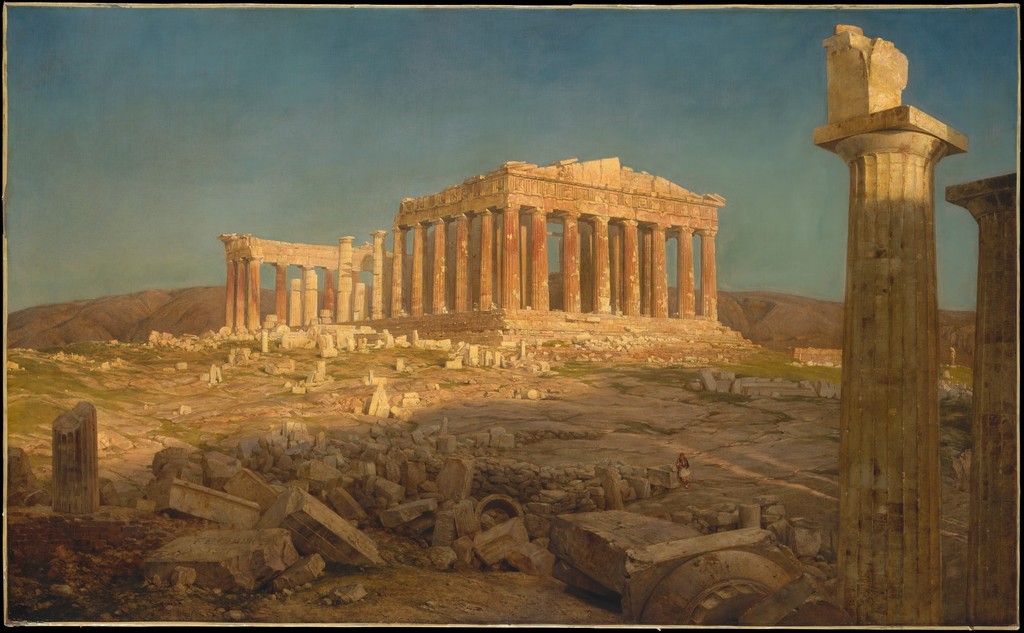
1865The Parthenon
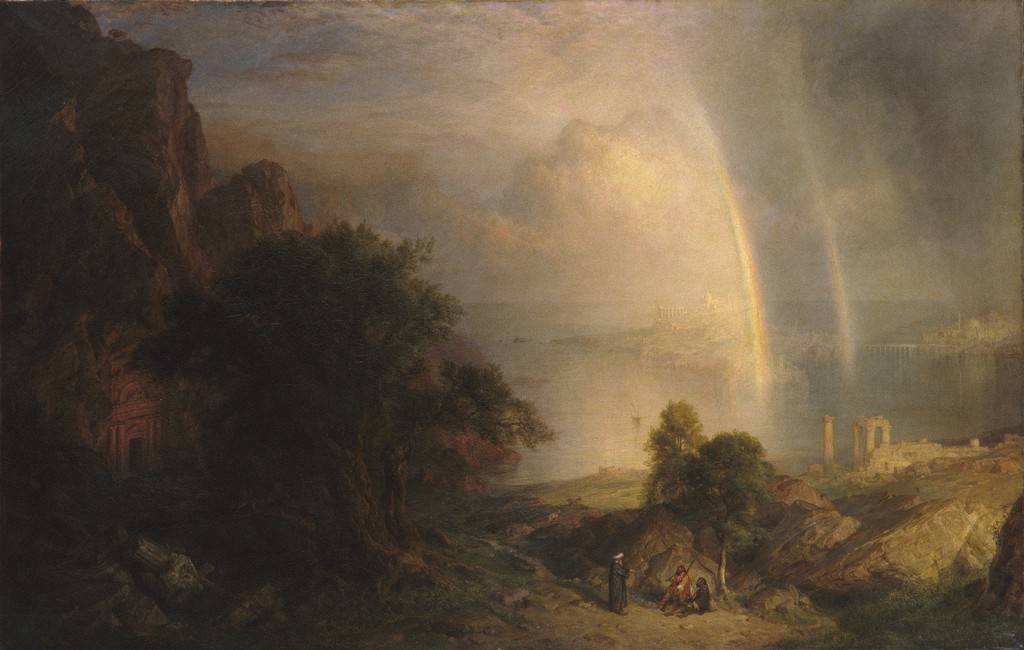
1871The Aegean Sea
About 1877Contents
- A viewpoint close to the rocks
- Breaking water and a quieter distance
- The sky, illuminated rocks and sails
- Church’s early coastal travels
- The comparison with Turner
- Two distinct Coast Scene paintings
- Mount Desert as a landscape seen and represented
A viewpoint close to the rocks
The largest rock mass enters from the left edge and occupies much of that side of the picture. Its upper ledge stands against the clouds, while the lower surface merges with shadow and water. Beside it, a narrower upright formation creates another dark silhouette. The interval between these rocks allows a glimpse of the sea beyond.
Church places the spectator close enough for the rocks to feel imposing. Their upper edges interrupt the sky, and their lower portions disappear among waves. The scene supplies no comfortable beach or level path from which to survey everything. Instead, the foreground draws us into an encounter with water moving around hard, irregular surfaces.
The narrow formation also divides the view. To its left, the bulky crag compresses the available space; to its right, sea and sky extend toward the horizon. This contrast between obstruction and openness makes the distant water feel more expansive. The painting’s effect depends on the rocks’ placement as much as on their rugged appearance.
Breaking water and a quieter distance
White foam gathers where waves strike the rocks, then spreads across the lower part of the canvas in broken curves. These pale marks stand out against dark water. Some passages look like spray rising into the air; others follow the surface as it folds around the foreground stones.
Farther back, a low line of orange-brown rocks catches the light. A wave breaks against this smaller barrier, creating another band of spray. Church gives the eye two encounters with the shore: the close, shadowed formations and the more illuminated rocks beyond them. Repeated collisions connect these different parts of the composition.
The sea near the horizon appears more even and less sharply marked. That visual change creates distance while strengthening the impression of movement nearby. The contrast should not be taken as a measurement of the actual weather offshore. It is a painted relationship between sharply described surf and the quieter appearance of water seen farther away.
This difference in visibility gives the picture a changing rhythm. Following the foam brings the eye across the foreground in short, irregular movements. Looking toward the horizon produces a longer, steadier sweep. Church accommodates both within one view, so that the sea feels active without making every part of the canvas equally turbulent.
The sky, illuminated rocks and sails
The sky occupies a substantial upper band. Lavender and pink clouds stretch horizontally, with a brighter opening toward the right. Their softer boundaries contrast with the angular outlines of the rocks. Warm highlights on the stone connect the lower scene to the colours above, giving the composition a unity across its different materials.
The bright low rocks near the centre are especially important. They interrupt a broad field of dark water and draw attention away from the looming left foreground. Church thus creates depth through light as well as through the diminishing size of objects. The illuminated band feels both farther away and available as a distinct point of focus.
A boat with pale sails occupies the right side of the sea. Much smaller sails appear near the horizon. These vessels introduce a human scale into a landscape dominated by rock and water. Their presence makes the open distance seem traversable, while the foreground remains difficult to approach.
The boat’s cream-coloured sails repeat the lighter accents in foam and sky. They also provide a compact shape against the long horizontal bands of water. Our attention can move from the crowded left rocks toward this small, isolated vessel, giving the composition a release from its initial sense of enclosure.
Church’s early coastal travels
Church had explored the northeastern coast before completing this painting. Debora Rindge’s chronology in the 1989 catalogue records travel to Mount Desert in the summer of 1850 and another visit in October 1851. It also records journeys to Grand Manan Island and the Bay of Fundy in August 1851, followed by a return to Grand Manan in August 1852.[1]
These journeys help place Coast Scene within sustained attention to marine subjects. They do not identify the exact rock formation or establish that Church painted the finished canvas at the shore. The picture can be understood alongside his coastal travels while retaining the distinction between an observed environment and a deliberately organised painting.
Franklin Kelly groups it with The Wreck and Grand Manan Island, Bay of Fundy as evidence of Church’s particular interest in marine and coastal views during 1851–52. These works demonstrate that his early landscape practice encompassed offshore weather, waves and exposed rock, alongside the wooded and pastoral scenery discussed elsewhere in his biography.[1]
Watch: Frederic Edwin Church
Choose a film to explore the artist’s work, its interpretation and its wider setting.
Frederic Edwin Church's "The Icebergs" on the Move at the DMA
Follow the Dallas Museum of Art as it moves Church’s large painting The Icebergs.
Watch on YouTubeThe comparison with Turner
Kelly interprets the handling of water in Coast Scene as an homage to J. M. W. Turner. He places that comparison within a wider account of Church’s response to Turner’s marine paintings, while arguing that the early connection concerned subject matter more strongly than the later stylistic lessons Church would absorb.[1]
Kelly also discusses two Turner paintings owned by New York collector James Lenox, Staffa, Fingal’s Cave and Fort Vimieux. He considers Church’s access to them likely but explicitly uncertain. This distinction matters: the comparison is a scholar’s account of artistic affinity, rather than a documented statement that Church copied a particular Turner composition to produce this canvas.
Adelson Galleries likewise mentioned a possible Turner homage when presenting the 1852 picture in its 2008 loan exhibition Romantic Landscapes and Seascapes. That later exhibition record shows the comparison’s continuing place in discussion of the work, while the painting’s sharply separated rocks, water and clouds invite consideration on their own terms.[3]
Two distinct Coast Scene paintings
Church returned to a similar subject in Coast Scene, Mount Desert, dated 1863 and recorded in the 1989 catalogue at the Wadsworth Atheneum. The later composition places a bright sun above the sea and builds a powerful mass of rocks and spray on the right. In the 1852 canvas, the dominant upright rocks stand on the left and a sailboat opens the view toward the right.[1]
Kelly discusses the 1863 painting’s National Academy exhibition and contemporary responses to its colour and agitated water. Those responses belong to the later canvas. Keeping the two works separate allows us to compare Church’s treatment of the coast across eleven years without assigning one picture’s exhibition history to the other.
Mount Desert as a landscape seen and represented
The National Park Service places Church and Thomas Cole within a broader history of artists helping popularise Mount Desert Island. Its account connects landscape pictures shown in American cities with growing interest in visiting the region. It also describes tourism’s unequal effects, including pressures on Wabanaki people. This regional history gives the apparently remote coast a human context; it does not establish that this particular canvas caused a specific change.[4]
A modern photograph by James St. John shows waves and wet rocks beside Thunder Hole on Mount Desert Island.[5] Brown stone interrupts white foam, with blue water extending toward a distant headland. It offers a comparison for the meeting of rock and surf in the region Church explored.
The photograph does not identify Church’s precise viewpoint. Its lower rocks and clearer daylight differ from the painting’s upright formations and coloured sky. Looking at both helps separate the recurring materials of a rocky coast from the choices that make Coast Scene distinctive: looming silhouettes, concentrated light and a small sailboat across the open sea.
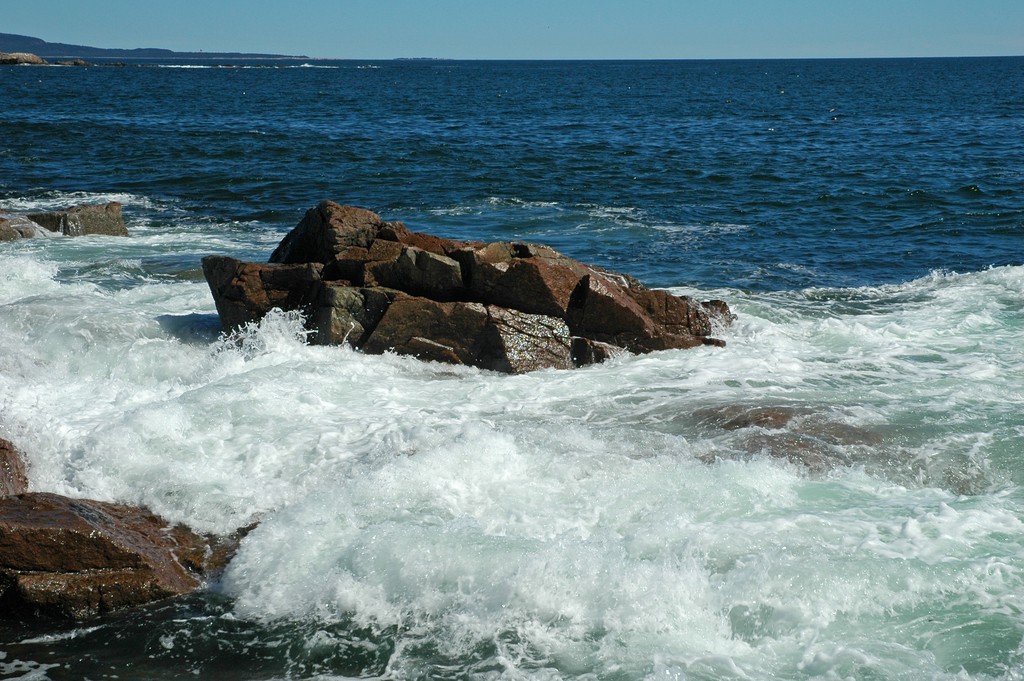
Rocky shore & waves (next to Thunder Hole, Mt. Desert Island, Maine, USA) 15, photograph by James St. John, 12 September 2006. Via Wikimedia Commons and original Flickr record, CC BY 2.0. Modern regional comparison of rocks and surf; not Church’s precise viewpoint. Resize credit to be added when exported. Rocky shore & waves (next to Thunder Hole, Mt. Desert Island, Maine, USA) 15, photograph by James St. John, 12 September 2006. Via Wikimedia Commons and original Flickr record, CC BY 2.0. Modern regional comparison, not Church’s precise viewpoint.. Image source. Creative Commons Attribution 2.0 Generic. Resized; full source proportions retained.
Artworks directory
A documented selection of Church’s works discussed across these articles, together with identified prints after his designs. This is not a catalogue raisonné. Repeated titles and aliases are reconciled; studies remain distinct from finished paintings. Some dates remain unconfirmed. Other makers are named where a print adapts Church’s work.
| Name | Date | Medium |
|---|---|---|
| Above the Clouds at Sunrise | 1849 | Oil on canvas |
| The Aegean Sea | About 1877 | Oil on canvas |
| The Andes of Ecuador | 1855 | Oil on canvas |
| Aurora Borealis | 1865 | Oil on canvas |
| Autumn in North America | Circa 1856 | Oil on board |
| Coast Scene | 1852 | Oil on canvas |
| Cotopaxi | 1862 | Oil on canvas |
| A Country Home | 1854 | Oil on canvas |
| El Khasné, Petra | 1874 | Oil on canvas |
| El Rio de Luz | 1877 | Oil on canvas |
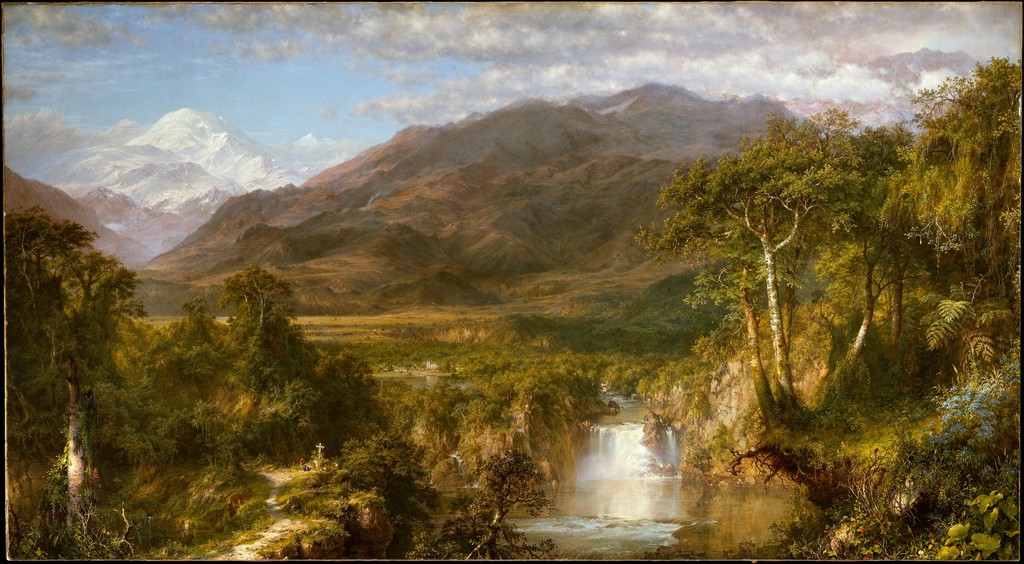
| The Heart of the Andes | 1859 | Oil on canvas |
| The Icebergs | 1861; foreground mast added between mid-1862 and early 1863 | Oil on canvas |
| Jerusalem from the Mount of Olives | 1870 | Oil on canvas |
| Mount Ktaadn | 1853 | Oil on canvas |
| Our Banner in the Sky | 1861 | Oil paint over lithograph on paper, laid down on cardboard |
| The Parthenon | 1871 | Oil on canvas |
| Rainy Season in the Tropics | 1866 | Oil on canvas |
| Storm in the Mountains | 1847 | Oil on canvas |
| Syria by the Sea | 1873 | Oil on canvas |
| Tamaca Palms | 1854 | Oil on canvas |
| Tropical Scenery | 1873 | Oil on canvas |
| Twilight in the Tropics | 1874; signed and dated, according to Bonhams’ catalogue | Oil on canvas |
| Twilight in the Wilderness | 1860 | Oil on canvas |
| View of Cotopaxi | 1857 | Oil on canvas |
| Niagara | 1857 | Oil on canvas |
| Magdalena River, New Granada, Equador | 1853 | Graphite heightened with white on wove paper |
| Tamaca Palm, Colombia or Ecuador | May–October 1853 | Graphite on gray laid paper |
| Mixed Sketches with a Champan, Río Magdalena, Colombia | May 1853 | Graphite on gray laid paper |
| Study for Rainy Season in the Tropics | 1865–1866 | Graphite on ruled notepad paper |
| Al-Khazneh, Petra (study) | February–March 1868 | Oil and graphite on tan paperboard |
| The Great Fall, Niagara (Charles Risdon, after Church) | 1874 impression | Hand-coloured chromolithograph on paperboard |
| The Heart of the Andes (William Forrest, after Church) | 1862 | Engraving in black on wove paper |
| Our Heaven Born Banner (William Bauly, adapting Church’s motif) | circa 1861 | Colour lithograph |
| A Tropical Moonlight (wood engraving after Church) | 1879 publication | Wood engraving in American Painters |
| Off Iceberg, Newfoundland | June 1859 | Oil and graphite on paperboard |
| Parthenon at Night, Athens | April 1869 | Oil and graphite on tan paperboard |
| Jerusalem from the Mount of Olives (study) | 1 April 1868 | Oil and graphite study |
| Horseshoe Falls (study) | December 1856–January 1857 | Oil on paper mounted to canvas |
| Niagara Falls, from the American Side | 1867 | Oil on canvas |
| Study for The Heart of the Andes | 1858 | Oil study |
| Mount Chimborazo through Rising Mist and Clouds | 1857 | Oil study |
| Cotopaxi Erupting, Viewed from Quito, Ecuador | June 1857 | Oil and graphite on tan paperboard |
| Cotopaxi (painted for Cyrus Field) | 1855 | Painting |
| Chimborazo | 1864 | Painting |
| Twilight, A Sketch | 1858 | Oil on canvas |
| View of Baalbek | 1868 | Oil and pencil on board |
| Three Bedouins | Date unconfirmed | Oil study |
| Coast Scene, Mount Desert (later canvas) | 1863 | Painting |
| The Wreck | Date unconfirmed | Painting |
| Grand Manan Island, Bay of Fundy | Date unconfirmed | Painting |
| Summer in South America | circa 1853 | Painting |
| Evening in Vermont | Date unconfirmed | Painting |
| Home by the Lake | Date unconfirmed | Painting |
| Storm in the Blue Mountains, Jamaica | August 1865 | Painting |
| The Natural Bridge, Virginia | 1852 | Painting |
| The Vale of St. Thomas, Jamaica | 1867 | Painting |
| Tequendama Falls, near Bogota, New Granada | Date unconfirmed | Painting |
| Sunrise in Syria | Before the 1876 exhibition | Painting |
| Cuernavaca (oil study; descriptive title) | 1898 | Oil study |
| Olana window design (descriptive title) | Date unconfirmed | Watercolour and graphite |
| Olana dining-room stencil sketch (descriptive title) | Date unconfirmed | Oil and graphite |
| Olana house (with Calvert Vaux) | 1870–1872; later additions | Architecture |
| Olana designed landscape | From 1860; developed over decades | Designed landscape |
Frequently Asked Questions
The canvas discussed here is dated 1852 in the 1989 exhibition catalogue and later gallery records.
It measures 50.8 × 76.2 centimetres, or 20 × 30 inches.
They are distinct canvases. The earlier work has also appeared under the Mount Desert title, so its date, dimensions and composition help identify it.
The 1989 catalogue records a private collection. The sources cited here do not establish its current owner or public availability.
Franklin Kelly interprets its water as a Turner homage. His discussion qualifies Church’s possible access to specific Turner paintings rather than claiming a documented act of copying.
Discussion
Look again at the images and ideas explored in Coast Scene. These editorial prompts invite your own observations.
Reader Insights
How does the close viewpoint affect your sense of the waves?
What distinction do you notice between the breaking water and the quieter distance?
Which small sail or illuminated rock helps you judge the scene’s scale?
Join the Conversation
Share a detail, comparison or question about Coast Scene below.
References
- Frederic Edwin Church, National Gallery of Art exhibition catalogue, 1989: Franklin Kelly, pp. 45–46 and 61; Debora Rindge, chronology pp. 159–160; catalogue 15, p. 30 and checklist p. 201; catalogue 37, p. 113 and checklist p. 202.
- Mnuchin Gallery, Church & Rothko: Sublime, exhibition introduction and caption for Coast Scene, Mount Desert, 1852.
- Adelson Galleries, Frederic Edwin Church: Romantic Landscapes and Seascapes, 18 January–1 March 2008, Coast Scene highlight.
- National Park Service, Art, Rusticators & Early Tourism, Acadia National Park.
- James St. John, Rocky shore & waves (next to Thunder Hole, Mt. Desert Island, Maine, USA) 15, photograph taken 12 September 2006, Flickr record.
- Splash image source.
Frederic Edwin Church, Coast Scene, 1852. Oil on canvas, 50.8 × 76.2 cm. Private collection in the 1989 NGA catalogue; current location unverified. Public-domain reproduction via Wikimedia Commons, source ArtRenewal.com; uploaded by Keraunoscopia. Frederic Edwin Church, Coast Scene, 1852, oil on canvas. Private collection in the 1989 catalogue. Public-domain reproduction via Wikimedia Commons, source ArtRenewal.com; uploaded by Keraunoscopia.. Image source. Public domain / faithful reproduction of a two-dimensional public-domain painting. Resized; full source proportions retained.