


 by Tom Gurney
Tom Gurney BSc (Hons) is an art history expert with over 20 years experience
Published on June 19, 2020 / Updated on November 29, 2026
Email: tomgurney1@gmail.com / Phone: +44 7429 011000
Overview
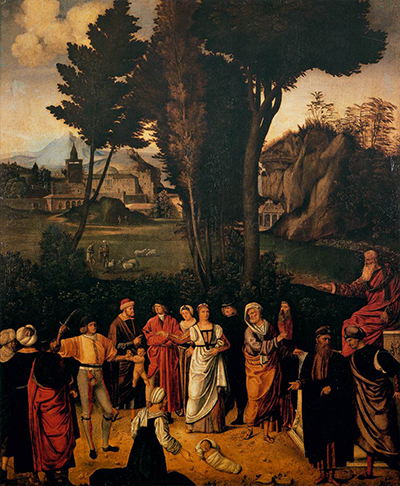
A sword rises on one side of the clearing. The king sits on the other. Between them an infant dangles from the executioner's grip as a woman stretches an arm out toward him. Above this low line of faces and gestures, tall trees give way to a village and distant mountains. The Uffizi Judgement of Solomon is an oil on panel measuring 89 by 72 centimetres. Its attribution to Giorgione has a long history and some scholars see another hand in the painting. It belongs with another panel in Florence, The Test of Fire of Moses, whose throne sits on the opposite side of the scene. [1] [2] [3]
At a Glance
- Datec.1505–08; earlier dates proposed
- CollectionUffizi Galleries, Florence
- AttributionGiorgione; collaboration debated
- Inventory1890 no. 947
The moment of the mother's appeal
In the First Book of Kings, two women who share a house each claim the same surviving newborn. One infant has died during the night and each claimant says the other is his mother. Solomon has a sword brought forward and orders the living child divided between them. The woman he judges to be the true mother begs him to give the infant away instead of killing him. The other is willing to let the division proceed. The king revokes his order and gives the child to the woman who was willing to lose him. A judgement that begins by calling for the most literal division possible ends by establishing that the claims are unequal. [1] [4]
The picture chooses the dangerous interval after the sword has been raised. The sword bearer is at the left of the gathering, seen frontally in a yellow top and tight pale leggings. His upright posture and the abrupt diagonal of his right arm make the order seem capable of being carried out very soon. The weight of the child hangs lower at his other side. Across the grass, Solomon's outstretched hand looks small by comparison. It carries the force of the command over a great deal of room, with little physical effort visible in the king's own body. [1] [2]
Look from the hanging infant to the small swaddled form on the ground. The dead child is near the foreground, below the standing adults and away from the executioner's sword. Its tilted head and wrapped body keep the death that brought the women there in view. A woman in the foreground turns her back on us and lowers herself, an action distinct from the extended arm in the middle of the group. The shaft of the sword and the dangling body grab our attention first. The painter also leaves other figures with positions and signals that an onlooker has to sort out. The scene becomes an ordeal of looking, with attention divided between two infants, two women and two authoritative men. [1] [2] [3]
Trees over the court
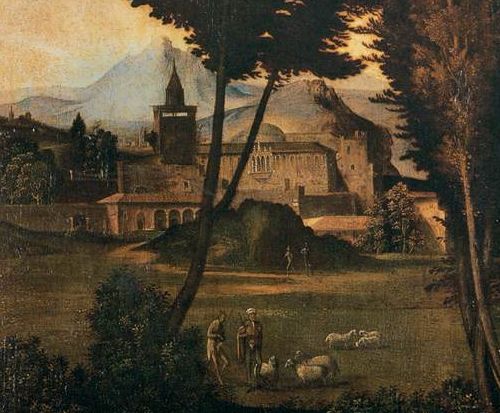
Large dark trees divide the image vertically. Their trunks rise directly behind the middle of the company and their foliage takes up a wide part of the sky. The seated king appears alongside rocks and darker hills to the right. At the left a settlement with a pointed tower moves into the light, and several small figures and animals come into view on open ground before it. There are no porticoes or walls to contain the crowd. The elaborate gathering, a place where a ruler has life and death in his power, is one transient event in a much larger piece of country. [2] [3]
Sarah Ferrari's study of Giorgione's landscape isolates the rocks in a detail. In the original format the steep shoulders of stone on the right can appear secondary to the procession of court figures. The detail makes the succession of warm and shaded planes easier to see. You can also follow a gap at the foot of the mass toward the small structure at its base. These secondary passages reward a different pace of looking from the crisis with the sword. The painting can accommodate both. Its tall trees occupy the middle of the distance, ready landmarks when the eye returns from the settlement or the rocks to the space where the king and the women are speaking. [2] [3]
A pair with two sides
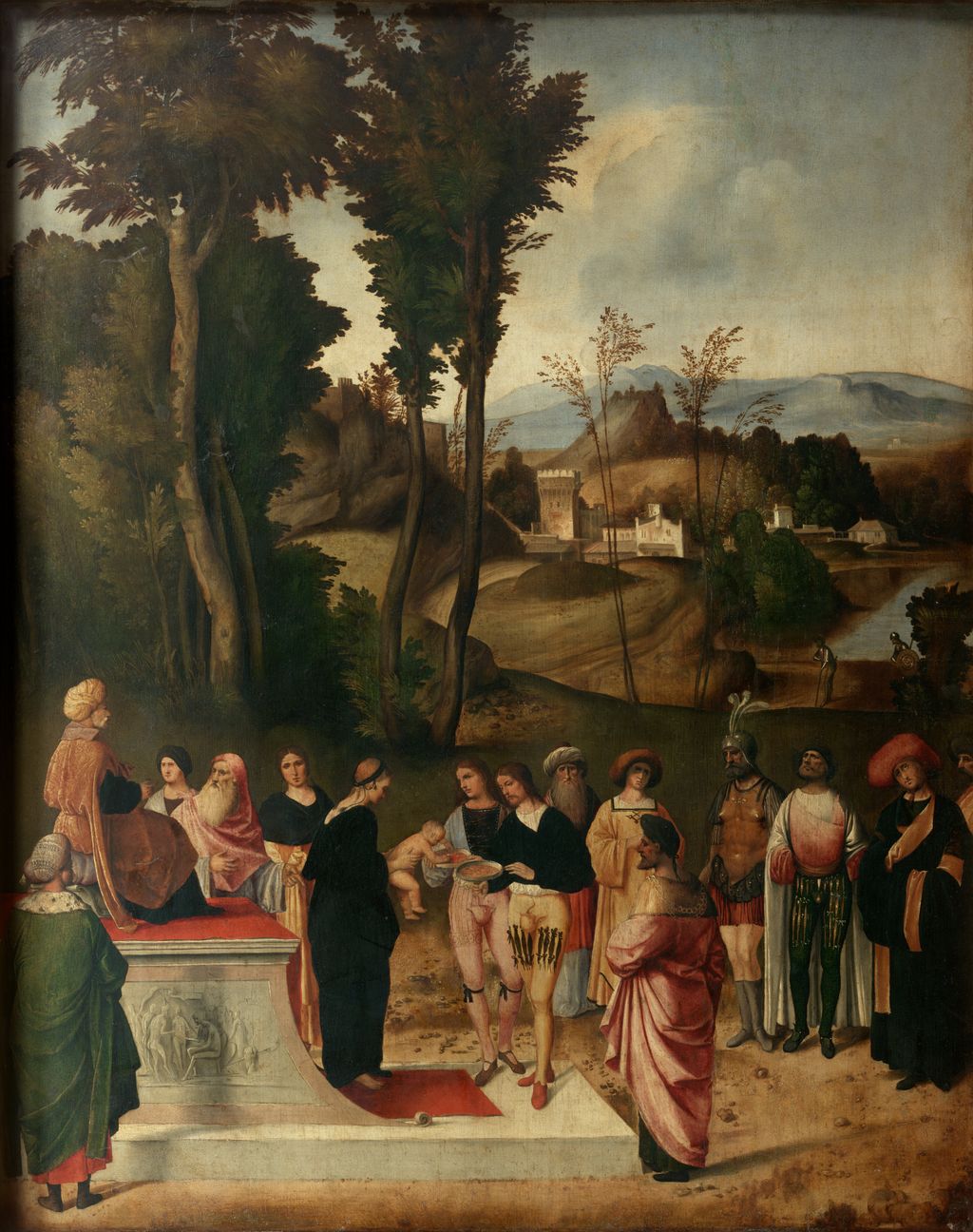
The panel is often described as the pendant of the Moses painting. Each places a ruler and an endangered child in the foreground of a landscape. Read them together and the placement of the rulers opens the pair outward. Pharaoh is at the left in the Moses scene and Solomon at the right in the judgement. The central company in each picture pays close attention to objects the king has required for his test. In Moses two trays are offered. In Solomon it is the sword that makes an order credible. The Italian catalogue treats the two subjects as complementary ways of thinking about wisdom. The difference in who has to respond supplies an especially telling contrast. In the Moses story it is the child who must act. In Solomon it is a mother whose words prevent the death. [1] [5] [6]
Evidence that the pair was intended to be seen together also survives on the backs. Interlaced branches and simulated marble decoration appear on both. A published examination describes worn recesses near the margins and raises the possibility of cupboard doors. A set of doors would let the owner encounter painted fronts and decorated backs at different moments of use. That was one plausible way for narrative pictures of this scale to live alongside ordinary household activity. The marks do not recover the original furniture or settle why these two stories were selected. The pairing is already documented in 1692 among the pictures at the Villa del Poggio Imperiale. [5] [6]
What the attribution can establish
The Florence panel carries the national catalogue identifier 0900286722 and the Uffizi's older inventory number 947. It appears in previous records associated with Giovanni Bellini. The national catalogue credits Giovanni Battista Cavalcaselle with advancing the attribution to Giorgione. His discussion with Joseph Archer Crowe in the nineteenth century established an important place for the panel among Giorgione's possible early works. Modern work on Cavalcaselle's notes has found a reference from 1858 that may concern the two Florentine panels. Its identification remains provisional, and histories of the two pictures differ on when the Giorgione label first appeared. [1] [2] [3] [7]
The national catalogue's approximate date is 1505–08. Ferrari reproduces it as the work of Giorgione and an unknown painter, around 1495–96. The difference reaches well beyond the rounding of an uncertain year. It affects which comparisons historians will try first and whether they understand the panel as evidence of a very early artistic formation or a later variation on his use of landscape. The firmest points are the identity of the two panels as objects, their appearance in the Florentine collection and the paired compositions we can study today. Much of the argument over the painter's hand begins again when a reader looks at the sharply lit standing figures and the quieter rocky background. [1] [2] [3] [5]
Other collections preserve their own versions of the story. The National Trust catalogues the large Kingston Lacy treatment under Sebastiano del Piombo. That painting also has a history of being associated with Giorgione. A print in the Metropolitan Museum reproduces Raphael's composition for the ceiling of the Stanza della Segnatura, where an altogether different shape had to accommodate the drama. These examples help explain the ease with which the title survives while the actual object becomes confused. In Florence, look for the king projecting his hand into the clearing from the far right and the large trees continuing up above him. As the moment of judgement is suspended, the view across the countryside gives the threatened infant a world in which he might still live. [1] [8] [9]
Annotated Details from Judgement Of Solomon
Select a point to see its detail.
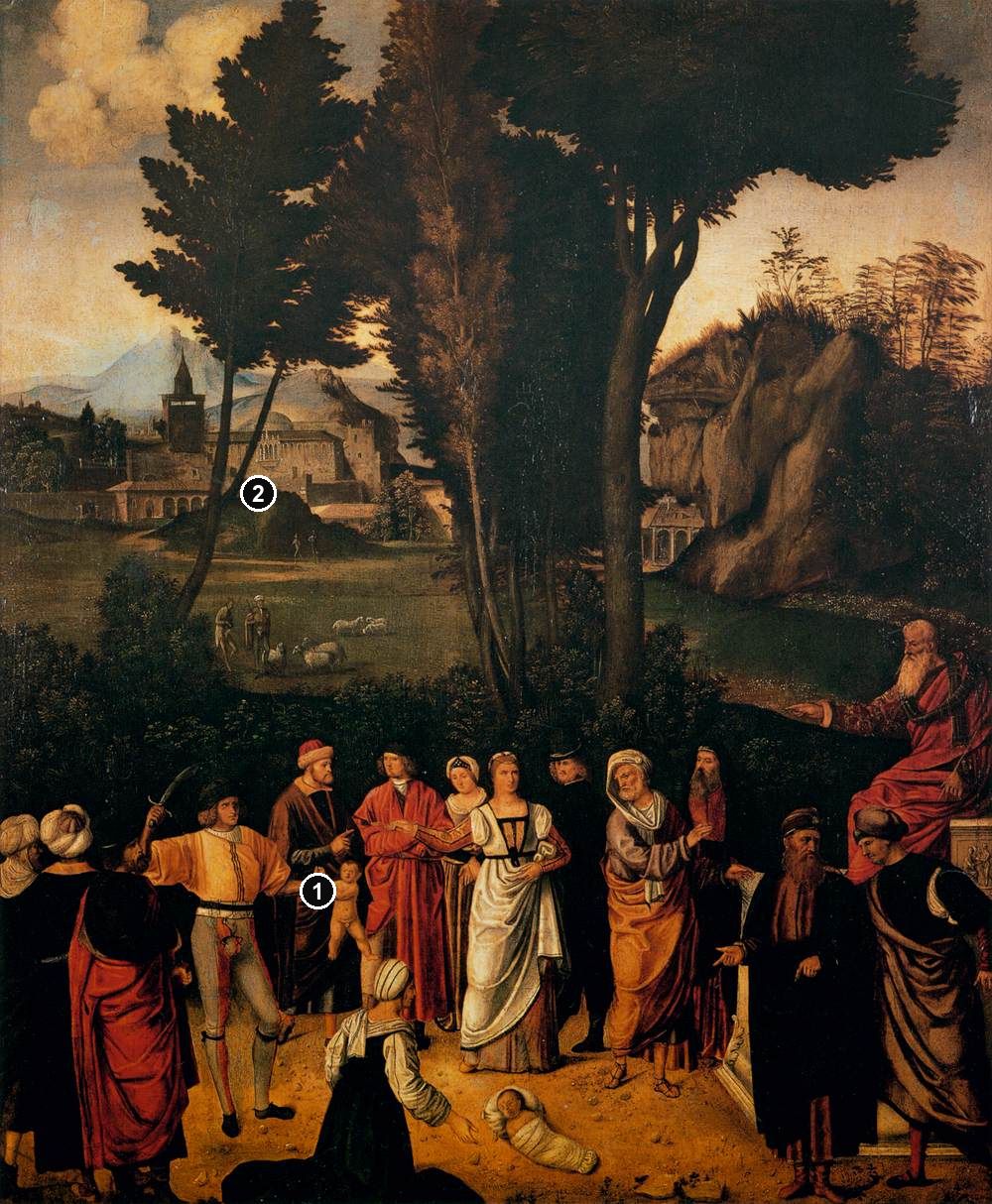
1. The sword and child · 2. The view beyond
Details from JUDGEMENT OF SOLOMON
Detail crops from the same image.
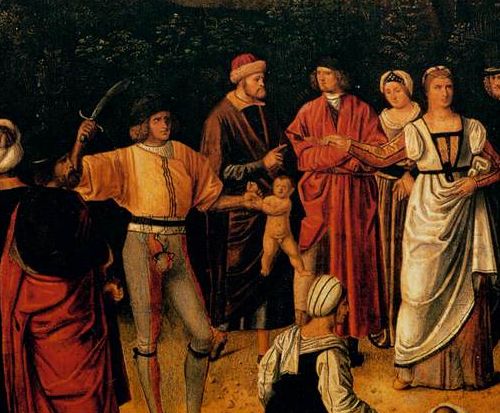
The sword and child
The executioner’s pose gives physical force to an order delivered from the opposite side.
The view beyond
The town and workers set a different pace from the urgent gathering below.
Giorgione’s career
Castelfranco Madonna
Early 1500sFondaco dei Tedeschi
1507–08Three Philosophers
1508–09Death in Venice
1510Discussion
Share what you noticed and how you arrived at your reading.
Reader Insights
Which detail would you point out to somebody seeing The Judgement of Solomon for the first time?
How does what the attribution can establish change how you read the work?
Join the Conversation
Share a detail, comparison or question about The Judgement of Solomon below.
References
- Catalogo generale dei beni culturali, Giudizio di Salomone, 0900286722. View source.
- Fondazione Federico Zeri, Giudizio di Salomone, work and photographic record 40182. View source.
- Sarah Ferrari, Una luce per la natura: Studi su Giorgione, figures 22 and 26. View source.
- United States Conference of Catholic Bishops, First Book of Kings, chapter 3. View source.
- Catalogo generale dei beni culturali, Mosè sottoposto alla prova del fuoco, 0900286684. View source.
- Exhibition catalogue, Université de Liège repository, Mosè alla prova del fuoco, catalogue V.1. View source.
- Giovanni Mazzaferro, Lo sguardo condiviso: il viaggio di Giovan Battista Cavalcaselle e Charles Eastlake nel Centro Italia. View source.
- National Trust Collections, Kingston Lacy collections and the Judgement of Solomon. View source.
- Metropolitan Museum of Art, Pietro Anderloni after Raphael, The Judgement of Solomon. View source.