


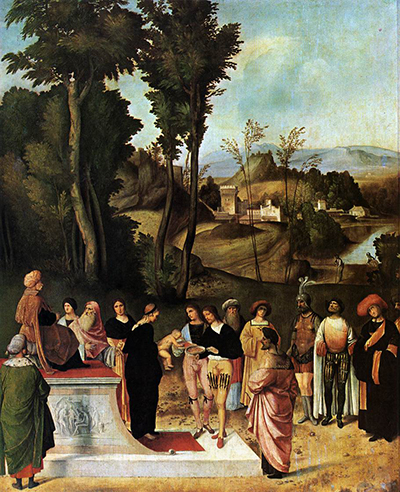
 by Tom Gurney
Tom Gurney BSc (Hons) is an art history expert with over 20 years experience
Published on June 19, 2020 / Updated on November 5, 2026
Email: tomgurney1@gmail.com / Phone: +44 7429 011000
Giorgione Quotes and Early Accounts
The most revealing words associated with Giorgione are usually words written about him. Early biography, descriptions of Venetian collections and later criticism have shaped the way his paintings are understood. They offer memorable observations about music, nature and the difficulty of explaining an image. They should not, however, be turned into a collection of speeches supposedly delivered by the painter. The sources used here do not establish a body of personal aphorisms in Giorgione’s own voice.
Two especially useful quotations come from Giorgio Vasari and Walter Pater. They belong to different centuries and answer different questions: Vasari tries to describe a Renaissance painter’s achievements, while Pater explores the effect that an artwork can have on its viewer. Reading their words beside paintings gives us a richer understanding than treating either writer as a transparent spokesman for Giorgione. [1] [2]
At a Glance
- ScopeWords about Giorgione, with each speaker identified
- Early sourceGiorgio Vasari, later biographical account
- Later criticWalter Pater, The School of Giorgione
Contents
Vasari: a confession of uncertainty
“I for my part have never understood it”
Vasari makes this admission while discussing Giorgione’s fresco decoration on the Fondaco dei Tedeschi in Venice. The words are Vasari’s, not Giorgione’s. They concern a particular decorative programme, rather than every enigmatic painting associated with the artist. In the same passage Vasari praises the appearance of its figures while struggling to explain what they mean. [1]
This makes the quotation unusually useful. An early writer could admire a work without being able to supply a convincing story for it. Looking and explaining were separate activities, and excellence in one did not guarantee success in the other. The admission also resists the assumption that people living closer to a painting’s creation necessarily possessed a complete key to its subject.
For a modern viewer, the sentence offers permission to be precise about uncertainty. We can recognise a gesture, a relationship of colours or an arresting landscape without immediately identifying every figure. That is a stronger response than replacing an unanswered question with an appealing but unsupported narrative.
The biography behind the quotation
Vasari’s account presents Giorgione as a gifted musician and painter. It connects his reputation with elegant company, painting from nature and a distinctive softness of colour. These descriptions are evidence for Vasari’s understanding of the artist. They do not record a modern interview, and the anecdotes should retain their place within a literary biography. [1]
The National Gallery’s account provides a useful counterweight. It stresses how little is securely known about Giorgione’s life and how much disagreement surrounds the attribution of his paintings. It also records documented work in Venice, including the Fondaco decoration, and notes the correspondence concerning his death in 1510. [3]
Read together, the two accounts encourage different degrees of confidence. A documented commission can establish employment at a particular place. A later biographical story may reveal how an artist’s reputation developed. Neither kind of evidence needs to be discarded, but they should not be made to perform the same task.
Pater: the condition of music
“All art constantly aspires towards the condition of music.”
This famous sentence comes from Walter Pater’s essay “The School of Giorgione.” It is a statement by a nineteenth-century critic, not a surviving declaration by the Renaissance painter. Pater uses music to consider an experience in which subject and artistic form appear inseparable: the effect depends on the arrangement itself, not simply on information that could be extracted from it. [2]
The sentence can help us notice what a summary leaves out. Describing a painting as a group of people in a landscape tells us something about its contents. It does not recreate the rhythm between those people, the relation of light to shadow, or the pace at which the eye travels through the setting. Those relationships are part of the meaning of the experience.
Pater’s idea remains an interpretation. It should not be used to claim that Giorgione intended all his paintings as musical equivalents, or that a modern response can recover his private thoughts. Its value is that it changes the questions we bring to an image.
Why Pater’s Giorgione is a historical construction
Pater discusses a “school” because an artistic character can seem recognisable even when the ownership of individual works is uncertain. The essay belongs to the history of Giorgione’s reception: the artist becomes a way of thinking about concentrated experience, suggestion and the relationship between painting and music. [2]
An attribution question and an aesthetic response therefore need separate answers. A viewer may find a painting deeply Giorgionesque without having proved that Giorgione painted it. The Städel Museum’s biography similarly describes his importance through his handling of colour and through the later understanding of his methods. It attributes the claim that he worked without preliminary drawings to Vasari, preserving the distinction between historical testimony and independently observed practice. [4]
The distinction can make looking more demanding, but also more rewarding. Instead of asking a famous name to settle every question, we can examine which qualities attracted that name in the first place. Critical language then becomes something to test against the object, rather than an instruction to admire it automatically.
The Adoration of the Shepherds: atmosphere with a subject
The National Gallery of Art’s Adoration of the Shepherds, often called the Allendale Nativity, offers a useful test. Its collection account describes a composition balanced between a dark rocky shelter and an open landscape, with the figures gathered in contemplation around the infant Christ. Here the religious subject is recognisable, yet the atmosphere remains essential to its effect. [5]
That combination prevents a false choice between storytelling and visual poetry. An image can have a defined subject and still communicate through the spacing of bodies, the softness of a distance and the movement from darkness into light. Identifying the Nativity does not exhaust the painting.
When reading Pater beside this work, ask what would disappear if the composition were described only as an episode from scripture. The arrangement makes attention itself visible: figures lower their heads, distances open beyond them, and a quiet gathering acquires emotional weight. This is an interpretive exercise, not a quotation placed in the artist’s mouth.
Il Tramonto and the limits of explanation
The National Gallery’s commentary on Il Tramonto, or The Sunset, introduces another complication. Damage and later interventions affect what can be identified in the picture. The collection distinguishes surviving original passages from areas that complicate interpretation, and treats proposed identities with caution. [6]
A sentence about mystery can sound wonderfully appropriate here, but it can also conceal a practical problem. Some uncertainty arises because an artist chose an unusual subject; some arises because a picture has changed. The two explanations lead us towards different kinds of enquiry. We may need conservation history as much as literary imagination.
This is why a quotation should open a conversation rather than close it. Vasari’s uncertainty about a Venetian fresco does not explain the condition of a London painting. Pater’s musical analogy does not repair a missing passage. Each quotation becomes more useful when its limits are kept visible.
Reading words beside paintings
The best way to use these quotations is to return from them to a particular image. Start with one visible relationship: a hand against a garment, a figure near a dark opening, or a line of landscape passing behind a face. Then ask whether the writer’s words help you see that relationship more clearly.
Keep the speaker’s name attached to the sentence. Vasari offers an early biographical voice; Pater offers a later critical one. A museum catalogue offers another kind of knowledge, grounded in the history and condition of an individual object. Their differences create a productive conversation around Giorgione rather than a substitute autobiography.
The result is a small, dependable collection of words with room for close looking. Giorgione’s paintings do not need invented sayings to seem thoughtful. The questions they raise about atmosphere, recognition and explanation are already substantial enough.
Works discussed on this page
Selected works discussed in the article. Different objects retain separate records; source links are in References.
| Name | Date | Medium |
|---|---|---|
| The Adoration of the Shepherds | 1505–10 | Painting |
| Il Tramonto (The Sunset) | 1506–10 | Painting |
Frequently Asked Questions
No. The sentence about art aspiring towards music is Walter Pater’s and appears in his essay The School of Giorgione.
They are quotations about Giorgione. Vasari’s own observations and stories should be distinguished from documented words spoken or written by the painter.
Discussion
Consider how the documented words and objects change your understanding of the artist.
Reader Insights
Which source most changes the way you look at the works?
Which distinction between objects or speakers is most useful?
What would you like to compare next?
Join the Conversation
Share a detail, comparison or question about Giorgione Quotes and Early Accounts below.
References
- Giorgio Vasari. Lives of the Artists: Giorgione and Fra Sebastiano del Piombo. English translation excerpt hosted by Fordham University’s Internet History Sourcebooks. Fondaco passage and biographical account. View source.
- Walter Pater. The Renaissance: Studies in Art and Poetry, The School of Giorgione. Library edition, 1910, Project Gutenberg eBook 4060. View source.
- National Gallery, London. Giorgione. Artist biography and documentary qualifications; accessed 5 November 2026. View source.
- Städel Museum. Giorgione. Digital collection biography; accessed 5 November 2026. View source.
- National Gallery of Art, Washington. Giorgione, The Adoration of the Shepherds, 1505/1510, 1939.1.289. Collection commentary; accessed 5 November 2026. View source.
- National Gallery, London. Giorgione, Il Tramonto (The Sunset). Collection commentary on subject, condition and alterations; accessed 5 November 2026. View source.