Buy Art Prints Now
from Amazon
* As an Amazon Associate I earn from qualifying purchases.
 by Tom Gurney
Tom Gurney BSc (Hons) is an art history expert with over 20 years experience
Published on June 19, 2020 / Updated on October 16, 2026
Email: tomgurney1@gmail.com / Phone: +44 7429 011000
The Anger of Achilles: Introduction
The Anger of Achilles is one of Jacques-Louis David's strongest late history paintings. Painted in 1819 during his Brussels exile, it returns to ancient tragedy after the Revolution, after Napoleon and after David's loss of his central public role in France. The painting is smaller than his monumental state canvases, but it carries the old David problem with new tension: what happens when private emotion collides with an obligation presented as public necessity? [1] [4]
The Kimbell Art Museum identifies the work as The Anger of Achilles, dated 1819, by Jacques-Louis David. The accession number is AP 1980.07. The painting is oil on canvas, measuring 105.3 by 145 cm, with framed dimensions of 132.7 by 172.7 by 10.2 cm. The Kimbell records it as on view and places it in the nineteenth century. [1] [4]
The museum's interpretation anchors the subject in Euripides' Iphigenia in Aulis and Racine's seventeenth-century dramatic version. Agamemnon has revealed that Iphigenia is not to marry Achilles after all; she is to be sacrificed so that the Greek fleet can sail for Troy. Achilles reaches for his sword in anger. Clytemnestra, Iphigenia's mother, looks on in grief. Iphigenia stands between innocence, obedience and terror. David makes the scene a controlled explosion of competing duties. [1] [4]
At a Glance
- ArtistJacques-Louis David [1]
- Kimbell TitleThe Anger of Achilles [1]
- Active TitleThe Anger of Achilles [1]
- Date1819 [1]
- MediumOil on canvas [1]
- Dimensions105.3 by 145 cm; framed 132.7 by 172.7 by 10.2 cm [1]
- CollectionKimbell Art Museum, Fort Worth [1]
- AccessionAP 1980.07 [1]
- DisplayRecorded by the Kimbell as on view [1]
- Primary Source TextEuripides' Iphigenia in Aulis and Racine's dramatic version [1]
- Main Subject ReadingIphigenia sacrifice crisis, with Achilles, Agamemnon, Iphigenia and Clytemnestra [1]
- Technical EvidenceKimbell conservation notes record pentimenti and late-stage changes [1]
- Source CautionFollow Kimbell's Iphigenia reading; keep Achilles/Briseis variant labels as metadata caution only [1] [2]
Contents
- Introduction
- Object Identity
- David in Brussels
- The Iphigenia Subject
- Looking at the Painting
- Colour, Gesture and Late Style
- Subject Variants and Caution
- Provenance and Museum Life
- Why It Matters
Object Identity
The established English page title matches the Kimbell title for the painting. The Kimbell object title and the established English page title therefore point to the same painting. The date is 1819. The medium is oil on canvas. The accession number is AP 1980.07. [1]
The work belongs to the Kimbell Art Museum in Fort Worth, Texas. The museum credits it to Jacques-Louis David, French, born in Paris in 1748 and dead in Brussels in 1825. The dimensions, 41 7/16 by 57 1/16 inches, or 105.3 by 145 cm, make it a significant but not colossal late canvas. [1]
The Kimbell's object text is important because it gives not only factual metadata but also a careful subject reading. It identifies the emotional range David was trying to stage: calm, heroic resolve, grief and anger. It also notes that David prized the painting highly as the culmination of his career-long effort to recover the perfection of ancient Greek art. [1]
That claim should be handled as museum interpretation rather than an absolute last word on the painting. Still, it explains why the work matters. This was not a minor exile exercise. David used a mythological tragedy to test the whole discipline of his late Neoclassicism. [1]
David in Brussels
David took exile in Brussels after Waterloo and the Bourbon Restoration. By 1819, he was no longer Napoleon's official image-maker, no longer the public Revolutionary painter and no longer a central actor in Parisian art politics. Yet he was still working seriously, surrounded by pupils, collectors and admirers. [1] [4]
The Anger of Achilles belongs with the late mythological paintings in David's cluster. Love and Psyche tests idealised love against physical awkwardness. The Farewell of Telemachus and Eucharis turns desire into a scene of departure and duty. Mars Being Disarmed by Venus makes war surrender to erotic and mythological ceremony. Achilles is sharper and more tragic: desire, family and military necessity meet in a moment of anger. [1] [4]
The late context matters, but it should not turn the painting into a simple self-portrait in disguise. David does not paint his own exile. He paints a classical crisis. Yet the choice of subject feels appropriate to an artist who had seen political duty, private loyalty and public violence collide for decades. The tragic story gave him a way to explore those collisions without returning to modern politics directly. [1] [4]
In the 1780s, ancient subjects had helped David make public virtue look severe and clear. In Brussels, antiquity feels more emotionally complicated. Achilles reaches for a sword, but Agamemnon's gaze and command restrain him. Iphigenia appears caught in a fate arranged by others. Clytemnestra's grief sits beside the demands of war. The painting is not a clean hymn to heroic action. It is a scene in which every moral position hurts. [1] [4]
The Iphigenia Subject
The Kimbell reads the scene through Euripides and Racine. In this version of the story, the Greeks cannot sail to Troy because the goddess Diana must be appeased. Agamemnon, king of the Greeks, agrees to sacrifice his daughter Iphigenia. Achilles, who had expected marriage, learns the truth and reacts in fury. [1]
The subject therefore places several duties in conflict. Agamemnon is father, king and military leader. Iphigenia is daughter, bride and sacrificial victim. Clytemnestra is mother and queen. Achilles is warrior, promised husband and protector. No single role resolves the crisis. [1]
This is why the painting is stronger than a simple scene of anger. Achilles' fury is justified, but it is not allowed to dominate the picture. Agamemnon's authority is powerful, but it is morally compromised. Iphigenia's innocence is moving, but it does not stop the machinery of war. Clytemnestra's grief is human, but powerless. [1]
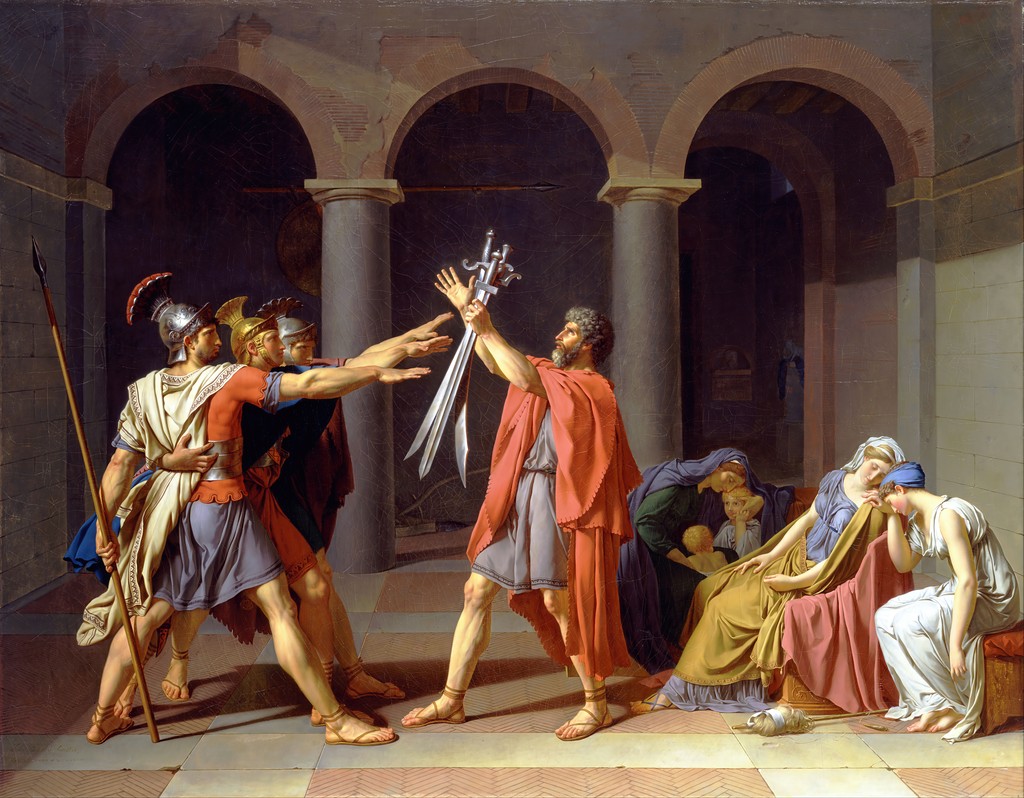
David had long been drawn to moments when public necessity presses on private bonds. In The Oath of the Horatii, family feeling is subordinated to civic duty. In The Lictors Bearing to Brutus the Bodies of His Sons, republican law crushes paternal feeling. In Achilles, the same conflict returns through Greek tragedy, but the emotional balance is less austere and more unstable. [1]
The title also needs careful handling. Achilles names the emotional crisis, but the painting is not only about Achilles. David places him inside a triangle of pressure formed by Agamemnon, Iphigenia and Clytemnestra. The hero's anger is the visible flash, yet the true subject is the structure that produces it. A warrior can reach for a sword, but the scene has already been arranged by kingship, prophecy and military ambition. [1]
That makes the Iphigenia story especially useful for David. The tragedy is not a duel between two men. It is a family catastrophe created by a public campaign. Agamemnon's power is shown at the moment when it becomes intimate and destructive. Iphigenia's bridal costume, as understood through the Kimbell reading, turns the promise of marriage into the machinery of sacrifice. Clytemnestra's grief makes the scene impossible to read as merely heroic. Achilles' anger becomes both necessary and insufficient. [1]
For readers moving through David's career, this distinction is important. The painting still belongs to Neoclassical history painting, but it does not present antiquity as a simple storehouse of moral examples. It shows antiquity as a field of impossible obligations. The classical source gives David distance from contemporary politics, while the emotional structure keeps the scene close to the problems that had always mattered to him: obedience, violence, civic demand and the private cost paid by families. [1]
Looking at the Painting
Achilles stands at the left, young, bare-armed and physically tense. His hand moves toward his sword. He is not a detached philosopher or a settled hero. He is a body at the edge of action. His anger gives the painting its title, but David controls that anger through composition. [1]
Agamemnon stands opposite him with a commanding gaze and authoritative gesture. The Kimbell describes this as a force that seems to freeze Achilles' outburst. That visual confrontation is the core of the painting: Achilles' impulse against Agamemnon's authority, youth against rule, anger against command. [1]
Iphigenia stands between the male confrontation and the grief of her mother. The Kimbell describes her as apparently dressed as a bride, clutching her heart and unaware of the full display of male conflict. That bridal appearance is crucial. It makes the sacrifice crueler because it exposes the deception behind the scene. She has been brought toward marriage and death at the same time. [1]
Clytemnestra's expression and posture complete the emotional field. She is not only grieving. The Kimbell suggests that her reaction includes disappointment at Achilles' inability to act as well as grief for her daughter. This is a powerful reading because it implicates the viewer. We want Achilles to resist, but we also see how public authority traps the scene before he can do anything. [1]
David arranges the figures in a tight moral theatre. Each character is legible, but none is simple. The painting asks the viewer to move from anger to command, from innocence to grief, and back again. The drama is not a battlefield. It is a room where sacrifice has already been decided. [1]
This compactness is one reason the painting can feel larger than its physical dimensions. David does not need an army, a ship or a battlefield to evoke the Trojan War. The war enters through what the figures know. Agamemnon's decision invokes the fleet waiting for wind, the divine demand and the campaign toward Troy. Iphigenia's body brings that vast public aim back to one victim. Achilles' hand on the sword shows how little space remains between outrage and action. [1]
The composition also depends on withheld movement. Achilles has not attacked. Iphigenia has not collapsed. Agamemnon has not turned away. Clytemnestra has not been given the power to interrupt the decision. David holds the figures at the instant before action might break the image apart. That suspended instant is familiar from his earlier work, but in the late painting it feels less like a lesson and more like an impasse. [1]
In that sense, The Anger of Achilles is an artwork about seeing power operate before catastrophe becomes spectacle. The viewer is not shown the sacrifice itself. David instead shows the moral moment when sacrifice is disclosed. The effect is quieter but sharper. The characters must live inside the knowledge of what is about to happen, and the viewer must judge a scene where every gesture is already too late. [1]
Colour, Gesture and Late Style
The late David palette is richer than the hard, spare world many readers associate with his 1780s paintings. Agamemnon's red cloak, Achilles' armour and straps, Iphigenia's pale form and Clytemnestra's grief create a dense visual field. The colour does not soften the tragedy. It heightens it. [1]
The Kimbell conservation notes are especially useful because they reveal David's working method. The museum explains that David seems to have established the underlying forms of bodies before clothing them, and that even details such as Agamemnon's eyes were built through layers. This confirms that the painting's theatrical clarity is grounded in careful construction. [1]
The conservation record also notes numerous late-stage changes. David altered costumes and accessories after the basic composition was already in place. Agamemnon's bare shoulder was covered with a red cloak secured by a gold coin clasp; the pentimento can still be seen as dark diagonal streaks against the red drapery. Achilles' strap and robe border also changed, and Iphigenia's eyes were shifted, possibly to intensify the poignancy of her emotional state. [1]
These details matter because they show the painting as a living process. David was not simply repeating a fixed Neoclassical formula. He was refining emotional signals late in the work. A shoulder covered, a strap redesigned, an eye shifted: small changes alter how authority, anger and vulnerability appear. [1]
The technical evidence also supports a broader reading of late David. His exile paintings can seem polished and remote, but the conservation record shows active revision. The painting's calm surface contains decisions, hesitations and corrections. That makes the emotional tension feel built into the object itself. [1]
The conservation evidence is also a useful guard against treating late David as merely cold or academic. The painting is certainly formal. Its bodies, draperies and gestures are organised with the discipline of an artist trained in the old academic system. But the technical record shows that David continued to test how much feeling a gesture or costume change could carry. Covering Agamemnon's shoulder with the red cloak, for example, strengthens his ceremonial authority while also making the pentimento visible to later viewers. Shifting Iphigenia's eyes changes not the story but the emotional pitch of the story. [1]
This is where the painting's late style becomes most interesting. David does not abandon clarity. He sharpens it, then complicates it. Each figure has a readable role, but the surface adjustments make the roles unstable in human terms. Achilles is brave but blocked. Agamemnon commands but cannot appear innocent. Iphigenia is visually central but politically powerless. Clytemnestra sees enough to suffer, but not enough to save her daughter. [1]
Because the Kimbell painting is relatively modest in scale, those adjustments carry unusual weight. In a vast ceremonial canvas, changes of costume or gaze might be absorbed into a crowd. Here they affect the whole drama. The viewer reads the work through a handful of faces, limbs and fabrics, so David's revisions become part of the emotional architecture. [1]
Subject Variants and Caution
Most public treatment of the Kimbell painting follows the Iphigenia in Aulis frame, and that is the safest object reading for this page. The Kimbell names Euripides and Racine, identifies Agamemnon, Achilles, Iphigenia and Clytemnestra, and explains the sacrifice-for-Troy situation. [1] [2]
Some image databases and secondary records describe the work through the Iliad and the Briseis episode, where Achilles' anger is directed at Agamemnon over the seizure of Briseis. Utpictura18, for example, labels the image around Achilles and Briseis while also recording the Kimbell accession number and the 1819 date. That variant should not drive the main manuscript, but it is worth recording for later metadata QA. [1] [2]
The safest public approach is to keep the Kimbell object interpretation as primary and avoid blending the two episodes. Achilles' anger appears in both mythic traditions, but Iphigenia and Briseis are not interchangeable. Captions, alt text and image metadata should not mix them. [1] [2]
This caution also keeps the painting from being flattened into generic Greek rage. David is not painting any angry Achilles. He is painting a particular tragic crisis in which marriage, sacrifice, paternal authority and war intersect. That specificity is what gives the late painting its force. [1] [2]
Provenance and Museum Life
The Kimbell gives a clear provenance. André Parmentier acquired the painting from David around 1 November 1819 in Enghien, Belgium. It was sold on 21 October 1824 because of Parmentier's bankruptcy to Carion Delmotte of Mons. It later belonged to J. Naigeon, curator of the Galerie du Luxembourg, Paris, until 1830. [1] [2]
By 1880 it was with Mme Noël des Vergers, where it remained until 1940. It then passed through a Swiss private collection, appeared on the American art market in 1977, went through Newhouse Galleries in New York and was purchased by the Kimbell Art Foundation in 1980. [1] [2]
That history is quieter than some of David's revolutionary or imperial provenances, but it still matters. A late Brussels painting moved from David's hand into Belgian and French ownership, then through private collections and the American art market before entering a major museum in Texas. Its present public identity depends on that modern Kimbell acquisition. [1] [2]
The Kimbell's conservation material also gives the museum's role special weight. The painting is not only displayed; it has been studied technically. For a work whose meaning depends on emotional control, the evidence of pentimenti and layered construction is particularly valuable. [1] [2]
Why the Painting Matters
The Anger of Achilles matters because it shows David returning to ancient tragedy after his own political world had broken. The old questions remain: duty, sacrifice, anger, command and the cost of public necessity. But the tone has changed. The painting is less cleanly heroic than Horatii and less monumentally philosophical than Socrates. It is more tense, more coloured, more emotionally crowded. [1] [4]
It also matters because it widens the late David story. The Brussels years were not a simple fade-out. In works like Achilles, Love and Psyche, Telemachus and Eucharis and Mars Being Disarmed by Venus, David continued to ask what classical painting could do after Revolution and Empire. The answer was not always noble serenity. Sometimes it was awkward desire, sometimes farewell, sometimes a warrior reaching for a sword he cannot use. [1] [4]
For David's wider career, the Jacques-Louis David biography places the painting within the artist's exile and late production. The David paintings hub sets it among his major history paintings, portraits, Revolutionary works and late mythological scenes. [1] [4]
For related antique and tragic subjects, compare The Oath of the Horatii, The Death of Socrates, The Lictors Bearing to Brutus the Bodies of His Sons and Andromache Mourning Hector. For late mythological comparisons, see Love and Psyche, The Farewell of Telemachus and Eucharis and Mars Being Disarmed by Venus. [1] [4]
Frequently Asked Questions
Discussion
The Anger of Achilles asks readers to study a late David scene where anger, command, grief and sacrifice are held in one compressed tragic moment.
Use the prompts below to think about Achilles' sword, Agamemnon's authority, Iphigenia's position and the Kimbell subject-reading caution.
Reader Insights
How does Achilles' movement toward the sword create action without letting the scene break open?
How do Agamemnon's gaze and gesture restrain Achilles without resolving the moral crisis?
Why does Iphigenia's bridal presence make the sacrifice more disturbing?
Join the Conversation
Share your reading of The Anger of Achilles below.
References
- Kimbell Art Museum, The Anger of Achilles, accessed 27 July 2026.
- Utpictura18, La colere d'Achille, accessed 27 July 2026.
- Wikimedia Commons, Category: Kimbell AP 1980.07, accessed 27 July 2026.
- Getty Museum, Jacques-Louis David: Empire to Exile, accessed 27 July 2026.