by Tom Gurney
Tom Gurney BSc (Hons) is an art history expert with over 20 years experience
Published on June 19, 2020 / Updated on October 16, 2026
Email: tomgurney1@gmail.com / Phone: +44 7429 011000
Jacques-Louis David Prints: Introduction
Jacques-Louis David is not best understood as a printmaker in the usual sense. His fame rests on paintings and drawings, but his images travelled through prints with unusual force. Engravings, lithographs, book illustrations, newspaper images, portfolio works and later reproductive prints carried David's compositions into settings where the original canvas could not go: albums, histories of the Revolution, Napoleonic image culture, illustrated books and private collections. [1]
That distinction matters. A print after David is not the same thing as a painting by David, and it is not always a print made by David himself. Many works in museum databases are described as after Jacques Louis David, after David, or based on David's composition. Those phrases are not pedantic. They explain how David's authority worked after the painting left his studio. A composition could become famous enough to be copied, engraved, reduced, reissued, translated into another medium and carried into a new political or historical context. [1]
This section is a guide to that reproductive afterlife. It follows prints after David's major works, revolutionary subjects, Napoleonic images and collection routes. The aim is not to assemble every surviving print connected with David. It is to explain why print culture matters for an artist whose public power depended on visibility, repetition and memory. [1]
At a Glance
- Page TypePrints and reproductive-culture hub [1]
- Core CautionDavid is best described as a painter and draughtsman; many print records are after David or based on his compositions [1]
- Key RoutesMarat, Horatii, Napoleon Crossing the Alps, the Coronation and the Tennis Court Oath [2] [3] [4] [5] [6] [7] [8]
- Record DetailsMaker, publisher, medium, date, after-attribution and version notes can change interpretation [2] [3] [4] [5] [6]
- Use of This PageA guide to circulation and public memory, not a complete catalogue of every David-related print [1]
Contents
- Introduction
- After David
- Revolutionary Images
- Horatii in Print
- Napoleon in Reproduction
- Prints and Paintings
- Using Print Records
Prints After David, Not David as Printmaker
The British Museum's Jacques Louis David authority record gives the safest starting point because it identifies him as a painter and draughtsman while also listing many related prints and objects. The list includes prints after his paintings, drawings after his compositions, book illustrations, newspaper images, political costume prints, Napoleonic prints and later works that reuse David's visual language. That mixed field is exactly why careful wording is needed. [1]
Some prints are straightforward reproductions of famous paintings. Others are reductions, adaptations, illustrated-book versions, late nineteenth-century reuses or works filtered through another draughtsman before reaching the engraver. Some objects preserve David's subject only indirectly. A reader moving through these records should ask three questions: who made the print, what David work or design does it follow, and what new context did the print enter? [1]
The answers can change the meaning. A large official engraving after a painting could present David's composition as a public monument. A book illustration could fold the same image into historical narrative. A newspaper or periodical print could turn David's art into a recognisable sign for readers who may never see the painting. A later print could revive, simplify or politicise the original image for a different audience. [1]
The relationship between print and painting also changes scale. David's canvases are often physically imposing. The Coronation of Napoleon and The Oath of the Horatii were made for large public rooms. Prints could reduce those images to sheets that could be handled, stored, sold, illustrated or collected. The image became mobile even when the painting stayed fixed. [1]
Revolutionary Images and Public Memory
Print culture was especially important for David's revolutionary imagery. The Revolution itself produced an enormous hunger for images: portraits of political actors, commemorations of events, satirical attacks, martyr images and historical scenes. David's own political involvement made his images unusually charged. He was not simply a painter whose works happened to be reproduced. He was a public artist working inside a political culture that depended on symbols. [2] [6] [7] [8]
The Death of Marat is the clearest example. The painting survives in Brussels, but the image of Marat dead in the bath became far more widely legible through copies and prints. The British Museum records several objects connected with Marat after David, including a nineteenth-century wood-engraving titled Marat dans sa baignoire, d'apres David. That print is not the painting; it is a later book-illustration route through which David's composition entered historical reading culture. [2] [6] [7] [8]
The print changes the original image's situation. David's painting is stark, large and devotional in its treatment of a revolutionary leader's death. A book illustration is smaller and more narrative. It places Marat into a printed history, alongside text and other images. The composition remains recognisable: bath, body, hanging arm, letter, makeshift table and knife. But the viewer meets it through a different medium, at a different distance. [2] [6] [7] [8]
The Tennis Court Oath shows another kind of relationship between David and print culture. David's vast painted project remained unfinished, but the composition still circulated through prints. The British Museum records an 1815 print after David by Francois Louis Couche, published by Baudouin Freres, showing Bailly administering the oath at Versailles. The BnF catalogue records a related Jazet print after David, published by Giraldon-Bovinet around 1825, and gives a digital route through Gallica. [2] [6] [7] [8]
Those records matter because the Tennis Court Oath was always entangled with public circulation. The BnF record for the Denon print describes a 1794 unfinished intaglio print after David's design and links it to the earlier exhibition of David's drawn sketch. In this case the print is not only a reproduction of a completed painting. It is part of the way an unfinished national image survived in public memory. [2] [6] [7] [8]
Horatii and the Controlled Reproductive Image
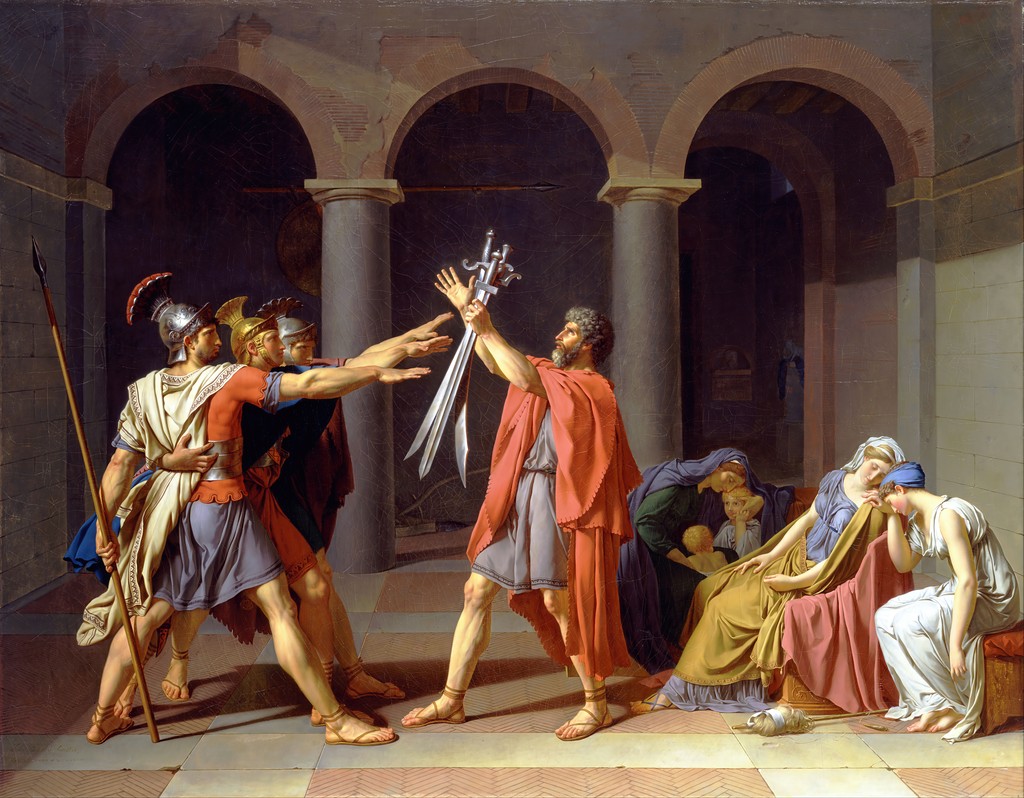
The Oath of the Horatii offers a more controlled example of print after David. The British Museum's record for Antoine Alexandre Morel's engraving, Serment des Horaces, identifies it as an engraving after David, published in Paris between 1802 and 1810. The same record notes that the contract between David and Morel was signed in 1802, that the print was finally published in 1810, and that surviving states show David making repeated changes to proofs. [3]
That is a crucial point. Reproductive printmaking was not always a loose afterlife beyond the artist's reach. In this case David's attention extended into the proof process. The print after the painting became another stage in the management of the composition's public form. [3]
The Oath of the Horatii had already become one of David's defining images of antique duty and civic sacrifice. A reproductive engraving could carry that image beyond viewers who saw the Louvre painting or knew the Salon reputation. It could also freeze the composition in another public format: the brothers swearing before their father, the swords at the centre, the women collapsed in grief, and the architecture clarifying the moral divide. [3]
The Museum's record also notes Napoleon I's coat of arms in the lower margin of the print. That detail is worth handling cautiously, but it signals how a pre-Revolutionary royal-commissioned painting could be reframed in the Napoleonic period. Prints do not simply repeat paintings; they can add dates, margins, coats of arms, inscriptions, publishers and formats that belong to their own historical moment. [3]
Napoleon in Reproduction
Napoleonic imagery depended heavily on circulation. David's paintings helped shape the visual language of the Consulate and Empire, but paintings alone could not do all of that work. Prints after David's Napoleon images helped extend the ruler's image into Britain, France and later historical collections. [1] [4] [5]
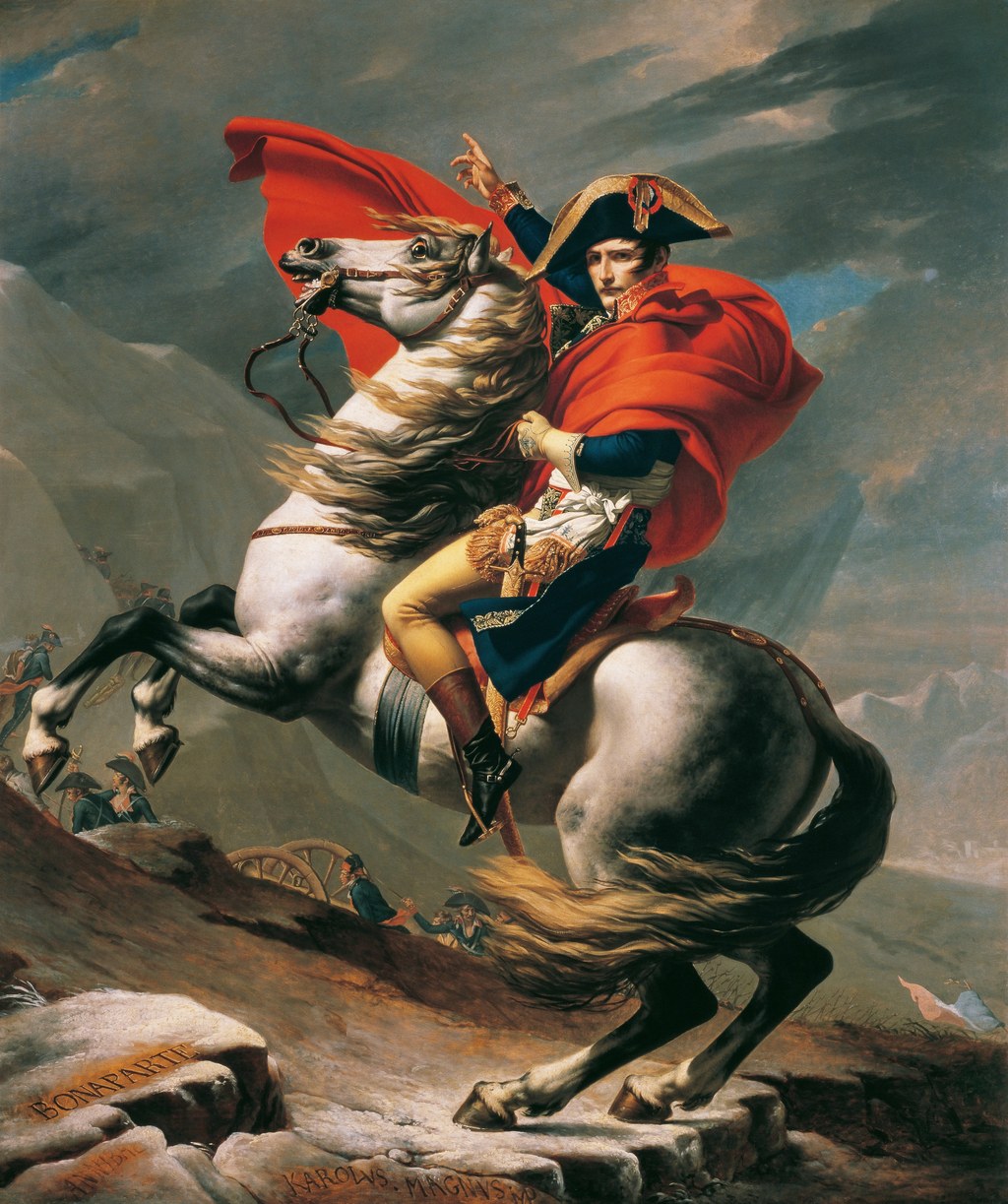
The British Museum records prints after Napoleon Crossing the Alps at the St Bernard Pass. One lithograph in the collection shows Napoleon on a rearing horse, facing left and pointing, with mountains behind him. Another British Museum record, Bonaparte Crossing the Alps from the Specimens of Art series, identifies a mixed-method mezzotint by William Nicholas after David, published by John McCormick in London in the 1830s. Its record explicitly notes the problem of versions, saying the print appears to reproduce one of the known painted versions. [1] [4] [5]
That version sensitivity is important. David painted more than one Napoleon Crossing the Alps, and prints after the image may not always correspond neatly to a single canvas. A responsible prints section should avoid treating every reproduction as if it copied one generic original. The print record can sometimes tell us which version may be involved; where it does not, the safer language is after David's composition or after the Napoleon Crossing the Alps image. [1] [4] [5]
The same caution applies to imperial ceremony. The British Museum's David authority route lists Sacre de Napoleon among prints after David, while the painting page for the Coronation of Napoleon carries the object-specific route for the Louvre canvas. A print after the Coronation can help show how imperial spectacle circulated, but the print's maker, date, format and source must be checked before it is used as evidence for details in the painting. [1] [4] [5]
Prints also make David's Napoleonic images easier to compare with wider visual culture. A painted ruler on horseback, an imperial ceremony, a portrait of administrative power and a historical scene all become portable through reproduction. That portability helped David's images outlive their immediate political setting. [1] [4] [5]
Prints, Drawings and Paintings Compared
The Drawings page follows David's working process: studies, transfer methods, compositional changes and the movement from paper to painting. The Paintings page follows the finished canvases and their major themes. Prints sit on the other side of the painting. They show what happens after a composition becomes public enough to be copied and circulated. [1]
That sequence can be useful. A drawing may show a figure before the final decision. A painting fixes the composition at scale. A print can translate the fixed image into another technology and another audience. With David, all three stages matter because his art depends on public legibility. His best-known images are already designed to be memorable: severe outlines, clear gestures, strong silhouettes and concentrated moral scenes. Those qualities made them unusually available to reproductive culture. [1]
Prints also introduce intermediaries. An engraver, lithographer, draughtsman, publisher or book editor can stand between David and the viewer. The British Museum records often name those roles: a print made by one person, after David, published by another, sometimes with an intermediary draughtsman. That chain is not noise. It is the history of how the image moved. [1]
This is why a prints hub should resist ranking prints as lesser versions of paintings. Some are modest reproductions. Some are documentary evidence for how David's reputation travelled. Some reveal political reuse. Some preserve a composition linked to a project that was never completed as intended. Their value often lies in circulation, not originality. [1]
How to Use the Prints Records
The best way to read David prints is to begin with the museum record before drawing conclusions from the image alone. Object type, title, maker, after-attribution, date, publisher, medium, dimensions and associated events all matter. A small wood-engraving after Marat does not carry the same authority as David's painted original. An engraving after Horatii with a named contract and proof history tells a different story from a later book illustration. A Napoleon print may require version caution before it is linked to a particular painted canvas. [1] [2] [3] [4] [5] [6] [7] [8]
For research, the strongest routes are institutional. The British Museum's David authority page gathers a large set of related objects across prints, drawings and later after-David material. BnF catalogue and Gallica records are essential for French Revolution prints, especially where digital consultation routes exist. Louvre and other museum collection records remain necessary for the original paintings and drawings that the prints reproduce or reinterpret. [1] [2] [3] [4] [5] [6] [7] [8]
Readers who want the clearest path through David's print afterlife should start with Marat, Horatii, Napoleon Crossing the Alps, the Coronation and the Tennis Court Oath. These subjects show the range: martyr image, antique civic model, heroic ruler, imperial ceremony and unfinished revolutionary monument. Each print route asks the same question in a different way: what happens when David's visual authority leaves the canvas and enters public circulation? [1] [2] [3] [4] [5] [6] [7] [8]
The answer is one reason David remained powerful after his political world changed. Prints carried his images into new decades, new countries and new forms of historical memory. They did not make David's reputation by themselves, but they helped keep it visible. [1] [2] [3] [4] [5] [6] [7] [8]
Frequently Asked Questions
Discussion
Prints after David show what happened when a composition left the canvas and entered public circulation.
Use the prompts below to think about reproduction, version caution and the way political images travel.
Reader Insights
What changes when a large David painting becomes a smaller engraving, lithograph or book illustration?
Which details belong to David's original composition, and which belong to the printmaker, publisher or later historical setting?
Does reproduction make David's images more stable, or does it make their meaning more changeable?
Join the Conversation
Share your reading of Jacques-Louis David's prints and reproductive afterlife below.
References
- The British Museum, Jacques Louis David collection biography BIOG24584, accessed 26 July 2026.
- The British Museum, Marat dans sa baignoire, d'apres David, 1898,0527.193, accessed 26 July 2026.
- The British Museum, Serment des Horaces, 1950,1111.66, accessed 26 July 2026.
- The British Museum, Napoleon crossing the Alps, 1850,0211.152, accessed 26 July 2026.
- The British Museum, Bonaparte Crossing the Alps, 2010,7081.4650, accessed 26 July 2026.
- The British Museum, Serment du Jeu de Paume le 20 juin 1789, 1874,1114.577, accessed 26 July 2026.
- BnF Catalogue general, Serment du Jeu de Paume, Jazet after David, accessed 26 July 2026.
- BnF Catalogue general, Le Serment du Jeu de Paume, Denon after Jacques-Louis David, accessed 26 July 2026.