 Buy Art Prints Now
from Amazon
* As an Amazon Associate I earn from qualifying purchases.
 by Tom Gurney
Tom Gurney BSc (Hons) is an art history expert with over 20 years experience
Published on June 19, 2020 / Updated on October 16, 2026
Email: tomgurney1@gmail.com / Phone: +44 7429 011000
Christ on the Cross: Introduction
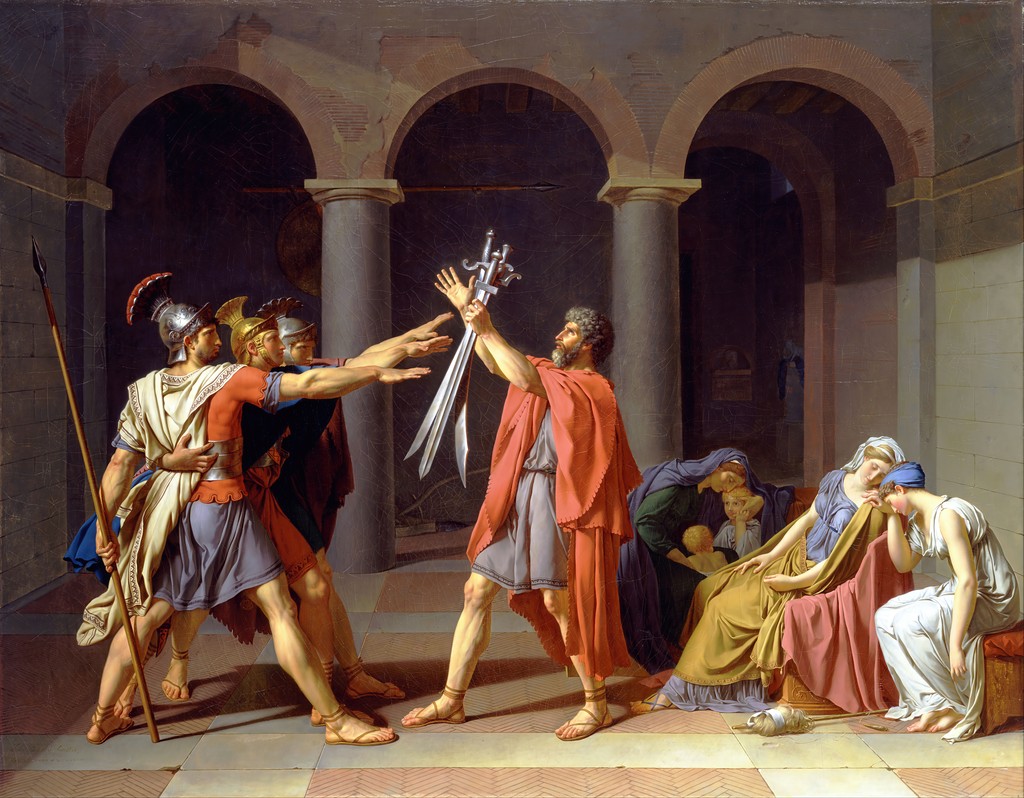
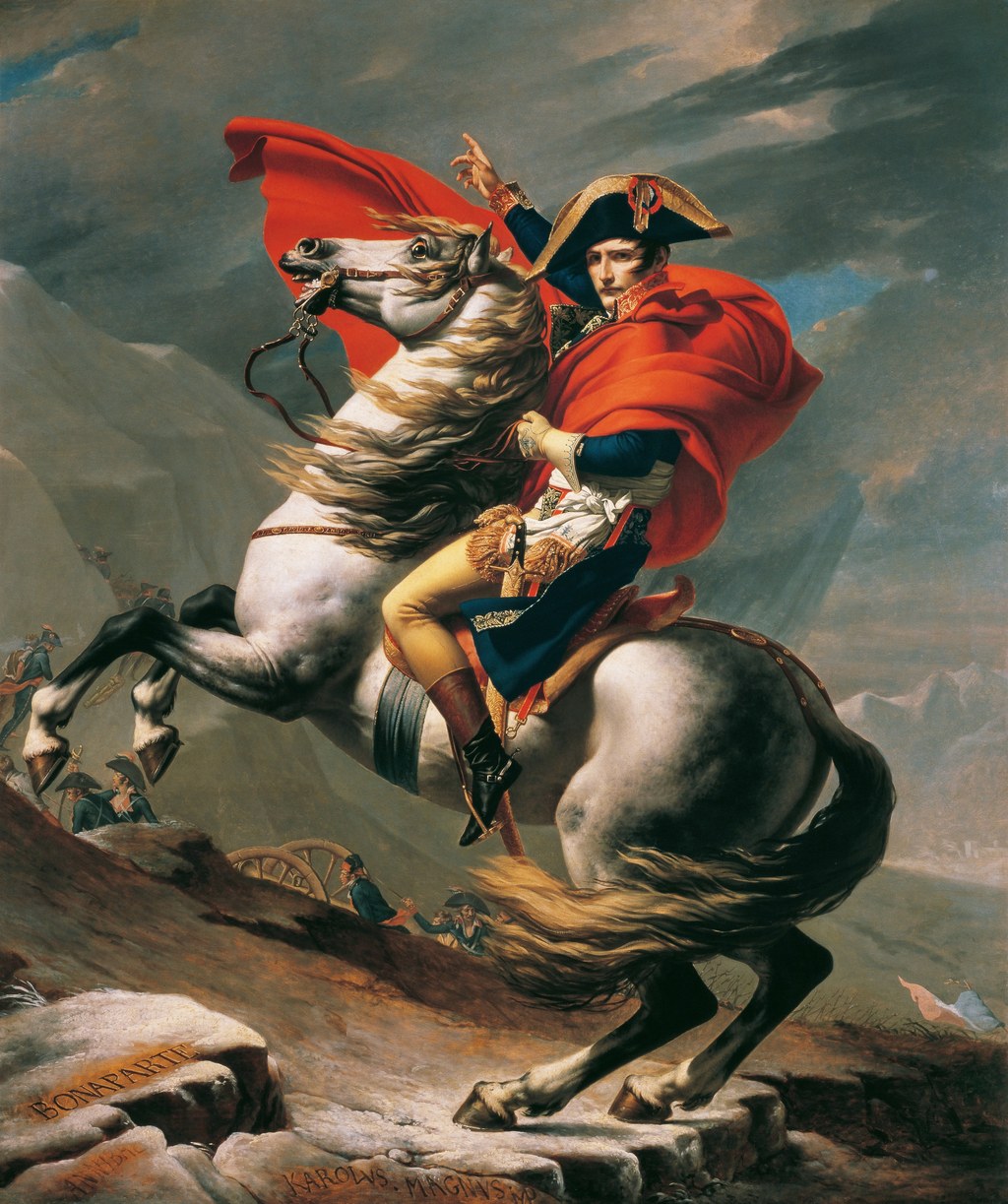
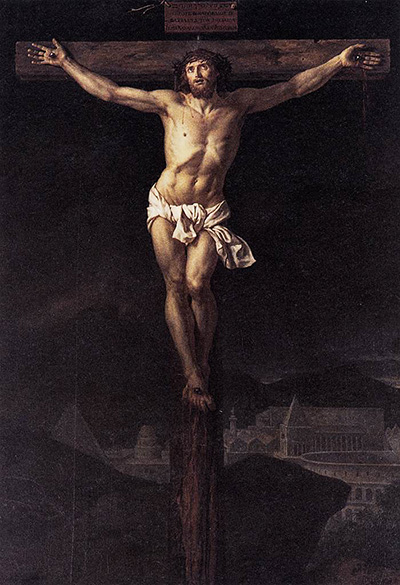
Christ on the Cross is one of Jacques-Louis David's relatively uncommon religious paintings. It was completed in 1782, between his early academic formation and the famous Neoclassical history paintings that would make his reputation in the following decade. The work is not a central David flagship in the way that The Oath of the Horatii, The Death of Socrates or The Death of Marat are, but it helps explain the range of commissions and subjects open to an ambitious French painter before the Revolution. [1] [4]
The strongest object record is now the Louvre collection entry for Le Christ en croix. The Louvre lists the painting under inventory number INV 20997, attributes it to Jacques-Louis David, dates it to 1782 and gives the medium as oil on canvas. The record states that it belongs to the Louvre Department of Paintings and is on long-term loan to the city of Mâcon, with its current location at the Cathedral of Saint-Vincent in Mâcon. The Louvre gives dimensions of 2.72 m high by 1.6 m wide. [1] [4]
Some secondary image records give different measurements, including 276 by 188 cm, so dimensions should be handled carefully. For this page, the Louvre record is the safest factual anchor. It also gives the work a clearer history than the older legacy page suggested. [1] [4]
At a Glance
- ArtistJacques-Louis David [1]
- Louvre TitleLe Christ en croix [1]
- Date1782 [1]
- MediumOil on canvas [1]
- Dimensions2.72 m by 1.6 m [1]
- CollectionLouvre Department of Paintings [1]
- InventoryINV 20997 [1]
- Current LocationCathedral of Saint-Vincent, Macon [1]
- Loan StatusLong-term loan to the city of Macon [1]
- CommissionCommissioned around 1781 by Louis de Noailles and Catherine de Cosse-Brissac [1]
- SalonExhibited at the Salon of 1783 [1]
- Source CautionUse Louvre dimensions as primary; secondary image records differ [1] [2]
- Image ReferenceLouvre and Commons records provide the safest image-credit check for this subject [1] [2]
Contents
- Introduction
- Commission and Early History
- Looking at the Painting
- Religious Painting in David's Career
- Why It Matters
Commission and Early History
According to the Louvre, the painting was commissioned around 1781 by Louis de Noailles, marshal of France, and his wife Catherine de Cossé-Brissac. David completed it in 1782, and it was exhibited at the Salon of 1783 in Paris. It was then installed in the Noailles family chapel in the church of the Capucines near the place Louis-le-Grand, now the place Vendôme. [1]
The later history is unusually instructive. The work was moved to the Noailles town house on the rue Saint-Honoré before April 1794. It was then confiscated during the Revolution and entered the national collections. The Louvre traces its movement through the dépôt de Nesle, the Muséum central des arts, Versailles, Louvre storage, and finally Mâcon, where it was sent in the early nineteenth century and later associated with Saint-Vincent. [1]
That history changes how the painting should be read. This is not simply a generic devotional image. It began as a private aristocratic religious commission, passed through Revolutionary confiscation and became part of the French museum and church-deposit system. The subject is sacred, but the object's life is tied to the political and institutional upheavals that would also reshape David's own career. [1]
Looking at the Painting
David presents Christ alone on the cross, isolated against a darkened field. The body is strongly lit, while the surrounding space recedes. The effect is solemn and concentrated. Instead of filling the scene with mourners, soldiers, Mary, John or narrative bystanders, David focuses on the crucified figure itself. [1] [2]
That restraint matters. The painting is not built around a busy Gospel episode. It is built around the body, the cross and the drama of light. Christ's torso, arms and bowed head carry the emotional weight. The surrounding darkness directs attention back to the exposed figure, making the work feel more like an object for contemplation than a crowded history scene. [1] [2]
At the same time, the painting is not detached from David's broader training. The body is anatomically emphatic, and the lighting gives the figure sculptural clarity. David had studied in Rome and absorbed the seriousness expected of large religious painting. Christ on the Cross shows him applying that discipline to a Christian subject before his mature public language turned most famously toward Roman virtue, Revolutionary martyrdom and Napoleonic ceremony. [1] [2]
Religious Painting in David's Career
David is usually remembered as the painter of antiquity, Revolution and Empire, but religious commissions were part of the world in which eighteenth-century French artists worked. Christ on the Cross belongs near St. Roch Interceding for the Plague-Stricken as evidence that David could still receive and execute church-related commissions before his career became dominated by civic and political subjects. [1] [4]
The painting also sits close in date to Andromache Mourning Hector and Belisarius Begging for Alms. Those works show David moving toward antique pathos and moral history. Christ on the Cross shows a related seriousness in a sacred register. The subject is different, but the artistic problem is similar: how to make suffering visible without letting the image collapse into mere sentiment. [1] [4]
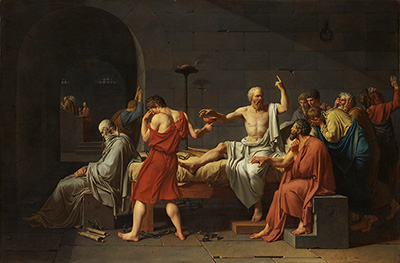
The comparison with The Death of Socrates should stay measured. Socrates turns chosen death into philosophical example. Christ on the Cross presents a theological subject rooted in Christian devotion. The two works share an interest in the meaningful body at the point of death, but they belong to different traditions and should not be made interchangeable. [1] [4]
Why It Matters
Christ on the Cross is a useful support page because it broadens David beyond the familiar sequence of Roman heroes, Revolution and Napoleon. It shows a painter still working within the expectations of late eighteenth-century French religious patronage, while also developing the clarity and bodily force that would matter in his later art. [1]
The painting's provenance also makes it a small lesson in history. A work commissioned for an aristocratic chapel entered state control through Revolutionary confiscation, passed through museum administration and ended up on long-term loan in Mâcon. Few David pages make that institutional movement so visible. [1]
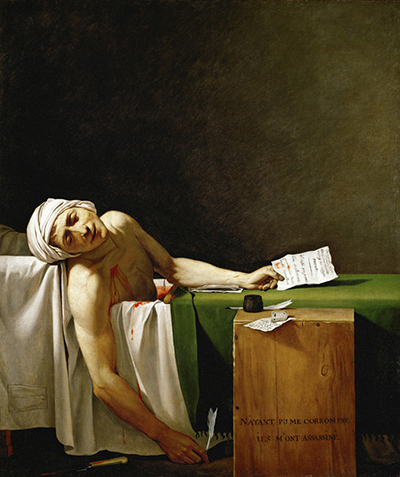
For David's wider career, see the Jacques-Louis David biography and the David paintings hub. For nearby early works, continue to Belisarius Begging for Alms, Andromache Mourning Hector, The Death of Seneca and Diana and Apollo Killing Niobe's Children. For later death and sacrifice subjects, compare The Death of Socrates and The Death of Marat. [1]
Frequently Asked Questions
Discussion
Christ on the Cross asks readers to consider a relatively uncommon religious subject within David's early career.
Use the prompts below to think about the solitary crucified body, the darkened space and the painting's movement from aristocratic chapel commission to public collection.
Reader Insights
How does the lit body of Christ change the emotional force of the surrounding darkness?
What changes when David removes most narrative bystanders and leaves the crucified figure alone?
How does the painting's path from Noailles chapel to Revolutionary confiscation and Macon change the way you read it?
Join the Conversation
Share your reading of Christ on the Cross below.
References
- Louvre Collections, Le Christ en croix, accessed 27 July 2026.
- Wikimedia Commons, File: Jacques-Louis David - Le Christ en croix, 1782.jpg, accessed 27 July 2026.
- Wikimedia Commons, Category: Le Christ en croix by Jacques-Louis David, accessed 27 July 2026.
- Encyclopedia.com, Jacques-Louis David, accessed 27 July 2026.