Buy Art Prints Now
from Amazon
* As an Amazon Associate I earn from qualifying purchases.
 by Tom Gurney
Tom Gurney BSc (Hons) is an art history expert with over 20 years experience
Published on June 19, 2020 / Updated on October 16, 2026
Email: tomgurney1@gmail.com / Phone: +44 7429 011000
The Coronation of Napoleon: Introduction
Jacques-Louis David's The Coronation of Napoleon is one of the great official images of modern political theatre. It records a real ceremony held at Notre-Dame de Paris on 2 December 1804, but it does not simply report what happened there. It reorganizes the event into a monumental image of dynastic legitimacy, imperial power, religious witness and carefully managed public memory. [1] [2] [4]
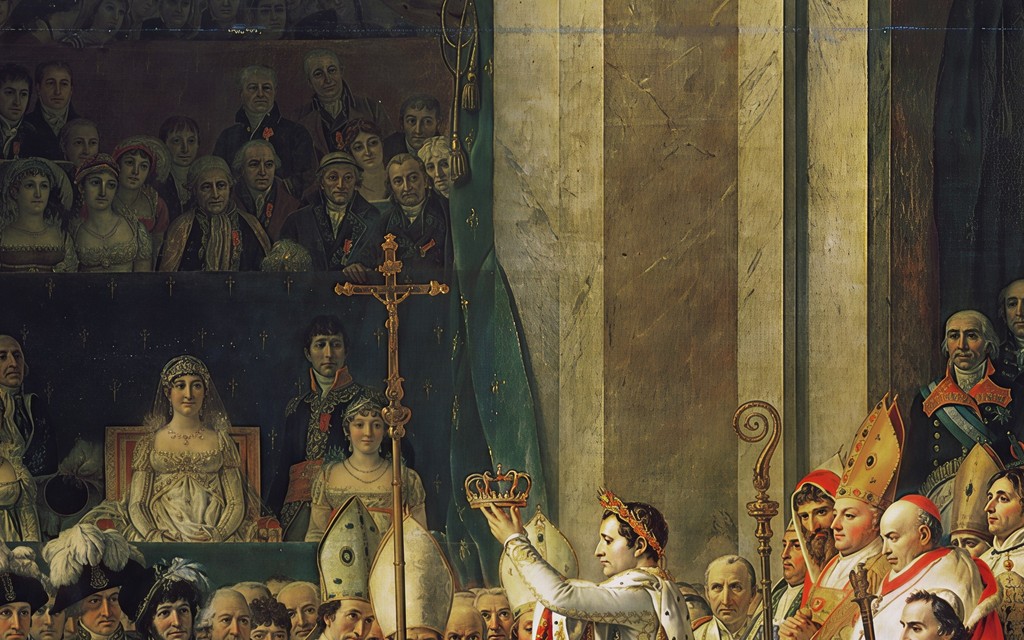
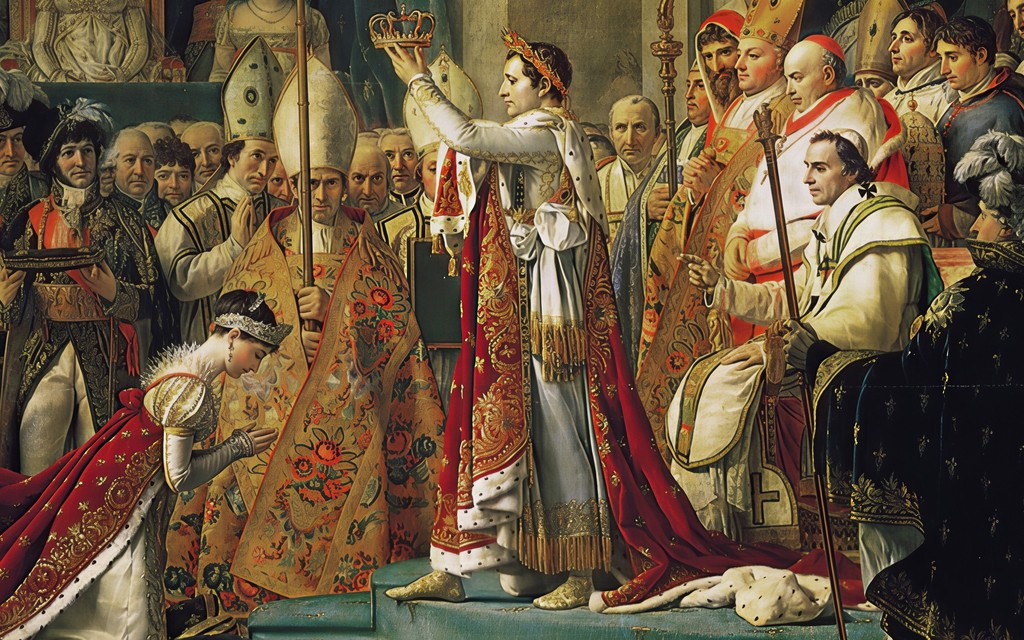
The painting's full Louvre title is much more precise than the familiar English shorthand. It identifies the subject as the coronation of Emperor Napoleon I and Empress Josephine in the cathedral of Notre-Dame, on 2 December 1804. The title matters because the scene shows not Napoleon being anointed or crowned by the pope, but Napoleon about to crown Josephine. He has already placed the imperial crown on his own head. David chooses the next instant, when the emperor raises another crown above his kneeling wife. [1] [2] [4]
That choice turns the ceremony into an image of controlled generosity. Napoleon dominates the composition, but the visible action is not his self-coronation. It is his crowning of Josephine. The pope is present, the altar is nearby, the cathedral setting is sacred and the assembled court fills the space, yet the decisive gesture belongs to Napoleon. David gives the emperor the centre of a religious ceremony while making him appear calm, dignified and beneficent. [1] [2] [4]
The result is not a neutral ceremony painting. It is official history made as spectacle. Napoleon wanted his new empire to look both new and ancient, constitutional and sacred, revolutionary and dynastic. David's canvas performs that difficult balancing act on an enormous scale. It asks viewers to see a soldier of the Revolution transformed into a legitimate emperor, surrounded by family, clergy, dignitaries, ambassadors and the machinery of state. [1] [2] [4]
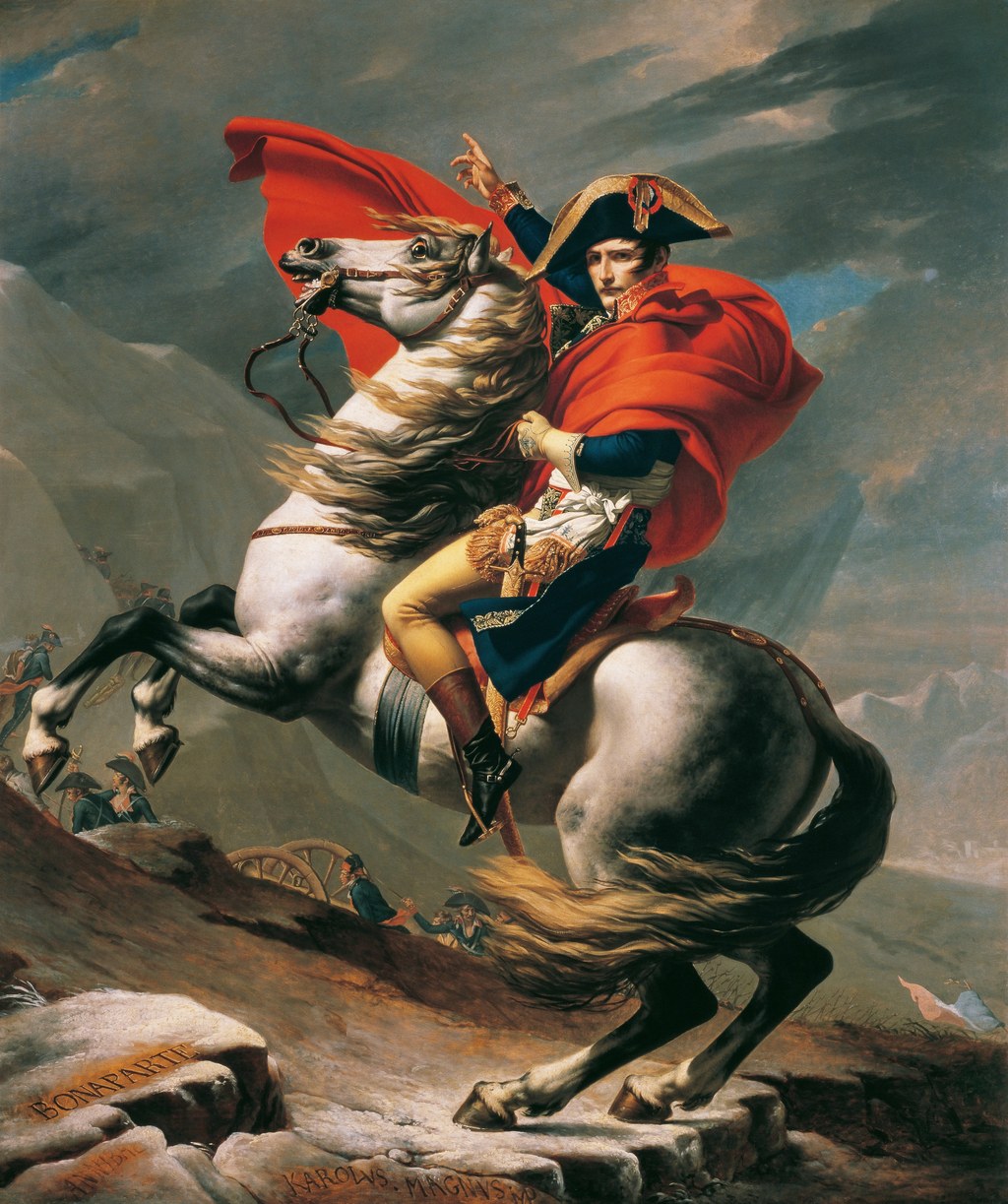
For David's career, the work marks the high point of his role as Napoleon's official image-maker. Earlier, he had made Bonaparte a heroic commander in Napoleon Crossing the Alps. Later, he would make the emperor a tireless administrator in Napoleon Bonaparte in His Study at the Tuileries. The Coronation sits between those images as a vast theatre of public legitimacy. It is not about speed or private labour. It is about the visual invention of an imperial order. [1] [2] [4]
At a Glance
- ArtistJacques-Louis David [1] [4]
- TitleLe Couronnement de l'empereur Napoleon Ier et de l'imperatrice Josephine dans la cathedrale Notre-Dame de Paris, le 2 decembre 1804 [1]
- Common English TitleThe Coronation of Napoleon [1] [2]
- Date1807 [1]
- MediumOil on canvas [1]
- Dimensions6.21 by 9.79 metres [1]
- CollectionMusee du Louvre, INV 3699 / MR 1437 [1]
- Scene CautionNapoleon is shown about to crown Josephine; the painting is official memory, not a neutral ceremony transcript [1] [2]
Contents
- Introduction
- Object Facts
- Notre-Dame Ceremony
- Commission and Studio
- Chosen Moment
- Pope Pius VII
- Collective Portrait
- Annotated Details
- Political Messaging
- Notre-Dame as Stage
- Display History
Object Facts and the Louvre Record
The Louvre records the painting under the French title Le Couronnement de l'empereur Napoleon Ier et de l'imperatrice Josephine dans la cathedrale Notre-Dame de Paris, le 2 decembre 1804. The work is also known as Le Sacre de l'empereur Napoleon Ier. It was made by Jacques-Louis David, with participation from Georges Rouget and Ignazio Eugenio Degotti, and is dated 1807. The inventory numbers are INV 3699 and MR 1437. [1]
The medium is oil on canvas. The dimensions are extraordinary: 6.21 metres high by 9.79 metres wide. The size is central to the painting's meaning. This is not a private cabinet picture, a portable imperial portrait or a small commemorative record. It is a life-size history painting with a crowd of figures, designed to surround the viewer with the authority of the event. [1]
The Louvre record notes that the canvas is currently visible in Salle 702, Salle Daru, in the Denon wing. Its present museum setting helps modern viewers study the painting as both a masterpiece and a document of Napoleonic image-making. The canvas is enormous, polished and seductive, but it is also a historical argument. Its details can be admired while its political purpose remains visible. [1]
The picture is sometimes called The Consecration or The Sacre of Napoleon, but the Louvre's own commentary makes a useful distinction. The painting does not show the religious anointing itself. It shows the coronation moment, after Napoleon has crowned himself and as he is about to crown Josephine. This difference is more than technical. It shifts attention away from priestly consecration and toward Napoleon's own agency. [1]
The composition contains more than two hundred life-size figures according to the 1808 descriptive account preserved in the Louvre record. The modern Louvre commentary gives a more precise working figure of about 190 total figures, including 93 identified portraits. Those numbers explain why a careful reading has to be selective. The painting is a collective portrait of empire, but its central meaning depends on hierarchy, arrangement and action rather than on identifying every face. [1]
Annotated Details from The Coronation of Napoleon
This annotated view breaks David's vast ceremony painting into readable details of ritual, hierarchy, costume and imperial theatre.
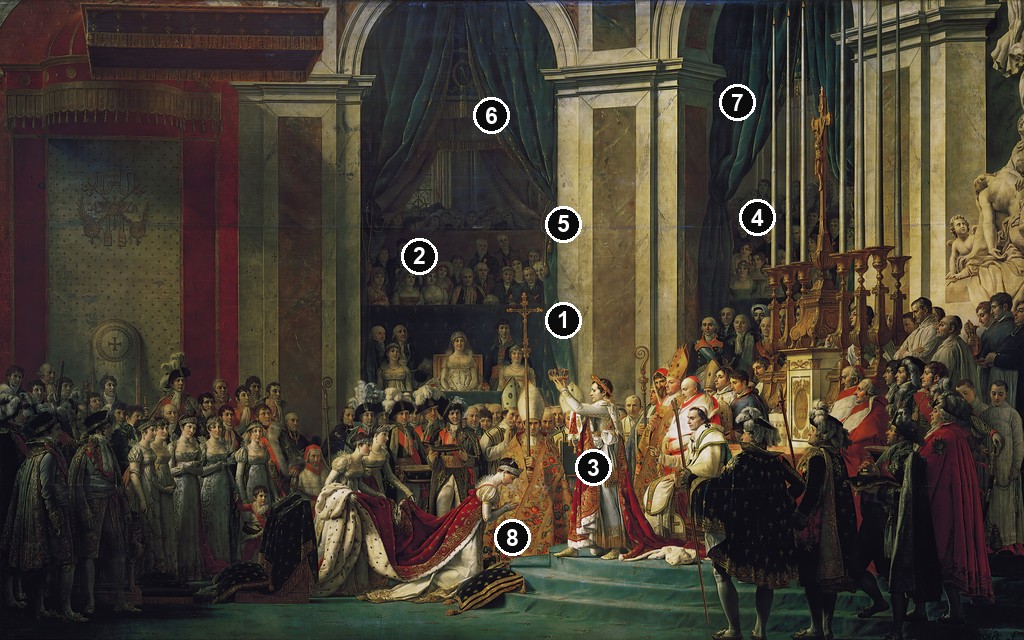
Details from THE CORONATION OF NAPOLEON
The details move from the central crowning action to the papal presence, Josephine's train and the architecture of spectatorship.
Central ceremony
The crowning action concentrates the ceremony's political and dynastic message.
Papal witness
The pope's seated presence complicates the balance between religious sanction and imperial self-fashioning.
Josephine's train
The train and attendant figures expand the central act into courtly spectacle.
Gathered court
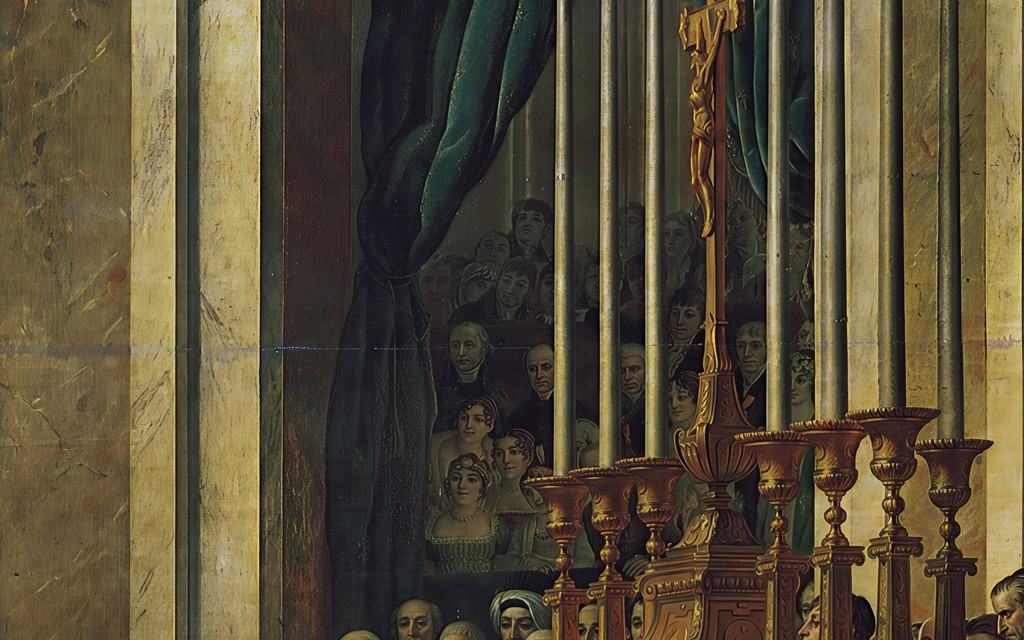
Rows of spectators make the event appear institutional, witnessed and historically fixed.
Raised crown
The small crown becomes the focus of a vast composition because every rank turns toward it.
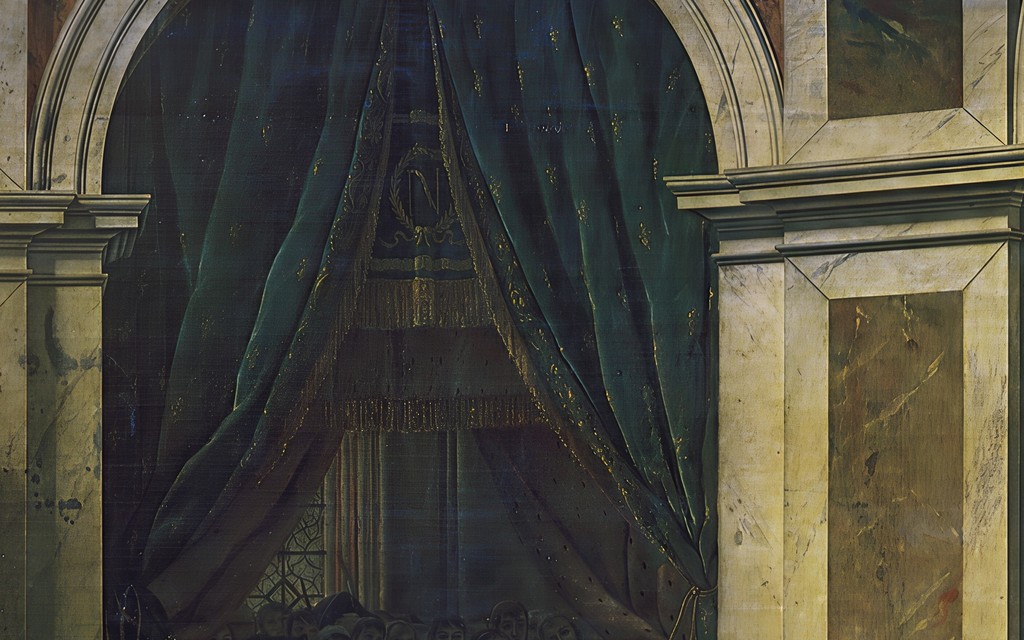
Notre-Dame setting
The high architectural frame turns the ceremony into a stage of historical continuity.
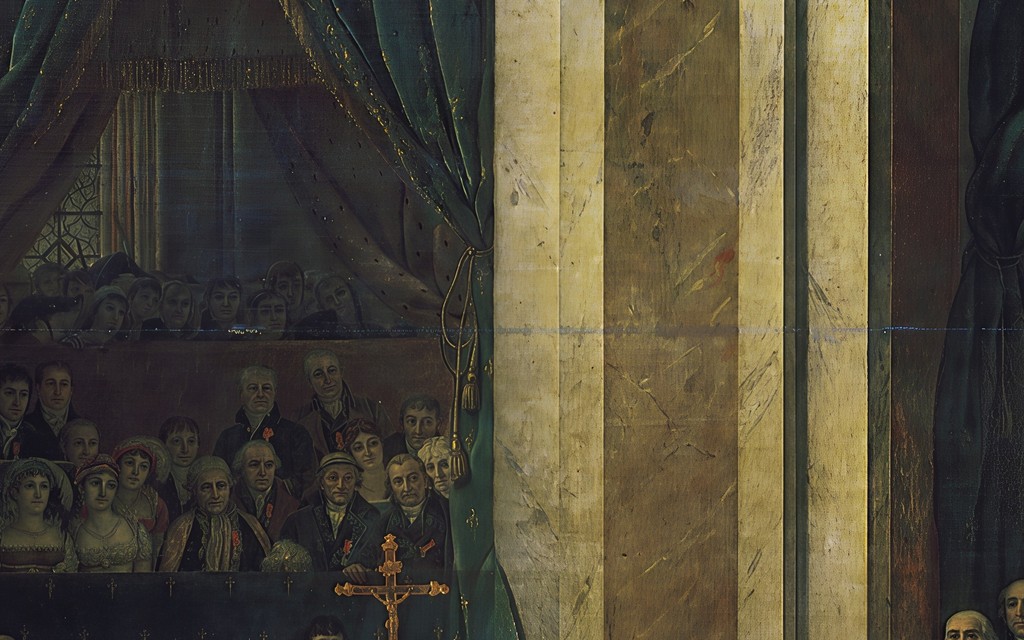
Imperial family gallery
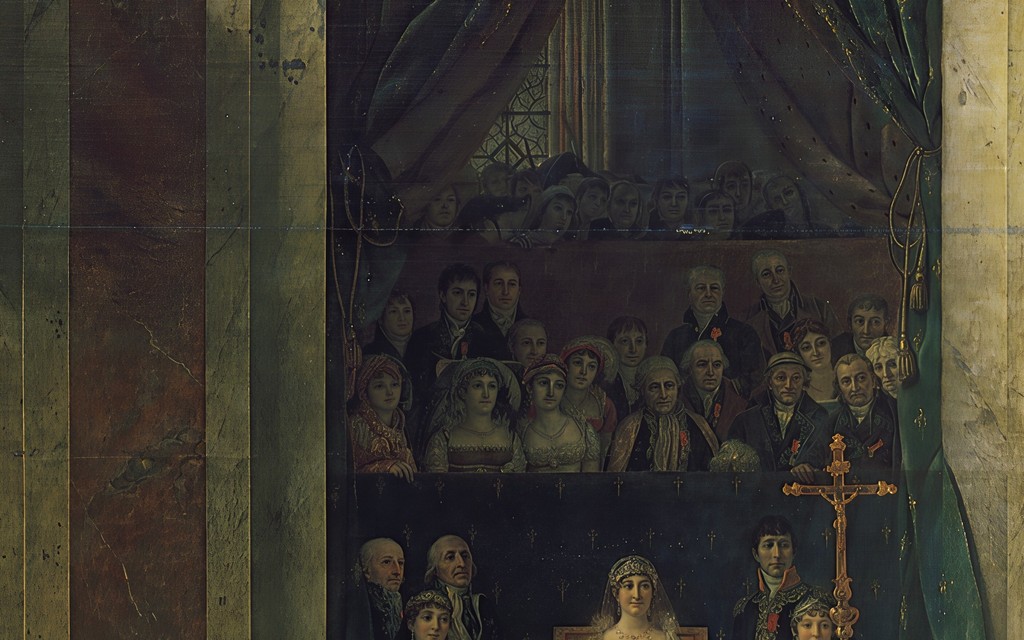
The gallery figures extend the family and court upward, making spectatorship part of the image.
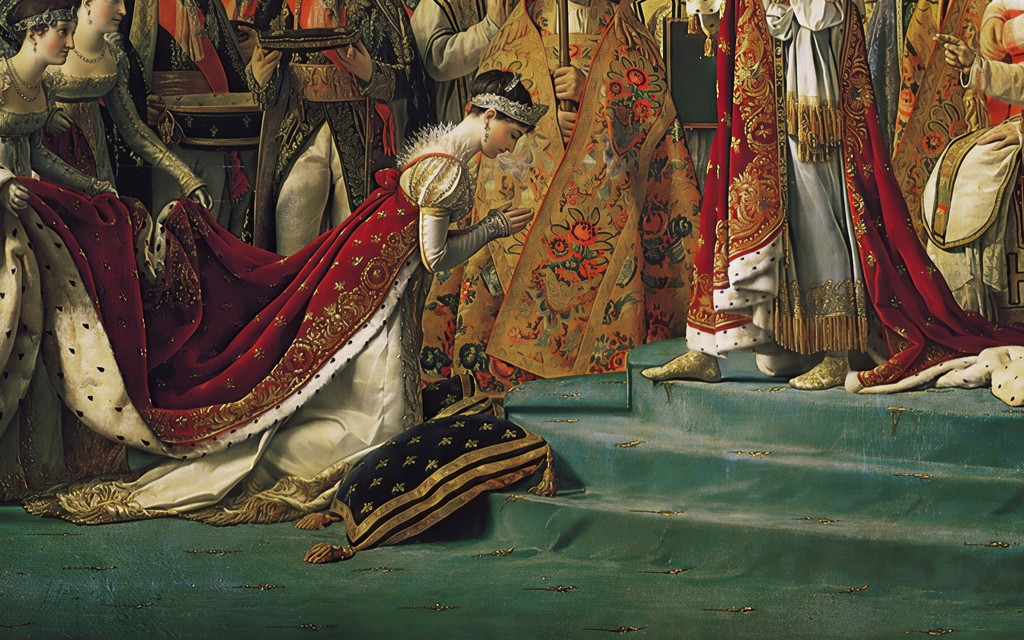
Ceremonial carpet
The patterned carpet and steps lead the eye into the ritual centre and stabilize the crowded scene.
The Ceremony at Notre-Dame
The ceremony took place in the choir of Notre-Dame de Paris on 2 December 1804. Napoleon had been proclaimed emperor earlier that year, after the law of 18 May 1804 entrusted the government of the French Republic to an emperor and made that imperial dignity hereditary in Napoleon Bonaparte. The coronation ceremony had to turn that political fact into public legitimacy. [1] [2]
The problem was delicate. Napoleon's regime emerged from the Revolution, but empire needed symbols older than the Revolution. The ceremony therefore joined several traditions. It drew on the imperial memory of Rome, the medieval coronations of Carolingian emperors, the sacral language of French kingship and the modern constitutional order. It was not simply a return to monarchy. It was a hybrid ritual built to suggest continuity, renewal and command at once. [1] [2]
Pope Pius VII's presence gave the event religious weight, but David's painting does not make the pope the source of power. He sits behind Napoleon, dressed in white and raising his hand in blessing. His presence matters, yet he is not the active crowning figure. Napoleon is. The painting therefore acknowledges religious sanction while visually subordinating it to imperial will. [1] [2]
This is why the chosen moment is so charged. If David had shown the anointing, the image would have emphasized sacred consecration. If he had shown Napoleon crowning himself, the image would have emphasized a more direct seizure of authority. By showing Napoleon crowning Josephine, David gives viewers a gesture that is theatrical, legible and emotionally warmer, while still keeping power in the emperor's hands. [1] [2]
The setting is also carefully managed. The ceremony occurred in the historic cathedral, but the choir of Notre-Dame was dressed for imperial ceremony with both permanent and temporary decoration. The Louvre notes that David did not reproduce every architectural detail exactly. He simplified, altered and arranged the space to serve the painting's order. The cathedral becomes a stage, not a neutral background. [1] [2]
Commission, Scale and Studio Process
Napoleon commissioned David before the coronation ceremonies, and the Louvre's detailed record places the commission in September 1804. It formed part of a larger group of four paintings intended to commemorate ceremonies connected with the imperial accession. The Coronation was completed; The Distribution of the Eagle Standards was also completed and is now at Versailles. Two further planned scenes, the enthronement and the arrival at the Hotel de Ville, were not executed. [1] [2]
The scale of The Coronation created practical problems as well as visual grandeur. David began painting on 21 December 1805 and worked until mid-November 1807, with retouches added in January 1808. The Louvre records that the work was made in an enormous studio installed in the disused chapel of the former College de Cluny, place de la Sorbonne in Paris. The artist needed a room large enough to hold the canvas and to let him step back from it. [1] [2]
David did not work entirely alone. The Louvre identifies Ignazio Eugenio Degotti as a participant responsible for architectural decor and perspective, and Georges Rouget as a painter who helped particularly with figures, costumes and accessories. That collaboration does not reduce David's authorship. It shows the scale of the enterprise. An image of imperial ceremony required an imperial mode of production: assistants, a special studio, models, props, records and negotiation with power. [1] [2]
The painting was expensive, but the price became part of its complicated history. David estimated the work at 100,000 francs, while the imperial administration ultimately paid 65,000 francs in instalments. The amount was large, yet it still fell below the artist's valuation. The negotiation reminds us that official art was not only ideology and beauty; it was also contract, labour, patronage and institutional bargaining. [1] [2]
The first public presentation came at the Musee Napoleon, the Louvre under Napoleon, in February 1808. It was later shown at the Salon of 1808 and again in 1810 for the Concours decennal. The public and critical reception was strong, although the Louvre sensibly cautions that imperial censorship shaped what could be said in public. Praise for the painting was real, but not politically neutral evidence. [1] [2]
The painting's first display also shows how unusual it was as a public event in its own right. A canvas of this scale, shown almost as a spectacle within the museum, invited viewers to relive a ceremony many had not witnessed directly. It made the coronation repeatable. The court had gathered once in Notre-Dame, but David's picture could gather future audiences before an idealized version of that gathering. In this sense, the work did not merely commemorate the ceremony. It extended the ceremony's political life. [1] [2]
That extension was limited by events. The empire changed quickly, and the image of Josephine at the centre of imperial continuity became awkward after Napoleon divorced her in 1809 and married Marie-Louise. The painting's slow and unsettled display history reflects that problem. A work meant to monumentalize power could become difficult to place when the dynasty it celebrated altered its own public story. [1] [2]
Napoleon, Josephine and the Chosen Moment
The central action is easy to read. Napoleon stands on the steps of the altar, dressed in white satin and a crimson velvet mantle decorated with gold bees. His arms are raised. He holds the crown that he is about to place on Josephine's head. Josephine kneels on a violet cushion, dressed in white, her mantle attended by ladies of honour. [1] [2]
This arrangement gives Josephine a privileged role without making her the source of authority. She receives the crown; Napoleon gives it. The gesture binds the imperial couple together in public, but it also states the direction of power. Josephine's kneeling body makes Napoleon's upright figure more commanding. Her visibility softens his authority while confirming it. [1] [2]
The Louvre commentary makes a key point about the political metaphor of Josephine's coronation. The act did not grant her independent governing powers or guarantee a regency. Instead, it symbolized a reconciliation of elements within French history: Old Regime nobility, Revolutionary trauma, Parisian public life, colonial origins and the blended family Napoleon had formed through marriage. David's image turns that symbolic reconciliation into a luminous central event. [1] [2]
There is another reason the moment mattered. David's first idea was to show Napoleon crowning himself. Preparatory studies and underlying changes in the canvas preserve that earlier conception. The Fondation Napoleon account of a major 1805 preparatory drawing explains that the self-crowning gesture was historically true but visually provocative. The final painting replaced it with the image of Napoleon crowning Josephine. [1] [2]
That change alters the emperor's character. In the earlier idea, Napoleon's power would have appeared more abrupt, almost defiant. In the finished painting, he becomes ceremonially generous. The gesture still asserts control, because he alone handles the crown. But the image asks the viewer to read that control as solemn, balanced and even tender. [1] [2]
David's revision also improves the composition. The final gesture creates a clear diagonal relationship between Napoleon's raised hands and Josephine's kneeling body. It gathers light, fabric and attention at the centre of the canvas. The whole court seems to turn toward this ceremonial exchange. Political adjustment and pictorial intelligence reinforce each other. [1] [2]
Pope Pius VII and Religious Authority
Pius VII sits behind Napoleon, visible in white against the ceremonial setting. His presence gives the scene its religious frame, but his role in the painting is deliberately limited. He blesses, witnesses and legitimates, yet he does not crown. The image gives the church a place within imperial theatre while keeping the decisive action in Napoleon's hands. [1] [2]
The pope's gesture itself has a history. The Fondation Napoleon account notes that David at one stage abandoned the blessing gesture, and that Napoleon later had him restore it. The Louvre record also notes that Napoleon asked David in January 1808 to raise the pope's right arm so that he made the gesture of blessing. That adjustment matters because it intensifies religious approval without transferring agency from Napoleon to the pope. [1] [2]
The relationship between Pius VII and Napoleon would become much more troubled in the years after the coronation. The painting does not show that conflict. It fixes a moment in which the papacy appears present, contained and useful to the empire. This is the nature of official history painting: it chooses the usable instant and leaves unstable consequences outside the frame. [1] [2]
David's Portrait of Pope Pius VII offers a quieter companion to this spectacle. In the portrait, the pope becomes a figure of stillness, character and diplomatic presence. In The Coronation, he is one role within a vast state ceremony. The contrast helps explain David's range as a Napoleonic painter. He could isolate a sitter's authority, or he could stage authority as a crowd, hierarchy and ritual. [1] [2]
The religious dimension should therefore be read with precision. The painting does not deny Catholic consecration, and it does not remove the pope. It absorbs religious authority into an imperial image. The altar, the cathedral, the vestments and the blessing all remain visible, but Napoleon controls the most memorable gesture. [1] [2]
The Court as a Collective Portrait
The Coronation is also a portrait of Napoleon's court. The Louvre states that David arranged the people present according to rank and function: clergy around the pope and altar, foreign ambassadors toward the background, imperial dignitaries and officers in the foreground and centre, the imperial family to the left, household officers behind them, and artists and intellectuals higher in the background. [1]
This hierarchy is one of the painting's main subjects. The figures are not randomly crowded around the ceremony. They form an ordered society. Each group has a place, costume and direction of attention. The new empire appears stable because everyone within it seems visually assigned to a role. [1]
The identified figures include major political and ceremonial actors, but a responsible public page does not need to name every person. The central named roles are enough for the main reading: Napoleon, Josephine, Pius VII, members of the imperial family, high dignitaries, clergy and court officials. The painting's bigger claim is that empire can gather France and Europe into a single theatrical order. [1]
Some absences and presences are politically revealing. Napoleon's mother, Laetitia Bonaparte, did not attend the ceremony, but she appears in the finished painting. The Louvre notes other figures who were shown despite being absent from the real event, including Cardinal Caprara and certain ambassadors. These are not mistakes in the ordinary sense. They are acts of official image-making. [1]
David also includes himself in a tribune, drawing, with members of his family and artistic circle. That self-placement is subtle but important. It turns the artist into both witness and maker of the event. David is inside the history he is constructing. His presence acknowledges artistic authority inside political theatre. [1]
The crowd is therefore more than decoration. It gives empire a body. Each figure, costume and grouping makes Napoleon's authority appear recognized. The image shows not only a ruler acting, but a society organized around that action. [1]
The lighting strengthens that political order. The Louvre commentary notes that light from the cathedral's high windows falls toward the centre of the painting, emphasizing the imperial couple and the pope. This is a painterly decision with political consequences. Light does not simply illuminate the scene; it ranks it. Napoleon, Josephine and Pius VII become the visual core from which the surrounding groups take their meaning. [1]
Costume works in the same way. White, crimson, gold, violet, ermine, plumes and ecclesiastical vestments create a surface of ceremony, but they also distinguish offices and loyalties. The painting is crowded, yet it does not dissolve into confusion because dress, posture and placement tell the viewer who belongs to which order. David makes the court readable as an institution. [1]
That readability is one reason the painting has remained so useful as a historical image, even when its political purpose is questioned. It offers a visual map of Napoleonic ceremony: family, clergy, military office, civil dignity, foreign diplomacy and artistic witness gathered around one act. The spectacle is immense, but the structure is firm. [1]
Changes, Omissions and Political Messaging
The Louvre commentary identifies two major kinds of departure from the actual ceremony. Some changes served political propaganda. Others served aesthetic clarity. The distinction is useful, but in the painting the two are intertwined. What makes the image beautiful also helps make the imperial message persuasive. [1] [2]
The inclusion of absent figures is the clearest political adjustment. Laetitia Bonaparte's presence in the gallery gives the imperial family an appearance of unity that the real ceremony did not fully possess. The presence of absent religious and diplomatic figures expands the event's apparent approval. David paints the ceremony as it needed to look for posterity, not only as it unfolded. [1] [2]
The rearrangement of people around the choir also changes the event. The Louvre explains that, in the actual ceremony, figures were disposed more broadly around Napoleon. David clears the foreground and masses the groups to the sides and background, allowing the imperial couple and the pope to dominate the lighted centre. The result is easier to read and more powerful as an image. [1] [2]
The most consequential change remains the replacement of Napoleon's self-crowning with the crowning of Josephine. This adjustment does not erase Napoleon's self-created authority. It disguises it in a more graceful form. The emperor still holds the crown, controls the action and stands above the kneeling figure. Yet the viewer encounters a scene of conferment rather than a more naked image of self-assertion. [1] [2]
The painting also contains a strange classical echo. The Louvre notes the presence, just to the right of Napoleon, of a priestly face inspired by a bust reputed to represent Julius Caesar. This discreet imagined presence creates a flattering comparison between Napoleon and ancient Roman power, while also carrying a darker warning about autocracy and monarchy. David's painting can sustain both meanings because it is so carefully layered. [1] [2]
The political message is therefore not a simple lie. It is a selection and ordering of truth. The ceremony happened. Napoleon did crown Josephine. The pope was there. The court was present. But the image edits the ceremony into a coherent myth of legitimacy, family, religion and state. [1] [2]
Notre-Dame as Stage
The cathedral setting gives the painting historical depth, but it is a reworked Notre-Dame. The choir's medieval Gothic architecture was partly concealed at the time by eighteenth-century decor. Temporary decorations designed for the coronation by Charles Percier and Pierre Fontaine were also present. David evokes this environment while simplifying and changing it. [1]
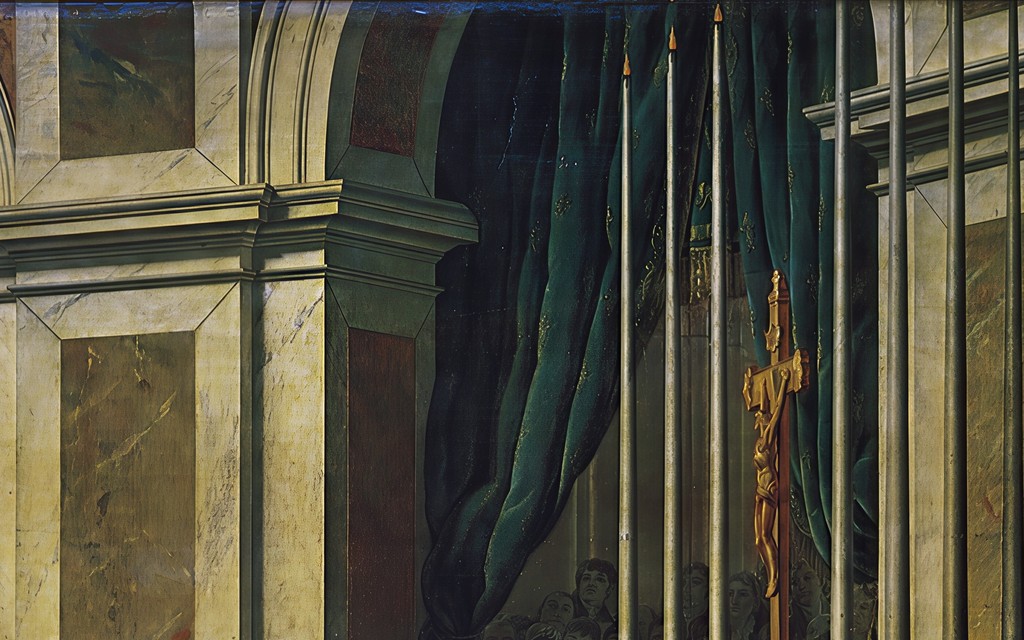
Those changes help the viewer understand the scene quickly. The vast interior could easily have swallowed the figures or scattered attention. Instead, David uses architecture as a frame. Columns, draperies, platforms, steps and curtains create an ordered ceremonial machine. The space leads the eye toward Napoleon and Josephine. [1]
The Louvre identifies specific adjustments, including changes to carpet patterns, spectator tribunes, coloured hangings and the papal throne arrangement. Such details matter because they show David's refusal to be trapped by literal accuracy. He had witnessed the ceremony and knew the space, but he shaped memory into composition. [1]
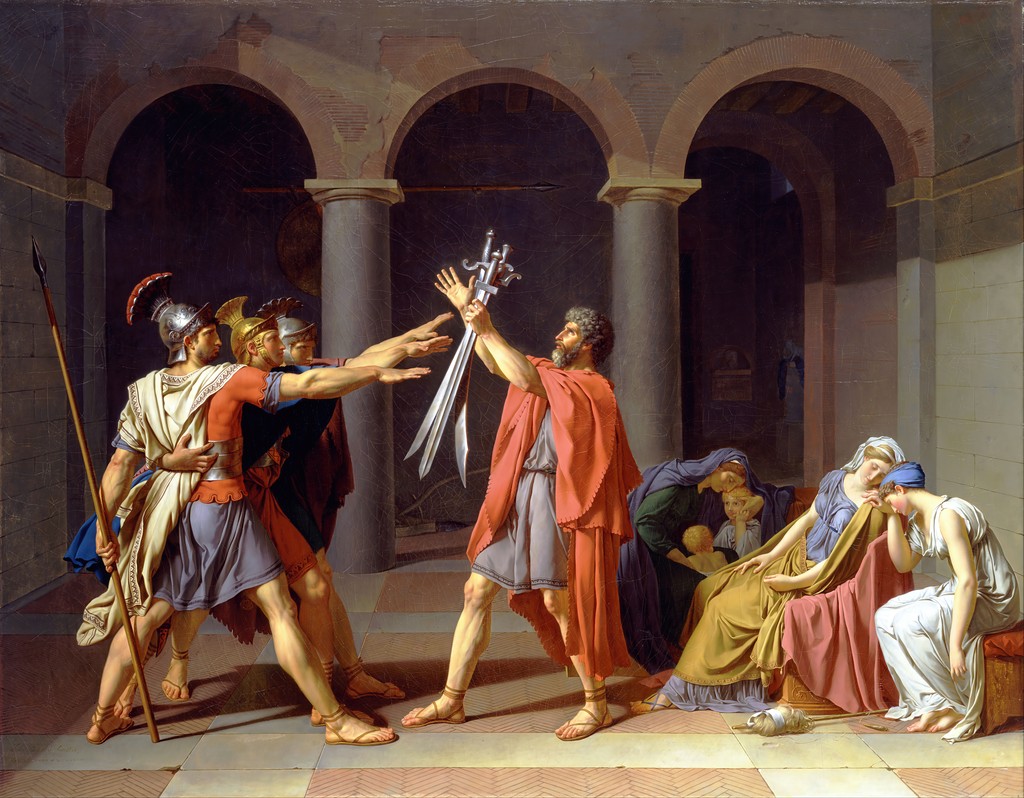
This is not unusual for history painting. David had built his reputation by turning stories into legible moral architecture, from The Oath of the Horatii to The Death of Socrates. In The Coronation, the subject is no longer ancient Rome or classical Athens. It is modern France, but the method remains classical in its drive for clarity, hierarchy and decisive gesture. [1]
The cathedral also lets Napoleon borrow from older French and European ceremony. He is not shown in a modern government chamber or a military camp. He is shown in sacred historical space, surrounded by signs of continuity. David's Notre-Dame becomes a place where revolutionary political power can dress itself in the memory of monarchy without admitting simple restoration. [1]
From Louvre to Versailles and Back
The painting's display history is part of its meaning. After its first presentations at the Louvre under the Empire, the work spent periods back in David's studio and did not quickly find a permanent palace destination. One possible placement in the Tuileries was considered, but not carried out. Napoleon's divorce from Josephine in December 1809 made the image politically awkward for a court now reorganized around Marie-Louise. [1] [3]
Under the Restoration, the canvas was not publicly visible, although it remained part of the Crown collections. In the 1830s, Louis-Philippe's historical galleries at Versailles created a new use for Napoleonic memory. The Louvre record states that the painting was installed in the Salle du Sacre at Versailles in connection with those galleries, remaining there from 1837 to 1889 before returning to the Louvre. [1] [3]
Versailles still preserves the memory of that installation. Its Salle du Sacre became, in 1833, a room dedicated to the glory of Napoleon Bonaparte, and it was designed to hold the greatest images of his reign. The original Louvre painting left Versailles for Paris in 1889. Today the room contains a second full-size version, painted by David in Paris and Brussels between 1808 and 1822, commissioned by a group of American businessmen, later acquired by Versailles in 1947. [1] [3]
This version history is important because viewers often encounter images of The Coronation without knowing which canvas is being discussed. A careful account needs to remain centered on the Louvre original, INV 3699/MR 1437. The Versailles canvas is not the Louvre painting moved back to Versailles. It is a second version that now helps reconstruct the Salle du Sacre's historical Napoleonic programme. [1] [3]
The history of display also changes the painting's politics. Under Napoleon, the work commemorated a current regime. Under the Restoration, it was sensitive enough to be withheld. Under Louis-Philippe, it became part of a broader national museum of French glories. At the Louvre, it is now studied as one of the central images of David's career and of European political art. [1] [3]
David as First Painter of the Emperor
David held the title of First Painter of the Emperor, and The Coronation shows what that role demanded. He had to be more than a portraitist and more than a decorator. He had to transform a political ceremony into an enduring public image, compressing real people, contested legitimacy, religious symbolism and dynastic ambition into a single composition. [1] [4]
This work belongs with the other Napoleonic pages in the David cluster. The Distribution of the Eagle Standards treats military loyalty as ceremony. Napoleon Crossing the Alps treats leadership as heroic movement. Napoleon in His Study treats rule as sleepless labour. The Coronation treats empire as public consecration and collective recognition. [1] [4]
The Getty's Empire to Exile exhibition frame is useful here because it emphasizes David's late career as both image-maker to Napoleon and political exile. The Coronation belongs to the height of that official career, when David's art was enlisted to stabilize imperial identity. But the later arc of exile reminds us that these images were tied to regimes that could rise, fall and be reinterpreted. [1] [4]
David's earlier Revolutionary art makes the painting even more complex. The artist who painted The Death of Marat as a martyr image for republican politics later painted Napoleon's court as a disciplined imperial society. That shift should not be flattened into betrayal or opportunism alone. It shows David's extraordinary ability to give visual form to successive political orders, each with its own rituals, heroes and claims on history. [1] [4]
The Coronation is therefore both a triumph and a warning. It proves David's mastery of large-scale composition, portraiture, ceremony and political symbolism. It also reveals how art can make power look inevitable by making it beautiful, ordered and memorable. [1] [4]
How to Look at the Painting
Begin with the centre. Napoleon's raised arms and Josephine's kneeling body form the emotional and political hinge of the image. Everything else is arranged around that exchange. The crown is small compared with the canvas, but the whole painting turns on it. [1] [2]
Then look at the pope. Pius VII is close to the centre, but he is not the centre. His blessing is visible, and his presence is indispensable to the ritual's sacred aura, yet David has made him secondary to Napoleon's action. The painting lets religious authority endorse empire without directing it. [1] [2]
Next follow the figures to the left and right. The imperial family, court officials, clergy, ambassadors and dignitaries are grouped according to rank and function. Their ordered placement makes the empire feel like a complete social world. The crowd does not distract from Napoleon; it confirms him. [1] [2]
Look also at the space. Notre-Dame is not painted as a detached architectural record. It is made into a ceremonial container. Draperies, platforms, steps and light organize the event so that history becomes readable. David's architecture serves politics. [1] [2]
Finally, remember what has been changed. Some people shown in the painting were not present. The ceremony's arrangement has been altered. Napoleon's first self-crowning idea has been replaced by the crowning of Josephine. The painting is truthful in subject, but strategic in form. Its grandeur depends on that strategy. [1] [2]
Why It Still Matters
The Coronation of Napoleon remains compelling because it understands power as performance. Napoleon did not only need armies, laws and titles. He needed images that could make a new dynasty visible, credible and memorable. David provided such an image at a scale few painters could manage. [1] [2] [4]
The painting also helps modern readers understand how official art works. It does not have to invent everything to become propaganda. It can use real ceremonies, real people and real settings, then select, arrange and clarify them until they carry the message power needs. The more convincing the details, the more persuasive the myth. [1] [2] [4]
As a painting, it is astonishing: vast, controlled, theatrical, dense with portraits and yet organized around one readable action. As a historical document, it is equally revealing. It shows a post-Revolutionary regime borrowing sacred and royal forms while claiming to inaugurate a new political age. [1] [2] [4]
For David's career, the work is one of his largest and most consequential achievements. It connects the moral severity of his Neoclassicism with the machinery of modern state image-making. It also stands as a reminder that the painter of republican virtue became the painter of imperial ceremony without losing his gift for order, drama and unforgettable public symbols. [1] [2] [4]
Related Pages
The Jacques-Louis David biography places The Coronation within the artist's move from Revolutionary politics to Napoleonic service and later exile. The David paintings hub sets it beside his wider history paintings, portraits and political works. [1] [4]
For David's other Napoleonic images, compare Napoleon Crossing the Alps, Napoleon Bonaparte in His Study at the Tuileries, The Distribution of the Eagle Standards, Portrait of Pope Pius VII and Unfinished Portrait of General Bonaparte. For David's earlier political and moral imagery, see The Oath of the Horatii, The Death of Socrates and The Death of Marat. [1] [4]
Frequently Asked Questions
Discussion
The Coronation of Napoleon is not just a record of ceremony; it is ceremony remade as image.
Use the prompts below to think about how David turns real people, sacred space and political strategy into official memory.
Reader Insights
Which part of the image most clearly gives Napoleon authority: Josephine's kneeling body, the pope's blessing, the court's attention, or Notre-Dame itself?
How does your reading change when you know the painting includes absent figures and altered arrangements?
Does David make imperial power look inevitable, generous, theatrical, or all three?
Join the Conversation
Share your reading of The Coronation of Napoleon below.
References
- Musee du Louvre, Le Couronnement de l'empereur Napoleon Ier et de l'imperatrice Josephine, INV 3699, accessed 26 July 2026.
- Fondation Napoleon, The Coronation, accessed 26 July 2026.
- Chateau de Versailles, Salle du Sacre, accessed 26 July 2026.
- Getty, Jacques-Louis David: Empire to Exile, accessed 26 July 2026.