Buy Art Prints Now
from Amazon
* As an Amazon Associate I earn from qualifying purchases.
 by Tom Gurney
Tom Gurney BSc (Hons) is an art history expert with over 20 years experience
Published on June 19, 2020 / Updated on October 16, 2026
Email: tomgurney1@gmail.com / Phone: +44 7429 011000
The Death of Young Bara: Introduction
Jacques-Louis David's The Death of Young Bara is an unfinished painting from 1794, now held by the Musee Calvet in Avignon. It belongs to the Revolutionary martyr images that David planned or painted during the most politically exposed period of his career. Unlike The Death of Marat, it was not completed and did not become a finished public icon in David's own lifetime. Unlike The Last Moments of Michel Lepeletier, it survives as an object, but its story is tangled in official commemoration, propaganda and later republican memory. [1] [3] [7]
The painting represents Joseph Bara, an adolescent attached to the Republican forces during the war in the Vendee, who died on 7 December 1793. The precise circumstances of his death were uncertain even in early accounts. Revolutionary politicians quickly turned him into a model of patriotic virtue, and David was asked to give that new martyr a visual form. The result is one of the strangest and most revealing works in David's Revolutionary career: a body at once vulnerable, idealised, political and unfinished. [1] [3] [7]
For readers moving through David's work, Bara should be read beside Marat and Lepeletier, but not absorbed into them. Marat is a completed murder image with a surviving original in Brussels. Lepeletier is a lost deathbed painting known through later evidence. Bara is a surviving, unfinished martyr painting whose subject had already become a political legend before the canvas was resolved. [1] [3] [7]
At a Glance
- ArtistJacques-Louis David [1] [7]
- Object TitleLa Mort de Joseph Bara [1]
- Active TitleThe Death of Young Bara [1] [3]
- Date1794 [1] [3]
- MediumOil on canvas [1] [3]
- Dimensions118 by 155 cm [3]
- CollectionMusee Calvet, Avignon, inventory 846.3.1 [1]
- StatusUnfinished Revolutionary martyr painting [1] [2] [3]
- Represented DeathJoseph Bara died on 7 December 1793 [3]
- Source CautionBara's exact role and death-story are politically shaped and uncertain [1] [3]
Contents
- Introduction
- Object Identity
- Joseph Bara
- David's Commission
- Visual Analysis
- Bara, Marat and Lepeletier
- Copies and Later Echoes
- Why It Matters
Object Identity
The Institut Calvet record identifies the work as La Mort de Joseph Bara by Jacques-Louis David, dated 1794. It is an oil on canvas, inventory number 846.3.1, preserved at the Musee Calvet. The same record states that it was painted after a decision of the Convention on 28 December 1793 and left unfinished. It remained in David's Paris studio, even after his exile to Brussels, before being sold at auction in 1826. It entered the collection of the comte de Pourtales, then passed to Horace Vernet, who donated it to the Institut Calvet in 1846. [1] [2] [3]
Histoire par l'image gives closely related object data: David as author, Musee Calvet as place of conservation, 1794 as creation date, oil on canvas, and dimensions of 118 by 155 cm. The work was significant enough to be loaned to the Louvre for the Jacques-Louis David exhibition that ran from 15 October 2025 to 26 January 2026. The Calvet loan notice describes it as a major work of the collection and stresses its unfinished state. [1] [2] [3]
That unfinished state is not a minor detail. It changes how the image should be interpreted. David did not bring the whole composition to the same level of finish. The painting is evidence of an intended public image, not the final form of one. Its incompletion belongs to the political chronology: the planned Revolutionary cult around Bara was overtaken by Thermidor and the fall of Robespierre. [1] [2] [3]
Joseph Bara and the Revolutionary Story
Joseph Bara was born in 1779 and died in December 1793. Histoire par l'image identifies him as the son of the gamekeeper of the seigneur of Palaiseau. While his older brothers served in Republican armies at the frontiers, Bara went to the Vendee and served under General Desmarres. The same source treats his exact role with caution, giving drummer, hussar and orderly as uncertain possibilities rather than a single fixed title. [1] [3]
That caution matters. The popular story of Bara is clearer than the evidence behind it. The legend says that he was surrounded by Vendean enemies, ordered to cry loyalty to the king, and chose instead to die for the Republic. Histoire par l'image explicitly frames that version as legend. The Institut Calvet also notes that Bara was killed in circumstances that were not clearly defined, before Robespierre gave an official version that made him a martyr of the Revolution. [1] [3]
The result was a political transformation. A dead adolescent from the war in the Vendee became a figure through whom Revolutionary leaders could speak about virtue, youth, sacrifice and loyalty to the Republic. The Convention ordered honours, planned a Pantheon ceremony, and asked David to contribute an image. The story of Bara was therefore not simply remembered; it was actively shaped. [1] [3]
David's Commission and the Unfinished Project
David was the obvious artist for such a task. By 1794, he had already joined the Revolution as both artist and political actor. He had been elected to the Convention and had helped organise ceremonies and civic symbols. The Louvre's account of Marat stresses this fusion of painting, public ritual and Revolutionary government in David's work. [3] [7]
For Bara, David's assignment was linked to commemoration and education. Histoire par l'image reports that David accepted the request to draw the young martyr's image so it could be shown in primary schools. This is a crucial clue to the painting's intended public function. It was not only a museum picture or a private memorial. It was meant to provide a model for citizens, especially young ones. [3] [7]
The ceremony around Bara was also interrupted by history. Histoire par l'image notes that the planned festival was set for 10 Thermidor but was cancelled because of the events of the previous day. In ordinary calendar terms, that means the project collided with the fall of Robespierre on 27 July 1794. The image remained unfinished because the political order that had needed it was collapsing. [3] [7]
This is why The Death of Young Bara carries a different emotional temperature from Marat. Marat was completed quickly and installed as a powerful Revolutionary icon. Bara remained suspended between plan and completion. The canvas preserves David's idea before it became a fully controlled official image. [3] [7]
Visual Analysis
The painting shows Bara as a nude adolescent body, lying low across the canvas. The format is horizontal, and the figure is isolated against a spare, open setting. Histoire par l'image describes the body as languid and androgynous, and notes that Bara appears to have been struck by blows. The source also points to signs at the left of the composition, including a flag and a soldier, as witnesses to the drama that has just occurred. [1] [3]
David's decision to show Bara unclothed is one of the painting's most charged choices. It removes the easy signs of military identity. Instead of a drummer-boy costume or hussar uniform, the viewer confronts vulnerability. The body becomes both childlike and classical. The nudity does not make the scene documentary. It moves the subject toward ideal form, antique pathos and symbolic sacrifice. [1] [3]
At the same time, the painting is not purely timeless. Histoire par l'image notes that Bara presses a cockade and a letter in his right hand. The cockade ties the body to the Republic, while the letter invites a more domestic reading, possibly connected to his mother. This detail has a clear relationship to David's Marat, where the letter in the dead man's hand becomes part of the political drama. [1] [3]
Because the work is unfinished, the viewer also sees David's process. The figure is the emotional centre. Surrounding elements remain more open. The image is not yet the polished machine of feeling that Marat became. That incompletion gives the work much of its modern interest: it shows the point where an official myth was still being assembled. [1] [3]
Bara, Marat and Lepeletier
The Revolutionary martyr group in David's career is often named as Lepeletier, Marat and Bara. The connection is real, but each work asks for a different reading. Lepeletier was a Convention deputy assassinated after voting for the death of Louis XVI. Marat was killed by Charlotte Corday and then presented by David as a near-sacred body of Revolutionary virtue. Bara was a child or adolescent soldier figure, elevated into a symbol of youthful Republican devotion. [1] [3] [7]
The differences matter because Revolutionary commemoration had to serve different audiences. Lepeletier spoke to the Convention and the immediate threat faced by deputies. Marat spoke to the popular imagination and to the image of the devoted Revolutionary writer. Bara spoke especially to education, youth and the moral formation of the Republic. His body was meant to teach. [1] [3] [7]
The Prints section helps explain why Bara's legend spread beyond David's unfinished canvas. Histoire par l'image notes that the cult of Bara produced many engravings, especially after the Convention decree of 7 May 1794. Some prints showed Bara in hussar uniform; others used symbols connected to David's planned Pantheon ceremony. The visual culture around Bara was therefore larger than one painting. [1] [3] [7]
This broader image world is also why The Death of Young Bara should not be treated as a simple illustration of a fact. It belongs to a campaign of memory. Its subject was a real death, but its form was shaped by official need, Revolutionary rhetoric and later reception. [1] [3] [7]
Copies and Later Echoes
The surviving Calvet canvas is the primary object for David's Bara page. There are, however, related versions and echoes that help explain the image's afterlife. The French POP/Joconde record for La Mort du jeune Barra in Lille identifies an old copy after David's sketch in the Musee Calvet at Avignon. It gives the Lille work as an oil painting on canvas, 96.2 by 129 cm, acquired by legacy in 1895. [4] [6]
That copy record is useful because it confirms that David's unfinished image was repeated and studied. It should not be mistaken for the Calvet original. The Calvet canvas is the David work; the Lille object is a copy after it. [4] [6]
Later nineteenth-century artists also returned to Bara. Paris Musees holds Jean-Jacques Henner's Bara, dated around 1882, and its record explicitly says that the legend made Bara a hero of the French Revolution and that his martyr figure became especially popular in the 1880s. The same record says Henner drew on David's La Mort de Bara in Avignon. This later revival shows how the Revolutionary boy martyr could be reactivated for later republican culture. [4] [6]
For David's page, these later works are supporting evidence only. They show reception, influence and the long life of the subject. They should not be used to reconstruct unsupported details of David's own unfinished canvas. [4] [6]
Why the Painting Matters
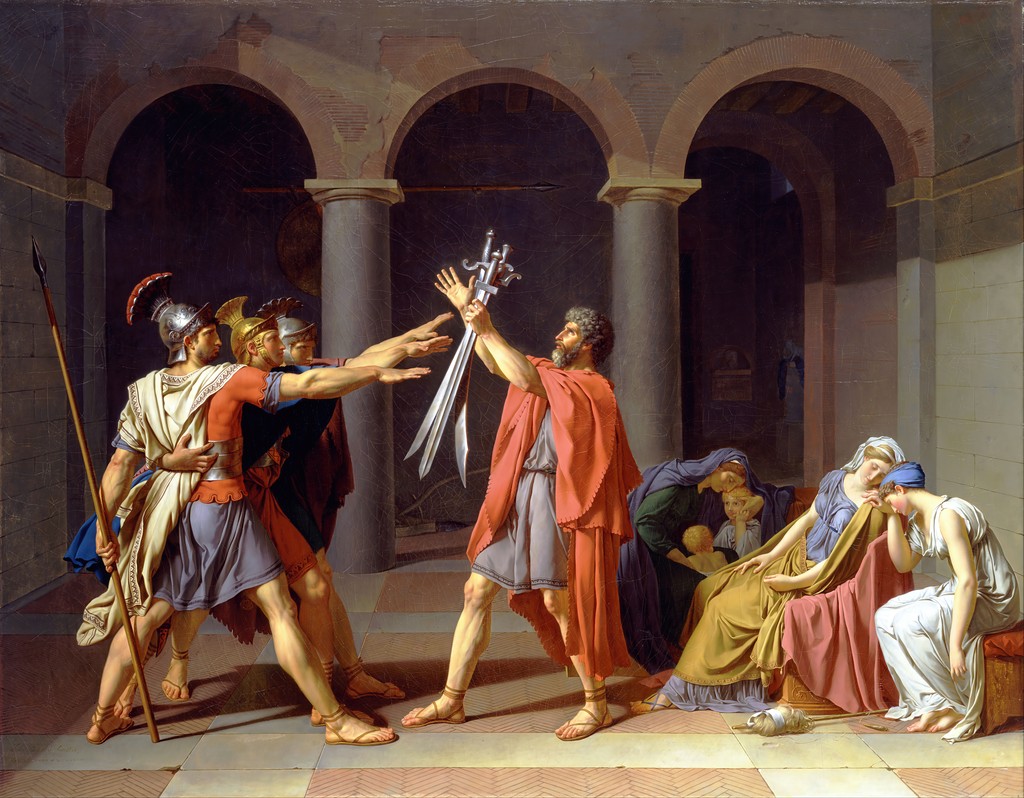
The Death of Young Bara matters because it shows David at the edge of what art could do for Revolutionary politics. He had already mastered antique moral drama in The Oath of the Horatii and The Death of Socrates. In Bara, that language is redirected toward a recent death that had barely become history. [1] [3] [5]
The painting also exposes the danger of political art. It is moving, but it is not innocent. The tenderness of the body and the austerity of the setting are part of a persuasive design. The viewer is encouraged to feel grief, admiration and indignation together. David's genius lies in making that mixture seem natural. [1] [3] [5]
At the same time, the unfinished surface prevents the image from closing completely. The body is intensely present, but the political programme around it broke apart before the work reached final form. That makes the painting a document of ambition and interruption. It is Revolutionary art caught mid-sentence. [1] [3] [5]
For readers, the safest route through the work is to hold two truths together. Joseph Bara was a real young person who died in the violence of the Vendee war. He was also remade almost immediately into a symbol. David's painting does not let us separate those truths neatly. It gives us the body, the myth, the politics and the unfinished work of memory all at once. [1] [3] [5]
Seen within the wider Biography and Paintings routes, the canvas marks the end of one Revolutionary possibility in David's art. It points back to antique sacrifice, stands beside Marat and Lepeletier, and looks forward to the moment when David's public imagery would have to find new patrons, new ceremonies and new forms of authority. [1] [3] [5]
Frequently Asked Questions
Discussion
The Death of Young Bara asks readers to hold together a real adolescent death, an official Revolutionary legend and an unfinished surviving canvas.
Use the prompts below to think about vulnerability, propaganda, memory and the point at which David's intended public image was interrupted.
Reader Insights
How does the unfinished state change the emotional force of a painting intended for public commemoration?
Where should a reader draw the line between Joseph Bara's documented death and the Revolutionary legend built around him?
What does Bara share with Marat and Lepeletier, and where does his youth make the image feel different?
Join the Conversation
Share your reading of The Death of Young Bara below.
References
- Institut Calvet, La Mort de Joseph Bara, accessed 27 July 2026.
- Institut Calvet, Une oeuvre majeure de l'Institut Calvet s'expose au Louvre, accessed 27 July 2026.
- Histoire par l'image, Pascal Dupuy, La mort de Bara, accessed 27 July 2026.
- POP: Plateforme ouverte du patrimoine, La Mort du jeune Barra, accessed 27 July 2026.
- Musee Fabre bibliographic record, La Mort de Bara: de l'evenement au mythe, accessed 27 July 2026.
- Paris Musees, Petit Palais, Bara by Jean-Jacques Henner, accessed 27 July 2026.
- Louvre, Jacques-Louis David exhibition overview, accessed 27 July 2026.