Buy Art Prints Now
from Amazon
* As an Amazon Associate I earn from qualifying purchases.
 by Tom Gurney
Tom Gurney BSc (Hons) is an art history expert with over 20 years experience
Published on June 19, 2020 / Updated on October 16, 2026
Email: tomgurney1@gmail.com / Phone: +44 7429 011000
Diana and Apollo Killing Niobe's Children: Introduction
Diana and Apollo Killing Niobe's Children is one of Jacques-Louis David's early mythological history paintings, made before his mature Neoclassical severity had fully emerged. The work is usually identified in museum and image records as Apollo and Diana Attacking the Children of Niobe. Painted in 1772, it belongs to the young David's repeated attempts to win the Prix de Rome, the academic prize that would finally send him to Italy two years later. [1] [5]
The Dallas Museum of Art is the present home of the painting. Google Arts & Culture's Dallas-linked object record gives the title Apollo and Diana Attacking the Children of Niobe, dates it to 1772 and records dimensions of 153.67 by 120.65 cm. A&AePortal and Wikimedia Commons record the Dallas accession number as 2008.6.FA, with the credit line Dallas Museum of Art, Foundation for the Arts Collection, Mrs. John B. O'Hara Fund in honor of Dr. Dorothy Kosinski. [1] [5]
The painting should be read as an early David work rather than as a polished statement of the later Revolutionary painter. It already shows his ambition for large-scale antique subject matter, but its crowded violence, sweeping movement and dramatic bodies still belong to the world from which David would gradually break away. [1] [5]
At a Glance
- ArtistJacques-Louis David [1]
- Active TitleDiana and Apollo Killing Niobe's Children [1] [5]
- Museum Title VariantApollo and Diana Attacking the Children of Niobe [1]
- Date1772 [1] [5]
- MediumOil on canvas [5]
- Dimensions153.67 by 120.65 cm [1]
- CollectionDallas Museum of Art [1]
- Accession2008.6.FA [5]
- Credit LineFoundation for the Arts Collection, Mrs. John B. O'Hara Fund in honor of Dr. Dorothy Kosinski [5]
- Source TextOvid, Metamorphoses, Book 6 [2] [4]
- SubjectApollo and Diana punish Niobe's children after Niobe insults Latona [2] [4]
- Competition ContextEarly Prix de Rome-era mythological history painting [1] [3]
- Image ReferenceDallas and Commons records provide the safest image-credit check for this subject [1] [5]
Contents
- Introduction
- The Niobe Myth
- David and the Prix de Rome
- Looking at the Painting
- Early Style and Later David
- Image and Object Cautions
- Why It Matters
The Niobe Myth
The subject comes from the story of Niobe, known especially through Ovid's Metamorphoses. Niobe, queen of Thebes and wife of Amphion, boasts of her many children and insults Latona, or Leto, whose divine children are Apollo and Diana. In punishment, the twins descend on Niobe's family and kill her sons and daughters with arrows. Niobe's pride is turned into catastrophic grief. [2] [4]
This myth gave David a subject full of motion and emotion. Unlike the later Death of Socrates, where one philosopher dominates the moral centre, the Niobe story is dispersed across many bodies. Children run, fall, shield one another and die. Niobe herself is mother, queen and guilty speaker, but in the chosen moment she is also the helpless witness to divine violence. [2] [4]
The Dallas Museum of Art blog connects David's painting specifically with Ovid's Metamorphoses and notes that the canvas shows the attack itself, with many of Niobe's children already dead and one youngest daughter still protected under her mother's cloak. That detail is useful because it keeps the scene precise. David is not painting the later transformation of Niobe into stone. He is painting the slaughter that makes that eternal mourning possible. [2] [4]
David and the Prix de Rome
The painting belongs to the academic competition world of the early 1770s. David was still a young artist trying to prove himself through history painting, the highest academic category. The Prix de Rome mattered not just as an honour but as a career mechanism. It promised training in Rome and proximity to antique and Renaissance models. [1] [3]
David did not win the prize in 1772. The Metropolitan Museum of Art's record for Pierre Charles Jombert's related Niobe sketch explains that Jombert's study and painting won first prize at the 1772 Prix de Rome, earning him three years of study in Rome. That competition context helps place David's canvas. It was not an isolated mythological experiment; it was part of a high-pressure academic test in which several young painters responded to the same severe antique subject. [1] [3]
This also explains why the painting feels so determined to impress. It is crowded with action. It displays anatomy, terror, maternal grief, divine descent and rapid movement. David is trying to show that he can command a large tragic subject. The result is powerful, but it is not yet the stripped-down moral architecture of his mature works. [1] [3]
Looking at the Painting
The composition turns the death of Niobe's children into a storm of bodies. Apollo and Diana appear as agents of punishment, armed with arrows and placed above the human panic below. The children are not anonymous decoration. Their bodies make the myth visible as a chain of individual catastrophes. [1] [2]
Niobe's role is especially difficult. Her boast causes the punishment, but David does not present her as a simple villain. In the moment represented, she is a mother trying to shield what remains of her family. The painting therefore lets pride and grief occupy the same figure. That double role gives the subject its cruelty. Niobe is guilty within the myth, but the image asks the viewer to confront the punishment as a scene of unbearable loss. [1] [2]
The painting also gives David a chance to stage the difference between divine distance and human vulnerability. The gods act from above; the children are trapped below. The arrows connect the two zones. In visual terms, the story becomes a descent of power from sky to earth, from offended divinity to exposed flesh. [1] [2]
This structure helps explain the energy of the young David's composition. The figures do not sit inside a calm geometric order. They twist, scatter and collide. The painting is built around panic, not philosophical steadiness. That makes it a useful early counterpoint to The Death of Socrates, where David later turns death into a controlled lesson in reason and resolve. [1] [2]
Early Style and Later David
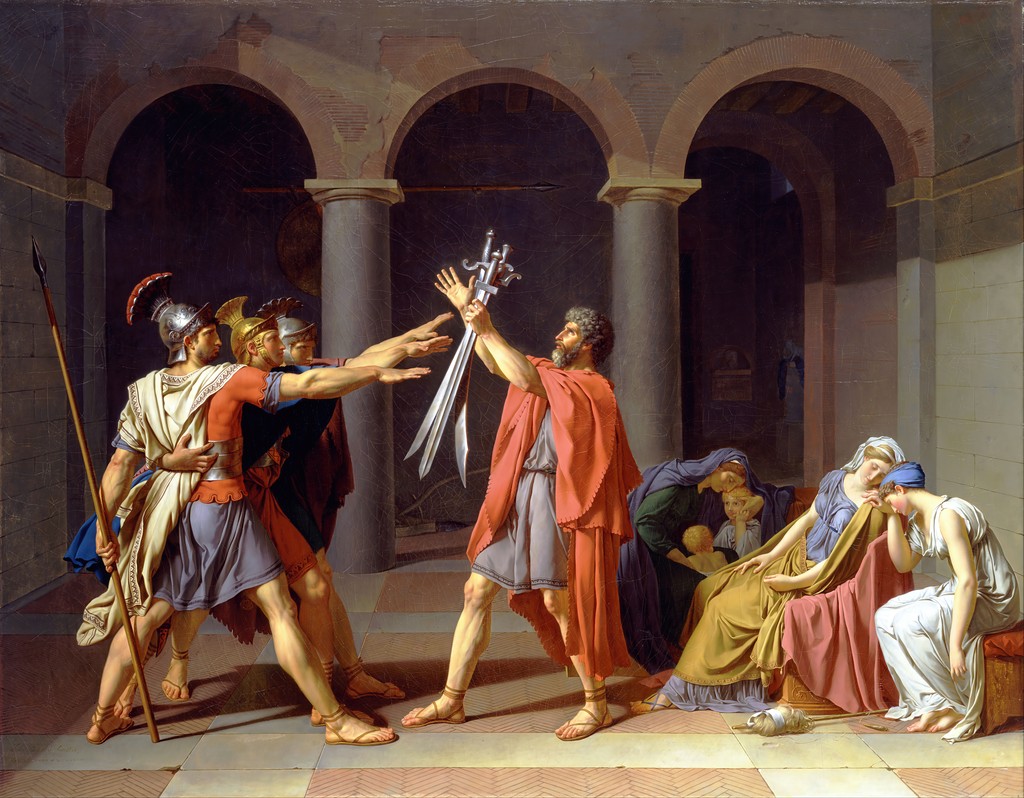
Diana and Apollo Killing Niobe's Children belongs near The Death of Seneca in David's development. Both works use antique subjects, both belong to the academy years and both show the young painter wrestling with pathos, theatricality and moral seriousness. Neither should be treated as if it already had the perfected severity of The Oath of the Horatii. [1] [3]
The difference matters because it makes David's later transformation clearer. In the 1780s, he found a way to make ancient history look disciplined, lucid and politically charged. In the Niobe painting, he is still using a more turbulent language. The violence is immediate and vivid, but the painting's lesson is less tightly controlled. [1] [3]
That does not make the work minor. It shows David's appetite for ambitious narrative before he had settled on the pictorial restraint that made him famous. The subject also anticipates concerns that would stay with him: the conflict between family and power, the use of antiquity as public example and the translation of suffering into history painting. [1] [3]
Image and Object Cautions
Because records use different English title forms, the safest wording is to connect Diana and Apollo Killing Niobe's Children with the Dallas title Apollo and Diana Attacking the Children of Niobe. The date 1772, Dallas Museum of Art location, accession number 2008.6.FA and dimensions around 120.65 by 153.67 cm are the strongest object anchors. [1] [5]
Image sources also need care. Wikimedia Commons includes public-domain file records, and World History Encyclopedia marks its image as public domain, while the Dallas object record remains the strongest anchor for title, object facts and credit wording. The image used here should therefore be read alongside the Dallas record before any alternate crop or detail view is selected. [1] [5]
Why It Matters
This painting matters because it catches David at a turning point before the turn. The subject is antique, violent and morally charged. The setting is academic competition. The result is not yet the famous David of Horatii, Socrates or Brutus, but it points toward him. [1] [3]
For readers following David's formation, this page belongs beside The Death of Seneca, Belisarius Begging for Alms and Erasistratus Discovering the Cause of Antiochus' Disease. Together they show the young artist using antique suffering, recognition and moral crisis to make himself into a history painter. [1] [3]
For later classical comparisons, continue to The Death of Socrates, The Oath of the Horatii, Lictors Bearing to Brutus the Bodies of His Sons and Andromache Mourning Hector. For David's wider career, see the Jacques-Louis David biography and the David paintings hub. [1] [3]
Frequently Asked Questions
Discussion
Diana and Apollo Killing Niobe's Children asks readers to watch a young David turning Ovid's myth into a turbulent academic history painting.
Use the prompts below to think about divine punishment, Niobe's grief and the way early David organizes violence before his mature Neoclassical severity.
Reader Insights
How does the painting separate Apollo and Diana's elevated power from the exposed children below?
How does David make Niobe both the cause of the punishment and a mother trying to protect what remains?
Which parts of the composition still feel crowded and theatrical compared with the later Socrates or Horatii?
Join the Conversation
Share your reading of Diana and Apollo Killing Niobe's Children below.
References
- Google Arts & Culture, Apollo and Diana Attacking the Children of Niobe, accessed 27 July 2026.
- Dallas Museum of Art Uncrated, January 2010 archive, accessed 27 July 2026.
- Metropolitan Museum of Art, The Punishment of the Arrogant Niobe by Diana and Apollo, accessed 27 July 2026.
- Ovid, Metamorphoses, Book 6, accessed 27 July 2026.
- Wikimedia Commons, File: Niobe JacquesLouisDavid 1772 Dallas Museum of Art.jpg, accessed 27 July 2026.
- Wikimedia Commons, Category: Apollo And Diana Attacking The Children Of Niobe, accessed 27 July 2026.