Buy Art Prints Now
from Amazon
* As an Amazon Associate I earn from qualifying purchases.
 by Tom Gurney
Tom Gurney BSc (Hons) is an art history expert with over 20 years experience
Published on June 19, 2020 / Updated on October 16, 2026
Email: tomgurney1@gmail.com / Phone: +44 7429 011000
The Distribution of the Eagle Standards: Introduction
Jacques-Louis David's The Distribution of the Eagle Standards is one of the great Napoleonic ceremony paintings in his career. Its full French title identifies the subject more exactly: the army's oath to the emperor after the distribution of the eagles on the Champ de Mars, 5 December 1804. The painting was created in 1810 and is now in the collection of the Musee national des chateaux de Versailles et de Trianon. [1] [2] [3]
The work belongs with The Coronation of Napoleon, but it is not a repeat of the same political idea. The Coronation shows imperial power in church, court and dynasty. The Distribution of the Eagle Standards shows the army binding itself to that power. One image turns Napoleon's accession into sacred public theatre; the other turns military loyalty into an oath before the emperor. [1] [2] [3]
This distinction matters because David was not simply recording an event. He was constructing a language of imperial legitimacy. The painting turns the exchange of military standards into a monumental scene of allegiance, gesture and symbol. It is David's Neoclassical seriousness redirected from Revolutionary virtue to Napoleonic command. [1] [2] [3]
It is also a painting that needs careful object language. The English title used on this site is shorter than the formal French title, and the sources preserve slightly different title and measurement details. Those differences are not errors to be smoothed away. They are part of the record around a huge state painting that moved through imperial, royal and museum settings. [1] [2] [3]
At a Glance
- ArtistJacques-Louis David [1] [4]
- Formal TitleSerment de l'armee fait a l'empereur apres la distribution des aigles au champ de Mars, 5 decembre 1804 [1]
- Active TitleThe Distribution of the Eagle Standards [1] [2]
- Date1810 [1] [2]
- MediumOil on canvas [1] [3]
- DimensionsApproximately 610 by 931 cm, with source variants for width [1] [2] [5]
- CollectionMusee national des chateaux de Versailles et de Trianon [1] [3]
- InventoryMV 2278 / INV 3700 / MR 1438 [1]
- CeremonyArmy oath after the distribution of eagles, Champ de Mars, 5 December 1804 [1] [2] [5]
- Display ContextSalle du Sacre pendant to The Coronation of Napoleon [3] [6]
- Source CautionKeep the Versailles final canvas distinct from the Met preparatory sketch and later standards material [6] [7] [8]
Contents
- Introduction
- Object Identity
- The Ceremony
- Pendant to the Coronation
- Composition
- Standards and Eagles
- Sketch and State
- Political Meaning
- Why It Matters
Object Identity
The French POP/Joconde record gives the title as Serment de l'armee fait a l'empereur apres la distribution des aigles au champ de Mars, 5 decembre 1804. It identifies the artist as Jacques-Louis David, dates the creation to 1810, and gives the inventory numbers MV 2278, INV 3700 and MR 1438. The work is an oil painting on canvas, signed and dated L. David 1810, and is held by the Musee national des chateaux de Versailles et de Trianon. [1] [2] [6]
The measurements are monumental. POP gives the height as 610 cm and the width as 931 cm. Fondation Napoleon gives the same height and a width of 9.310 m. Histoire par l'image gives 610 by 975 cm and notes that the decor was painted by Ignazio Degotti. For public reading, the essential point is scale: this is not a cabinet painting or a private Napoleonic portrait. It is a vast official canvas made for state display. [1] [2] [6]
POP records the historical subject date as 5 December 1804 and states that the painting was commissioned by Napoleon I for the throne room of the Tuileries Palace. Google Arts & Culture, in a Versailles record, adds useful provenance notes: the painting was commissioned for the Salle du Trone at the Tuileries, executed with Degotti for perspective work, modified by David in 1810, mentioned in the Salle des Gardes at the Tuileries until 1814, recorded in David's studio in 1816, handed over to the royal museums administration in 1820, and entered Versailles in 1837 under Louis-Philippe. [1] [2] [6]
That object history gives the painting a longer political life than the ceremony itself. It was made for Napoleon's regime, survived the fall of the Empire, and was later absorbed into the historical galleries of Versailles. The image was born as imperial propaganda, but its museum life made it part of the nineteenth-century story of France looking back at Napoleon. [1] [2] [6]
The Salon history reinforces that public ambition. Fondation Napoleon records the painting as a work presented at the Salon of 1810 in the Musee Napoleon. By that date, the event it represented was already six years old. David was therefore not painting immediate reportage. He was producing an official retrospective image, one that made the founding gestures of the Empire available to later viewers as if they were permanent historical facts. [1] [2] [6]
The Ceremony of 5 December 1804
The ceremony took place at the Champ de Mars three days after Napoleon's coronation at Notre-Dame. Histoire par l'image explains that the eagle had been adopted in June 1804 as an emblem of the Empire. The ceremony was meant to replace the flags of earlier regimes with new imperial standards and to bind units to Napoleon through an oath. [2] [5]
Fondation Napoleon states that the painting was shown at the Salon of 1810 in the Musee Napoleon, then the Louvre, and that it represents the ceremony of 5 December 1804. The subject is therefore doubly staged. It was first a public military rite after the coronation, and later a painted image of that rite presented within Napoleon's cultural system. [2] [5]
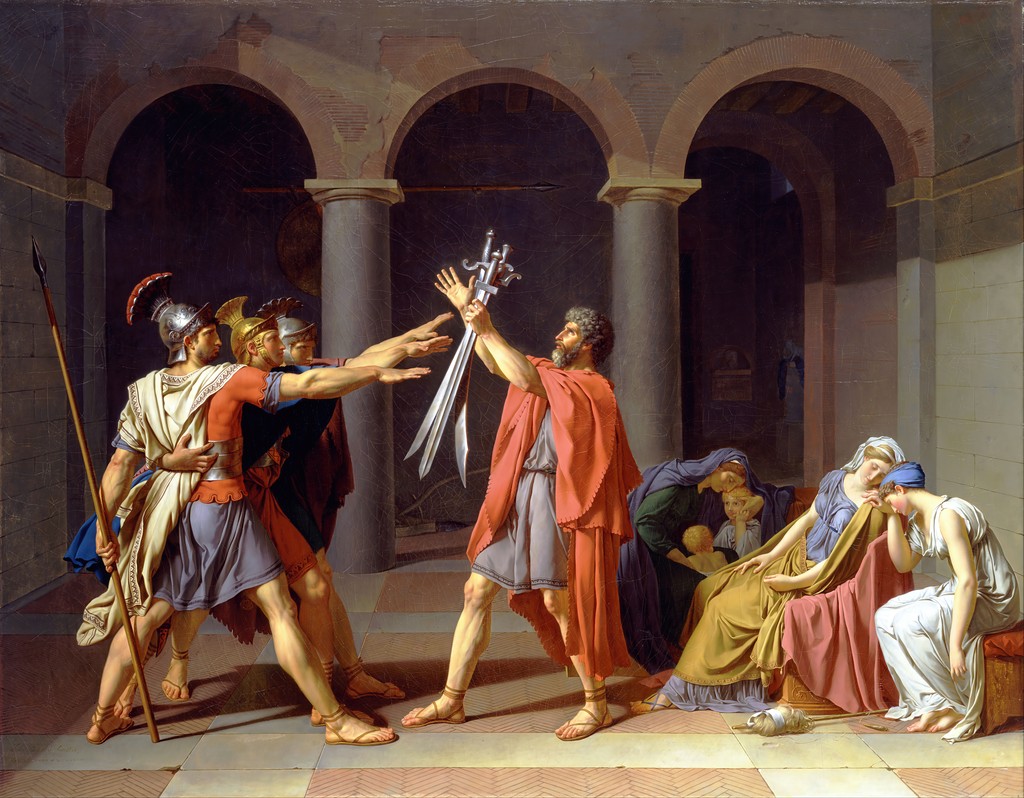
The eagle symbol reaches back to Rome, and that reference was deliberate. Napoleon's Empire repeatedly used antique forms to make modern power look ancient, durable and inevitable. David understood that language perfectly. He had built his career on antique models of virtue, sacrifice and public duty. Here, the Roman reference does not send the viewer back to Horatius or Socrates. It serves a living emperor. [2] [5]
The ceremony was not just pageantry. It gave physical objects to the army: standards that could be carried, defended, followed and remembered. The oath attached bodies to symbols. Histoire par l'image presents this as part of Napoleon's warrior legitimacy: the emperor becomes not only crowned sovereign but military centre. [2] [5]
Weather, architecture and stagecraft also mattered. Histoire par l'image notes that the ceremony took place after delays and in difficult weather, with a temporary setting created by Percier and Fontaine. David's painting does not make wet snow or logistical awkwardness the centre of the image. It translates the event into order, rhythm and symbolic force. That is one reason the canvas is so useful as political art: it does not merely remember the ceremony; it perfects it. [2] [5]
A Pendant to the Coronation
Versailles places the painting in direct relation to the second version of the Coronation. The Salle du Sacre page describes the room as a space devoted from 1833 to the glory of Napoleon Bonaparte, First Consul and emperor, and says the greatest paintings of his reign were intended for that room because they could not fit elsewhere. It names David's Coronation and the Distribution of the Eagles as the two immense canvases commissioned to commemorate the ceremonies of Napoleon's imperial accession. [3] [4] [6]
The Versailles David biography also describes David after the proclamation of the Empire as attached to Napoleon and occupied for years by enormous compositions commemorating the coronation ceremonies: the Coronation at Notre-Dame and the Distribution of the Eagles on the Champ de Mars. Google Arts & Culture calls the painting a pendant to the second version of the Coronation now in the same room. [3] [4] [6]
The word pendant should not be read only as a matter of display symmetry. It points to the structure of imperial image-making. The Coronation stages church, court, family and dynasty. The Distribution stages army, standards, oath and collective military force. Together they make Napoleon's power appear both consecrated and defended. [3] [4] [6]
That partnership also clarifies David's changing role. In the 1780s and 1790s, he had painted moral crisis, Revolutionary death and republican ceremony. Under Napoleon, he became First Painter of the Emperor. The studio and the state now met in a different way. Instead of martyrdom for a republic, David was asked to create monuments for a regime built around one man. [3] [4] [6]
Composition and Movement
Histoire par l'image emphasises that the composition is more dynamic than the Coronation. The figures on the left of the platform include dignitaries of the new regime, while Napoleon advances surrounded by marshals and military leaders. The army responds in a mass gesture of oath-taking. The result is not a quiet documentary scene but a choreographed surge of bodies and arms. [5]
The painting depends on diagonals. Soldiers raise their arms, marshals lift their batons, flags and standards rise above the crowd, and the imperial eagle gives the movement a symbolic summit. Histoire par l'image reads the meeting of extended arms as a triangular energy that leads toward the eagle and tricolour flag. That structure matters because it turns the crowd into a single visual force. The army appears as many bodies with one will. [5]
Napoleon is present, but the painting is not a simple portrait. Histoire par l'image notes that he is no longer the sole centre of the composition in the same way. He descends toward the army, while the symbolic work is carried by the eagle, standard and oath. The image presents a relationship: emperor and army, command and consent, symbol and action. [5]
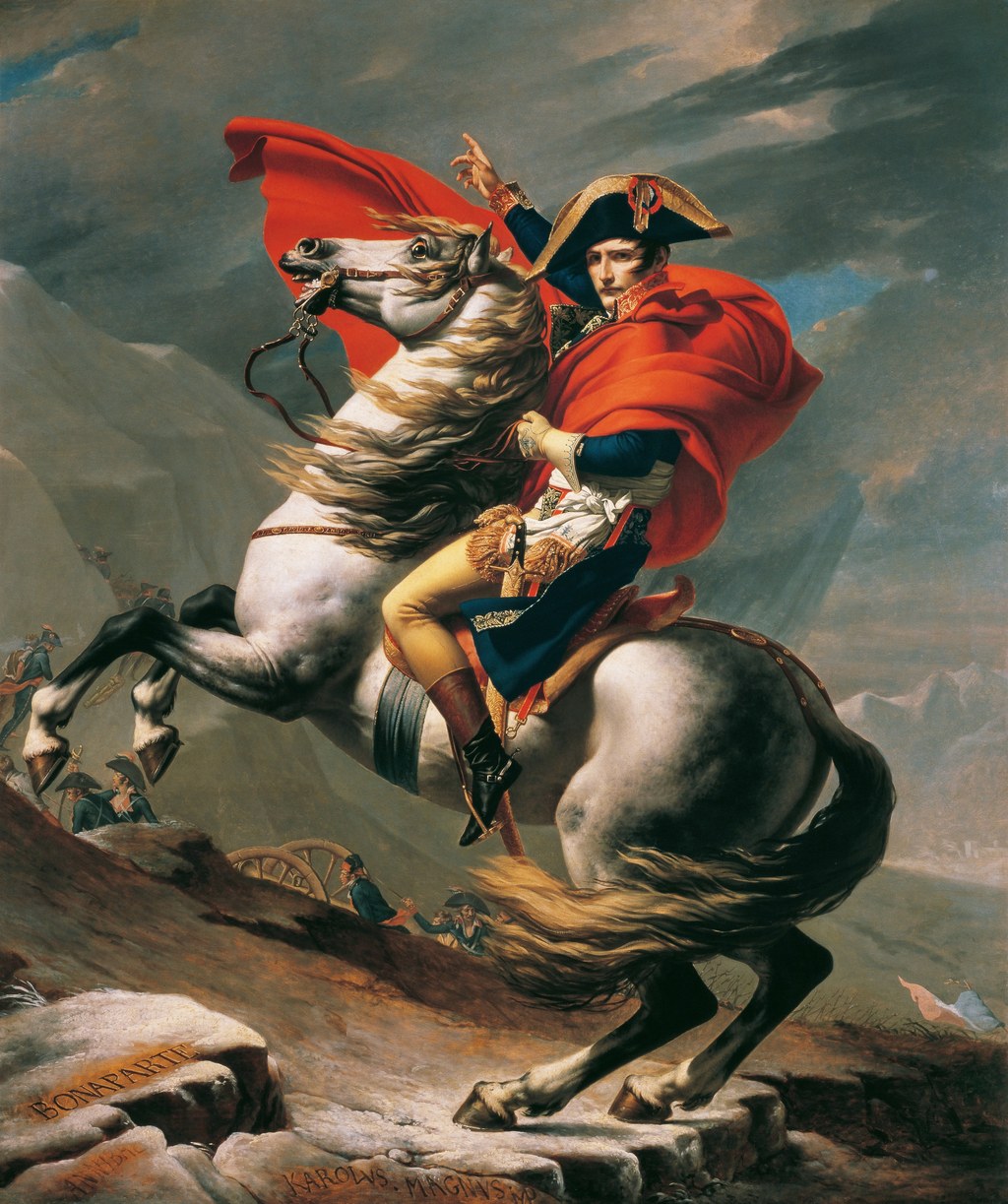
The scale helps this effect. A viewer standing before the canvas is faced with a public body rather than a single hero. This is the opposite of Napoleon Crossing the Alps, where one rider and one rearing horse carry the whole myth. The Distribution of the Eagle Standards requires a massed audience inside the picture and a massed audience in front of it. [5]
Standards, Eagles and Oath
The imperial eagle was more than a decorative finial. It was the object around which the oath was organised. Fondation Napoleon's later article on David's studies for army standards explains that, in 1812, Napoleon again turned to the problem of eagles and standards, and that David's 1810 painting had already immortalised the ceremony of the army's oath on 5 December 1804. The article also explains the symbolic function of the eagle as an ensign that armies were to receive from the emperor and defend. [5] [8]
That later source should be used cautiously for this painting, because it concerns new standards in 1812 rather than the 1804 ceremony itself. Still, it confirms that the eagle remained a serious imperial symbol, not a painted accessory. It also shows David's practical involvement in Napoleonic visual culture beyond canvas alone. He was asked to think about standards, costumes and the look of state power. [5] [8]
In the painting, the eagle gathers several meanings. It recalls Rome, gives the army a point of loyalty, and places the emperor's authority above the crowd without simply repeating the religious symbolism of the Coronation. Histoire par l'image compares the eagle's role in this painting with the cross in the Coronation. That comparison is useful: one canvas uses sacred Christian ceremony, the other military-antique symbolism. Both try to make Napoleon's power appear legitimate. [5] [8]
Sketch, Version and State
The finished Versailles canvas should be kept distinct from related studies and sketches. The Metropolitan Museum of Art has a preparatory oil sketch titled The Distribution of the Eagles, dated around 1809-1810. The Met describes it as oil over black chalk on paper laid down on canvas, measuring 54 by 85.2 cm, and notes that it allowed David to work out the composition and colour distribution for the final version. [1] [6] [7]
This Met work is valuable because it shows David planning the large canvas, but it is not the Versailles painting. It is also currently listed as on loan to the Met rather than as a permanent Met-owned object. That status matters for image use and citation. Any use of the sketch should clearly identify it as preparatory material rather than as the finished painting. [1] [6] [7]
The finished painting also has state and alteration questions. Google Arts & Culture says it was modified by David in 1810. POP records the signed and dated inscription. Histoire par l'image and Versailles help place it in the completed Salon and Versailles display history. These sources support a basic narrative: commissioned for imperial ceremony, developed and completed by David with assistants where noted, shown at the Salon of 1810, then absorbed into later state museum history. [1] [6] [7]
The manuscript should not invent more than that. It should not claim exact motivations for every alteration unless those are tied to a named source. It should not identify every figure beyond source support. The scene is crowded and politically loaded; precision is better than a grand list of uncertain names. [1] [6] [7]
The dimension discrepancy is another reminder to stay close to the evidence. POP and Fondation Napoleon give a width of 931 cm or 9.310 m, while Histoire par l'image gives 975 cm. For readers, the essential fact is the same in every account: David was working at a size intended for state display, where the painting would overwhelm ordinary domestic scale and behave almost like architecture. [1] [6] [7]
Political Meaning
The Distribution of the Eagle Standards is a painting about loyalty under pressure. It shows an army giving itself to an emperor, but it also shows the emperor depending on that army to make his rule visible. Power moves in both directions. Napoleon gives standards; the army gives oath. The image turns this exchange into a theatrical contract. [4] [5]
That contract is very different from the republican imagery of Marat, Lepeletier and Bara. There, David used death to make civic virtue visible. Here, he uses ceremony to make obedience and cohesion visible. The moral charge remains, but its political centre has changed. The viewer is no longer asked to honour a martyr of the Revolution. The viewer is asked to see imperial allegiance as grand, unanimous and historically grounded. [4] [5]
This does not make the painting less serious. It makes it more revealing. David's great skill was his ability to give modern politics an antique body. In the Eagle Standards, that body is collective: marshals, soldiers, uniforms, flags, standards and the emperor moving through them. The painting shows how Neoclassicism could serve not only opposition, reform or republican memory, but also empire. [4] [5]
For readers following David's Napoleonic works, the best path runs through several pages. Napoleon Bonaparte in His Study at the Tuileries presents the emperor as tireless administrator. The Coronation presents dynastic ritual. Napoleon Crossing the Alps presents heroic ascent. Portrait of Pope Pius VII introduces the diplomacy and tension around sacred authority. Unfinished Portrait of General Bonaparte turns back to the military leader before the imperial machine was fully formed. [4] [5]
Why the Painting Matters
The Distribution of the Eagle Standards is not the most intimate of David's paintings, and it is not meant to be. It is a public machine of allegiance. Its power lies in the way it turns a military administrative act into an image of destiny. Standards are distributed, arms rise, the emperor advances, and the army appears to become one body. [1] [3] [5]
The painting also shows the cost of David's adaptability. The artist who once shaped images for Revolutionary sacrifice now shaped images for imperial loyalty. That shift can feel uneasy, but it is central to understanding him. David did not abandon history painting under Napoleon. He redirected it toward a new political master. [1] [3] [5]
At Versailles, the painting now belongs to the museum memory of Napoleon rather than the immediate theatre of the Empire. Its meaning has changed again. It no longer asks modern viewers to swear anything. Instead, it lets them study how ceremony, scale, symbol and painting worked together to make power feel permanent. [1] [3] [5]
That is the reason this work deserves more than a passing mention in David's cluster. It is not simply a large Napoleonic crowd scene. It is one of the places where David's old belief in history painting meets the machinery of modern state spectacle. The oath, the eagle, the standards and the regimented crowd all show a painter trying to make political unity visible on a scale large enough to overwhelm doubt. [1] [3] [5]
Frequently Asked Questions
Discussion
The Distribution of the Eagle Standards asks readers to study how David turned a military ceremony into an image of imperial allegiance.
Use the prompts below to think about scale, oath-taking, Roman eagle symbolism and the relationship between the Versailles canvas and the Coronation.
Reader Insights
How does the huge canvas scale change the scene from a recorded ceremony into a public image of state power?
What work does the imperial eagle do that a normal military flag could not do in David's composition?
How does this military oath image alter your reading of the Coronation, where sacred and dynastic ritual dominate?
Join the Conversation
Share your reading of The Distribution of the Eagle Standards below.
References
- POP: Plateforme ouverte du patrimoine, Serment de l'armee fait a l'empereur apres la distribution des aigles, accessed 27 July 2026.
- Fondation Napoleon, Salon 1810: Distribution des Aigles, accessed 27 July 2026.
- Chateau de Versailles, Salle du Sacre, accessed 27 July 2026.
- Chateau de Versailles, Jacques-Louis David, accessed 27 July 2026.
- Histoire par l'image, Jeremie Benoit, Napoleon et sa legitimite de guerrier, accessed 27 July 2026.
- Google Arts & Culture / Palace of Versailles, The Army takes an Oath to the Emperor after the Distribution of Eagles, accessed 27 July 2026.
- The Metropolitan Museum of Art, The Distribution of the Eagles, accessed 27 July 2026.
- Fondation Napoleon, David's studies for the army's new standards, January 1812, accessed 27 July 2026.