Buy Art Prints Now
from Amazon
* As an Amazon Associate I earn from qualifying purchases.
 by Tom Gurney
Tom Gurney BSc (Hons) is an art history expert with over 20 years experience
Published on June 19, 2020 / Updated on October 16, 2026
Email: tomgurney1@gmail.com / Phone: +44 7429 011000
Equestrian Portrait of Stanislas Kostka Potocki: Introduction
Jacques-Louis David painted Equestrian Portrait of Stanislas Kostka Potocki in 1780-1781, while he was still close to the Roman and Italian experiences that shaped his early career. The work is an oil on canvas now held by the Museum of King Jan III's Palace at Wilanow in Warsaw. Google Arts & Culture, using the Wilanow Palace Museum record, gives the title as Equestrian portrait of Stanislaw Kostka Potocki, the date as 1781, the dimensions as 2180 x 3040 mm without frame, and the original Polish title as Portret konny Stanislawa Kostki Potockiego. [1] [2] [5]
The painting is a dramatic exception within David's early output. Before the great public severity of The Oath of the Horatii and The Death of Socrates, David produced a full-scale equestrian portrait of a young Polish aristocrat on a restless horse, with a barking dog heightening the energy at ground level. It is still a portrait, but it borrows the scale and theatrical authority of courtly equestrian painting. That mixture makes the canvas feel both old-fashioned and newly sharpened by David's discipline. [1] [2] [5]
At a Glance
- ArtistJacques-Louis David [1] [5]
- Active TitleEquestrian Portrait of Stanislas Kostka Potocki [1] [5]
- Source TitleEquestrian portrait of Stanislaw Kostka Potocki [1]
- Original Polish TitlePortret konny Stanislawa Kostki Potockiego [1] [3]
- Active URL/jacques-louis-david/equestrian-portrait-of-stanislas-kostka-potocki/ [1]
- Date1780-1781 in Wilanow research; 1781 in Google Arts & Culture and Utpictura18 [1] [3] [4] [5]
- MediumOil on canvas [1] [5]
- Dimensions2180 x 3040 mm without frame; Utpictura18 gives 304 x 218 cm [1] [5]
- CollectionMuseum of King Jan III's Palace at Wilanow, Warsaw, Poland [1] [3] [5]
- InventoryWil.1779 / Wil 1779 [3] [5]
- SitterStanislaw Kostka Potocki, 1755-1821, shown at twenty-six [1]
- Wilanow RoleOwner of Wilanow from 1799 to 1821; collector and founder in 1805 of one of Poland's oldest museums [1]
- Making ContextItalian travels in 1779-1780; developed in stages in 1780-1781 and finished in Paris [2] [3]
- Signature DetailSigned and dated on the dog's collar [1] [5]
- ProvenanceParis studio to Warsaw in 1781; Wilanow from 1799 to 1939; returned to Poland in 1956 after wartime displacement [1]
- Legend CautionNaples riding-school and horse-taming story treated as tradition, not verified fact; the more dramatic version is associated with Jules David [2] [3] [4]
- Technical ResearchWilanow research records changes including an order-sash shift from the Order of St Stanislaus to the Order of the White Eagle [3]
- Catalogue Cross-CheckUtpictura18 places the work in the Salon de 1781 and cites Antoine Schnapper and Arlette Serullaz, David catalogue, RMN, 1989, no. 42 [5]
- Image CautionCurrent page image retained; Wilanow/Google object identity is strong but reuse terms need later page-level review [1] [2] [3] [4]
Contents
- Introduction
- Object Facts and Collection
- Potocki, Italy and David's Early Career
- A Modern Painter Uses an Older Format
- The Legend and the Evidence
- Composition and Close Looking
- Provenance and Wartime History
- Image and Source Cautions
- Why the Painting Matters
Object Facts and Collection
The Wilanow Palace Museum identifies the sitter as Stanislaw Kostka Potocki, born in 1755 and died in 1821. The museum's Google Arts & Culture record describes him as a twenty-six-year-old sitter, later owner of Wilanow from 1799 to 1821, a collector of art, and founder in 1805 of one of Poland's oldest museums. The painting is therefore important not only as a work by David, but also as an image tied to the identity of the Wilanow collection itself. [1] [3] [5]
Utpictura18 records the work as a painting on canvas measuring 304 x 218 cm, conserved in Warsaw at the Palace of King Jan III at Wilanow, with inventory number Wil 1779. It also notes that the work is signed and dated, with the signature and date placed at the lower left on the dog's collar. These details match the Wilanow and Google Arts object spine closely enough to give the page a stable factual base, while the exact story of the commission remains more cautious. [1] [3] [5]
The scale is essential. At more than three metres high, the painting was not a private cabinet portrait. It needed space, distance and architectural setting. Its present association with Wilanow gives it a fitting home, because the image links the sitter's later collecting life to the palace where his cultural ambitions became part of a public collection. [1] [3] [5]
Potocki, Italy and David's Early Career
Stanislas Kostka Potocki belonged to the Polish aristocratic world, but he also had strong cultural interests beyond Poland. The Wilanow record stresses his role as collector and museum founder, while Wilanow's conservation-history essay places the portrait within his Italian travels. Potocki's year-long journey to Italy from 1779 to 1780 is described there as relatively well documented, though the surviving correspondence does not securely explain every circumstance of the portrait's creation. [1] [2] [3] [4]
That uncertainty matters. Older accounts built the painting around a lively Neapolitan story in which Potocki supposedly mastered an untamed horse, inspiring David to make the portrait. Wilanow's English essay treats that legend with care, explaining that a reliable 1834 Wilanow catalogue description was based on information from Aleksander Potocki, the sitter's son, while later family traditions expanded the scene into a more dramatic anecdote. The museum's conservation article is even more careful: the documentation does not prove the episode, but it also does not allow every possibility to be dismissed. [1] [2] [3] [4]
For David, the commission came at a formative moment. He had won the Prix de Rome and was working out how antique discipline, Italian study and the inheritance of earlier European painting could become a public style of his own. Equestrian portraiture was not the obvious path for a painter who would soon define Neoclassical civic history painting. That is why this picture is so useful in the David cluster: it shows him testing grandeur before his most famous antique and Revolutionary subjects fixed his reputation. [1] [2] [3] [4]
A Modern Painter Uses an Older Format
Equestrian portraiture carried a long history of rank, command and public display. European rulers and military figures had often been shown mounted above the viewer, controlling a powerful animal as an image of social and political authority. David's Potocki portrait inherits that tradition, but the sitter is not a monarch or a battlefield commander. He is a young aristocrat shown at a moment of controlled instability. [1] [2] [3] [5]
Google Arts & Culture notes that David drew on the achievement of earlier painters and points particularly to Rubens and Van Dyck as important precedents for the depiction of the horse. This is not surprising. The horse gives the painting much of its drama: the head bends downward, the body presses forward, and the animal's nervous energy is echoed by the dog near its legs. Potocki sits above this movement, visible as a rider whose authority must be read through poise rather than through a military scene. [1] [2] [3] [5]
The result is not simply a throwback to Baroque splendour. Wilanow's Polish conservation essay describes the painting as joining late Baroque and Rococo habits with Classicism. That is a fair way to see it. The format is grand and theatrical, but David's finish is controlled. The surface is polished; the drawing is exact; the sitter's pose is made legible within a carefully ordered composition. [1] [2] [3] [5]
The Legend and the Evidence
The painting's famous legend should be treated as part of its reception, not as a simple fact. Wilanow's English account explains that the portrait was traditionally connected to a sketch made in a riding school in Naples and that the later story of Potocki taming a difficult horse became attached to the image. The museum also notes that this more romantic version was challenged by later scholarship. [2] [3] [4]
This caution improves the painting rather than weakening it. It reminds readers that portraits can accumulate stories because they look like dramatic events. David's image certainly seems to invite narrative: a rearing or resisting horse, a dog reacting below, and a young rider in command. Yet the sources are strongest when they speak of stages of making, later descriptions, preparatory drawings and archival gaps. A stronger reading therefore lets the legend remain visible while making clear that the museum evidence is more measured. [2] [3] [4]
The conservation research published by Wilanow adds another layer. It reports that technical study in 2016 revealed earlier painted layers and helped revise earlier views of the work's making. The painting appears to have developed in stages in 1780-1781, beginning after David's return from Naples and being finished in Paris in 1781. The research also connects preparatory material with changes in the sitter's order sash, showing that the final image was not simply a spontaneous record of a single event. [2] [3] [4]
Composition and Close Looking
The power of the painting comes from tension held in balance. Potocki is placed high, the horse fills the canvas, and the stone setting behind them gives the scene a restrained architectural weight. The dog at the lower edge is more than a lively detail. It sharpens the horse's reaction and gives the viewer a point of disturbance near the ground, making the rider's composure more noticeable. [1] [2] [3]
Potocki's body is turned into a display of elegance and control. The raised arm, riding posture and formal costume belong to aristocratic self-presentation, but the animal below him prevents the portrait from becoming static. David gives the sitter a public image of command without turning the scene into battle. The courage is social and theatrical rather than military. [1] [2] [3]
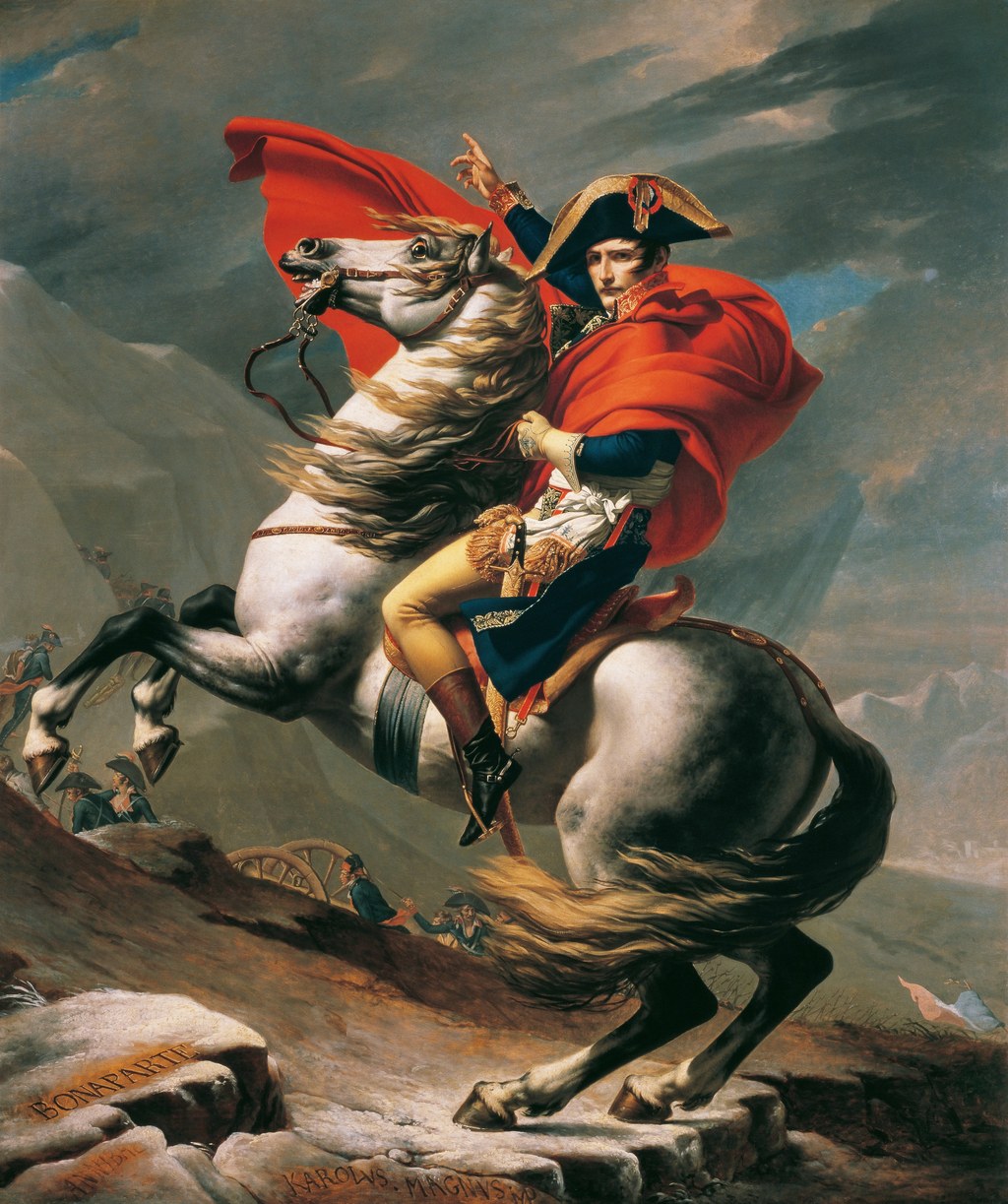
The painting also helps explain why David's later Napoleonic images could make horses carry political meaning so effectively. Napoleon Crossing the Alps would become a far more famous mounted image, but the Potocki portrait already shows David thinking about the body of the rider, the charged body of the horse and the authority produced between them. The later Napoleon picture transforms equestrian language into mythic political theatre; the Potocki portrait uses it for aristocratic identity. [1] [2] [3]
Provenance and Wartime History
Google Arts & Culture gives a concise provenance outline. The painting was transported from David's Paris studio to Warsaw in 1781. Because of its size, it was for a time kept in the workshop of Mateusz Tokarski, conservator and custodian of the Stanislas Augustus Poniatowski Gallery, and then moved to the studio of Franciszek Smuglewicz at the Royal Castle in Warsaw. When Aleksandra and Stanislaw Kostka Potocki took over Wilanow in 1799, the painting came to the palace and remained there until 1939. [1] [3]
The twentieth-century history adds weight to the object. During the German occupation of Poland, the portrait was taken to Germany; after the war it was held in the Soviet Union with other wartime loot, and in 1956 it returned to Poland. That history makes the painting part of the broader story of displaced cultural property as well as part of David's artistic career. [1] [3]
For readers moving through the Jacques-Louis David paintings group, this provenance also helps distinguish the page from David's French state and Revolutionary works. The portrait has a French artist, an Italian making-story, a Polish sitter, a Warsaw/Wilanow collection history and a wartime displacement narrative. Its identity is European in a very literal sense. [1] [3]
Image and Source Cautions
The page keeps the current page image while the source note marks the image evidence as amber. Google Arts & Culture and Wilanow establish object identity and a museum photo credit to Z. Reszka, but final reuse, crop, credit and commercial-use terms still need a later image-specific review. The page also keeps source caution around the Naples riding-school legend, the painting's commission and purchase circumstances, and the Stanislas/Stanislaw spelling difference between the active route and institutional records. [1] [2] [3] [4] [5]
Why the Painting Matters
Equestrian Portrait of Stanislas Kostka Potocki matters because it catches David before his public image hardened into the painter of Revolution and Empire. It shows him borrowing the authority of older equestrian portraiture, studying earlier masters and working at a scale usually associated with rulers. At the same time, the painting belongs to a particular Polish sitter and a particular Polish collection history. [1] [2] [5]
The work also warns against making David too narrow. He was not only the painter of The Death of Marat or The Coronation of Napoleon. He could also produce a portrait that is aristocratic, theatrical and technically ambitious, while still showing the compositional control that would define his mature Neoclassicism. [1] [2] [5]
Seen beside David's later portraits and mounted images, the Potocki portrait becomes a bridge. It points backward to Rubens and Van Dyck, sideways to Polish collecting and aristocratic display, and forward to David's own use of monumental bodies as instruments of public meaning. It is a grand portrait with a complicated documentary trail, and that combination is what keeps it alive. [1] [2] [5]
Frequently Asked Questions
Discussion
Equestrian Portrait of Stanislas Kostka Potocki turns equestrian portraiture into a test of poise, status and evidence.
Use the prompts below to think about format, legend and the painting's Polish collection history.
Reader Insights
How does David's use of an older equestrian format change when the sitter is a young Polish aristocrat rather than a ruler?
What should remain of the Naples horse-taming story once the museum evidence is treated cautiously?
How does the Wilanow and wartime history change the painting's identity inside David's career?
Join the Conversation
Share your reading of Equestrian Portrait of Stanislas Kostka Potocki below.
References
- Google Arts & Culture, Equestrian portrait of Stanislaw Kostka Potocki, accessed 27 July 2026.
- Museum of King Jan III's Palace at Wilanow, The equestrian portrait of Stanislaw Kostka Potocki, accessed 27 July 2026.
- Museum of King Jan III's Palace at Wilanow, Portret konny Stanislawa Kostki Potockiego J.-L. Davida w swietle nowych badan konserwatorskich i archiwalnych, accessed 27 July 2026.
- Museum of King Jan III's Palace at Wilanow, The Equestrian Portrait of Stanislaw Kostka Potocki by Jacques-Louis David, accessed 27 July 2026.
- Utpictura18, Portrait du comte Stanislas Kostka Potocki - David, accessed 27 July 2026.