Buy Art Prints Now
from Amazon
* As an Amazon Associate I earn from qualifying purchases.
 by Tom Gurney
Tom Gurney BSc (Hons) is an art history expert with over 20 years experience
Published on June 19, 2020 / Updated on October 16, 2026
Email: tomgurney1@gmail.com / Phone: +44 7429 011000
Love and Psyche: Introduction
Jacques-Louis David's Love and Psyche is one of the most disconcerting paintings of his late career. The active English title is familiar, but the Cleveland Museum of Art identifies the work as Cupid and Psyche. Painted in 1817, it belongs to David's exile years after the fall of Napoleon. The subject is mythological, the bodies are idealised, and the setting is intimate, but the painting does not settle into an easy image of romantic harmony. [1] [5]
The Cleveland Museum of Art records the painting as Cupid and Psyche, 1817, by Jacques-Louis David, French, 1748-1825. It is oil on canvas, accession number 1962.37, acquired through the Leonard C. Hanna Jr. Fund. The unframed dimensions are 184.2 by 241.6 cm, and the framed dimensions are 221 by 282 by 10 cm. Cleveland also marks the work as open access, stating that it can be copied, modified and distributed without asking permission. [1] [5]
This museum record is unusually strong for the Jacques-Louis David cluster. It gives secure object identity, measurements, credit line, current gallery location and a clear open-access status. It also gives a concise interpretation: David used the story of Cupid and Psyche to explore the conflict between idealised love and physical reality. That tension is central to the painting. This is not just another late Neoclassical nude. It is David testing the mythology of love against awkwardness, desire and waking day. [1] [5]
At a Glance
- ArtistJacques-Louis David [1]
- Museum TitleCupid and Psyche [1]
- Active TitleLove and Psyche [1]
- Date1817 [1]
- MediumOil on canvas [1]
- Dimensions184.2 by 241.6 cm unframed; 221 by 282 by 10 cm framed [1]
- CollectionCleveland Museum of Art [1]
- Accession1962.37 [1]
- Credit LineLeonard C. Hanna Jr. Fund [1]
- Gallery ContextFrench Neoclassical Painting and Sculpture [1]
- Open AccessCleveland marks the work as available to copy, modify and distribute without asking permission [1]
- Related DrawingCleveland drawing 2002.91 is an 1813 preparatory study for the painting [3]
- Source CautionPreserve the active route title while anchoring object facts to Cleveland's Cupid and Psyche record [1]
Contents
- Introduction
- Object Identity
- Late David After Napoleon
- The Mythological Subject
- Looking at the Painting
- Late Style and Unease
- Related Drawing and Process
- Provenance and Exhibition History
- Why It Matters
Object Identity
The museum title is Cupid and Psyche. The active route, Love and Psyche, can be preserved because it is clean, established and intelligible, but the object record should remain anchored to Cleveland's title and accession. The painting is dated 1817. The medium is oil on canvas. The accession number is 1962.37. [1]
The work is large enough to have the presence of history painting, even though the scene is bedroom-like and private. At more than 1.8 metres high and more than 2.4 metres wide unframed, it does not behave like a small cabinet picture. David gives mythological intimacy the scale of a serious public canvas. [1]
The credit line is Leonard C. Hanna Jr. Fund. Cleveland records the gallery location as French Neoclassical Painting and Sculpture. That placement is useful because the painting can look like a challenge to expectations of Neoclassicism. It belongs to the movement, but it refuses a purely noble or marble-cool treatment of the subject. [1]
The museum also notes a detail that matters for interpretation: David included two butterflies, one above the sleeping Psyche and another on the base of the bed frame. Psyche's name was often associated with the soul and with butterfly imagery, so the detail quietly gives the sleeping woman a symbolic presence even when Cupid visually dominates the first encounter. [1]
The title difference is worth keeping visible. Love and Psyche is the established local title, but Cupid and Psyche is the museum title for the object. The difference is not a crisis, because both phrases point to the same mythological pair. It does, however, affect captions, metadata and image credit. The painting should not be presented as an unidentified generic love scene when Cleveland gives a precise title, date, accession and credit line. [1]
Late David After Napoleon
Love and Psyche belongs to the period after David's Revolutionary and Napoleonic public roles had ended. The Getty's Empire to Exile exhibition frames David's post-1790s career as one of political exile and complex late images. This painting sits squarely in that later world. It is not an imperial commission, not a Revolutionary martyr image and not a public ceremony. It is a mythological painting made after the painter's central public stages had closed. [1] [5]
That exile context should not be overworked into autobiography. The painting does not tell us directly how David felt about Brussels, Napoleon's fall or the Restoration. But the date matters. In 1817, David was no longer the public image-maker of imperial France. He could return to myth, desire and antique story with a different kind of freedom, and also with a different kind of unease. [1] [5]
The late David pages in this cluster make more sense together. The Farewell of Telemachus and Eucharis turns classical love into parting and restraint. The Anger of Achilles revisits heroic conflict through myth. Mars Being Disarmed by Venus makes war surrender to erotic and mythological ceremony. Love and Psyche belongs among these works as a late painting where desire is beautiful, odd and slightly unstable. [1] [5]
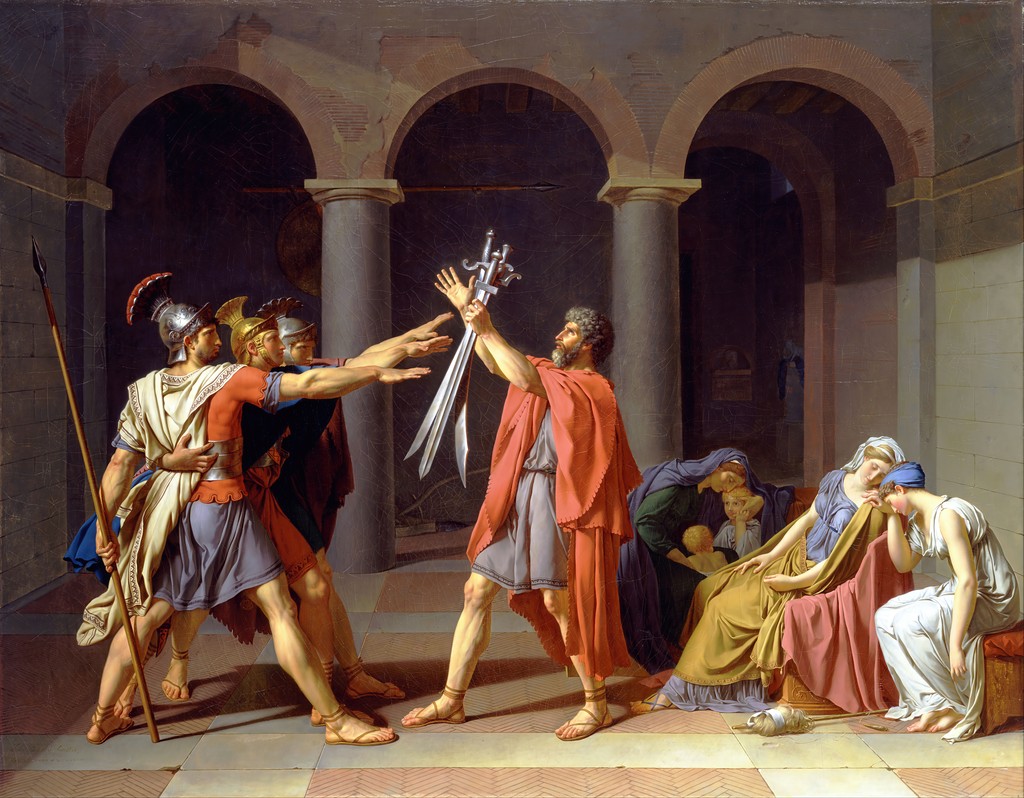
It is also far from the David many readers first meet through The Oath of the Horatii or The Death of Socrates. Those works depend on duty, self-command and moral clarity. Love and Psyche keeps the classical subject but shifts the pressure toward sexuality, youth, secrecy and the uneasy boundary between ideal form and physical reality. [1] [5]
That shift does not mean David abandoned seriousness. Rather, seriousness takes a different form. The painting is not civic in the way Horatii is civic, and it is not philosophical in the way Socrates is philosophical. Its drama lies in the private encounter between myth and body. By painting Cupid as visually awkward and self-conscious, David makes the god of love less remote and less noble. The myth becomes more human, and therefore more troubling. [1] [5]
The Mythological Subject
The story of Cupid and Psyche was one of the great love myths of the ancient world. Psyche is a mortal woman of extraordinary beauty. Cupid visits her secretly at night, with the condition that she must not know his identity. The relationship is therefore built on desire and concealment. Psyche's eventual wish to see her lover breaks the terms of the arrangement and sets the later trials of the myth in motion. [1]
David does not paint the full story. He selects a private aftermath: Psyche sleeps, while Cupid is awake beside her. The open window and morning light suggest that night is ending. The secrecy of the nocturnal visit is about to be threatened by day. [1]
Cleveland's description is important because it names David's originality. Cupid was usually presented as an ideal adolescent or beautiful youth. David instead gives him a less flattering force: an ungainly teenager with a smirk, aware of his physical conquest and looking outward toward the viewer. This Cupid does not dissolve into poetic sweetness. He makes the myth feel bodily and even uncomfortable. [1]
Psyche, by contrast, sleeps. She is beautiful, pale and still, but not fully in command of the scene. Her eyes are closed. Cupid's gaze is open. This imbalance gives the painting its modern unease. The viewer is not simply invited to admire an ideal pair. The viewer is placed in a room where one figure is awake, self-conscious and almost conspiratorial, while the other remains unaware. [1]
Looking at the Painting
The composition is horizontal and intimate. The lovers occupy a bed, surrounded by drapery and lit by a clear attention to skin, fabric and the open window behind them. Cupid's wings identify him as divine, but his body is not heroic in the usual sense. He is awkward, adolescent and physically present. [1]
Psyche's body is smoother and more classically poised. She lies asleep, her form curved and luminous, closer to the idealising tradition many viewers expect from mythological painting. David sets her against Cupid's angularity. The contrast is not accidental. It makes the painting a study in two different kinds of beauty: one polished and one deliberately uneasy. [1]
The open window is crucial. It gives the picture air and landscape, but it also introduces time. The myth depends on night and concealment. Daylight threatens to expose what has been hidden. In this sense, the window is not decorative. It is narrative pressure. [1]
Cupid's bow and related attributes keep the subject legible, while the butterflies deepen Psyche's identity. Cleveland's note about the two butterflies is a reminder that the image contains symbolic delicacy even when Cupid's face resists ideal sweetness. The painting is not crude. It is sophisticated because it lets grace and discomfort occupy the same room. [1]
The bed frame, drapery and physical closeness of the bodies also matter. David does not place the lovers in an abstract cloud or remote mythological heaven. He gives them a bed. The scene is earthly, material and tactile. That is why Cleveland's conflict between idealised love and physical reality is such a useful frame for the painting. [1]
The painting's size deepens that tension. A small erotic mythological picture might be consumed as private fantasy. David's canvas is large, deliberate and difficult to ignore. The viewer has to confront the sleeping body, the waking god and the smirking glance at a scale closer to public history painting. That mismatch between subject intimacy and canvas ambition gives the work much of its late strangeness. [1]
Late Style and Unease
Love and Psyche has often seemed strange because it does not behave like a simple late return to classical beauty. David had spent decades making ancient subjects morally legible. Here, antiquity becomes less stable. Cupid is not the perfect god of love. Psyche is not the fully awakened heroine. The scene is suspended between pleasure, secrecy and impending discovery. [1] [5]
This instability is one of the painting's strengths. David's earlier classical works often ask the viewer to admire discipline: the oath, the chosen death, the public sacrifice. In Love and Psyche, discipline loosens. The body, the bed and the glance become more important than civic action. The painting feels private, but it is not innocent. [1] [5]
The late mythological paintings also show David looking beyond the public language that had made him famous. In Brussels, he no longer had to build legitimacy for the Revolution or the Empire. He could explore myth as a field of memory, desire and ambiguity. That does not make the late works escapist. They are shaped by the loss of public political purpose, and they ask what history painting can become when public certainty has broken down. [1] [5]
Love and Psyche is especially sharp because Cupid looks at the viewer. The look interrupts passive looking. It makes the viewer aware of occupying the space of the room. Cupid's smirk is not simply an expression inside the story; it is a challenge outward. The viewer becomes implicated in the scene's secrecy and awkward pleasure. [1] [5]
Related Drawing and Working Process
Cleveland also owns a related drawing, Cupid and Psyche, dated 1813, accession number 2002.91. The museum describes it as part of a group of preparatory studies for the final painting. The drawing is gray wash and pen and black ink with white paint and traces of black chalk, and it shows that David had worked out the composition several years before completing the canvas. [3] [4]
The drawing's record notes that David integrated looser charcoal sketches into a more finished composition, with only minor details changed in the final painting, including Cupid's facial expression. That is important because Cupid's expression is one of the final canvas's most unsettling features. The shift from study to painting was not just mechanical. David refined the psychological charge of the image. [3] [4]
The drawing also has a strong provenance: Cleveland records that scholars believe David gave it to his pupil, the Comte de Forbin, in thanks for his devotion. That tradition should remain attached to the drawing, not transferred to the painting without evidence. But it reinforces the wider point that late David's mythological works were not casual inventions. They were built through drawing, revision and careful preparation. [3] [4]
The Met's Radical Draftsman exhibition is useful here because it framed David's drawings as a way to see beyond public success into the progress of ideas. Love and Psyche benefits from that approach. The finished painting may look startling, but it came from sustained compositional thought. [3] [4]
The drawing also helps control interpretation. It shows that the final canvas was not simply an impulsive late provocation. David had considered the arrangement, the relation between sleeping Psyche and alert Cupid, and the role of expression. The finished Cupid's face may feel unexpected, but it was part of a worked-out pictorial decision. That makes the awkwardness harder to dismiss as accident or decline. [3] [4]
Provenance and Exhibition History
The Cleveland provenance for the painting begins with Giovanni Battista, Comte de Sommariva, whose sale took place in February 1839. It then passed through Dubois, James Alexandre Comte de Pourtales, Madame de Furtado, and later Murat family ownership before Rosenberg and Stiebel sold it to the Cleveland Museum of Art in 1962. [1] [2] [5]
This provenance matters because it gives the painting a European collecting history before its American museum life. It also connects the work to Sommariva, an important collector associated with David's late period. Commission language should be used only where securely sourced, but Cleveland's provenance confirms that the painting was in Sommariva's orbit by the 1839 sale. [1] [2] [5]
The exhibition history is also unusually rich. Cleveland lists the work in the 1817 Brussels charitable exhibition for Sainte-Gudule and the Ursulines, in Ghent City Hall in 1817 according to Dowd, in Paris in 1826 for the benefit of the Greeks, in the Orangerie David bicentenary exhibition of 1948, in The Age of Neoclassicism in 1972, and in Jacques-Louis David: Empire to Exile at the Getty and the Clark in 2005. [1] [2] [5]
That history shows that Love and Psyche has repeatedly been treated as a serious late David, not a marginal curiosity. Its difficulty is part of its importance. The painting asks viewers to revise a narrow idea of David as only a painter of republican austerity or imperial pageantry. [1] [2] [5]
The Brussels exhibition context is especially important. The painting entered public view after David's exile had begun, in a setting very different from the Paris Salon culture of his youth or the imperial commissions of Napoleon's reign. A late mythological painting by David could now circulate as a work by a celebrated but politically displaced master. Its reception therefore belongs to the afterlife of public reputation as much as to the mythology of Cupid and Psyche. [1] [2] [5]
The 2005 Empire to Exile exhibition at the Getty and the Clark confirms that modern scholarship has found real importance in this late phase. David after Napoleon was not just repeating himself. He was making complex images in a changed political and personal world. Love and Psyche is one of the paintings that proves the point. [1] [2] [5]
Why the Painting Matters
Love and Psyche matters because it shows David pushing mythological painting toward discomfort. The subject could have produced sweetness, tenderness or ideal romance. Instead, David gives the viewer an ungainly Cupid, a sleeping Psyche, a charged bed, an opening window and a mood that is both beautiful and troubling. [1] [5]
It also matters because it belongs to the exile sequence. After Revolution and Napoleon, David did not simply repeat his earlier formulas. He returned to antiquity with new uncertainty. The ancient world no longer guaranteed civic virtue or heroic clarity. It could also reveal desire, awkwardness and the strange comedy of bodies. [1] [5]
For David's wider career, the Jacques-Louis David biography places the painting within exile and late mythological production. The David paintings hub sets it among his history paintings, portraits, Revolutionary images and late works. [1] [5]
For related late subjects, compare The Farewell of Telemachus and Eucharis, The Anger of Achilles and Mars Being Disarmed by Venus. For another David page around Psyche, see Psyche Abandoned. Together, these works show late David loosening the severe moral structure of his earlier art while keeping the classical body at the centre of the question. [1] [5]
Frequently Asked Questions
Discussion
Love and Psyche asks readers to study how David turns mythological intimacy into a strange late-career test of ideal beauty and physical unease.
Use the prompts below to think about Cupid's gaze, Psyche's sleep, daylight and the painting's open-access Cleveland object record.
Reader Insights
How does Cupid's outward look change the viewer's role in this private mythological scene?
Why does the open window matter in a story built around secrecy and night?
What feels different here from the moral severity of Horatii or Socrates?
Join the Conversation
Share your reading of Love and Psyche below.
References
- Cleveland Museum of Art, Cupid and Psyche, accessed 27 July 2026.
- Cleveland Museum of Art, Cupid and Psyche print record, accessed 27 July 2026.
- Cleveland Museum of Art, Cupid and Psyche drawing, accessed 27 July 2026.
- Metropolitan Museum of Art, Jacques Louis David: Radical Draftsman, accessed 27 July 2026.
- Getty Museum, Jacques-Louis David: Empire to Exile, accessed 27 July 2026.