Buy Art Prints Now
from Amazon
* As an Amazon Associate I earn from qualifying purchases.
 by Tom Gurney
Tom Gurney BSc (Hons) is an art history expert with over 20 years experience
Published on June 19, 2020 / Updated on October 16, 2026
Email: tomgurney1@gmail.com / Phone: +44 7429 011000
Madame David: Introduction
Madame David is one of Jacques-Louis David's most revealing late portraits because it turns the painter's public world inward. The sitter is Marguerite-Charlotte David, née Pécoul, David's wife, painted in 1813. The National Gallery of Art in Washington records the work as an oil on canvas, gives its overall size as 72.9 by 59.4 cm, and identifies it with accession number 1961.9.14 in the Samuel H. Kress Collection. [1]
The portrait comes from a moment when David was still closely tied to Napoleonic power. Only a year earlier he had painted The Emperor Napoleon in His Study at the Tuileries, another work now at the National Gallery of Art. Yet Madame David is not a state portrait. It is domestic, personal and unusually direct: a painter looking at the woman who had lived beside him through the Revolution, the Empire and the pressures that eventually led toward exile. [1]
At a Glance
- ArtistJacques-Louis David [1]
- TitleMadame David [1] [3]
- Active URL/jacques-louis-david/madame-david/ [1]
- Date1813 [1]
- MediumOil on canvas [1]
- CollectionNational Gallery of Art, Washington [1]
- Accession1961.9.14 [1] [3]
- Dimensions72.9 by 59.4 cm [1]
- SitterMarguerite-Charlotte David, née Pécoul [1]
- Collection CreditSamuel H. Kress Collection [1]
- Title VariantPortrait of Marguerite-Charlotte David, née Pécoul [1]
- Image CautionNGA/Open Access support is strong; exact file match and credit line should remain tied to the museum record [1] [2] [3]
Contents
- Introduction
- Object Identity
- Marguerite-Charlotte David
- Looking at the Portrait
- Provenance and Afterlife
- Image and Source Cautions
- Why Madame David Matters
Object Identity
The National Gallery of Art gives a secure object record for the painting. It is titled Madame David, dated 1813, attributed to Jacques-Louis David, and held in Washington as part of the Samuel H. Kress Collection. The work is on view in the West Building, Gallery M56, according to the NGA record. The museum also marks the image media as free and in the public domain, making it comparatively well supported for public use. [1] [2] [3]
The sitter identity is also unusually clear. The NGA provenance begins with a bequest in 1826 by the sitter, Marguerite-Charlotte David, née Pécoul, to her daughter Baronne Claude-Marie Meunier, née Laure-Emilie-Félicité David. The museum notes that David's own chronological list of works from around 1815 included the portrait of his wife. Later exhibition history includes the major Louvre and Versailles David exhibition of 1989-1990 and the 2005 exhibition Jacques-Louis David: Empire to Exile, where the work appeared as Portrait of Marguerite-Charlotte David, née Pécoul. [1] [2] [3]
That title variant is useful rather than confusing. Madame David is the established short title. Portrait of Marguerite-Charlotte David, née Pécoul makes the sitter identity explicit. Both point to the same work in Washington. [1] [2] [3]
Marguerite-Charlotte David
Marguerite-Charlotte Pécoul was not an incidental sitter in David's career. She was his wife and part of the social world that framed his movement between private life and public politics. The portrait was painted after the heroic Republican canvases and during the Napoleonic period, when David's art had become bound to public authority. That makes the intimacy of the picture important. It does not withdraw from history, but it shows a different scale of history: a household, a marriage and a face seen at close range. [1]
David's portraits often turn on the relation between character and pose. In Madame Récamier, the sitter becomes an icon of modern elegance, stretched across a spare Neoclassical setting. In Portrait of Pope Pius VII, ceremony, religion and diplomacy sit behind the likeness. Madame David is quieter. It depends less on public role and more on presence, dress and the emotional compression of a familiar face. [1]
The painting also belongs beside David's earlier family portraits, including Portrait of Francois Buron, Portrait of Madame Francois Buron and Portrait of Marie-Francoise Buron. Those 1769 works show the young artist looking at relatives in the household that shaped his training. Madame David shows the mature artist returning to a private sitter, but with decades of public painting behind him. [1]
Looking at the Portrait
The NGA visual description emphasizes the sitter from the lap up, facing the viewer in a yellow upholstered chair. She wears a white high-waisted dress with lace at the neckline and short puffed sleeves. A white feathered headpiece frames her brown curls, and a red shawl with silver and blue trim rests around her arm and chair. Her arms are crossed lightly at the wrist, and her hands rest in her lap. [1]
The arrangement is simple, but David makes it substantial. The dark background sets off the pale dress, the feathered headwear and the warm yellow of the chair. The red shawl adds a note of color without overwhelming the sitter. The crossed arms create a compact shape, closing the body gently inward while the face remains open to the viewer. [1]
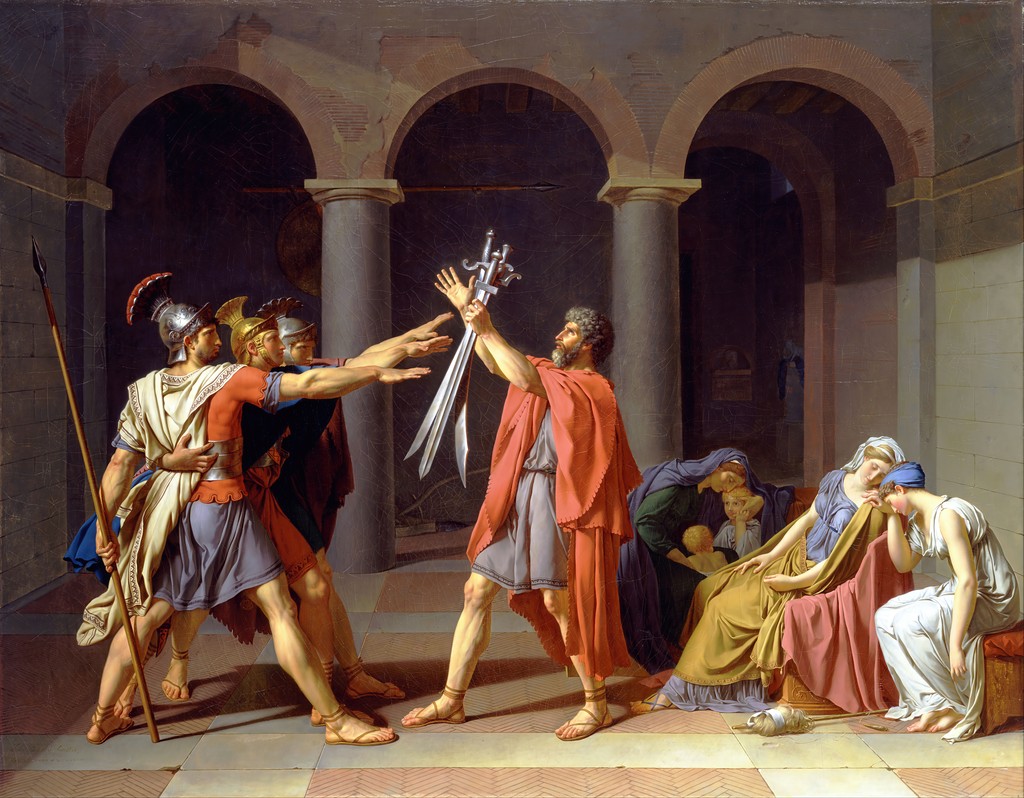
This is not the severe geometry of The Oath of the Horatii or the sharpened moral drama of The Death of Socrates. It is portraiture built from tact. David gives Marguerite-Charlotte a poised, slightly guarded dignity. The face is alert but not theatrical. The costume is fashionable but not merely decorative. The chair, dress and shawl create social position; the expression keeps the picture human. [1]
The signed and dated inscription recorded by the NGA places the portrait firmly in 1813. That date matters. It comes near the end of David's Paris career, before Napoleon's fall and before the final Brussels years. The portrait therefore sits at a threshold: still imperial in date, but domestic in subject; still polished and public enough to be exhibited later, but intimate in its first meaning. [1]
Provenance and Afterlife
The NGA provenance keeps the painting close to David's family for much of its early history. After Marguerite-Charlotte David's 1826 bequest to her daughter, the work passed through descendants and family connections before entering the art market in the twentieth century. It was with Pierre Cailleux in Paris after the Second World War, jointly owned by Otto Wertheimer and M. Knoedler & Co. from 1953, sold to the Samuel H. Kress Foundation in 1954, and given to the National Gallery of Art in 1961. [1]
That path reinforces the portrait's dual character. It began as a family image, then became a museum object and a public example of David's late portraiture. Exhibition history helped shift it from domestic memory into art-historical evidence, especially in shows devoted to David's school, French painting and the movement from Empire to exile. [1]
Image and Source Cautions
Image reference: the page image follows the National Gallery of Art and Commons record by title and object number, while the credit line should stay tied to the museum object record. The NGA object page marks the media as free and public domain, and the NGA Open Access page supports reuse, making this a strong source-backed image candidate for NGA accession 1961.9.14. [1] [2] [3]
Why Madame David Matters
Madame David matters because it widens the reader's idea of David. The artist can seem dominated by public events: The Death of Marat, The Coronation of Napoleon, imperial portraits and political martyr images. This work shows the same painter in a private register, using the discipline of Neoclassical portraiture for a sitter whose identity was personal before it was historical. [1]
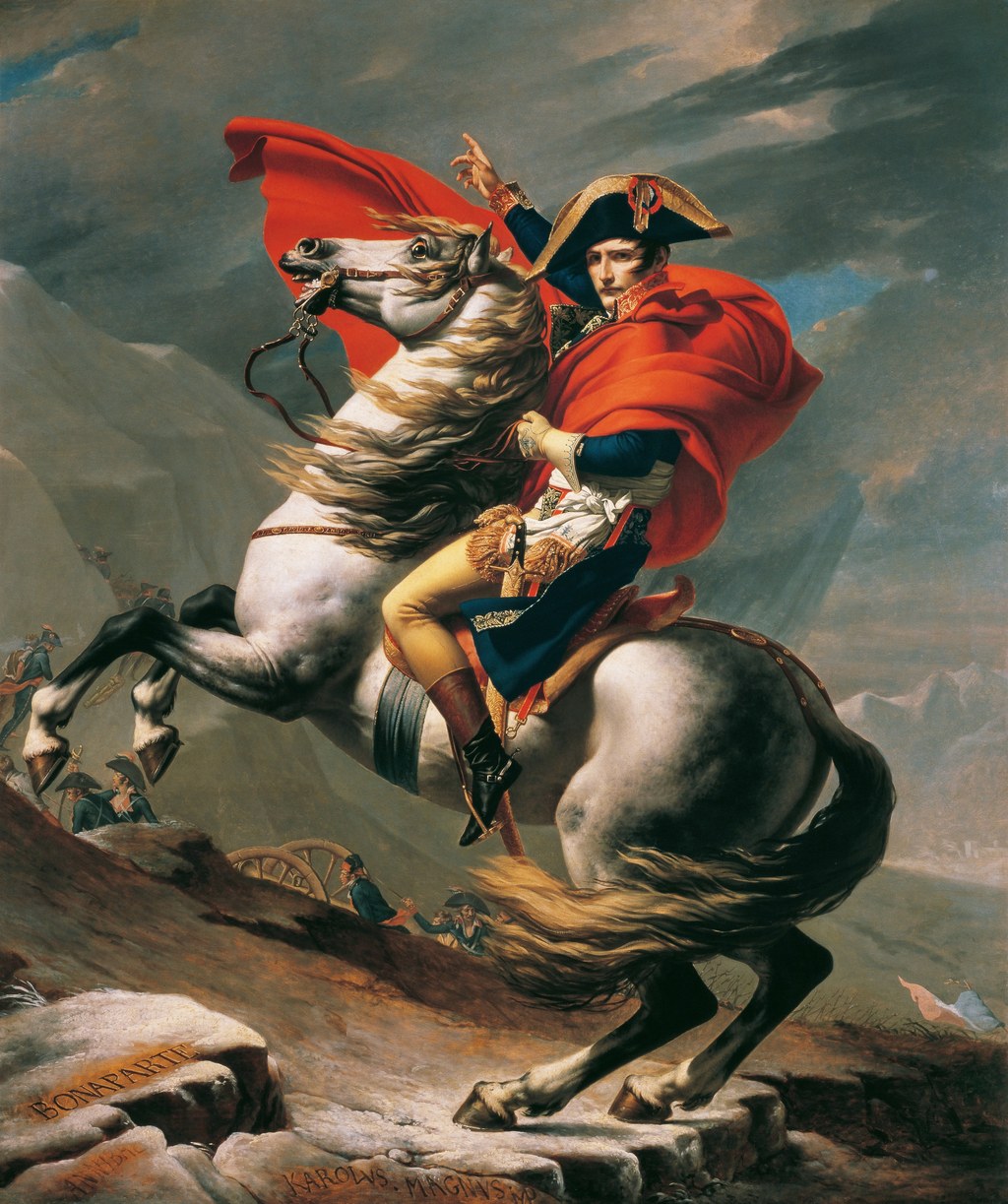
For the wider shape of David's life, see the Jacques-Louis David biography. For his portrait practice across public, political and intimate settings, compare Madame Récamier, Self Portrait, Portrait of Pope Pius VII and Unfinished Portrait of General Bonaparte. For a broader view of David's artwork, use the David paintings hub. [1]
Frequently Asked Questions
Discussion
Madame David turns David's public portrait discipline toward an intimate late-career sitter: his wife, Marguerite-Charlotte David.
Use the prompts below to think about domestic portraiture, Napoleonic context and the path from family memory to museum object.
Reader Insights
How does the sitter's identity as David's wife change the portrait's emotional register?
What changes when an 1813 Napoleonic-period portrait is domestic rather than ceremonial?
How does family provenance affect the way the painting becomes public art history?
Join the Conversation
Share your reading of Madame David below.
References
- National Gallery of Art, Madame David, accessed 27 July 2026.
- National Gallery of Art, Open Access Images, accessed 27 July 2026.
- Wikimedia Commons, Jacques-Louis David, Madame David, 1813, NGA 46113.jpg, accessed 27 July 2026.