Buy Art Prints Now
from Amazon
* As an Amazon Associate I earn from qualifying purchases.
 by Tom Gurney
Tom Gurney BSc (Hons) is an art history expert with over 20 years experience
Published on June 19, 2020 / Updated on October 16, 2026
Email: tomgurney1@gmail.com / Phone: +44 7429 011000
Mars Being Disarmed by Venus: Introduction
Mars Being Disarmed by Venus is Jacques-Louis David's last great history painting. Completed in Brussels in 1824, the year before his death, it stands at the far end of a career that had passed through royal patronage, Revolutionary politics, Napoleonic power and exile. The painting is now in the Musées royaux des Beaux-Arts de Belgique in Brussels, the city where David spent his final years. [1] [2] [6]
The subject is mythological rather than political in the obvious sense. Venus and the Graces disarm Mars, the god of war. Cupid is present, and the setting is a cloud-borne classical interior. Yet the painting is not simply a decorative fantasy. It is a late statement by an artist whose life had been shaped by war, revolution and the collapse of political systems. David returns to the gods, but he does so after history has exhausted many of the public certainties that once gave his painting its force. [1] [2] [6]
The painting belongs beside the late and exile works in David's cluster: The Anger of Achilles, Love and Psyche and The Farewell of Telemachus and Eucharis. Those paintings show David turning to myth, beauty and erotic tension after the public stages of Paris had closed to him. Mars Being Disarmed by Venus makes that late turn monumental. [1] [2] [6]
At a Glance
- ArtistJacques-Louis David [1]
- Source TitleMars desarme par Venus [1]
- Active TitleMars Being Disarmed by Venus [1] [2]
- Date1824 [1]
- MediumOil on canvas [1]
- Dimensions308 by 265 cm [1]
- CollectionMusees royaux des Beaux-Arts de Belgique, Brussels [1]
- Inventory3261 [1]
- SignatureL. David Brux 1824 [1]
- ContextLate Brussels/exile history painting [2] [6]
- Source CautionKeep late-style readings interpretive and distinguish studies/satire from the final painting [2] [3] [4] [5]
Contents
- Introduction
- Object Identity
- David in Brussels
- Mythological Subject
- Composition and Style
- Late Style
- Reception
- Why It Matters
Object Identity
The Royal Museums of Fine Arts of Belgium identify the painting as Mars désarmé par Vénus, dated 1824, inventory number 3261. The museum record gives the medium as oil on canvas and records the signature, place and date near the lower left on a step: L. David Brux 1824. It gives the dimensions as 308 x 265 cm and states that the work came from the bequest of Jules David-Chassagnol, Paris, in 1886, entering the museum in 1893. [1]
Those facts make the Brussels context secure. This is not a loose attribution or a later copy. It is a signed late canvas by David, preserved in the Belgian royal museum that also holds The Death of Marat. The work's local route, `/jacques-louis-david/mars-being-disarmed-by-venus/`, preserves the existing English title, while the full source title and variant English title, Mars Disarmed by Venus and the Graces, should remain available in references and captions. [1]
The dimensions also matter. At more than three metres high, the painting is large enough to announce itself as history painting rather than an intimate mythological scene. David had painted giant civic and imperial canvases before, from the Revolutionary projects to The Coronation of Napoleon and The Distribution of the Eagle Standards. Mars Being Disarmed by Venus does not have the same public commission context, but it keeps the ambition of scale. [1]
David in Brussels
David moved to Brussels after the Bourbon Restoration because of his Revolutionary and Napoleonic past. The painting therefore belongs to exile, not retirement in the quiet sense. He was old, but still active. He painted portraits, mythological subjects and late drawings, and he remained an artist whose name carried political memory. [2] [6]
Satish Padiyar's RIHA Journal article treats Mars Disarmed by Venus and the Graces as a final public history painting made in relation to late style and exile. The article notes that the work was completed in Brussels around twenty months before David's death in December 1825, and that David exhibited it in Restoration Paris and politically neutral Brussels. It also records the surprise of Paris viewers in 1824 at the ambition and virtuosity of a painter in his mid-seventies. [2] [6]
That reception context helps prevent a lazy reading of the work as mere late decline. The painting may be odd, artificial and difficult, but it was not a timid ending. David made a large, polished, provocative picture at the moment when Romanticism was becoming a powerful public alternative. In 1824, Delacroix's Massacre of Chios was shown at the Salon. David, from exile, answered with a classical world of bodies, clouds, theatre and disarmament. [2] [6]
The Mythological Subject
The painting shows the god of war surrendering his martial identity to love and pleasure. Mars reclines while Venus and the Graces remove or handle the attributes of war. Cupid participates in the disarming. The source tradition around Mars and Venus is not only noble allegory. Classical literature often treats their union with comedy, erotic exposure and embarrassment. [2] [4]
That comic or unstable quality is important. The painting is sometimes described as an allegory of Peace, and that reading is supported by the basic subject: war is disarmed by love. But the image is not a simple moral slogan. Mars does not look like a defeated battlefield enemy. He appears passive, languid and available. Venus does not conquer through violence. She alters the scene through seduction, ritual and touch. [2] [4]
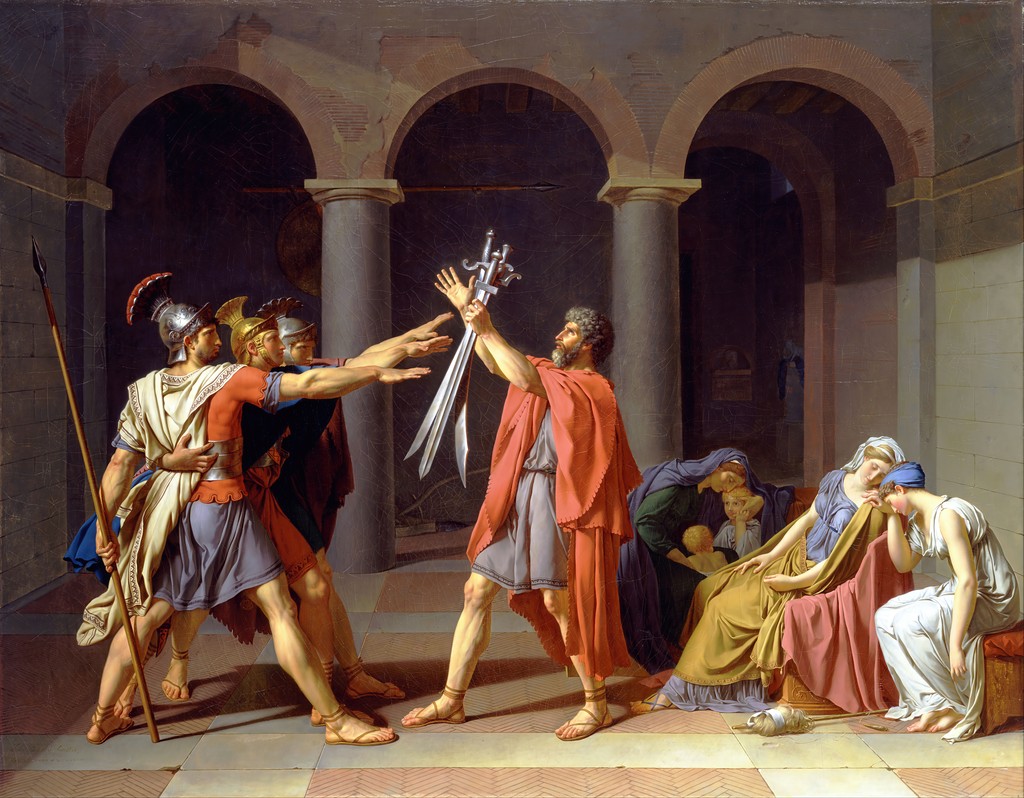
The Three Graces help make the action elegant, but they also make it busy. Helmets, arms, shields, flowers, drapery and bodies compete for attention. The painting does not have the austere clarity of The Death of Socrates or the severe geometry of The Oath of the Horatii. It is polished, crowded and knowingly theatrical. [2] [4]
The mythological subject allowed David to speak indirectly. He no longer had a revolutionary ceremony or imperial commission to anchor the picture in public life. Instead, he used a classical scene to think about the end of heroic action, the transformation of war, and perhaps the exhaustion of the stern moral language that had made him famous. [2] [4]
Composition and Style
The composition sets Mars and Venus on a raised bed or couch, surrounded by attendants and set high among clouds. The large vertical format creates a stage-like effect. The scene seems lifted away from ordinary ground, as if the viewer is looking into a theatre of myth rather than a historical room. [1] [3] [4]
Mars is the nominal god of war, but the painting weakens his authority. He is seated or reclining, not charging. His weapons and armour are being taken from him. Venus, the Graces and Cupid occupy the action. War is present as a body and as objects; love is present as movement, touch and ceremony. [1] [3] [4]
POP's record for a related Besançon study gives a useful iconographic description for David's Mars and Venus project. It describes Mars seated on his bed with lance and sword, Venus nude and reclining beside him with a flower crown, Cupid kneeling before the couch to remove Mars's sandals, and the Graces behind carrying away helmet, bow and shield. That drawing is not the Brussels painting, but it confirms the structure of the subject and the importance of the disarming action in David's planning. [1] [3] [4]
The Louvre also preserves a study for Mars désarmé par Vénus et les Grâces, inventory RF 23007, 45, in the Department of Prints and Drawings. The record identifies it as graphite and connects it to an album that also includes studies for the Sacre and the Distribution of the Eagles. That context is suggestive: even in a late mythological project, David's working materials sit beside studies for his great Napoleonic state paintings. [1] [3] [4]
Late Style Without Certainty
It is tempting to turn Mars Being Disarmed by Venus into David's final confession. The temptation should be resisted. The painting was made at the end of his life, and it clearly invites late-style interpretation, but no single psychological key unlocks it. Sources support cautious claims: it is late, made in exile, large, mythological, and understood by modern scholars as bound up with the end of David's political and artistic world. [2] [6]
Padiyar's reading is especially valuable because it treats the work as more than a weak afterword. He argues that the painting stages a critical disarming of the Neoclassical aesthetic itself. That is a strong scholarly interpretation, not a museum object fact, so it should be used as interpretation rather than certainty. [2] [6]
The painting can look almost deliberately paradoxical. It is classical, but not severe. It is an allegory of peace, but it is full of erotic play. It is a farewell work, but it is huge and assertive. It arrives after war and empire, but it chooses gods rather than modern politics. These tensions are the point. David's final canvas does not resolve his career into a neat moral. It leaves the viewer with a beautiful, uneasy dismantling of heroic energy. [2] [6]
Reception and Afterlife
The painting attracted attention when exhibited in Paris in 1824, partly because David was still a charged figure there. He was absent from France as an exile, yet his work returned to the Parisian public. That return matters. David's body remained outside French political life, but his painting could still enter the arena of criticism and spectatorship. [2] [5] [6]
The work also became a target for satire. The Art Institute of Chicago holds a lithograph after David's final history painting, titled Loveless Disarming Himself. Its catalogue explains that the print transforms Mars into a weary French officer and the goddesses into women who pilfer his battle gear, turning David's cloud-borne classical scene into a crude brothel parody. This response shows that viewers did not always treat the painting with reverence. Its combination of eroticism, antique costume and disarmed masculinity could be mocked. [2] [5] [6]
That mockery is useful evidence. It reminds us that late David was not safely monumental in everyone's eyes. The painting was big, polished and ambitious, but also vulnerable to charges of theatricality, artificiality or old-fashioned classicism. Its afterlife includes admiration, discomfort and parody. [2] [5] [6]
The modern recovery of David's later work has changed the tone. The Getty's Empire to Exile exhibition presented David's post-1790s career as complex rather than merely declining. RIHA's later scholarship placed Mars Disarmed at the centre of questions about exile, subjectivity and the end of Neoclassical political language. The painting now looks less like an eccentric footnote and more like a final problem posed by the artist himself. [2] [5] [6]
The survival of preparatory studies strengthens that modern view. The Besançon POP record notes that several sketches are related to the final canvas, with material divided among Besançon, Lille, Montauban and Cambridge. The Louvre album sheet adds another route into David's workshop. These records show that the late painting was not a casual flourish but a worked-out project with a documentary trail across drawings, studies and the final Brussels canvas. [2] [5] [6]
Why the Painting Matters
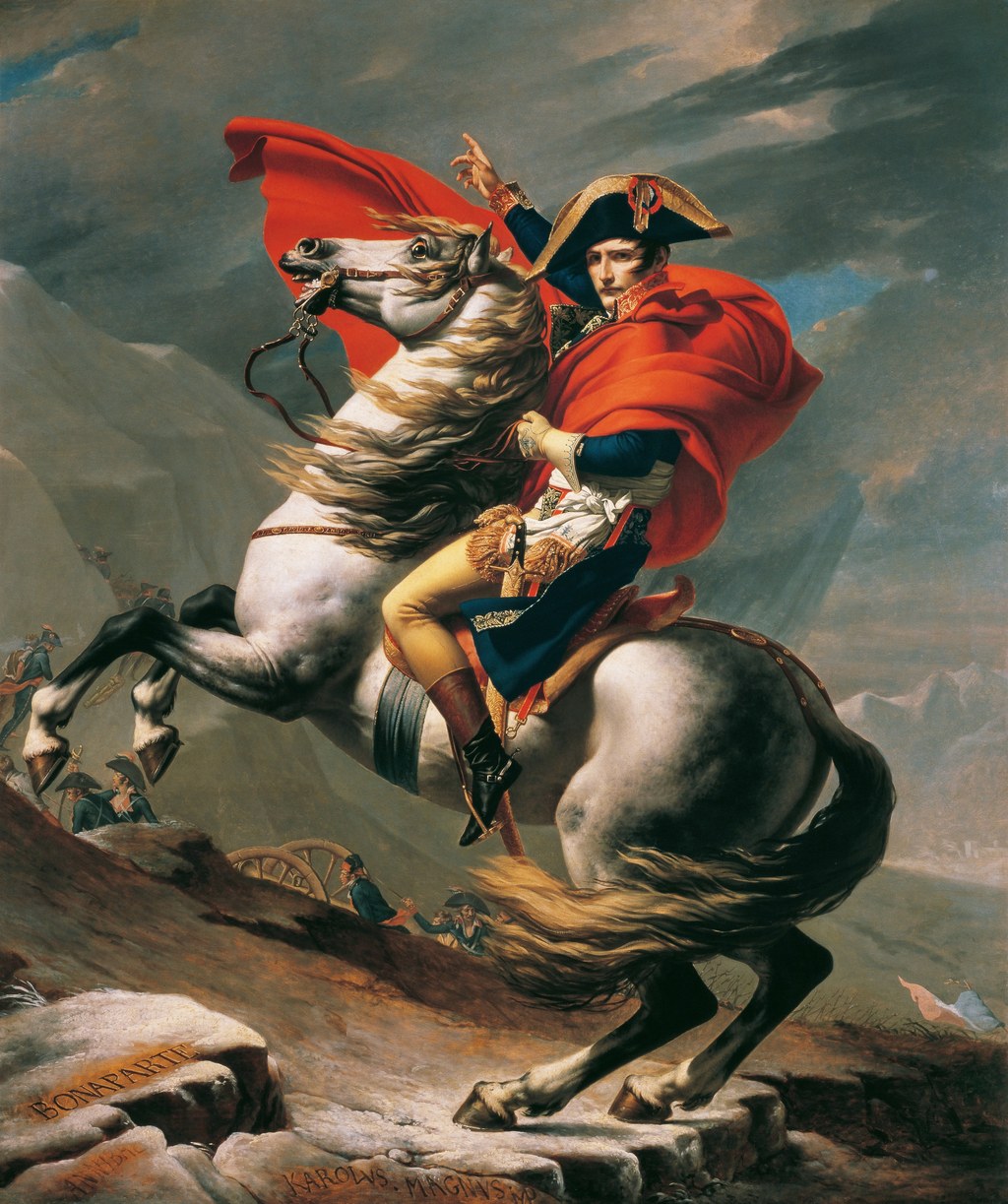
Mars Being Disarmed by Venus matters because it shows David ending with ambiguity. Earlier in his career he often made action look morally clear. Horatii demands sacrifice. Socrates chooses death. Marat becomes martyr. Napoleon crosses the Alps or receives loyalty from the army. In this final mythological painting, action is undone. The warrior is disarmed; the heroic body relaxes; power slips into ceremony and pleasure. [1] [2] [6]
That does not mean the painting is apolitical. Its politics are indirect. A man who had lived through Revolution, Terror, Empire, Restoration and exile painted the god of war being gently stripped of his weapons. The allegory is not a programme for peace, but it is impossible to separate from the historical weight behind it. [1] [2] [6]
For readers, the best route through the late David pages is to compare this painting with Love and Psyche, The Farewell of Telemachus and Eucharis and Anger of Achilles. All three show myth becoming a language for desire, restraint, youth, farewell and conflict. Mars Being Disarmed by Venus expands that late mythological language to the scale of a final history painting. [1] [2] [6]
It is not the austere David many readers expect. That is exactly why it is important. The painting lets the cluster end with a question rather than a monument: what happens to a painter of heroic public action when the old political causes are gone, the new art is moving elsewhere, and war itself is imagined as a body being gently disarmed? [1] [2] [6]
Frequently Asked Questions
Discussion
Mars Being Disarmed by Venus asks readers to study David's final large history painting as both a mythological scene and a late work made from exile.
Use the prompts below to think about disarmament, theatrical classicism and the difference between source-backed object facts and late-style interpretation.
Reader Insights
How does the painting change when it is read as David's last major history painting rather than as a decorative myth alone?
Does Mars seem defeated, seduced, relaxed or transformed by the actions of Venus, the Graces and Cupid?
How does this late mythological canvas compare with David's earlier public images of sacrifice, oath and political power?
Join the Conversation
Share your reading of Mars Being Disarmed by Venus below.
References
- Musees royaux des Beaux-Arts de Belgique, Mars desarme par Venus, accessed 27 July 2026.
- RIHA Journal, Satish Padiyar, Last Words: David's Mars Disarmed by Venus and the Graces (1824), accessed 27 July 2026.
- Louvre Collections, Etude pour Mars desarme par Venus et les Graces, accessed 27 July 2026.
- POP: Plateforme ouverte du patrimoine, Etude pour Mars desarme par Venus et les Graces, accessed 27 July 2026.
- Art Institute of Chicago, Loveless Disarming Himself, accessed 27 July 2026.
- Getty Museum, Jacques-Louis David: Empire to Exile, accessed 27 July 2026.