Buy Art Prints Now
from Amazon
* As an Amazon Associate I earn from qualifying purchases.
 by Tom Gurney
Tom Gurney BSc (Hons) is an art history expert with over 20 years experience
Published on June 19, 2020 / Updated on October 16, 2026
Email: tomgurney1@gmail.com / Phone: +44 7429 011000
Portrait of Anne Marie Louise Thélusson, Countess of Sorcy: Introduction
Jacques-Louis David painted Anne-Marie-Louise Thélusson, Comtesse de Sorcy in 1790, at a moment when portraiture gave him a quieter way to register the social changes around Revolutionary Paris. The painting belongs today to the Bayerische Staatsgemäldesammlungen and is associated with the Neue Pinakothek in Munich. It is recorded as an oil on canvas measuring 129 x 97 cm, with inventory number HUW 21. The sitter, born Anne-Marie-Louise Rilliet, had married Jean-Isaac Thélusson, Comte de Sorcy, in 1787, and David's portrait places her inside a world of wealthy Protestant banking families, new titles, refined patronage and changing ideas of public self-presentation. [1] [3]
This is not one of David's large civic dramas like The Oath of the Horatii or The Death of Socrates. Its power is more compressed. A young woman sits before a grey background in a white dress and pale shawl, posed with a formal stillness that avoids the crowded interiors and status props common in elite portraiture. David gives her rank without theatrical clutter. The result is a portrait that feels controlled, modern and slightly severe, while still carrying the intimacy of a private likeness. [1] [3]
At a Glance
- ArtistJacques-Louis David [1] [2] [3]
- Public Page TitlePortrait of Anne Marie Louise Thélusson, Countess of Sorcy [1] [3]
- Institutional TitleAnne-Marie-Louise Thélusson, Comtesse de Sorcy [1]
- French TitlePortrait d'Anne-Marie-Louise Thélusson, comtesse de Sorcy, née Rilliet [3]
- Active URL/jacques-louis-david/portrait-of-anne-marie-louise-thelusson-countess-of-sorcy/ [1]
- Date1790 [1] [2] [3] [4]
- MediumOil on canvas [1] [2] [3] [4]
- Dimensions129 x 97 cm [1] [2] [3] [4]
- InventoryHUW 21 [1] [2] [3] [4]
- CollectionBayerische Staatsgemäldesammlungen - Neue Pinakothek [1] [2] [3]
- Loan StatusPermanent loan from HypoVereinsbank, Member of UniCredit [1] [3]
- Display StatusPinakothek record lists the painting as not on display; status may change [1]
- SitterAnne-Marie-Louise Rilliet, Comtesse de Sorcy after marriage [1] [3]
- Marriage ContextMarried Jean-Isaac Thélusson, Comte de Sorcy, in 1787 [1] [3]
- Image CautionCurrent page image retained; Pinakothek, bavarikon and Commons credit routes remain for later image review [1] [2] [4]
Contents
- Introduction
- Object Facts and Present Collection
- The Sitter and the Thélusson Circle
- David's Portraiture in 1790
- Dress, Pose and Background
- A Portrait Between Intimacy and Rank
- Image and Source Cautions
- Why the Painting Matters
Object Facts and Present Collection
The Pinakothek collection record identifies the painting as Anne-Marie-Louise Thélusson, Comtesse de Sorcy by Jacques-Louis David, dated 1790. It lists the medium as oil on canvas, the dimensions as 129 x 97 cm and the inventory number as HUW 21. The record also states that the work is a permanent loan from HypoVereinsbank, Member of UniCredit, and that the bank acquired it from private ownership in 1971. The painting is currently listed as not on display in the Pinakothek database, a reminder that collection status can change even when the public identity of the object is stable. [1] [2] [3] [4]
Bavarikon, using data from the Bayerische Staatsgemäldesammlungen, gives the same core facts and adds a useful rights note for the digital object and metadata. For readers, this matters because the artwork itself is long out of copyright, but modern reproductions can still carry platform-specific terms. Any reproduction should therefore be read alongside a clear credit to the holding collection and a careful note of the image provider. [1] [2] [3] [4]
The Sitter and the Thélusson Circle
Anne-Marie-Louise was born into the Rilliet family, a wealthy Swiss Protestant banking family living in Paris. According to the Pinakothek account, she married Jean-Isaac Thélusson, Comte de Sorcy, in 1787, when she was seventeen. The Louvre's 2025 David exhibition material identifies her as Louise Rilliet and situates the commission alongside a portrait of her sister Robertine, who married Jean-Louis Tourteau d'Orvilliers. The two portraits were connected to these marriages, giving David a paired opportunity to represent sisters whose social identities were being reshaped by family alliance, money and title. [1] [2] [3]
That background is important, but the portrait should not be reduced to a social label. David does not frame Anne-Marie-Louise with a house, a landscape, books, instruments or a display of luxury. The family context sits behind the painting, while the image itself concentrates on posture, fabric, face and atmosphere. Her seated figure is presented as a person of status, yet the visual language avoids easy aristocratic excess. That balance makes the painting especially revealing within David's portrait practice. [1] [2] [3]
The Pinakothek also notes that Protestant families such as the Rilliets and Thélussons had only recently been allowed to acquire land in France and use the titles attached to property. That detail helps explain why David's portrait is neither simply courtly nor conventionally bourgeois. It shows a social class close to privilege, but also newly conscious of how that privilege should appear in a period of political strain. [1] [2] [3]
David's Portraiture in 1790
David is often introduced through his public history paintings, but portraiture was not a sideline. It brought commissions, income and access to influential sitters. The Louvre's exhibition note on the Thélusson portrait emphasizes that his work as a portraitist helped him build a clientele, even while his reputation rested above all on history painting. This page belongs beside portraits such as Madame Récamier, Portrait of Madame de Verninac and the Sériziat family portraits, rather than only beside David's revolutionary or Napoleonic scenes. [1] [3]
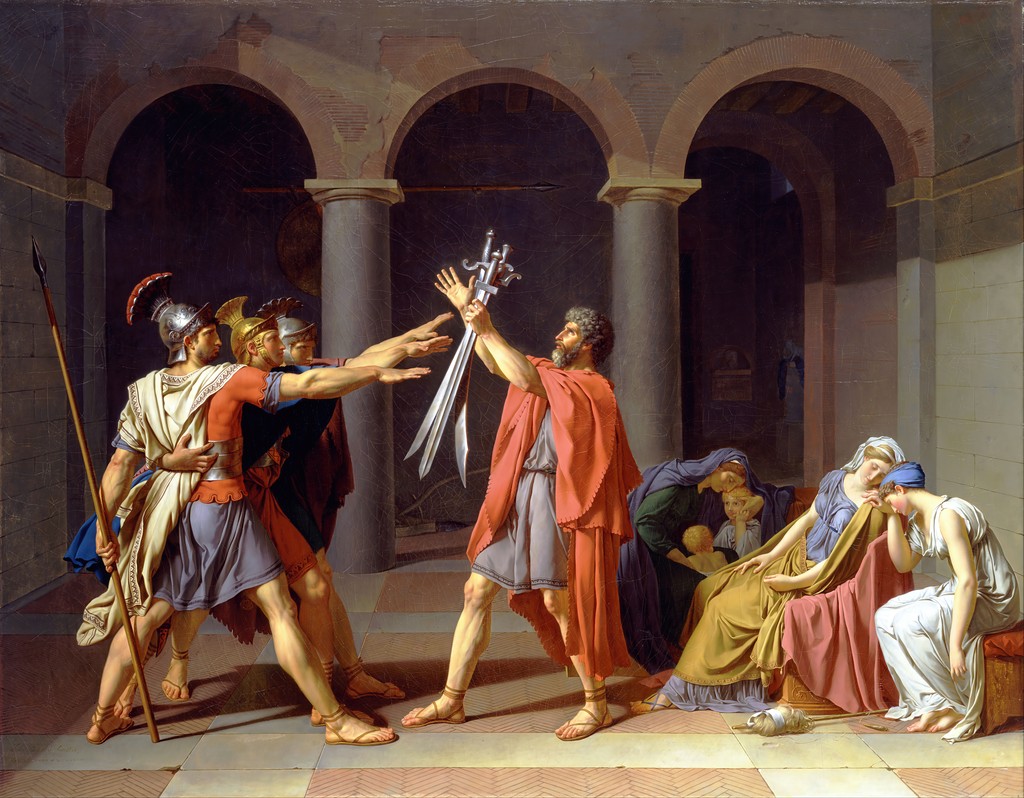
The year 1790 matters. David had already made his name with severe antique subjects, including The Oath of the Horatii and Lictors Bearing to Brutus the Bodies of His Sons. Those works used Roman stories to explore discipline, sacrifice and public virtue. In the Thélusson portrait, the same taste for clarity enters private portraiture. The lines are restrained, the background is simplified and the sitter's identity is built through pose rather than through narrative action. [1] [3]
The painting also anticipates David's later portraits in its reduction of setting. The sitter is not dissolved into anecdote. She occupies a spare pictorial space where the grey ground, chair, white dress and pale shawl do most of the work. David turns social portraiture into an exercise in control, and that control gives the image its authority. [1] [3]
Dress, Pose and Background
Anne-Marie-Louise sits upright in an armchair, facing outward with a composure that is more reserved than relaxed. The chair's red upholstery creates the strongest note of color, while the white dress and pale wrap set the figure against the grey background. A small orange sash is partly visible, but David does not allow bright costume detail to dominate the image. The sitter's hair is treated naturally when compared with older courtly conventions, and the clothing avoids the stiff architecture of corset and hoop. [1] [2] [3] [4]
The Pinakothek reads this dress as aligned with fashion after the outbreak of the Revolution. That does not mean the painting is a political manifesto. It means that the portrait's visual choices participate in a broader movement away from older ceremonial display. The unadorned background, the softened costume and the clean silhouette make the sitter legible as modern, cultivated and self-possessed. [1] [2] [3] [4]
The Louvre exhibition note is especially helpful on the format. It presents the Thélusson and Robertine portraits as a new kind of Davidian portrait: cut below the knees, set against a neutral vibrating ground and stripped of accessory-heavy staging. In Anne-Marie-Louise's case, this produces a poised frontality. The body is stable, the gaze is direct and the chair supplies structure without turning the scene into a room portrait. [1] [2] [3] [4]
A Portrait Between Intimacy and Rank
David's handling of the sitter is cool but not indifferent. He gives Anne-Marie-Louise dignity through quietness. The plain ground removes distraction; the armchair anchors her; the dress and shawl soften the severity of the pose. Nothing in the painting asks the viewer to read the sitter through sentimental anecdote. Instead, the image asks us to notice how a body, a chair, a garment and a field of grey can become a statement of social presence. [1] [3]
This distinguishes the work from both older aristocratic portrait display and David's later political portraiture. In Napoleon Bonaparte in His Study at the Tuileries, David builds a public myth of labor and command through furniture, papers, clock and uniform. In Anne-Marie-Louise Thélusson, he does almost the opposite. He removes the obvious props and lets the portrait depend on carriage, surface and restraint. [1] [3]
The comparison with Portrait of Émilie Sériziat and Her Son and Portrait of Pierre Sériziat is useful because those later portraits also show David working with intimacy, family connection and informal social identity. The Thélusson portrait is earlier and more upright. It has less outdoor ease, less domestic warmth and more frontal reserve. That difference helps readers see the range of David's portrait language during the 1790s. [1] [3]
Image and Source Cautions
Image reference: the image route remains cautious because several cited records carry different image and rights paths. Pinakothek displays a CC BY-SA 4.0 marker, bavarikon supplies rights metadata including NoC-OKLR for the digital object and CC0 for metadata, and the Commons file records a Creative Commons Attribution-ShareAlike 4.0 digital-representation route with public-domain artwork context. Any image choice should be reconciled across Pinakothek, bavarikon and Commons, with credit wording tied to the selected cited record. [1] [2] [4]
Why the Painting Matters
The portrait matters because it shows David adapting Neoclassical discipline to the needs of private likeness. It belongs to a pivotal moment between the old regime's codes of aristocratic portraiture and the simplified modern portrait types that emerged around the French Revolution. The sitter's family background, Protestant banking world and marriage into the Thélusson title give the painting a specific social history. Yet the visual economy of the portrait prevents that history from turning into costume drama. [1] [3]
For David's wider career, the work is a reminder that he was not only a painter of public crises. His portraits could be just as deliberate as his history paintings, and sometimes more subtle. The Thélusson portrait has no murder, oath, coronation or classical death. Its drama lies in how little David needs in order to make a sitter present: a grey ground, a chair, a controlled pose and a surface of pale cloth. [1] [3]
Seen within the larger Jacques-Louis David paintings group, Anne-Marie-Louise Thélusson, Comtesse de Sorcy helps connect the artist's famous public works to the private networks that sustained his career. It is a portrait of one woman, but also a record of a society learning new visual manners at the edge of revolution. [1] [3]
Frequently Asked Questions
Discussion
Portrait of Anne Marie Louise Thélusson, Countess of Sorcy shows David adapting severe Neoclassical control to a private portrait of rank, marriage and social change.
Use the prompts below to think about title, restraint and the portrait's place among David's 1790s sitters.
Reader Insights
How does the English Countess title differ in tone from the French Comtesse de Sorcy title?
What does David gain by removing most setting, accessory and narrative detail?
How does this earlier frontal reserve compare with the later Sériziat portraits?
Join the Conversation
Share your reading of Portrait of Anne Marie Louise Thélusson, Countess of Sorcy below.
References
- Bayerische Staatsgemäldesammlungen / Sammlung Pinakothek, Anne-Marie-Louise Thélusson, Comtesse de Sorcy, accessed 27 July 2026.
- bavarikon, Anne-Marie-Louise Thélusson, Comtesse de Sorcy, accessed 27 July 2026.
- Musée du Louvre, Jacques-Louis David exhibition spotlight, Une alliance de rigueur et de noblesse, accessed 27 July 2026.
- Wikimedia Commons file, Jacques-Louis David - Anne-Marie-Louise Thélusson, Comtesse de Sorcy, accessed 27 July 2026.