Buy Art Prints Now
from Amazon
* As an Amazon Associate I earn from qualifying purchases.
 by Tom Gurney
Tom Gurney BSc (Hons) is an art history expert with over 20 years experience
Published on June 19, 2020 / Updated on October 16, 2026
Email: tomgurney1@gmail.com / Phone: +44 7429 011000
The Lavoisier Portrait: Introduction
Jacques-Louis David's portrait of Antoine Laurent Lavoisier and Marie Anne Lavoisier is one of the most arresting images of Enlightenment intelligence in European painting. A husband and wife stand together at a worktable, surrounded by instruments, papers and the cool order of scientific practice. He sits with pen in hand; she stands beside him, leaning across the table with a confidence that makes her presence more than decorative. The painting presents marriage, science, status and style as a single public identity. [1] [2] [3] [4]
Painted in 1788, the portrait belongs to the same charged years that produced David's great antique history paintings and carried France toward revolution. It is not a battlefield, martyr scene or Roman oath. It is a portrait. Yet its drama is just as political. The Lavoisiers appear as rational, modern and cultivated people, but their wealth, social position and connection with state finance would soon become dangerous. The painting is elegant because it was made for a world of privilege. It is unsettling because that world was already beginning to break apart. [1] [2] [3] [4]
The work is now in The Metropolitan Museum of Art in New York. The Met records it as Antoine Laurent Lavoisier (1743-1794) and Marie Anne Lavoisier (Marie Anne Pierrette Paulze, 1758-1836), painted by Jacques Louis David in 1788. It is oil on canvas, 102 1/4 by 76 5/8 inches, or 259.7 by 194.6 centimetres, with the object number 1977.10 and the credit line Purchase, Mr. and Mrs. Charles Wrightsman Gift, in honor of Everett Fahy, 1977. [1] [2] [3] [4]
Those object facts matter because the portrait has often been loved as a clear statement of scientific partnership. It is that, but technical study has made it more complex. Conservation and scientific analysis at the Met revealed an earlier version beneath the visible surface: one in which the Lavoisiers looked more like fashionable members of the French elite than the sober, scientifically minded couple we see today. David did not simply paint an identity. He revised one. [1] [2] [3] [4]
That revision is now central to the painting's meaning. The finished portrait gives us the Lavoisiers as people of experiment, order and intellect. The hidden first composition points toward luxury, tax-farming wealth and social display. Between those two versions lies the pressure of the late 1780s, when a portrait could not avoid the politics of how a wealthy couple wished to be seen. [1] [2] [3] [4]
At a Glance
- ArtistJacques-Louis David [1] [5] [6]
- TitleAntoine Laurent Lavoisier and Marie Anne Lavoisier [1]
- Active Page TitlePortrait of Antoine-Laurent Lavoisier and His Wife [1]
- Date1788 [1]
- MediumOil on canvas [1]
- Dimensions259.7 by 194.6 centimetres; 102 1/4 by 76 5/8 inches [1]
- CollectionThe Metropolitan Museum of Art, object 1977.10 [1]
- Technical CautionModern study revealed an earlier fashionable composition beneath the visible scientific portrait [2] [3] [4]
Contents
- Introduction
- Object Facts
- The Lavoisiers
- Instruments and Staging
- Hidden First Composition
- Technical Study
- Salon Withdrawal
- Revolutionary Aftermath
- David's Portraiture
- How to Read
Object Facts and the Met Portrait
The portrait is monumental. Its size gives Antoine and Marie Anne Lavoisier a public presence usually associated with rank and power, yet David avoids the full theatrical apparatus of court portraiture. There is no throne, no ceremonial architecture and no grand allegorical setting. Instead, the sitters occupy a controlled interior organized around a table, papers and scientific instruments. [1]
The Met describes the painting as a landmark of European portraiture, presenting a modern couple in fashionable but simple dress. That combination is the heart of the picture. David does not deny elegance; Marie Anne's white dress, blue sash and poised body are central to the painting's visual charm. But he also redirects elegance toward intellect. The table is not merely furniture. It is a stage for work. [1]
Antoine Lavoisier is seated, but not passive. His hand holds a pen, and his attention appears suspended between writing, thought and the presence of his wife. He is placed among instruments and documents, signs of the chemical experiments and administrative record-keeping for which he was famous. David does not show him in the heat of experiment. He shows him in the calmer image of intellectual command. [1]
Marie Anne Lavoisier stands over him with one hand resting on the table and her body leaning into the space of work. This is a crucial choice. She is not pushed to the side as a spouse who merely accompanies male achievement. Her posture makes her an active figure in the scene. The Met record notes her role in keeping experimental logbooks and providing etched illustrations for Lavoisier's publications, and the portrait's composition gives visual force to that partnership. [1]
The painting's polished surface supports this meaning. David's finish is smooth, lucid and disciplined. The grey background, the red cloth, the black suit, the white dress and the metal and glass instruments are arranged with a clarity that makes science appear almost moral. The picture suggests that knowledge is not disorderly curiosity but a practice of refinement, record and control. [1]
Antoine and Marie Anne Lavoisier
Antoine Laurent Lavoisier was among the defining figures of eighteenth-century chemistry. He was associated with major work on oxygen, combustion, water and the language of modern chemical classification. The Met record describes him as often associated with the birth of modern chemistry, and David's portrait helps explain why that reputation became so visually durable. It does not show Lavoisier as an isolated thinker. It shows him inside a social and material system of knowledge. [1] [2] [5] [6]
That system includes Marie Anne Pierrette Paulze Lavoisier. She was not simply the wife of a famous scientist. She played a practical role in the world of experiments, records, translation, visual documentation and scientific sociability. In David's portrait, that role becomes visible through proximity and posture. She stands at the table because she belongs to the intellectual work being represented. [1] [2] [5] [6]
The couple's marriage also had social and financial dimensions. The Lavoisiers were tied to the wealthy world of the Ferme generale, the private tax-collection system that made Lavoisier's fortune and later helped make him politically vulnerable. This is why the portrait's signs of science cannot be separated from its signs of status. The instruments are not poor scholars' tools. They sit in a setting made possible by money, rank and access. [1] [2] [5] [6]
David's genius is that he makes these tensions look harmonious. The portrait does not feel crowded by competing identities. It presents scientific seriousness, marital affection, fashionable elegance and social wealth as if they naturally belonged together. The technical discoveries beneath the surface now show that this harmony was achieved through revision. [1] [2] [5] [6]
For viewers today, Marie Anne is one of the painting's most compelling figures. Her white dress catches the eye before the instruments do, and her body creates the diagonal that animates the composition. If Antoine is the seated figure of calculation, Marie Anne is the standing figure of presence and mediation. She links viewer, table, husband and scientific image. [1] [2] [5] [6]
Instruments and Staging
The scientific instruments in the finished painting have long shaped how the portrait is read. They identify the sitters with experiment, measurement and modern chemistry. Glass vessels, measuring devices, papers and writing tools transform the table into a laboratory image, though David keeps it beautifully ordered. This is science translated into portrait language. [1] [3] [4]
The instruments are not shown in active use. No reaction is occurring; no flame, vapour or dramatic laboratory event interrupts the calm. Instead, the objects serve as credentials. They tell the viewer that the couple's identity rests on disciplined inquiry. The stillness is part of the message. David makes scientific modernity look composed and socially elevated. [1] [3] [4]
The papers and pen perform similar work. They connect experiment to record, theory and publication. Lavoisier's science depended not only on apparatus but on systems of naming, measuring, writing and communicating. David does not need to explain those systems in detail. He gives them a visible grammar: table, document, pen, instrument, partner. [1] [3] [4]
The red cloth gives warmth and authority to the lower half of the painting. It also becomes, after the technical study, one of the most fascinating areas of the canvas. Beneath it, analysis revealed a different desk arrangement. What appears now as an elegant scientific table partly conceals an earlier object world of fashionable wealth. [1] [3] [4]
That shift changes the stakes of the instruments. They were later additions, not simply original features of the first design. In the visible painting, they define the couple's place in the history of chemistry. In the hidden version, that identity was not yet foregrounded. David's revision made the instruments carry the painting's public meaning. [1] [3] [4]
The result is not a neutral inventory of equipment. It is a constructed portrait of intellectual virtue. The instruments tell a story about how the Lavoisiers wished to be understood and how David, alert to the politics of representation, could reshape portraiture around that wish. [1] [3] [4]
The Hidden First Composition
The modern understanding of the portrait changed dramatically after conservation and technical analysis at the Met. When conservator Dorothy Mahon examined the painting during varnish work, small irregularities and cracks suggested that something lay beneath the visible surface. A wider campaign followed, involving infrared reflectography, macro X-ray fluorescence mapping, microscopy and analysis of small paint samples. [2] [3] [4]
The findings were striking. Beneath the sober grey background and scientific table, the earlier composition showed Marie Anne Lavoisier with a large plumed hat decorated with ribbons and artificial flowers. The red table covering had once concealed a neoclassical desk with gilt bronze decoration. The scientific instruments that now define the couple's public identity were absent from that first design. [2] [3] [4]
This discovery does not reduce the painting to a before-and-after trick. It deepens the work. The visible portrait is not simply what David first imagined; it is what he chose after reconsidering the sitters' image. The earlier version presented fashionable, wealthy consumers of luxury. The final version presents a modern scientific couple. Both identities were true enough to matter, but only one was allowed to remain visible. [2] [3] [4]
The Heritage Science study shows how technically complex that concealment was. Infrared reflectography revealed underdrawing and compositional changes, while macro X-ray fluorescence helped map pigments and hidden forms in detail. The study identified, among other things, the red pigments associated with the hidden hat and the ways David covered colourful earlier features with thin, carefully chosen paint mixtures. [2] [3] [4]
The absence of known preparatory drawings for this portrait makes the canvas itself especially important. The technical study suggests that David worked out the portrait directly on the prepared support, adjusting the composition as it developed. That is different from the process visible in some of his history paintings, where surviving drawings show the evolution of scenes such as The Death of Socrates. [2] [3] [4]
In Lavoisier, the hidden composition turns the painting into a record of decision. It shows David not only as a maker of smooth surfaces but as an artist capable of recalculating a public identity in paint. The finished portrait looks inevitable, but the evidence beneath it tells us that it was negotiated. [2] [3] [4]
Chemistry Looking at Chemistry
There is a pleasing historical symmetry in the way the portrait has been reinterpreted. Lavoisier's reputation rests on experiment, measurement and chemical analysis, and modern chemical analysis has now changed how his portrait is understood. The painting that presents instruments of eighteenth-century science has itself been examined with instruments of twenty-first-century conservation science. [2] [3] [4]
That symmetry should not be overstated into a tidy moral. The Met's technical work did not simply "solve" the painting. The Heritage Science study is careful about the limits of each method and about the need to combine imaging, microscopy, pigment analysis and art-historical interpretation. Infrared reflectography could show underdrawing and some hidden changes; macro X-ray fluorescence could map elements in the pigments; samples and microscopy helped interpret colour and layering. Meaning came from the combination. [2] [3] [4]
This makes the portrait a useful lesson in how art history changes. A painting is not fixed only because its surface is fixed. New methods can reveal earlier decisions, concealed forms and questions that were unavailable to previous generations. In this case, the discovery does not replace visual looking; it makes looking more attentive. The grey background, blue ribbons, red tablecloth and scientific apparatus all become more charged when one knows what lies beneath them. [2] [3] [4]
It also makes David's technique part of the subject. The study shows that he concealed strong earlier colours and forms with remarkable skill, using thin layers and carefully chosen mixtures so that the final surface remained calm and coherent. The portrait's restraint was not merely a style. It was a technical accomplishment, and that accomplishment helped turn a fashionable elite portrait into an image of scientific modernity. [2] [3] [4]
Salon Withdrawal and Revolutionary Pressure
The portrait was intended for the Salon of 1789, but royal authorities recommended that it be withdrawn. The Met connects this decision to fears that the painting could inflame public feeling. Lavoisier's involvement with gunpowder studies and a misunderstanding about the removal of gunpowder from the Bastille in the summer of 1789 had made his alliances politically sensitive. His role as a tax collector made the danger worse. [1] [2] [4]
This is the precise Revolutionary context the portrait needs. It is not enough to say that France was changing. The painting touched a specific social wound: the resentment attached to privilege, finance, state administration and the wealthy tax-collecting class. A public image of the Lavoisiers could not be politically innocent in 1789, however intellectually refined it appeared. [1] [2] [4]
The withdrawal also makes David's revision feel more urgent. If the visible portrait emphasizes science, simplicity and shared intellectual labour, it does so in a climate where luxury and tax wealth were becoming liabilities. The hidden fashionable version would have made those liabilities easier to see. The final version shifts attention toward usefulness, reason and contribution. [1] [2] [4]
That does not mean David cynically erased privilege. The painting remains luxurious, and its scale alone announces wealth. But it changes the moral pitch of that wealth. The Lavoisiers are not shown merely as consumers. They are shown as producers of knowledge. In a society suspicious of idle privilege, that difference mattered. [1] [2] [4]
The portrait was not publicly exhibited until the Exposition Universelle of 1889, a century after the Revolution began. By then, Lavoisier's scientific fame and the history of his execution had transformed the way the painting could be viewed. What had once been too volatile for the Salon could later be admired as an image of enlightened achievement shadowed by political tragedy. [1] [2] [4]
Revolutionary Aftermath
Antoine Lavoisier was executed by guillotine on May 8, 1794. The Met record links his death to his status as a tax collector and to the political suspicion surrounding his public roles. The portrait therefore carries a retrospective sadness that David could not fully have known in 1788. The calm scientific image became, after 1794, a memorial to a man whose intellectual stature did not protect him from Revolutionary violence. [1] [2] [5] [6]
Marie Anne Lavoisier survived the Terror. Her presence in the painting complicates any reading that treats the image as only a portrait of Antoine. She stands not as a symbolic accessory but as a historical person whose work, survival and memory helped shape the Lavoisier legacy. The painting's double format matters: it gives the scientific household a visible form. [1] [2] [5] [6]
David's own political path makes the painting still more charged. He would become deeply involved in Revolutionary politics and later serve Napoleon. The artist who painted the Lavoisiers as cultivated scientific elites would soon produce The Death of Marat, a Revolutionary martyr image with a very different moral atmosphere. The distance between these works is part of the force of David's career. [1] [2] [5] [6]
The Lavoisier portrait sits between worlds. It is pre-Revolutionary in its patronage, scale and social polish. It is modern in its image of scientific work and partnership. It is tragic in hindsight because its sitters' identities could not be separated from the structures that the Revolution attacked. [1] [2] [5] [6]
This is why the hidden composition is more than a conservation discovery. It reveals a portrait responding to a social crisis before that crisis had fully declared itself. David's revision moved the Lavoisiers from fashionable elite display toward scientific legitimacy. The surface became more restrained because the world around the sitters demanded a new kind of public face. [1] [2] [5] [6]
David's Portraiture
David is best known for history paintings, but the Lavoisier portrait shows how ambitious his portraiture could be. It does not merely record likeness. It constructs an identity. The scale, posture, objects, clothing and finish all work together to define the sitters as modern, intelligent and worthy of esteem. [1] [3] [5] [6]
The painting belongs beside David's other portraits, including Madame Recamier and Napoleon Bonaparte in his Study at the Tuileries. In each case, David uses setting and pose to say what kind of public self is being made. Recamier becomes an image of Directoire elegance and unfinished restraint. Napoleon becomes a ruler defined by labour and law. The Lavoisiers become a couple whose status is justified through knowledge. [1] [3] [5] [6]
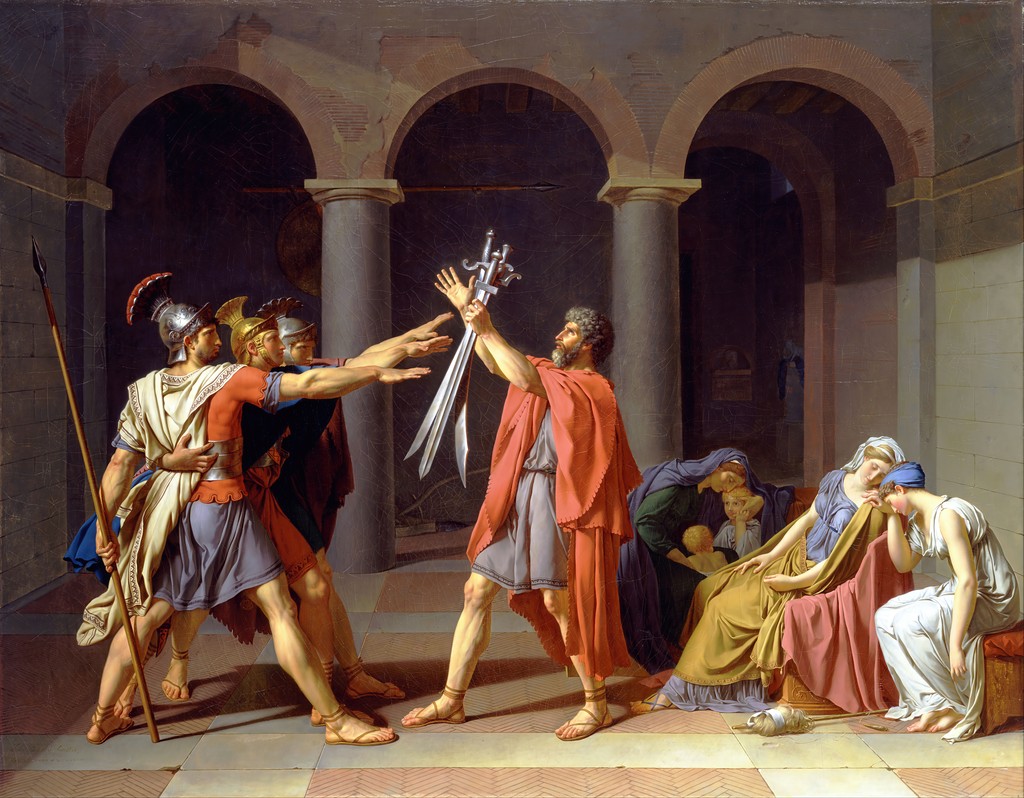
The comparison with David's antique history paintings is equally important. In The Oath of Horatii, bodies and architecture are arranged around civic duty. In Socrates, death becomes a lesson in philosophical resolve. In the Lavoisier portrait, the moral claim is quieter but still strong: reason, experiment and partnership are made visible as social virtues. [1] [3] [5] [6]
David's handling of Marie Anne is especially revealing. Her pose has grace, but also command. She is placed above and beside Antoine, close enough to touch and close enough to participate. The picture does not erase gender hierarchy, but it gives her an active role in the construction of the couple's identity. That choice is one reason the portrait still feels modern. [1] [3] [5] [6]
The technical evidence also enlarges David's status as a portraitist. The smooth final surface once seemed to present clarity without struggle. Now we can see that the clarity was made through revision, concealment and recalculation. David's portraiture was not only elegant; it was strategic. [1] [3] [5] [6]
How to Read the Painting
Begin with the relationship between the two figures. Antoine sits; Marie Anne stands. He is linked to paper, pen and instruments; she is linked to movement, touch and presentation. The portrait does not separate science from social life. It shows knowledge as something made within a household, a marriage and a public culture. [1] [3] [4]
Then look at the table. It is the boundary between viewer and sitters, but also the place where their identities are assembled. Instruments, documents and cloth create a still life of Enlightenment status. Nothing is casual. The objects define what the couple wants the viewer to notice. [1] [3] [4]
Look next at colour. The white dress and black suit create a strong contrast, while the red cloth warms the composition and draws attention to the working surface. The grey background restrains the whole scene. David avoids the bright display that technical study now tells us belonged to the first version beneath. The final surface is quieter because quietness itself has become meaningful. [1] [3] [4]
The hands are also important. Antoine's hand with the pen connects thought to writing. Marie Anne's hand on the table connects her body to the work surface. Their closeness suggests collaboration without turning the portrait into a sentimental domestic scene. Affection is present, but it is organized by purpose. [1] [3] [4]
Finally, remember the hidden painting. The visible Lavoisiers are not the only Lavoisiers David painted. Beneath them are traces of another public identity: fashionable, expensive, closer to elite display. Holding both versions in mind makes the portrait sharper. It is an image of science, but also an image of self-fashioning at a moment when self-fashioning could become a matter of survival. [1] [3] [4]
Why It Still Matters
The Lavoisier portrait matters because it brings together art history and the history of science without reducing either one. It is a major David portrait, a major image of an Enlightenment couple and a major case study in how technical examination can change interpretation. The painting that once seemed to speak with crystalline clarity now speaks in layers. [1] [2] [3] [4]
Its visible image remains powerful: Antoine and Marie Anne Lavoisier joined at a table of experiment and record, dressed with restraint, presented as rational people of modern knowledge. But the hidden composition asks us to consider how that image was produced. Science was not the couple's only identity. Wealth, fashion, tax finance and social ambition were present too, and David covered them with a new visual argument. [1] [2] [3] [4]
That new argument did not save Antoine Lavoisier from the Revolution. It did, however, help preserve a public image of the Lavoisiers that later generations could admire. The portrait asks viewers to see the couple through the dignity of work, intelligence and collaboration. Technical study now asks viewers to see the cost, timing and calculation behind that dignity. [1] [2] [3] [4]
For David's career, the painting proves that portraiture could be as intellectually charged as history painting. It may not show an oath, a martyr or an emperor, but it still stages a drama of values. In one large canvas, David brings together marriage, chemistry, social display, political danger and artistic revision. The result is not just a likeness of two people. It is a portrait of a world trying to choose how it should be seen. [1] [2] [3] [4]
Related Pages
The Jacques-Louis David biography places the portrait within the artist's rise through the Academy, his pre-Revolutionary success, his Revolutionary politics and his later service to Napoleon. The David paintings hub sets it among the full range of his history paintings, portraits, Revolutionary images and late works. [1] [5] [6]
For the closest comparison in David's handling of death, virtue and pre-Revolutionary moral seriousness, see The Death of Socrates. For the later political transformation of death into Revolutionary image, compare The Death of Marat. For David's other public portraits and status images, Madame Recamier and Napoleon Bonaparte in his Study at the Tuileries offer useful contrasts. [1] [5] [6]
The portrait also belongs beside The Oath of Horatii, because both works show David turning bodies, objects and setting into a moral language. Horatii does this through antique civic duty. Lavoisier does it through modern scientific identity. Together they show how David could make very different subjects feel severe, lucid and historically urgent. [1] [5] [6]
Frequently Asked Questions
Discussion
The Lavoisier portrait is elegant, but its calm surface was made through revision.
Use the prompts below to think about how David turns science, marriage, wealth and political danger into one image.
Reader Insights
Which detail first defines the couple for you: Marie Anne's posture, Antoine's pen, the scientific instruments, or the red tablecloth?
How does the hidden first composition change your trust in the visible image?
Does the portrait justify status through knowledge, or does it reveal how carefully status had to be repackaged?
Join the Conversation
Share your reading of Portrait of Antoine-Laurent Lavoisier and His Wife below.
References
- The Metropolitan Museum of Art, Antoine Laurent Lavoisier and Marie Anne Lavoisier, 1977.10, accessed 26 July 2026.
- The Metropolitan Museum of Art, Lavoisier Portrait Discoveries, accessed 26 July 2026.
- The Metropolitan Museum of Art, Refashioning the Lavoisiers, accessed 26 July 2026.
- Heritage Science, Discovering the evolution of Jacques-Louis David's portrait of the Lavoisiers, accessed 26 July 2026.
- The National Gallery, Jacques-Louis David artist biography, accessed 26 July 2026.
- The British Museum, Jacques-Louis David collection biography BIOG24584, accessed 26 July 2026.