 Buy Art Prints Now
from Amazon
* As an Amazon Associate I earn from qualifying purchases.
 by Tom Gurney
Tom Gurney BSc (Hons) is an art history expert with over 20 years experience
Published on June 19, 2020 / Updated on October 16, 2026
Email: tomgurney1@gmail.com / Phone: +44 7429 011000
Portrait of the Comte de Turenne: Introduction
Jacques-Louis David painted Portrait of the Comte de Turenne in 1816, during the first year of his exile in Brussels after Napoleon's defeat and the Bourbon Restoration. The active painting page is best understood as the large three-quarter-length portrait now associated with the Ny Carlsberg Glyptotek in Copenhagen. Google Arts & Culture, using the Glyptotek record, identifies the work as an oil on wood measuring 1120 x 810 mm. Wikimedia Commons gives the same date, support, dimensions, collection and accession number MIN 1900 for the Google Art Project image. [1] [2] [3]
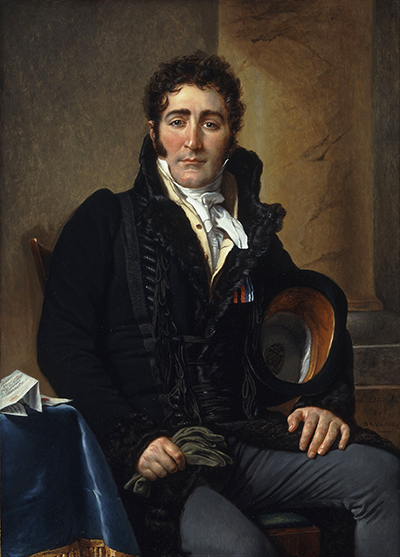
The sitter was Henri-Amédée-Mercure de Turenne d'Aynac, a comte and former Napoleonic officer. David does not show him in action. He sits indoors, dressed with military elegance, holding gloves and a tall hat, with a letter on the table that identifies him. The portrait is a quiet but pointed image of exile: a soldier and nobleman represented by a painter who had also lost his place in France. [1] [2] [3]
At a Glance
- ArtistJacques-Louis David [1] [2] [3] [4] [5]
- TitlePortrait of the Comte de Turenne [1] [2]
- Active URL/jacques-louis-david/portrait-of-the-comte-de-turenne/ [1]
- Date1816 [1] [2] [3] [4]
- Active VersionLarge three-quarter-length Copenhagen/Glyptotek portrait [1] [3]
- MediumOil on wood [1] [2]
- Dimensions1120 x 810 mm; Google gives 810 mm wide by 1120 mm high [1] [2]
- CollectionNy Carlsberg Glyptotek, Copenhagen [1] [2] [3]
- AccessionMIN 1900 in the Commons record [2]
- SitterHenri-Amédée-Mercure de Turenne d'Aynac [1] [2] [4]
- ContextPainted in Brussels exile after Napoleon's defeat and the Bourbon Restoration [1] [3] [5]
- Version CautionClark Art Institute owns a related 1816 bust-length oil-on-canvas portrait [3] [4]
- Documented VersionsBordes notes that David's 1819 Brussels works list included both a large Turenne portrait and a bust-length portrait [3]
- Key DetailsLetter with sitter identity and address, signature pointing to Brussels, gloves, tall hat and military dress [1] [2]
- Image CautionCurrent page image retained; later image work should verify it against the Copenhagen/Glyptotek object [1] [2] [3] [4]
Contents
- Introduction
- Object Facts and Version Caution
- David in Brussels
- The Letter, Signature and Identity
- Military Dress and Exile Poise
- The Clark Turenne Portrait
- Image and Source Cautions
- Why the Painting Matters
Object Facts and Version Caution
This page needs careful version language because David painted more than one portrait of Turenne in 1816. Philippe Bordes, writing in The Burlington Magazine, notes that David listed two Turenne portraits among the works of his exile: a large portrait and a bust-length portrait. Bordes identifies the large three-quarter-length work with the panel painting in the Ny Carlsberg Glyptotek, while the bust-length canvas later entered the Sterling and Francine Clark Art Institute. [1] [2] [3] [4]
The portrait discussed here corresponds to the Copenhagen/Glyptotek work, not the Clark bust-length painting. The Clark work remains important supporting context because it confirms that Turenne sat for David more than once and that the subject belonged to David's Brussels exile circle. The two works should be kept distinct because they differ in format, support and collection history. [1] [2] [3] [4]
The Glyptotek-linked Google Arts & Culture record gives the title as Portrait of the Comte de Turenne, the creator as Jacques-Louis David, the date as 1816, the dimensions as 810 mm wide by 1120 mm high and the type as oil on wood. Commons adds the accession number MIN 1900 and identifies the depicted sitter as Henri-Amédée-Mercure de Turenne d'Aynac. These are the safest object facts for the manuscript. [1] [2] [3] [4]
David in Brussels
The year 1816 gives the portrait its emotional and political charge. David had been deeply entangled with revolutionary and Napoleonic power. After Waterloo and the restoration of the Bourbons, he settled in Brussels, where he spent the final decade of his life. The Met's record for David's 1816 portrait of General Étienne-Maurice Gérard describes this moment as exile following Napoleon's defeat and notes that David painted members of the city's émigré imperial aristocracy. [1] [3] [4] [5]
Turenne belongs to that world. Google Arts & Culture describes him as one of Napoleon's officers and places him among the fellow exiles David met in Brussels. This does not make the portrait a public manifesto, but it does make the sitter's identity politically legible. A man who had served the Napoleonic order is shown in dignified private space, still marked by rank, uniform, gloves, hat and the careful signs of personal address. [1] [3] [4] [5]
The portrait therefore belongs beside David's other late exile and Napoleonic portraits, including Napoleon Bonaparte in His Study at the Tuileries, Portrait of Pope Pius VII and the Clark-related military circle around General Gérard. It is less grand than those state-facing images, but it shows how David continued to give visual authority to people formed by the Empire. [1] [3] [4] [5]
The Letter, Signature and Identity
The letter on the table is one of the painting's most distinctive details. Google Arts & Culture notes that David wrote the sitter's identity and address on it. That detail matters because it turns the portrait into a document as well as a likeness. Turenne is not merely an anonymous officer in fine clothing; the painting names him within the picture world. [1] [2]
David also used the signature to draw attention to Brussels. This is more than a place label. In 1816, Brussels was the condition under which the portrait existed. The signature and letter together make identity, place and political aftermath part of the image. David's precision is not just technical; it is historical. [1] [2]
The letter, gloves and hat are visible details, and they are worth close attention because they are source-supported parts of David's design. The tone, however, should stay cautious. The painting suggests confidence, discipline and social rank, but it does not let us know Turenne's private feelings. The useful reading is not that he felt fearless or anxious, but that David built a controlled image of presence after defeat. [1] [2]
Military Dress and Exile Poise
Turenne sits in a dark coat with rich surfaces and ordered accessories. His gloves and hat sit close to the body, almost as if he has just arrived or is about to depart. The pose is contained rather than theatrical. There is no battlefield behind him and no dramatic gesture. David gives the sitter's military identity through dress, medals and bearing. [1] [2] [4]
This restraint is typical of David's late portrait discipline. He does not need a complex narrative setting to suggest a life shaped by public events. The chair, table, letter, gloves and uniform hold the meaning. Their arrangement makes the image readable without turning it into an anecdote. [1] [2] [4]
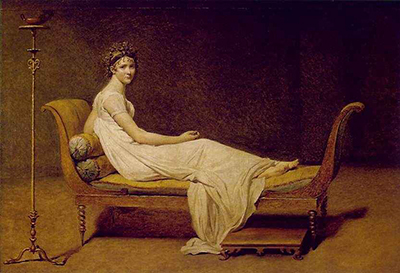
The portrait can also be compared with Madame Récamier and Portrait of Madame de Verninac. In those portraits, social identity is expressed through pose, dress and furniture. In Turenne, the same portrait logic serves military and political memory. The sitter's rank is not shouted; it is held in reserve. [1] [2] [4]
The Clark Turenne Portrait
The Clark Art Institute's related portrait, Comte Henri-Amédée-Mercure de Turenne-d'Aynac, is useful because it keeps the Turenne problem from looking too simple. The Clark describes its work as an 1816 oil on canvas acquired in 1999. Its educational material states that Turenne was a nobleman who served in the French army, that he and David were both closely associated with Napoleon, and that the portrait was painted while they were living in exile. [3] [4]
Bordes's Burlington Magazine note gives the scholarly framework: David knew of two Turenne portraits, one large and one bust-length. The Copenhagen work is the large version. The Clark work is the bust-length canvas. This distinction matters for captions, collection references and any discussion of support or format because the two portraits have different materials and object histories. [3] [4]
For readers, the important point is that Turenne was not a one-off name attached to an uncertain image. He was important enough in David's exile work to appear in two related portraits. That makes the Copenhagen portrait more meaningful as a record of David's Brussels circle. [3] [4]
Image and Source Cautions
The page keeps the current page image while the source note separates the Copenhagen/Glyptotek portrait from the related Clark canvas. Google Arts & Culture and the Commons Google Art Project file identify the Copenhagen oil-on-wood work; Burlington and Clark evidence clarify the version split. Commons carries a public-domain marking with the usual jurisdiction caveat, so any later image-refresh or annotated-image work should match the file to the Copenhagen object, preserve MIN 1900 where used, and keep Clark facts out of captions for the active page. [1] [2] [3] [4]
Why the Painting Matters
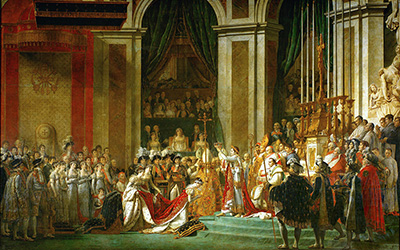
Portrait of the Comte de Turenne matters because it shows David working after political catastrophe. The heroic machinery of The Coronation of Napoleon and Napoleon Crossing the Alps had belonged to a public regime. In 1816, that regime was gone, and David was painting fellow survivors of the imperial world in Brussels. [1] [3] [4] [5]
The portrait is not as famous as David's Revolutionary or Napoleonic monuments, but it is a sharp document of late style and exile identity. Turenne's dress, gloves, hat and letter create a carefully managed image of a man displaced by history but still presented with composure. David's old precision remains, but its purpose has changed. Instead of proclaiming a state, it preserves a circle. [1] [3] [4] [5]
Seen within the wider Jacques-Louis David paintings group, this portrait is a modest but telling late work. It links the artist's political past to his Brussels present and gives the viewer one more route into David's final decade: not through mythology alone, but through the faces of those who shared the afterlife of Napoleon's fall. [1] [3] [4] [5]
Frequently Asked Questions
Discussion
Portrait of the Comte de Turenne is a late portrait about identity after political displacement.
Use the prompts below to think about version evidence, exile and David's controlled portrait language.
Reader Insights
How does the Copenhagen and Clark distinction change the way captions and collection facts should be read?
What changes when Turenne is seen as part of David's Brussels circle after 1815?
How do the letter, gloves and hat make the sitter's identity public without creating a dramatic scene?
Join the Conversation
Share your reading of Portrait of the Comte de Turenne below.
References
- Google Arts & Culture, Portrait of the Comte de Turenne, accessed 27 July 2026.
- Wikimedia Commons file, Portrait of the Comte de Turenne, Google Art Project, accessed 27 July 2026.
- The Burlington Magazine, Philippe Bordes, David's Portrait of the comte de Turenne at Williamstown, accessed 27 July 2026.
- Clark Art Institute, Comte Henri-Amédée-Mercure de Turenne-d'Aynac, accessed 27 July 2026.
- The Metropolitan Museum of Art, General Étienne-Maurice Gérard, accessed 27 July 2026.