 Buy Art Prints Now
from Amazon
* As an Amazon Associate I earn from qualifying purchases.
 by Tom Gurney
Tom Gurney BSc (Hons) is an art history expert with over 20 years experience
Published on June 19, 2020 / Updated on October 16, 2026
Email: tomgurney1@gmail.com / Phone: +44 7429 011000
Portrait of the Sisters Zenaide and Charlotte Bonaparte: Introduction
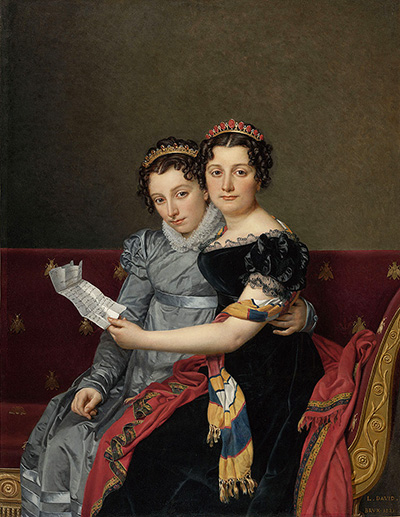
Portrait of the Sisters Zénaïde and Charlotte Bonaparte is one of Jacques-Louis David's most poised exile portraits. Painted in Brussels in 1821, it shows Zénaïde Bonaparte and her younger sister Charlotte, daughters of Joseph Bonaparte and Julie Clary, seated together with a letter from their father. The Getty-linked object record identifies the work as an oil on canvas by David, dated 1821, measuring 129.5 by 100.6 cm, and held by the J. Paul Getty Museum with object number 86.PA.740. [1] [2]
The established English page title uses Zénaïde without accents, while museum and scholarly routes often use Zénaïde. The display title can respect the accented French name where possible, but the artwork remains the same double portrait: two Bonaparte sisters, a family letter, and David's late style working through exile, status and sibling intimacy. [1] [2]
At a Glance
- ArtistJacques-Louis David [1]
- TitlePortrait of the Sisters Zénaïde and Charlotte Bonaparte [1] [2] [3]
- Active URL/jacques-louis-david/portrait-of-the-sisters-zenaide-and-charlotte-bonaparte/ [1]
- Date1821 [1] [3] [4]
- MediumOil on canvas [1] [3] [4]
- CollectionJ. Paul Getty Museum, Los Angeles [1] [2] [3] [6]
- Object Number86.PA.740 [1] [2] [3] [6]
- Dimensions129.5 by 100.6 cm [1] [3]
- SittersZénaïde Bonaparte and Charlotte Bonaparte [1] [4] [5] [6]
- SubjectDouble portrait with a letter from Joseph Bonaparte [1] [5] [6]
- Version CautionMuseo Napoleonico records one original and two copies; the Getty work is treated here as the original [4] [5]
- Image ReferenceGetty Open Content support is strong; credit wording should stay tied to object 86.PA.740 [2] [3] [6]
Contents
- Introduction
- Object Identity
- The Sisters and the Letter
- David in Brussels
- Looking at the Portrait
- Image and Source Cautions
- Why the Portrait Matters
Object Identity
Getty CONA records the painting as Portrait of the Sisters Zénaïde and Charlotte Bonaparte, with the variant title Portrait of Zénaïde and Charlotte Bonaparte. It classifies the work as a French Neoclassical painting and a double portrait, names Jacques-Louis David as creator, identifies the sitters as Charlotte Bonaparte and Zénaïde Bonaparte, and gives the Getty Museum at the Getty Center as the current location. Wikimedia Commons gives the Getty Center location, room S204, object number 86.PA.740, the 1821 date, oil on canvas medium, and the same 129.5 by 100.6 cm dimensions. [1] [2] [3] [4]
The source history is unusually important because the subject exists in more than one version. Museo Napoleonico in Rome records a version in its own collection, dated 1821 and catalogued as oil on canvas, inventory MN 935. Its account says Julie Clary, using the title Countess de Survilliers after 1815, commissioned the portrait in Brussels, and that a signed receipt records one original and two copies. The Rome museum identifies the Getty picture as the original, formerly in the Roccagiovine collection, while the Rome and Toulon works are copies. That evidence lets the article handle the image carefully: the Los Angeles work is the Getty original in the current public cluster, while related copies belong to the wider version history. [1] [2] [3] [4]
The Sisters and the Letter
Zénaïde and Charlotte were Napoleon's nieces. Their father, Joseph Bonaparte, had been king of Spain and later lived in the United States after Napoleon's fall. The letter in the painting links the daughters in Brussels with their absent father in Philadelphia. Getty-linked and Napoleonic sources both stress that the letter is not a casual accessory. It is the hinge of the picture, turning a double portrait into a family scene shaped by displacement. [1] [4] [5] [6]
The sisters' mother, Julie Clary, was also central to the commission. Museo Napoleonico states that Joseph's family stayed in Brussels for several years from June 1820 after taking refuge in America following Waterloo. The portrait therefore belongs to a very specific Bonaparte-family moment: imperial rank remained visible, but imperial power had collapsed; family identity persisted, but the family itself was dispersed. [1] [4] [5] [6]
Zénaïde, born in 1801, is the elder sister. Museo Napoleonico notes that she married her cousin Carlo Luciano Bonaparte, Prince of Canino, in Brussels in 1822. Charlotte, born in 1802, later married Napoleon Louis, son of Louis Bonaparte, and continued with painting and drawing after studying with artists including Léopold Robert and Samuel Jesi. Those later facts should not overtake the portrait, but they help explain why the sisters were not passive symbols. They belonged to a politically displaced family and to a cultivated world in which art, marriage and dynastic memory were tightly interwoven. [1] [4] [5] [6]
David in Brussels
The painting also speaks about David's own exile. After Napoleon's fall and the Bourbon restoration, David did not resume life as a Parisian court painter. He lived in Brussels, where late mythological pictures such as Love and Psyche and Mars Being Disarmed by Venus show him reworking classical and allegorical subjects far from the political centre he had once helped visualize. [3] [4] [5]
Portrait of the Sisters Zénaïde and Charlotte Bonaparte is more personal and more political than those mythologies. The sitters are members of Napoleon's family, but they are not shown as participants in a ceremony or as heirs to power. They sit on a red sofa, dressed with elegance, close enough for Charlotte to lean into Zénaïde and for Zénaïde to seem both sister and protector. David's politics are not declared in slogans. They are embedded in the displaced family, the letter, the imperial bees and the bare surrounding wall. [3] [4] [5]
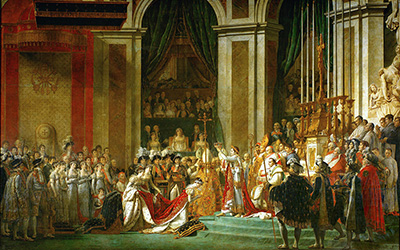
That makes the painting a useful bridge between David's Napoleonic images and his late private portraiture. Compare it with The Coronation of Napoleon, where the Bonaparte family is staged inside public ritual, and Napoleon Bonaparte in His Study at the Tuileries, where political authority is condensed into the image of solitary work. Here, Bonaparte identity appears after defeat, inside family correspondence and sisterly proximity. [3] [4] [5]
Looking at the Portrait
The composition turns contrast into intimacy. Zénaïde sits upright in a dark dress, facing the viewer with a more direct assurance. Charlotte is placed close beside her in a cooler blue-gray dress, her body and expression more reserved. Their heads, hands and the folded paper create the emotional centre of the painting. The sisters are linked by touch and by the act of reading, but David does not make them identical. [3] [5] [6]
The red velvet sofa embroidered with golden bees carries dynastic meaning. The bees had been part of Napoleonic imagery, and their appearance here gives the domestic scene a political aftertaste. The tiaras also mark rank. Yet the plain dark background works against luxury. It isolates the sisters, making the sofa, dresses, letter and embrace feel almost portable: signs of a world carried into exile rather than securely installed in a courtly room. [3] [5] [6]
David's realism matters most in the small details. The folds of the letter, the difference between the sisters' dresses, the angle of Charlotte's body and the protective placement of Zénaïde's arm all turn the portrait into a scene of relation. It is not simply a display of aristocratic costume. It is a carefully controlled image of nearness under pressure. [3] [5] [6]
The signature and date recorded on the Commons file place the work in Brussels in 1821. That inscription gives the painting a final kind of self-awareness. David signs from exile, painting exiled princesses who read a letter from an exiled father. The object is polished, but its subject is unsettled. [3] [5] [6]
Image and Source Cautions
The image used here follows the Getty and Commons object route for the Los Angeles original, not the Rome copy. Commons and Google Arts and Culture both point toward Getty Open Content support, while the direct Getty collection page remains the preferred museum credit route. Credit wording should stay tied to object 86.PA.740 and to the selected Getty image record. [2] [3] [4] [6]
Why the Portrait Matters
Portrait of the Sisters Zénaïde and Charlotte Bonaparte matters because it shows David adapting the tools of state portraiture to a world after state power has been lost. The grand Napoleonic machine is gone, but the signs remain: bees, rank, family names, and the memory of rule. David turns those signs into a double portrait about attachment, absence and survival. [1] [4] [5]
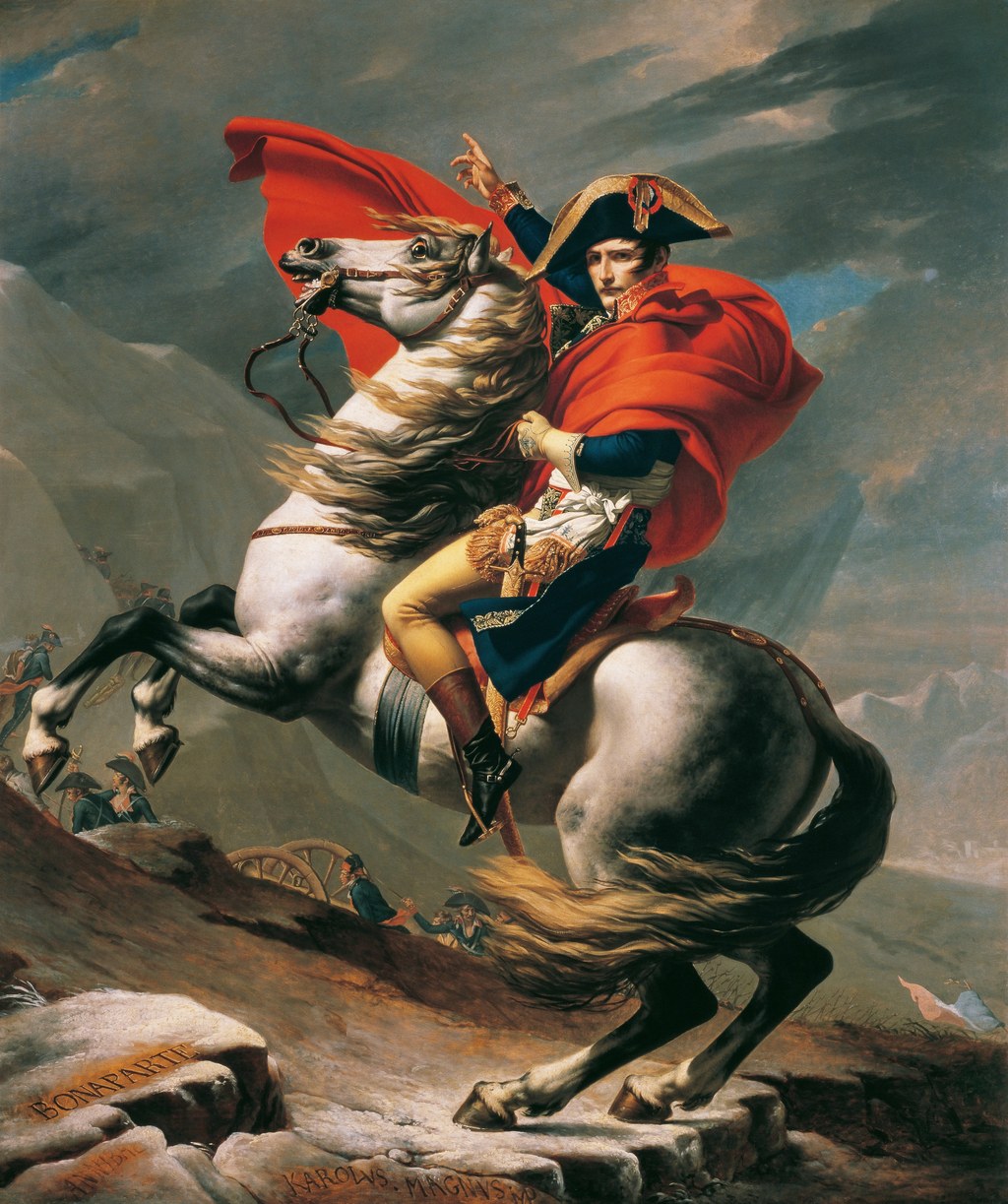
Within the Jacques-Louis David cluster, the page belongs beside the David paintings hub and the Jacques-Louis David biography. For the Napoleonic sequence, compare Napoleon Crossing the Alps, The Coronation of Napoleon, Distribution of the Eagle Standards and Unfinished Portrait of General Bonaparte. For David's late Brussels mood, compare Madame David, Self Portrait and Farewell of Telemachus and Eucharis. [1] [4] [5]
The painting is therefore neither a minor family anecdote nor a simple princess portrait. It is a late David work in which politics has become domestic, exile has become visible, and the Bonaparte image survives through two sisters reading a letter. [1] [4] [5]
Frequently Asked Questions
Discussion
Portrait of the Sisters Zenaide and Charlotte Bonaparte shows David turning Bonaparte history into a compact family scene of exile, correspondence and sisterly closeness.
Use the prompts below to read the portrait through family politics, version history and the quiet pressure of the letter.
Reader Insights
How does Joseph Bonaparte's absent presence change the emotional centre of the double portrait?
Where do the signs of Napoleonic rank survive after political power has collapsed?
How should a reader handle the Getty original and the known copy history together?
Join the Conversation
Share your reading of Portrait of the Sisters Zenaide and Charlotte Bonaparte below.
References
- Getty CONA, Portrait of the Sisters Zénaïde and Charlotte Bonaparte, accessed 27 July 2026.
- J. Paul Getty Museum, Portrait of the Sisters Zénaïde and Charlotte Bonaparte, accessed 27 July 2026.
- Wikimedia Commons, Jacques-Louis David - Portrait of the Sisters Zénaïde and Charlotte Bonaparte.jpg, accessed 27 July 2026.
- Museo Napoleonico, The sisters Zenaide and Carlotta, accessed 27 July 2026.
- Fondation Napoléon, The Sisters, Zénaïde and Charlotte Bonaparte, accessed 27 July 2026.
- Google Arts and Culture / J. Paul Getty Museum, Portrait of the Sisters Zénaïde and Charlotte Bonaparte, accessed 27 July 2026.