


 by Tom Gurney
Tom Gurney BSc (Hons) is an art history expert with over 20 years experience
Published on June 19, 2020 / Updated on November 6, 2026
Email: tomgurney1@gmail.com / Phone: +44 7429 011000
James McNeill Whistler began Symphony in White, No. 3 in 1865 and prepared it for public exhibition in 1867. The University of Glasgow catalogue identifies the canvas as YMSM 061. It belongs to the Barber Institute of Fine Arts at the University of Birmingham, where its accession number is 39.24.[1][4]
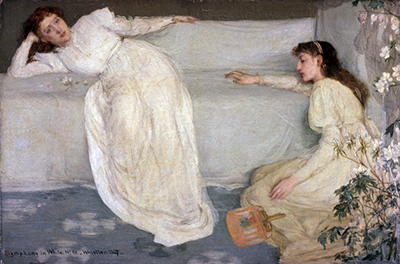
Two women occupy a pale interior. Joanna Hiffernan reclines on a white sofa at the left, while sixteen-year-old Emelie “Millie” Eyre Jones sits on the floor at the right. Their white and cream dresses, the blue-grey carpet, warm fan, flowers, hair and skin form related colour intervals rather than a single unbroken white field.[1][6][10]
The painted inscription explains the work's unusual date history. Whistler first wrote 1865, then changed the last digit to 7 when preparing the canvas for the Royal Academy. He may have touched the picture again by 1873. The official 1865–67 date is therefore a making range, not a claim that nothing happened before or after one decisive finishing day.[1][2][3]
At a Glance
- CatalogueYMSM 061
- Date1865–67; possible later work to 1873
- MediumOil on canvas
- SittersJoanna Hiffernan and Emelie ‘Millie’ Eyre Jones
- Inscribed date1867; final 7 written over 5
- YMSM dimensions52 × 76.5 cm
- Barber dimensions51.4 × 76.9 cm
- CollectionBarber Institute, 39.24
- FrameFlat Whistler, painted c.1871–73; later gilded
- Current locationConfirm with Barber, Courtauld or Tate
Contents
- The painting at a glance
- Which white symphony is this?
- From “the Sofa” to *Symphony in White, No. 3*
- Joanna Hiffernan on the sofa
- Millie Jones on the floor
- Two poses joined by one line
- Hiffernan's white dress
- Jones's yellowish white
- Fan, flowers and carpet
- Was the carpet Chinese?
The painting at a glance
The Barber records an oil-on-canvas painting measuring 51.4 × 76.9 centimetres. YMSM gives 52 × 76.5 centimetres. The slight discrepancies belong to the two institutional measurements; both records describe the horizontal canvas YMSM 061, Barber 39.24.[1][4]
A straight-backed sofa runs parallel to the picture's upper and lower edges. Hiffernan leans on her right arm and extends her left arm across its back. Jones, seated on the carpet in left-facing profile, reaches her right arm along the same support while her other arm rests on her knees.[1][2]
The linked arms make a long line across two differently placed bodies. A fan leans beside Jones's knee. White blossoms enter at the lower right, and a grey wall, panel or curtain closes the background. The room appears simple, but its furniture does not resolve into perfectly consistent three-dimensional construction.[1][2]
Which white symphony is this?
This is the third work in the sequence, YMSM 061. It is not YMSM 038, the standing full-length canvas now called Symphony in White, No. 1: The White Girl. It is also distinct from YMSM 052, Symphony in White, No. 2: The Little White Girl, with Hiffernan beside a mantel and mirror.[1]
The numbering is deceptive because the sequence was organised retrospectively. No. 3 was the first Whistler painting exhibited with a musical title. The earlier two pictures had entered public life under short descriptive titles and were renamed to fit the numbered group.[1][13]
Material and identity controls prevent motifs from drifting across pages. The first symphony's standing pose, bearskin rug and dropped lily do not belong here; the second's mirror, Hiroshige fan and Swinburne poem do not belong here either. YMSM 061 has two seated bodies, a sofa, a floor fan and a separate treatment history.[1][10]
From “the Sofa” to *Symphony in White, No. 3*
Anna Matilda Whistler called the work “the Sofa” in November 1865. In March 1867 William Michael Rossetti recorded that Whistler had formerly called it The Two Little White Girls. The Royal Academy catalogue then gave Symphony in White No. 3.[1][7][8]
Each title frames the same canvas differently. “The Sofa” identifies the large structural prop. “Two Little White Girls” counts and characterises the figures. “Symphony” asks viewers to compare recurring tones, while “No. 3” makes the picture part of a series.[1][13]
The earlier name should not be used to infantilise the sitters. Hiffernan was an adult partner and collaborator; Jones was sixteen. “Little” was Whistler's title language, not a reliable description of equal age, legal position or studio power.[7][10]
Joanna Hiffernan on the sofa
Hiffernan reclines at the left and looks directly towards the viewer. Her red or copper-coloured hair, fair skin and bright eyes give the strongest warm and cool accents within the pale half of the room.[1][2][10]
She was an Irish-born model, Whistler's partner and a collaborator who managed practical affairs as well as posing. Reducing her to “the artist's mistress” makes a relationship label substitute for the visible labour of holding a difficult pose and the broader work she performed around his career.[10]
This was among the last major white-dress compositions for which she modelled. Yet the canvas does not narrate a farewell, fatigue or private argument. Her direct gaze and extended body are available to formal and biographical inquiry without being converted into a proven emotional confession.[1][10]
Millie Jones on the floor
Emelie Eyre Jones, called Millie, sits at the right. Whistler described her as fair-haired in 1865, while the final surface gives her hair reddish-blond or brown warmth. She faces Hiffernan in profile rather than looking out at the spectator.[1][6]
Jones was born in 1850. When Whistler urgently requested further sittings in January 1866, she was sixteen. That age belongs in the account because “two little white girls” and the languid arrangement can otherwise make unequal studio circumstances disappear beneath aesthetic language.[7][10]
Millie's sister Augusta Maria also posed for Whistler. Some later sittings are not perfectly assigned between the sisters, but YMSM identifies Millie in this canvas. Family resemblance or shared modelling work is not sufficient reason to substitute Augusta.[1]
Two poses joined by one line
Hiffernan's body stretches across the sofa, and Jones's body rises diagonally from the floor. Their positions are unequal in height and orientation, yet their arms nearly continue each other along the sofa back.[2][6]
Whistler singled out this relationship in his August 1865 letter to Fantin-Latour. He was pleased by the upper line and by the arrangement of the two arms. His comment shows that pose was built as design, not merely recorded as two women happened to rest.[6]
The line also holds the composition in tension. It connects the sitters but does not make them converse. Hiffernan meets the viewer, Jones turns inward, and the gap between their heads prevents the group from becoming an intimate double portrait.[1][2]
Hiffernan's white dress
Whistler told Fantin that Hiffernan wore the same very white linen dress used for the earlier White Girl. In YMSM 061 it has a high neck, narrow trimming, long gathered muslin sleeves and low double-capped shoulders.[1][6][10]
He emphasised that the body and legs remained legible through the fine dress. The present modelling does make her weight, knees and lower limbs apparent beneath flowing fabric. That observation concerns painting cloth over a body; it does not authorise an invented erotic narrative.[2][6]
Reusing a garment created visual continuity across separate canvases. It did not turn No. 1 and No. 3 into stages of a single scene, nor does it prove that every passage of white was mixed or applied in the same way.[1][10]
Jones's yellowish white
Jones wears a different material and a different white. Whistler described a yellowish-white silk dress of the kind called foulard. Its loose puffed sleeves narrow above the elbow, and its lower portion becomes browner where shadow gathers.[1][2][6]
That warm dress is central to the symphony. It lets the viewer compare linen with silk, bright exposed cloth with shaded folds, and Hiffernan's cooler white against Jones's cream. Difference makes the title work.[2][4]
Hamerton later treated the yellowish dress as evidence against a symphony in white. Whistler treated it as a related note within the key. Both responses begin from the same visible fact but understand the musical metaphor differently.[3][13]
Fan, flowers and carpet
A warm red or reddish fan leans against Jones's knee. Its position helps stabilise the diagonal body and introduces a concentrated accent near the lower edge. The fan may participate in Whistler's wider interest in Asian objects, but no secure design or print on it has been identified here.[1][13]
The fan is not a thermometer. The inherited web page claims that it proves the scene occurred on a hot day. Fans can be used, collected or posed for many reasons, and this one is not even shown moving air.[1][18]
The flowers are mainly white azaleas. Two sprays identified as Dutchman's breeches carry the palest purple. The carpet began in Whistler's description as a delicate light blue and became a more subdued blue-grey patterned plane.[2][6]
Was the carpet Chinese?
Whistler may have asked Dante Gabriel Rossetti for a Chinese blue-and-white rug around 1864–65. YMSM discusses the possibility that it was intended for this picture, but the identification is not conclusive.[1][6]
The carpet's blue pattern is therefore secure as visible description; its exact national attribution and borrowing history remain graded. It should not be called a documented Rossetti loan simply because that possibility fits Whistler's collecting circle.[1]
This distinction matters because a generic Japonisme label can make every patterned object seem interchangeable. Fan, carpet, sofa, dresses and flowers have separate materials and evidential histories even while Whistler orchestrates them together.[1][10]
A room whose furniture does not quite add up
The sofa appears to run horizontally across a shallow grey room. Yet the back seems to end at an uncertain point behind Hiffernan while the seat continues farther left. Wall, furnishing and curtain do not describe a fully measurable architectural box.[1]
The ambiguity need not be corrected into a plausible floor plan. Whistler needed the sofa to support the arm line, divide wall from carpet and place one body above another. Its pictorial functions could take priority over carpentry.[2][13]
The patterned floor similarly offers both surface and recession. Jones sits convincingly upon it, but the blue-grey field also presses forward as a broad colour area. Shallow depth and embodied weight coexist.[2][10]
White is not one colour
Hiffernan's linen is brighter than Jones's silk. Sofa upholstery shifts again; wall and curtain supply greyer whites; the carpet introduces blue; skin, hair, fan, leaves and flowers add warm and cool punctuation.[1][2][4]
The title therefore does not promise monochrome. It announces a family of relationships. A white passage can look cool beside cream, warm beside blue-grey, solid beside fine muslin or shadowed beside exposed cloth.[2][13]
This variety also prevents the pale room from being treated as empty neutrality. White textiles had costs, maintenance and class associations, and two named models physically produced the pose. Formal refinement depends on materials and labour.[4][10]
Why call a painting a symphony?
Whistler used musical words to move discussion away from literary plot and towards arrangements of colour and line. No. 3 was the first painting he publicly presented as a “Symphony”; “Harmony,” “Variations,” “Nocturne” and “Arrangement” followed in later years.[1][13]
The analogy did not mean that painting literally became music. It proposed that a dominant colour might work like a key, allowing related tones rather than demanding endless repetition. Visual intervals among the whites are the picture's equivalent of harmonic relation.[13]
Nor does formal titling make subject matter irrelevant in every sense. Viewers still encounter Hiffernan, Jones, dresses, sofa and fan. The title changes the hierarchy of attention; it cannot repeal biography, gender, age or the social conditions of a sitting.[4][10][13]
Hamerton's objection
Philip Gilbert Hamerton reviewed the painting in the Saturday Review in June 1867. He acknowledged varied and delicate tints but objected that brown hair, flesh, green leaves, a red fan and a yellowish dress meant it was not precisely a symphony in white.[3][13]
The criticism is useful because it lists the very contrasts a modern viewer needs to notice. Hamerton expected the title to name a dominant visible substance more literally; Whistler expected it to describe an organising key.[3]
Other critics raised different concerns. Some attacked drawing or eccentricity, while others praised the chromatic study, refinement and unusual restraint. The Academy response cannot be reduced to one baffled critic.[2][3][13]
Whistler's answer came later
Whistler's famous reply asks whether a symphony in F must repeat only the note F. The joke became one of his clearest defences of colour variation within a governing key.[3][13]
It was almost certainly not an immediate 1867 letter to Hamerton. Whistler wrote a version beside the old cutting in a press book years later, and variants appeared through later publications and the 1892 Goupil campaign. Dates proposed for the written response range around 1878 to about 1890.[3][13]
That delay changes the episode. The riposte is not just spontaneous irritation; it is retrospective self-fashioning. Whistler recovered criticism, sharpened his theory and republished the exchange so that the old review served his mature public persona.[3][13][14]
The August 1865 plan
On 16 August 1865 Whistler sent Fantin-Latour a letter drawing now catalogued as M.0323. He labelled a delicate grey background, white sofa, light-blue carpet, Hiffernan's very white dress, Jones's yellowish dress and dark-purple flowers.[6][9]
The sketch shows that the main disposition had been found by mid-August. Hiffernan already lies above and Jones below, with their arms making the line that pleased Whistler. Text and drawing function together as a working report.[6]
They do not document completion. Colour changed, flowers changed, hands remained unresolved and the date itself was altered. A confident compositional plan can precede years of adjustment.[1][2][6]
Other studies and discarded arrangements
M.0322 shows both women seated on the sofa with their heads near each other at the right. That option would have created a more compact, sociable group and left the lower floor less occupied.[2][9]
M.0326 studies a draped reclining woman, while M.0327 examines a seated figure holding a fan. These sheets show Whistler working through semi-classical clothing and bodily lines without necessarily mapping one-to-one onto the final figures.[2][9]
The drawings should not be forced into a neat sequence from first thought to final solution. Some isolate poses, one communicates an already developed composition, and the painting continued changing after them. Their different functions are part of the evidence.[2][9]
Huth bought an unfinished picture
Louis Huth owned “the Sofa” by 25 November 1865. Anna Whistler hoped her son would add as many successful touches as he had to the previous white painting and that Huth might acquire more work.[3][7][17]
Her letter shows purchase before completion. It also expresses a mother's commercial optimism, so its praise should not be treated as neutral criticism. More securely, it fixes title, owner and continuing work.[7]
Early sale did not stop Whistler from considering the canvas available for improvement. Huth's possession and Whistler's continuing artistic claim later came into conflict over reworking, loans, cleaning and costs.[3][15]
Millie's urgent return in 1866
Whistler asked Jones to sit again for a few days on 17 January 1866 because the picture was wanted at once. The request confirms both continued work and the time pressure placed on a teenage model.[7]
Shortly afterwards Whistler left for Valparaiso. The trip interrupted his London practice, but the sources do not divide every surviving passage into before-voyage and after-voyage campaigns. Chronology should remain broader than brushwork guesswork.[1][7]
Later letters suggest that Millie or possibly her sister posed again in 1868, perhaps for this canvas, and Hiffernan may also have returned. Because those later assignments are less secure, they cannot displace the documented principal sitters.[1]
Still unfinished in February 1867
Whistler sent a small painting, probably YMSM 061, to Paris with his brother in February 1867. He told Alfred Stevens that the hands were only indicated and that he intended to touch the flowers later.[1][7]
At the same time he judged the picture, as an ensemble and composition, ready to be seen by artists. The distinction is important: local incompletion did not prevent the whole arrangement from functioning.[1][7]
Fantin-Latour probably saw No. 3 in Paris and admired the head of the woman in white, while finding the general appearance dreamlike or clouded. Stevens and James Tissot also responded positively. The picture was discussed among artists before its London exhibition.[3]
Degas's notebook copy
Edgar Degas made a rough sketch of the composition in notebook 20, now Louvre RF5634. The timing is probably early 1867, when the painting was in Paris at Whistler's brother's home.[1][12]
Degas may have drawn from the original, remembered it, or used knowledge of Whistler's letter sketch. The evidence secures his engagement with the design more strongly than it secures the precise circumstance of copying.[12]
The notebook sheet matters because it places Whistler within a Parisian exchange rather than an isolated British development. A horizontal painting made in London could move physically and conceptually through the networks of Fantin, Stevens, Tissot and Degas.[3][12]
Degas and *Mademoiselle Fiocre*
Theodore Reff related Whistler's composition to Degas's Mademoiselle Fiocre in the Ballet “La Source”. Both separate two meditative female figures along a strong diagonal, linking them while preserving psychological and spatial distance.[12]
Degas did not reproduce sofa, dresses or white key. He translated a compositional problem into a theatrical setting with different figures and colour. The relation is better described as adaptation than tracing.[12]
This outward influence is a useful correction to accounts in which Whistler only receives ideas from French art. The same period allowed multiple directions of exchange, with drawings, paintings, letters and memory carrying forms across borders.[3][12]
Royal Academy 1867
The Royal Academy accepted Symphony in White No. 3 as catalogue 233. Whistler changed the painted date from 1865 to 1867, aligning the inscription with its public presentation.[1][8]
He told Lucas Ionides that his pictures were well hung, though crowds and fashionable crinolines could block the view. The remark brings exhibition conditions into the history: a low, horizontal canvas could be physically obscured by visitors.[3][13]
No. 3 appeared among strongly coloured Victorian pictures, which intensified its pale key. Critics understood that its difference involved both title and palette, even when they disagreed over whether the restriction produced refinement or evasion.[3][13]
Praise, irritation and drawing
The Chronicle praised Whistler's artistic charm and the affinities among whites while acknowledging offhandedness. Frederick George Stephens called the work a chromatic study. Such responses recognised formal ambition rather than merely tolerating novelty.[3][13]
Other reviews complained that the figures were badly drawn or that a limited palette avoided difficulties expected of professional painting. Hamerton combined admiration for tint with suspicion of the title.[2][3][13]
These arguments concern values as much as accuracy. A flowing contour could look refined to one reviewer and deficient to another. Whistler later selected hostile passages for republication because conflict helped him define his position.[3][14]
Whistler and Albert Moore
Whistler met Albert Joseph Moore in 1865. They shared an interest in pale colour, shallow figure arrangements, semi-classical drapery, musical language and compact identifying marks. Their work developed in unusually close dialogue.[2][11]
Moore's The Marble Seat, exhibited at the Academy in 1865, may have stimulated the sofa arrangement. The connection is plausible, not documented as a copied blueprint. Whistler's M.0323 already shows substantial transformation.[2][11]
Moore's A Musician hung close to No. 3 at the 1867 Academy. Critics compared the two artists' delicate colour keys and classically dressed groups. Proximity made the exchange visible to contemporary viewers.[2][11][13]
Millie Jones in Moore's studio
Jones also modelled for Moore. She has been connected with A Musician and posed nude for Azaleas, exhibited in 1867. Her labour linked the two studios materially, not just stylistically.[1][11]
This shared model complicates the language of influence. Similar bodies and poses might arise from artists looking at each other's work, from working with the same person, or from a common interest in classical and Aesthetic figure types.[10][11]
It also restores a network often narrated only through male friendship. Jones carried experience between sittings while remaining subject to the time, exposure and physical demands those projects imposed.[10][11]
Influence in both directions
Later writers argued over whether Moore influenced Whistler or Whistler influenced Moore. YMSM treats their mutual admiration as so close that exact allocation is often impossible.[2][11]
Frederick Leighton's Spanish Dancing Girl adds a third contemporary comparison: figures in semi-classical dress arranged asymmetrically on a bench within shallow space. The type belonged to a broader 1867 field, not one private invention.[2][13]
Specific claims remain possible. The Marble Seat predates Whistler's known design; No. 3 predates some related Moore works; Jones moved between studios. Reciprocal influence means preserving those dates while resisting a single victor's story.[2][11]
Thin paint and visible touch
The canvas is painted with fairly thin colour of creamy consistency. Flowing strokes overlap across Hiffernan's skirt, and edges of earlier brushwork remain visible beneath later marks.[2][10]
Thin does not mean weightless. The modelling conveys the pressure and direction of Hiffernan's legs beneath the dress. Whistler uses successive strokes to make muslin, body and sofa legible without dense impasto.[2]
Jones's warmer dress darkens towards its lower shadow. These variations describe light, material and colour relation together. The sources do not provide an exact analytical pigment inventory, so naming unsupported pigments would turn observation into fiction.[2]
A different brush for the face
Whistler used much smaller, pointed sable brushes for Hiffernan's face. Careful strokes preserve bright blue eyes, fair skin and copper hair as precise accents against broader handling elsewhere.[2][10]
The change of tool helps the head hold the viewer's attention. It does not make every other passage careless. Large fabric areas and a small face pose different problems of scale, edge and recognition.[2]
Walter Sickert attacked the painting's technique in 1908 while reacting against the reverent Pennell biography. His judgement belongs to Whistler's critical afterlife, not to neutral material examination. It should be read alongside, not substituted for, the technical record.[2]
What changed after the early photograph
An early Lucas Collection photograph preserves the picture before the date was altered. Comparison with the present surface reveals adjustments to the drapery behind Jones and to the flowers at the right.[1][2][9]
Those changes probably occurred early in 1867 before the Academy. “Probably” matters: the photograph fixes relative order, not the exact day of each alteration.[2][9]
The date change is visible on the canvas, while the hands and flowers were still described as incomplete in February. Together, inscription, letter and photograph show Whistler preparing an older conception for a new public state.[1][7][8]
Was it finished in 1867?
The Academy exhibition makes 1867 a strong endpoint for the principal campaign. It does not prove that Whistler considered every detail permanently closed. His own February letter anticipated more work.[1][7]
In January 1873 he discussed a “two figures” picture with Huth that he intended to take up again after Academy work. YMSM connects this possibly to No. 3, but the reference is not wholly secure and the scale of any actual alteration is unknown.[1][3][15]
The balanced formulation is therefore 1865–67, possibly touched until 1873. Saying simply “painted in 1867” loses the original date; saying “completed in 1873” overstates an uncertain correspondence link.[1][3]
The lost frame and surviving frame
The painting's original 1865 frame has not been located. The present border is a Flat Whistler frame whose painted Maltese Cross pattern dates from about 1871–73.[2][16]
Later gilding covers much of that decoration, though the pattern survives beneath. The gilding may belong to the 1892 Goupil presentation. Transport back from that exhibition abraded the frame, and repair may have followed.[2][16]
The surviving frame is therefore historically close to the early exhibition life but not the original 1865 surround. It preserves two presentation states—painted pattern and gilded cover—rather than one untouched design.[2][16]
The 1873 exhibition
The Society of French Artists showed the picture at Deschamps Gallery in London in 1873. Reviews described two pale, languid women and clustered white blossoms, sometimes finding emotional pathos despite Whistler's formal emphasis.[3][14]
This was also the moment when Whistler may have considered further work and when the painted frame decoration was probably current. Painting, border and title were being presented as an integrated later state.[2][3][16]
Huth's ownership remained conditional in Whistler's imagination. The artist spoke about progress and value as though continued intervention might affect whether the collector kept the picture, even after the 1865 sale.[3][15]
Brussels in 1884
Whistler persuaded Huth to lend the canvas to Les XX in Brussels. He wanted the work seen abroad and expected that audience to understand it well.[3][14][15]
At Huth's request it was insured for 500 guineas. Insurance is risk management for a loan, not proof that the painting changed hands at that price or a timeless statement of market value.[3][15]
Whistler also contemplated rubbing up, polishing or revarnishing exhibits. The correspondence shows his continuing concern with presentation, but no undocumented 1884 treatment should be inserted into the object's material history.[3][15]
Cleaning and varnishing in 1892
Goupil Gallery displayed No. 3 in Nocturnes, Marines & Chevalet Pieces in 1892. The painting was photographed for the exhibition album and was cleaned and varnished during the campaign.[2][3][14]
Huth had hesitated to lend and refused to pay the treatment cost, arguing that the exhibition organiser should fund work undertaken to improve the show. Whistler insisted that his care returned the picture in beautiful condition.[2][15]
Neither position is disinterested. Huth defended property and money; Whistler defended artistic authority and intervention. The secure record is that cleaning and varnishing occurred without an agreed bill, not that either man's rhetoric settles the modern condition.[2][15]
Whistler rearranges the critics
Whistler designed the Goupil catalogue around quotations from earlier reviews. Hamerton's complaint, drawing criticism from the Athenaeum and a statement by Ruskin were made to speak again in a new argumentative setting.[3][14]
By placing old attacks beside a celebrated work, Whistler turned criticism into evidence of his own independence and the reviewers' failure. The catalogue did not neutrally archive 1867; it staged a victory twenty-five years later.[3][13][14]
After Goupil, Whistler wanted another Paris loan. Huth refused, saying he wished to enjoy undisturbed possession during his remaining years. Artist-as-steward and collector-as-owner had reached incompatible conclusions.[3][15]
From Huth to the Barber
Whistler sold the painting to Louis Huth in 1865, before completion. Huth kept it through the long sequence of loans and disputes, then sold it through Agnew to Edmund Davis in 1899.[3][17]
A 1915 recollection says Davis had paid about £2,000 and later refused £30,000. Those figures are secondary testimony recorded years after the transaction, not surviving invoices that settle value.[3][17]
After Davis's death, Christie's sold the canvas on 7 July 1939 for 3,300 guineas. The Barber Institute bought it at that auction and assigned accession 39.24. The Barber remains its owner.[3][4][17]
Where can it be seen in 2026?
The Barber's live loans page identifies Symphony in White No. III among current loans. It lists the painting within The Barber in London at the Courtauld Gallery through 31 August 2026 and also exposes a separate association with Tate Britain's James McNeill Whistler, running to 27 September 2026.[5]
Those dates overlap, so the page cannot securely place one physical canvas at both venues on 25 August. Tate's official exhibition page confirms the retrospective, but the public records available here do not resolve the exact transfer or current room.[5]
The responsible answer is to state Barber ownership and flag the loan conflict. Anyone planning a visit should confirm directly with the Barber, Courtauld or Tate rather than relying on a room claim that the sources cannot support.[5]
The inherited route and image
The standalone web address currently returns a live article and belongs to the sitemap and paintings hub. Its familiar title, canonical relationship and resolved local image remain useful implementation scaffolding.[18]
Its 386-word body receives no prose carryover. The page gives 1967 instead of 1867, corrupts the sitters' names and descriptions, infers hot weather from the fan and treats women and flowers as a simplistic artistic obsession.[18]
It also says Whistler answered criticism by letter as though the riposte were immediate. The article must instead separate Hamerton's 1867 review from Whistler's later press-book and publication strategy. No route, HTML, link or image has been altered during editorial preparation.[3][13][18]
Why *Symphony in White, No. 3* matters
No. 3 made Whistler's musical language public. The title taught viewers to see cool linen, warm silk, grey wall, blue carpet, skin, hair, fan and leaves as a related key. Its difference from monochrome is the point, not an exception.[1][2][13]
The canvas also records a network. Hiffernan and Jones produced the poses; Jones worked for Moore; Whistler and Moore exchanged formal ideas; Fantin, Stevens and Tissot responded in Paris; Degas transformed the two-figure diagonal. Aesthetic innovation moved through bodies, letters, loans and friendships.[6][10][11][12]
Finally, it exposes how “finished” art remains negotiable. The painted date changed, drapery and flowers shifted, a later frame was decorated and gilded, Huth resisted Whistler's claims, and Goupil treatment generated another bill dispute. Harmony emerged through repeated adjustment and contested stewardship.[2][3][15][16]
Frequently Asked Questions
Discussion
How many kinds of white can you distinguish before the picture stops feeling white?
Follow the cool sofa, warmer dresses, blue-grey carpet, skin, fan and flowers, then compare those variations with the linked line of the women's arms.
Reader Insights
Which neighbouring colours make each dress and furnishing appear warmer or cooler?
How do the sofa back and two extended arms bind separate poses together?
What changes when an 1865 date is overwritten for the 1867 exhibition?
Join the Conversation
Share a close observation or an object-history question.
References
- Margaret F. MacDonald and Grischka Petri, “Symphony in White, No. 3,” YMSM 061, The Paintings of James McNeill Whistler: A Catalogue Raisonné, University of Glasgow, 2021. https://www.whistlerpaintings.gla.ac.uk/catalogue/display/?mid=y061&xml=sub
- Margaret F. MacDonald and Grischka Petri, “Symphony in White, No. 3: Technical Description,” YMSM 061, University of Glasgow, 2021. https://www.whistlerpaintings.gla.ac.uk/catalogue/display/?mid=y061&xml=tec
- Margaret F. MacDonald and Grischka Petri, “Symphony in White, No. 3: History,” YMSM 061, University of Glasgow, 2021. https://www.whistlerpaintings.gla.ac.uk/catalogue/display/?mid=y061&xml=his
- Barber Institute of Fine Arts, “James McNeill Whistler: Symphony in White, No. III,” accession 39.24. https://barber.org.uk/james-mcneill-whistler-1834-1903/
- Barber Institute of Fine Arts, “Loans,” checked 25 August 2026; Tate Britain, “James McNeill Whistler,” 21 May–27 September 2026. https://barber.org.uk/collections/loans/ ; https://www.tate.org.uk/whats-on/tate-britain/whistler
- James McNeill Whistler to Henri Fantin-Latour, 16 August 1865, GUW 11477, with M.0323, The Correspondence of James McNeill Whistler, University of Glasgow.
- Anna Matilda Whistler to Whistler, 25 November 1865, GUW 06526; Whistler to Emelie Jones, 17 January 1866, GUW 09171; Whistler to Alfred Stevens, February 1867, GUW 08145, University of Glasgow.
- William Michael Rossetti diary, 31 March 1867; Royal Academy of Arts, 99th Exhibition, London, 1867, cat. 233.
- James McNeill Whistler, M.0322, M.0323, M.0326 and M.0327 related drawing records; early Lucas Collection photograph, as documented in YMSM 061.
- Margaret F. MacDonald, ed., The Woman in White: Joanna Hiffernan and James McNeill Whistler, Washington and New Haven: National Gallery of Art and Yale University Press, 2020.
- Robyn Asleson, Albert Moore, London, 2000; Albert Moore, The Marble Seat, A Musician and Azaleas, collection and exhibition records.
- Theodore Reff, “Degas: A Master among Masters,” Metropolitan Museum of Art Bulletin, vol. 34, no. 4, 1977; Edgar Degas notebook 20, Louvre RF5634.
- Chronicle, Athenaeum, Saturday Review and Fun Royal Academy reviews, 1867; Arabella Teniswood-Harvey, “The Painter's Music,” University of Glasgow Whistler Writings. https://whistlerwritings.gla.ac.uk/the-painters-music.html
- Society of French Artists, 1873; Les XX, 1884; Nocturnes, Marines & Chevalet Pieces, Goupil Gallery, 1892; Whistler memorial exhibition, New Gallery, 1905, catalogues and reviews.
- James McNeill Whistler, Louis Huth, Charles Deschamps and Edward Guthrie Kennedy correspondence, 1873–94, including GUW 02242–45, 07908–13 and 09715, University of Glasgow.
- Sarah L. Parkerson Day, Whistler frame report, 2017; YMSM 061 frame documentation.
- Barber Institute and YMSM 061 provenance; Agnew records; Christie's, London, 7 July 1939, lot 100.
- James McNeill Whistler Waterhouse+ route, sitemap, hub, local-image, carryover, inherited-prose and protected-live inventories, frozen 25 August 2026.


