


 Buy Art Prints Now
from Amazon
* As an Amazon Associate, and partner with Google Adsense and Ezoic, I earn from qualifying purchases.
 by Tom Gurney
Tom Gurney BSc (Hons) is an art history expert with over 20 years experience
Page Created on June 19, 2020 / Page Updated on November 1, 2026
Email: tomgurney1@gmail.com / Phone: +44 7429 011000
Madonna with Canon Joris van der Paele
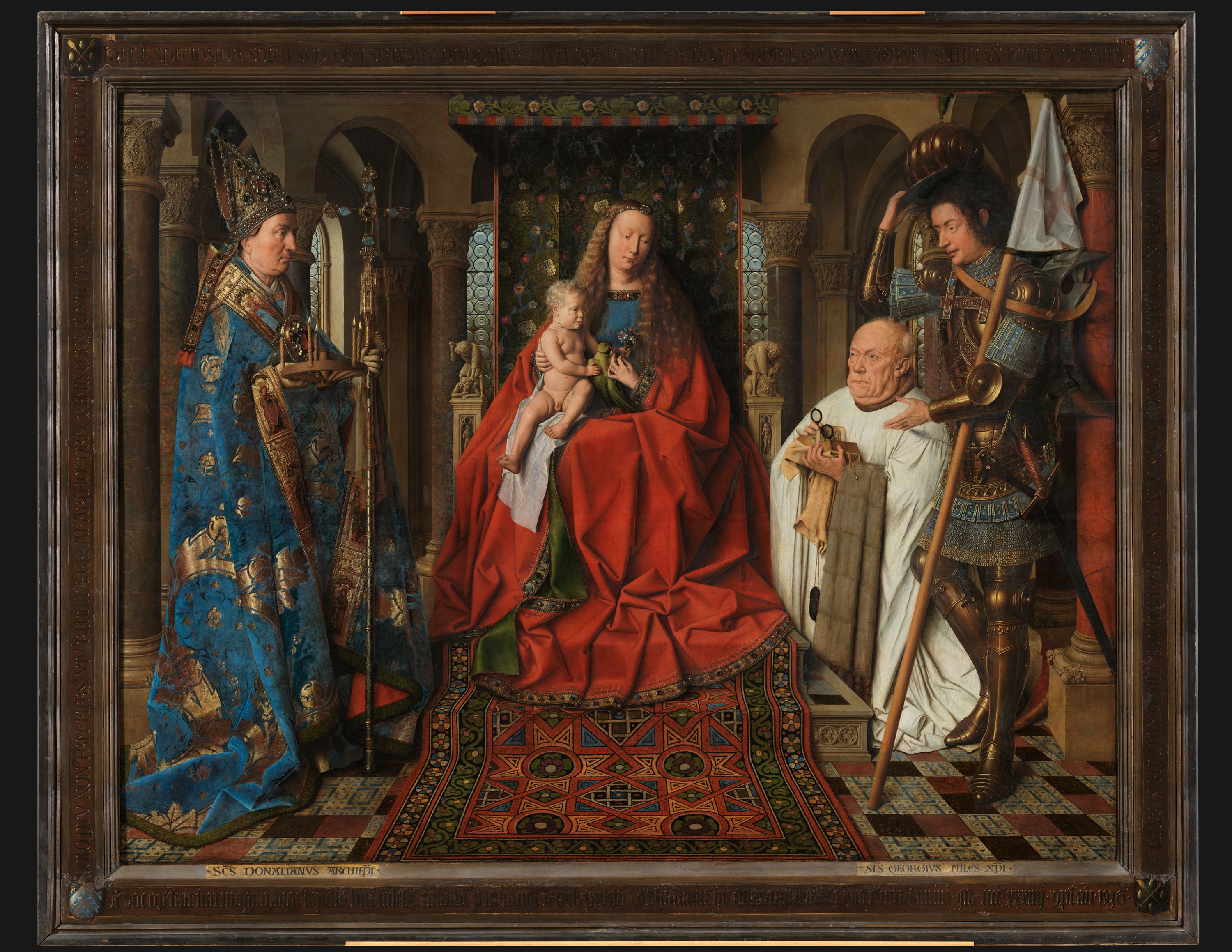
An elderly man has paused over a book. His spectacles hover above its pages, while a soldier in shining armour leans forward to introduce him to the Virgin and Child. Across the room stands a bishop carrying a cross and a wheel of lighted candles. Jan van Eyck makes these different presences share one floor, one architecture and one compelling field of light. The man is Canon Joris van der Paele; the painting preserves his likeness within the sacred company whose intercession he sought.
Completed in 1436, the painting belongs to the Groeningemuseum in Bruges, inventory 0000.GRO0161.I. Musea Brugge gives the panel's dimensions as 124.5 by 160 centimetres, and 148 by 184 centimetres with its original frame. Painted in oil on oak, it is an imposing object rather than a small handheld devotional picture. The surviving frame identifies the patron and painter and records the dates 1434 and 1436. Its words belong to the work as fully as the richly dressed figures inside them.[1]
At a Glance
This is also a monument to remembrance. Van der Paele funded religious services intended to continue after his death. His portrait, the saints of his church and namesake, and the frame's record of his generosity gave those observances a visible focus. The painting asks us to consider how a person might remain present within a community after his bodily presence ended. Its astonishing surfaces serve that enduring purpose, even when they draw us into the pleasures of looking.
A meeting arranged around the Virgin
Mary occupies the centre, seated beneath patterned cloth. Her red mantle falls in broad, angular folds over the throne and toward the carpet. The small naked Child turns across her lap, handling a green bird beside a cluster of flowers. The white cloth beneath him makes his flesh stand out against the red. Before identifying any symbol, notice how the arrangement gives the central pair a shared activity. Their small exchange of hands interrupts the ceremony of an otherwise solemn gathering.
The two standing saints create different kinds of welcome. Saint Donatian, on the left, holds himself upright within a magnificent blue and gold cope. His mitre extends upward toward the arches; the tall processional cross establishes another vertical beside him. Saint George, on the right, bends and raises his helmet. One figure supplies stability, the other movement. Between George and Mary the kneeling canon appears particularly exposed: pale face, white garment, occupied hands and no protecting armour.
The broad arrangement is balanced without being mechanically symmetrical. Donatian's heavy garment spreads near the left edge; George's legs and long shaft extend toward the lower right. Mary's mantle and the carpet occupy the interval. Each principal figure has a clear silhouette, yet their belongings cross the spaces between them. The cross, helmet, book, flowers and bird give the eye routes through the gathering. Looking can proceed through gestures and objects as well as from face to face.
Donatian was patron of the Bruges church for which the painting was made; George was Van der Paele's namesake and patron saint. The picture therefore joins the donor's institutional identity to his personal protection. George's presenting gesture makes that relationship especially clear. The canon has not simply placed his portrait beside a fashionable religious subject. The choice and disposition of the saints explain how he belongs to this particular gathering.[1]
George's body overlaps the canon's white clothing, making the introduction unusually immediate. The saint's lowered hand occupies the space above the patron's shoulder; his other hand lifts the helmet. Courtesy becomes visible through the removal of an object that normally protects the head. The soldier's brilliant appearance could have overwhelmed the kneeling man, but his inclination directs attention toward him instead. Van Eyck gives the advocate magnificence while letting the mortal beneficiary retain his own distinct presence.
For comparison, the donor in the Madonna of Chancellor Rolin faces Mary without a presenting saint. Here introduction is part of the composition's action. The difference affects how the viewer approaches the portrait: Van der Paele appears supported by named advocates, while his kneeling posture preserves the distance between human hope and sacred authority. Shared space makes access imaginable without making every participant equal.
The man behind the portrait
The canon's career extended far beyond Bruges. Musea Brugge's 2020 exhibition research placed his long service at the Roman Curia against the conflicts of the papal schism and wider European diplomacy. Its account connected his ability to finance the painting and memorial foundation with a successful ecclesiastical career, including attention to his own financial interests. This provides a necessary corrective to reading the picture as a transparent record of private humility. The kneeling figure had acquired the resources to commission a major work from the Burgundian court painter.[2]
His reputation continues to be reconsidered. Hendrik Callewier's 2025 biography, De ijdelheid van de kanunnik, follows his ambition and wealth through Rome, Utrecht and Bruges. The Rijksmuseum library record reproduces the publisher's summary of that argument; it is an introduction to the book, not the book's complete archival evidence. The useful question it raises is how the portrait's devotional presentation relates to a career shaped by advancement and accumulation. One need not dismiss the canon's religious concern to recognise the prestige involved in making it so conspicuous.[3]
Utrecht deserves a place in this history, rather than being lost between Rome and Bruges. The historical society Oud-Utrecht's presentation of Callewier's research describes Van der Paele as a canon connected with both cities and foregrounds his Utrecht ambitions. That wider network reminds us that the donor's identity cannot be reconstructed solely from the place where his picture survives. The painting fixes him within one Bruges sacred setting, while his working life connected several ecclesiastical centres.[4]
What the picture itself supplies is a sharply individual face. The bald head, folded skin around the mouth and heavy eyelids differ from George's youthful appearance and Mary's composed features. Van Eyck does not conceal the changes of age beneath a generalized ideal. The portrait makes remembrance bodily specific. Even without the identifying inscription, we would recognise that this face asks to be remembered as a particular person's rather than as an anonymous representative of piety.
It is tempting to go further and diagnose the sitter. A Gresham College lecture on the painting proposed particular illnesses and blindness, using the depicted face and hands alongside chapter records. The same lecture acknowledges that those records do not specify the disease or state that he was blind. Such retrospective diagnoses remain proposals. The secure historical point is that infirmity affected his attendance and prompted dispensations; the painting is not a clinical examination.[5]
The hands deserve attention without being turned into medical proof. One supports the book, the other holds the spectacles, while the fur garment rests across his forearm. Their tasks make the portrait feel temporarily interrupted. He has something to return to when the encounter ends, although within the painting it never does. This suspended activity gives the donor a life beyond the pose: reading, handling familiar possessions and pausing in thought.
The foundations and the corrected dates
The first chaplaincy dates to 13 September 1434. A chaplaincy was an endowed provision for a cleric to perform specified services; it was more than the dedication of an architectural chapel. Alfons Dewitte's study of the surviving documents distinguishes the second chaplaincy, founded on 30 January 1443, from an intervening memorial provision in 1440. The distinction matters because the painted frame refers to two chaplaincies, while the picture itself was completed seven years before the second foundation.[6]
The provisions combined three weekly Masses from the first foundation with four from the second, covering the week. They also required continuing attention to the graves of the canon and his family. Dewitte records obligations, funding and liturgical equipment, but finds no explicit reference to the painted panel in the documents he discusses. This is strong evidence for the memorial activity around Van der Paele, with a corresponding limit: the foundation records do not by themselves establish the painting's exact original position.[6]
That difference between a recurring service and a permanent image helps explain the work's ambition. A Mass takes place at an appointed time; a picture remains available between observances. One calls for living voices and gestures, the other presents the donor in an unending act of devotion. Their rhythms could reinforce each other. The canon's likeness could prompt remembrance even when the particular service he funded was not being performed.
The foundation also involved other people accepting duties. Remembrance depended on clerics, administrators and the institution that would maintain the arrangements. Van der Paele's investment sought a future within that collective life. The picture gives an ideal form to the relationship: a named man is introduced by saints within the setting of a church. Behind that ideal lay the practical problem of persuading a community to continue acting on his behalf.
Musea Brugge's exhibition account therefore understands the commission as part of a memorial foundation and an epitaph project. The term epitaph need not mean a simple written gravestone: an image could identify the person commemorated and sustain requests for prayer. The precise installation remains debated. Calling the painting a memorial is better supported than confidently placing it on a reconstructed altar or above a tomb at an exact height.[2]
Reading the frame as part of the image
The lower border records that Joris van der Paele, canon of this church, had the work made through Jan van Eyck. It names the foundations and distinguishes 1434 from completion in 1436. The wording is not equivalent to a modern label saying only when the artist painted the panel. It locates patronage, religious provision and authorship together. The expression identifying the canon with this church originally addressed viewers in an actual institutional setting.[1]
The plural foundations cannot simply be assigned to 1436. The documentary sequence requires the frame's text to be considered as something with a history of revision. This does not diminish its value as evidence. Rather, it asks us to separate the original painted object's completion from changes to the commemorative statement around it. The border remained useful because it could continue to articulate the patron's developing provisions for remembrance.
Across the upper border, biblical language from Wisdom praises a figure surpassing the sun and stars and invokes light and an immaculate mirror. The words frame Mary's appearance below. Side inscriptions identify the histories of Donatian and George; shorter labels identify the saints at the bottom. The donor's contemporary name and the saints' legendary past therefore occupy the same material boundary. Reading moves between the local, dated commission and a sacred history presented as enduring.[1]
Donatian's rescue from drowning and George's victory through martyrdom give the still figures histories beyond the scene. Neither episode is acted out in the main gathering. Instead, the words and attributes recall them: the candle wheel for the bishop, the military equipment and banner for George. The frame allows recognition and narrative to accompany a composition centred on presence rather than on a dramatic incident.
Watch: Jan van Eyck in context
Choose a Smarthistory close reading of the Arnolfini Portrait or the closed and opened Ghent Altarpiece.
Jan van Eyck, The Arnolfini Portrait
Look closely at the room, mirror and gestures in the London double portrait.
Watch on YouTubeIts lettering also has a visual character. In his 2012 Van Eyck Studies abstract, Douglas Brine examined the inscriptions' imitation of metalwork and their differing epigraphic styles. His argument connects their appearance with contemporary commemorative monuments. The text was made to be looked at as well as deciphered. On a painted wooden object, letters can appear engraved or cast, extending the work's fascination with translating one material into another.[7]
Notice the relationship between that illusion and the objects inside the border. Donatian's cross, jewels and golden ornament appear as precious things; the writing presents another display of material authority. A border that resembles durable metal can make commemoration seem physically lasting. Its function is therefore both documentary and pictorial. Cropping it away gives a cleaner modern rectangle, but weakens the encounter with the historical object the donor commissioned.
Church architecture and the smaller biblical stories
The setting curves around the figures. Round arches open into shadow, while columns and carved capitals establish a substantial enclosure. The patterned floor is seen more from above than the faces, giving the figures room to stand and the carpet room to unfold. At the back, glazed openings puncture the darkness. This is architecture designed to sustain a sacred assembly, not a neutral background that could be exchanged without consequence.
Its identification remains uncertain. Saint Donatian's own church and the Holy Sepulchre in Jerusalem have both been proposed as points of reference; neither is established as a literal architectural portrait. A Flemish Art Collection study links the throne's sculpted Adam and Eve, Cain and Abel, and Samson with the lion to Christian histories of sin, sacrifice and victory over death. It also reads the Child's white cloth and central placement in relation to the Eucharist. These are interpretive connections, not an inventory of separate actions happening in the room.[8]
The miniature carvings alter the pace of looking. From a distance, throne supports help organise the central seat. Closer inspection turns those supports into inhabited surfaces, where bodies struggle or stand. Painted sculpture supplies a different kind of narrative from the living figures: its monochrome appearance sets it apart, while its physical attachment to the throne binds it to Mary and Christ. One can register the whole gathering first and discover these small episodes later.
Their modest size is part of their effect. They do not compete with the canon's face or the Child's gestures for immediate attention. Instead, they reward a return to the work. A viewer familiar with biblical interpretation could connect older stories with Christ's redemptive role; another viewer could first notice the contrast between seemingly carved matter and living flesh. The work allows knowledge to accumulate through looking without requiring every detail to announce itself equally loudly.
The central figure's scale also resists a purely architectural measurement. Mary's mantle fills the room with a breadth that makes the throne's occupant dominant, even though the small arches recede behind her. The architecture offers a recognisable sacred environment, while the hierarchy of figures governs its proportions. The viewer is invited to accept a convincing room and an exceptional presence together. Neither needs to cancel the other.
This helps explain why the painting can feel intimate despite its formality. The room has little space left for an onlooker to wander through. The figures occupy its front and the carpet extends toward our position. We encounter the assembly almost at its edge. Compared with the expansive landscape beyond Rolin's chamber, this enclosure concentrates attention upon the donor's introduction and the materials immediately around him.
Spectacles, flowers and the act of seeing
The spectacles form two small dark circles against pale cloth and book. They are conspicuous partly because the canon is not wearing them. Their position makes the transition from reading visible: the book remains open, but attention has shifted elsewhere. At this scale the object is both ordinary and narratively exact. It explains a pause without a separate episode showing what the canon was doing beforehand.
Stephen Hanley's study argues that early spectacles should be connected particularly with close reading, rather than treated as a generic emblem of defective vision. He proposes a further association between optical magnification and the devotional language of magnifying God, especially the Magnificat. He also observes that the text beneath the lens is blurred rather than simply enlarged. His reading connects physical description with religious interpretation; it does not establish the exact prayer in the book, whose writing remains undeciphered.[9]
That uncertainty about the text is productive. The book can signify a sustained practice of reading without supplying a single passage that solves the scene. Its open leaves, gathered edges and the hand holding them make it something used. The difference from the inscription is striking: the frame offers readable public identification, while the book presents the private activity from which the canon appears to have turned. Both involve words, but they address the viewer differently.
The flowers and parakeet work within the central exchange of hands. Their delicacy contrasts with the armour and ceremonial metalwork, while the bird's green gives a small point of colour within Mary's red and blue. Its rounded head and compact body can be followed before its partly obscured tail. This is a living creature held near another living body, not a flat emblem detached from the scene's actions.
The child's exposure, the white cloth and the bird also make close attention to touch unavoidable. Mary supports him; he handles the bird; fingers meet around the flowers. These contacts give the central sacred figures a bodily immediacy different from the donor's still posture. The image does not distribute realism only to the mortal portrait. It uses physical relationships to make the holy encounter imaginable as well.
Armour, reflections and the painter's possible presence
George's armour offers a different experience of light. Curved plates interrupt the figure with bands of bright and dark, while decorative edges and rivets distinguish one piece from another. His knee and lower leg project into the foreground, where the hard metal meets the patterned floor. The helmet held above his head has several surfaces at different angles. Its reflections make the object seem to contain fragments of the room as it moves through it.
The museum's Dutch description identifies repeated reflections of Mary and a window in the helmet. It also draws attention to a standing figure in the shield on George's back, wearing a red hat and dark blue clothing. That figure may represent Van Eyck. The qualification matters: the reflection's presence is visible, but a securely identified self-portrait is a further claim. It should not be used to convert every patch of reflected colour into a named witness.[10]
The shield faces toward the space outside the main assembly, bringing a figure from that implied space into the picture through reflection. Its placement can make the viewer conscious of a position in front of the painted surface. The reflected form is tiny compared with the donor's portrait, yet it introduces another scale of presence. Someone can appear in the work almost incidentally, at the edge of the saint's equipment, rather than through a full-sized body.
Brine's Courtauld lecture abstract relates the proposed self-image to the painter's professional identity and wish for remembrance alongside his patron. This is a more particular reading than treating it as a repeated version of the Arnolfini mirror. The memorial commission supplies a context in which the maker's inclusion could matter beyond a demonstration of optical skill. The abstract presents an argument, however; it is not documentary proof that the reflected person is Jan.[11]
The comparison with Donatian is equally revealing. His small flames, patterned cloth and jewels respond to light without the broad distortions of polished armour. The painter changes the shape, concentration and distribution of brightness for each surface. A jewel, a gold thread and a steel plate cannot all be made convincing through the same repeated highlight. Their differences make the room feel materially abundant while keeping the single painted surface coherent.
What material research can establish
Susan Jones's Metropolitan Museum essay uses this work to illustrate oil paint's ability to distinguish textures. Oil permits transparent passages, careful blending and sharply descriptive touches; Van Eyck's achievement depends on how he deploys those possibilities. He did not invent the medium. In this painting, the contrast between soft cloth, reflective armour and ornament gives that familiar correction an immediate visual purpose: admiration can be directed toward specific handling rather than a legendary secret recipe.[12]
Modern imaging makes the material inquiry more precise. The VERONA project documented the Bruges painting through normal and raking light, infrared and ultraviolet photography, infrared reflectography, radiography and elemental scanning. KIK-IRPA carried out the imaging apart from the macro-XRF work undertaken by the University of Antwerp. Standardised examination allows comparisons with other Van Eyck paintings. The resulting resources extend looking beneath or beyond what an ordinary colour photograph can show.[13]
The methods answer different questions. A photograph records appearance under particular lighting; an elemental map can locate substances through their chemical constituents. Neither should be treated as an automatic explanation of artistic intention. A hidden line may record preparation or alteration, while a pigment distribution may reveal working method or later intervention. Interpretation depends on where the observation occurs and how it relates to the rest of the object.
The distinction became central to the Antwerp examinations of 2015 and January 2021. Macro-XRF identifies elements, but copper alone does not identify a unique green pigment. The later macro X-ray powder diffraction study investigated crystal structures in selected small areas. Musea Brugge names questions concerning lead white, ultramarine and the greens of the parrot and canopy. Its public text outlines the investigation rather than supplying a complete recipe for each painted passage.[14]
The university's account adds that diffraction can identify degradation products as well as pigments. This matters because the colour seen today and the material originally applied are related but different subjects. Research into change helps conservators distinguish deterioration from an artist's choice. The presence of an analytical campaign does not itself mean that the painting has undergone a new comprehensive cleaning, and the examination should not be described as one.[15]
A 2022 symposium abstract goes further on ultramarine. Janssens and colleagues compared the Van der Paele panel with the Ghent Altarpiece, the Madonna at the Fountain, a Coxcie copy and other Netherlandish paintings. They reported a distinctive mineral pattern in the Van Eyck works and proposed two possibilities: a particular ultramarine source or specific workshop preparation. They explicitly described the findings as preliminary. This is evidence of a promising comparison, not an established pigment signature capable of authenticating any picture on its own.[16]
KIK-IRPA's BALaT record also preserves a long photographic and intervention-file history for the object. Its index is useful evidence of repeated examination, although an index is not the contents of the conservation files. The museum's current dimensions differ from measurements in older literature and metadata; the current owning collection's figures are used here. Such discrepancies are a reason to identify which measurements are being cited, rather than silently combine numbers for different recorded extents.[17]
Copies, removal and a changed public life
The composition had a life beyond the single panel. Didier Martens's French-language study follows adaptations in Castile that often retain the Virgin, Child and parrot while leaving the canon behind. A revealing difference concerns the bird's tail: Van Eyck partly concealed it, whereas many later versions extend it over Mary's mantle. Martens argues that the repetitions often depended on an intermediate model. Infrared evidence shows the original's shorter, obscured arrangement was already planned in the underdrawing.[18]
This is more informative than simply counting copies. A small adjustment can identify the route through which a composition travelled. It also shows that imitation could involve selection and change: the sacred central group remained useful after its connection with one named Bruges donor had been removed. The original painting's individual memorial purpose and the later appeal of its figures therefore belong to different stages of reception.
The original itself stayed closely associated with Saint Donatian's. The Flemish Art Collection records the chapter's refusal of Mary of Hungary's request in 1547 and its protection of the work during religious conflict. French forces confiscated it in August 1794; it returned to Bruges in 1816, after the church had been demolished. Its survival preserved the painted encounter and frame while the institution's original architectural setting was lost.[8]
French collections provide another witness to its later fame. The Louvre's Chalcographie catalogue records a wood engraving of the canon after the painting by Jules Louis Laurent Langeval, inventory 6699 C. It isolates the donor as a fragment from the larger composition. The man whose likeness was embedded in prayer could thus circulate independently as an admired portrait. The print is evidence of reception, not a work engraved by Van Eyck.[19]
That separation changes what we see. A portrait detail foregrounds ageing skin, book and spectacles; the complete framed painting restores saints, liturgical associations and the donor's named provisions. Neither view makes the other unnecessary, but only the whole object shows how Van Eyck joined them. The canon's face is exceptionally memorable because it belongs both to a mortal individual and to a far larger arrangement of hoped-for protection.
The painting's continuing force comes from that combination. Its records identify an ambitious commission and a programme for remembrance; its material surfaces make the sacred assembly astonishingly present. The dates and later history complicate a simple narrative, while the book, reflections and miniature carvings keep looking active. Van der Paele wanted a future place in prayer. Van Eyck gave that wish a form in which a face, a community and an artist's powers remain inseparable.
Related reading
 Jan van Eyck.jpg)


Discussion
What do you notice in Madonna with Canon Joris van der Paele by Jan van Eyck? Share a close observation or a source that adds useful context.
Join the Conversation
Keep observations specific and evidence clear.
References
- Musea Brugge, “Madonna with Canon Joris van der Paele”, Groeningemuseum, inventory 0000.GRO0161.I; current measurements and inscription transcriptions. View Source.
- Musea Brugge, Van Eyck in Bruges, 2020 press dossier, relevant sections on the patron, memorial function and research, especially p. 9. View Source.
- Rijksmuseum Research Library, catalogue record for Hendrik Callewier, De ijdelheid van de kanunnik: Joris van der Paele en Jan van Eyck (2025); publisher's summary consulted, not the full book. View Source.
- Oud-Utrecht, “De ijdelheid van de kanunnik”, presentation of Hendrik Callewier's archival research, 15 April 2026; event notice, not a transcript. View Source.
- Gresham College, “Van Eyck's The Virgin with the Canon: Visual Disability and Societal Attitudes as Depicted in the Northern Renaissance”, 25 October 2016, published lecture text; clinical identifications treated as hypotheses. View Source.
- Alfons Dewitte, “De kapelanie-stichtingen van kanunnik Van der Paele: Brugge 1434 en 1443”, Biekorf 72 (1971), pp. 15–20, original archival study, via DBNL. View Source.
- Douglas Brine, “The Fictive Metalwork Inscriptions of Jan van Eyck's Van der Paele Virgin”, Van Eyck Studies colloquium, 2012, published abstract p. 36; abstract consulted. View Source.
- Anne van Oosterwijk, “Madonna with Canon Joris Van der Paele”, Flemish Art Collection, object study; chronology of the second chaplaincy corrected against Dewitte's archival publication. View Source.
- Stephen Hanley, “Optical Symbolism as Optical Description: A Case Study of Canon van der Paele's Spectacles”, Journal of Historians of Netherlandish Art 1, no. 1 (2009). View Source.
- Musea Brugge, IIIF presentation record and high-resolution image, including the museum's Dutch object description. View Source.
- Douglas Brine, “Jan van Eyck and the shield of St George”, Courtauld Research Forum, 17 March 2016, lecture abstract. View Source.
- Susan Jones, “Painting in Oil in the Low Countries and Its Spread to Southern Europe”, Metropolitan Museum of Art, 2002. View Source.
- Musea Brugge, “VERONA: Large-scale research into the works of Jan van Eyck”, institutional account of imaging and open access. View Source.
- Musea Brugge, “New scientific research into Van Eyck's Madonna with Canon Joris van der Paele”, 2015 and 2021 investigations. View Source.
- University of Antwerp, ARCHES, “MA-XRPD on Madonna with Canon Joris van der Paele by Jan van Eyck”, 12 July 2021. View Source.
- Koen Janssens, Steven de Meyer, Frederik Vanmeert, Geert Van der Snickt and Jana Sanyova, “Did Jan van Eyck use a type of natural ultramarine specific for his workshop?”, 2022 symposium Book of Abstracts, p. 10; preliminary findings. View Source.
- KIK-IRPA, BALaT, object 101965, “Madonna met kanunnik Joris Van der Paele”; public metadata and photographic/intervention-file index. View Source.
- Didier Martens, “Un triptyque brugeois de la Renaissance à Castrojeriz (Burgos) et l'influence de la Madone au chanoine Van der Paele en Castille”, Quintana 12 (2013), pp. 21–36; relevant object and copying discussion consulted. View Source.
- Musée du Louvre, Chalcographie, Jules Louis Laurent Langeval, “Le chanoine Van der Paele (George de Pala)”, wood engraving, inventory 6699 C. View Source.

 Jan van Eyck.jpg)


