


 Buy Art Prints Now
from Amazon
* As an Amazon Associate, and partner with Google Adsense and Ezoic, I earn from qualifying purchases.
 by Tom Gurney
Tom Gurney BSc (Hons) is an art history expert with over 20 years experience
Page Created on June 19, 2020 / Page Updated on November 1, 2026
Email: tomgurney1@gmail.com / Phone: +44 7429 011000
The Offerings of Cain and Abel in the Ghent Altarpiece
Above Adam, at the outer left of the opened Ghent Altarpiece, two small figures present their gifts. The shepherd Abel lifts a lamb; Cain holds a sheaf of grain. Across the upper register, above Eve, a second scene shows Cain attacking his brother. KIK-IRPA’s panel list distinguishes the sacrifice on Adam’s side from the murder on Eve’s. These are successive episodes whose relationship becomes clear when both corners are considered together.[1]
Their subdued colour can make them seem like architectural ornaments beside the much larger bodies below. Looking closely changes that impression. The raised animal, lowered sheaf and violently upraised weapon carry a compressed account of worship, rivalry and death. The scenes occupy different ends of the altarpiece, but their figures belong to one family and one narrative. Their place above the first parents brings the consequences of the Fall into the generation that follows.
At a Glance
Compare the two upper corners
Details from The Offerings of Cain and Abel in the Ghent Altarpiece
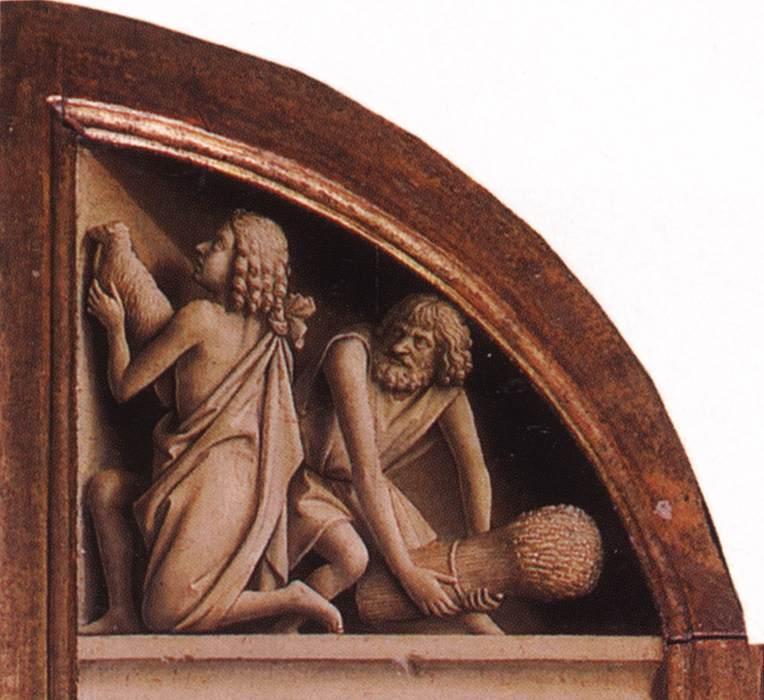
Offering above Adam: lamb and grain
Abel raises the lamb at left; Cain holds the sheaf at right. Web Gallery of Art via Wikimedia Commons, Public Domain Mark 1.0. Published by 2011; predates the current upper-register campaign. Unmodified detail.
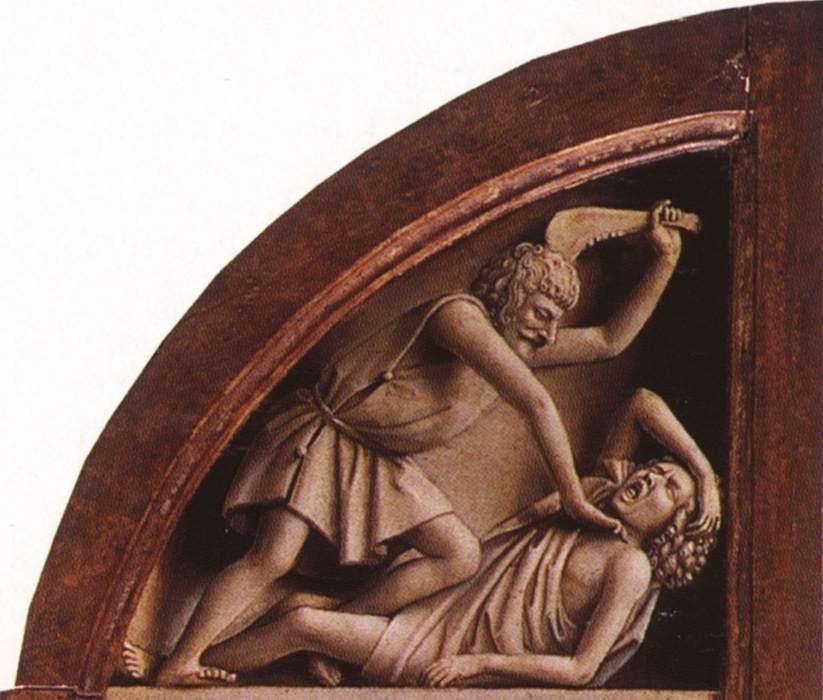
Companion above Eve: the murder of Abel
Cain raises a jawbone over Abel in the opposite upper corner. Web Gallery of Art via Wikimedia Commons, Public Domain Mark 1.0. Published by 2011; predates the current upper-register campaign. Unmodified detail.
Reading the offering’s gestures
In the older published photograph reproduced here, Abel kneels at the left, turning upwards with the animal held close to the tall inner edge of the compartment. His drapery crosses one shoulder and gathers behind his body. The raised gift, curling hair and lifted profile make an ascending group within a space that rises towards the left. The small figure’s action fits the shape of its architectural enclosure.
Cain occupies the lower, right-hand side. His bearded head turns towards Abel, while his hands support the large grain bundle close to the ledge. The sheaf’s dense, repeated texture contrasts with the animal’s body and the smooth areas of exposed flesh. Neither brother stands before a detailed landscape. A dark recess, a curved arch and a horizontal sill concentrate attention on their bodies, gestures and gifts.
The difference in height helps the viewer distinguish the two acts. Abel raises his offering towards the upper corner; Cain’s gift remains below. The comparison is more precise than describing one man simply as cheerful and the other as wicked. The subject makes their unequal reception meaningful, but a tiny face in an aged reproduction cannot disclose every motive that a later commentator might wish to find there.
Painted sculpture rather than carved stone
The Vlaamse Kunstcollectie describes the two scenes as small imitations of sandstone sculpture. Its offering record identifies the work as oil on panel within the 1432 altarpiece at Saint Bavo’s Cathedral. The figures’ apparent stone colour and projecting forms are therefore achievements of painting. They do not establish the presence of separately installed carved reliefs. The catalogue’s numerical dimensions should also not be treated as an independently verified measurement of the little offering compartment.[2]
The illusion is different from the great nude beneath it. Adam appears as a bodily presence, with skin whose colour and surface invite recognition as flesh. His sons appear as figures rendered in another apparent material, within a smaller architectural opening. A viewer moves between these levels of representation without leaving the painted ensemble. The restricted colour gives the narrative a sculptural character while allowing it to remain subordinate in scale.
Weale’s 1912 account calls the upper spaces demi-lunettes and describes the episodes as representations in high relief. Read alongside the collection’s explicit identification of imitation sculpture, that language records the strength of the illusion. Weale also transcribes the death-related inscriptions beneath Adam and Eve. The small stories above consequently sit within an arrangement whose written and pictured elements repeatedly connect humanity’s beginnings with mortality.[3]
The story in Genesis
Genesis 4 gives the brothers distinct livelihoods: Cain cultivates the ground and Abel tends flocks. Cain brings produce; Abel offers firstlings and their fat portions. God favours Abel’s gift, and Cain becomes angry. Before the killing, he receives a warning about sin and the possibility of mastering it. The narrative separates the offering, the response, the warning and the subsequent violence. The two upper scenes preserve a similar distinction between bringing gifts and committing murder.[4]
The USCCB’s explanatory notes stress that Genesis does not state why the gifts receive different treatment. They also reject the idea that the story simply disparages farming: Adam himself had been given work on the soil. The painted sheaf can identify Cain’s occupation without making agriculture intrinsically sinful. Nor does the picture prove that Abel’s animal was accepted merely because it cost more. Those explanations would add certainty where the text leaves a question.[4]
That unresolved preference gives the interval between the images consequence. The brothers initially perform comparable acts of worship, although a viewer may anticipate the ending. Across the altarpiece, the second image presents the moment when an unequal response has become an assault on another person.
Abel’s faith and the Christian reading
The Epistle to the Hebrews supplies an interpretation that differs from simply repeating Genesis. Hebrews 11:4 explicitly connects Abel’s more acceptable sacrifice with faith and describes him as righteous. Its continuing witness after death gives the story a place within a succession of faithful lives. This later scriptural perspective helps explain how Christian viewers could regard the small offering as more than an agricultural scene, while keeping the interpretation distinct from what Genesis itself says.[5]
Hebrews 12:24 introduces another connection: Christ’s blood is compared with Abel’s, but speaks more effectively. The accompanying commentary contrasts Abel’s blood crying from the ground with Christ’s opening access to God. That is a comparison built upon a difference. Abel and Christ do not become interchangeable figures; the earlier innocent death offers a way to contemplate the later Christian sacrifice. The paired scenes can consequently participate in a Christian account of redemption while retaining their Genesis identities.[6]
Watch: Jan van Eyck in context
Choose a Smarthistory close reading of the Arnolfini Portrait or the closed and opened Ghent Altarpiece.
Jan van Eyck, The Ghent Altarpiece (2 of 2)
Follow the heavenly figures and the gathering around the Lamb when the wings open.
Watch on YouTubeIn his 1920 discussion of the altarpiece, the priest L. Aerts explicitly reads Abel as shepherd, sacrificer and martyr anticipating Christ. He links the offered lamb with the altarpiece’s central Lamb and treats the killing above Eve as part of the same interpretative structure. This is a documented historical reading of the work. It helps establish the scene’s reception without supplying a surviving statement by either painter explaining every choice.[7]
The Adoration of the Mystic Lamb below makes the animal comparison compelling. Yet the upper lamb is held as a gift within an episode, whereas the lower Lamb receives adoration within a larger vision. Following that echo adds depth to looking; preserving the distinction prevents a small narrative detail from being made to explain the entire polyptych.
A tradition older than Van Eyck
Paul-Henri Michel’s French study traces the subject through murals, manuscript pictures and sculpture. He shows how offerings, murder and divine questioning were selected or combined differently, rather than following one unchanging pictorial formula. The animal and plant gifts could act as identifying attributes, allowing the brothers to be recognised even when the surrounding story was abbreviated. This helps explain the economy of the Ghent image: a few objects carry substantial narrative information.[8]
Michel discusses a broadening range of artistic choices, including altars and more elaborate settings in later manuscript images. The Ghent scene’s compact architectural format belongs within that wider history, but the comparison does not identify one manuscript as its direct source. Its painters selected a particularly concentrated arrangement. The image makes the offerings legible without showing every event through which Genesis takes the reader.[8]
Aerts proposed a more local sculptural comparison with Romanesque capitals in Maastricht’s church of Our Lady. He drew attention to the raised lamb, the sheaf and similarities in clothing and appearance, referring readers to Raphael Ligtenberg’s illustrated study. That proposal is useful evidence of an earlier scholar looking beyond painting. It remains a comparison, rather than proof of a documented visit by Van Eyck or an exact model copied into the altarpiece.[7]
The murder above Eve
The companion photograph shows a decisive change in bodily relationships. Cain now rises over Abel, who lies on the ground beneath him. One arm holds the weapon above his head while the other bears down on his brother. Abel’s head falls backwards and his legs bend across the base of the compartment. Where the offering gathered two separate gifts within a shared space, the murder locks the figures into a violent, overlapping group.
The two architectural shapes answer one another. The offering’s enclosure rises towards the left; the murder’s towards the right. Their opposing curves belong to the outer upper corners, rather than two interchangeable pictures. The attack is fitted into its arch just as the lifting of the lamb is fitted into the other. Reading the pair involves comparing both the story and the painters’ adjustment of movement to a constrained shape.
Marjan Pantjes’s 2019 study in Oud Holland explains that Genesis names no murder weapon. Medieval artists supplied different implements, with the jawbone becoming a conspicuous tradition. Her study lists Van Eyck’s altarpiece among Netherlandish examples and follows the motif into later art. The object raised above Abel in the Ghent scene therefore belongs to an extended interpretative history; it should not be cited as a detail explicitly prescribed by Genesis.[9]
Pantjes’s main subject is a later painting by Hans Memling, where she identifies sculptural figures through attributes and their relationship to Passion scenes. The comparison demonstrates how painted sculpture could carry Old Testament meanings inside a Christian picture. It does not authorise transferring every interpretation of Memling’s figures to Ghent, or treating the existence of a shared attribute as proof that the two paintings have identical programmes.[9]
Position, support and historical survival
The cathedral’s guide places Adam and Eve at the outer edges of the open upper register and identifies them as sinful humanity redeemed through Christ. Their children’s stories extend that frame of reference without making the parents the direct actors in the fratricide. The sacrifice and murder also remain distinct from the much larger gathering below. Their importance comes partly from the way they set a long human history around the heavenly figures.[10]
KIK-IRPA’s structural study distinguishes the Adam/City View and Eve/Interior View supports from the side panels divided through their thickness in Berlin. These surviving double-sided units retain much of their original framing and proportions. That physical history matters when the offering is detached as a photographic detail: it is one passage within an assembled, framed shutter, rather than an independently surviving miniature whose dimensions and support history can simply be separated from the surrounding object.[11]
The current upper-register project also distinguishes the panels’ histories. Adam and Eve remained in Belgium during the nineteenth-century dispersal that took other wings to Berlin. Their supports and frames received attention during the first modern restoration phase, while the third phase investigates the open upper paintings and their varied condition. This does not mean they remained permanently in Belgium through every later wartime movement, or that their paint underwent the same interventions as every neighbouring panel.[12]
The project also continues to investigate the relationship between Hubert’s and Jan’s work. A catalogue-level Jan attribution for the offering does not, by itself, identify the painter of each small figure. Recognising the brothers’ shared project is compatible with leaving the individual execution of this passage unresolved.[12]
What the recent reports establish
The March 2024 press kit describes removal of old varnish and retouches from Adam and Eve and reports their generally good preservation. These are dated findings about the relevant panel units and figures. They do not publish an isolated pigment analysis, loss percentage or newly identified underdrawing for this little offering. The report can locate it within a conservation campaign without supporting a spectacular scene-specific discovery that the publication never claims.[13]
KIK-IRPA’s later funding update states that the enlarged final intervention is planned to finish in December 2026, with the fully restored altarpiece expected back in the cathedral in spring 2027. Those remain plans at the date of this revision. The older photographs used here predate the present upper-register campaign. They are useful witnesses for composition and comparison, but should not be mistaken for newly photographed final treatment results.[14]
The offering rewards attention because so much is done with so little space: an animal held high, a sheaf held low, two different responses and a corresponding act of violence across the ensemble. Scripture, historical interpretation, the physical object and its photographic record answer different questions about it. Considered together, they allow the small scene to retain both its narrative clarity and its place within the larger painting.
Related reading
 Jan van Eyck.jpg)


Discussion
What do you notice in The Offerings of Cain and Abel in the Ghent Altarpiece? Share a close observation or a source that adds useful context.
Join the Conversation
Keep observations specific and evidence clear.
References
- KIK-IRPA, Ghent Altarpiece press dossier, 20 June 2014, upper-register panel list. View Source
- Vlaamse Kunstcollectie, archived record, De Aanbidding van het Lam Gods (Het offer van Kaïn en Abel), inventory 10000094. View Source
- W. H. James Weale, The Van Eycks and Their Art, 1912, p. 49. View Source
- United States Conference of Catholic Bishops, Genesis 4:1–10 and explanatory notes on 4:1–16 and 4:4. View Source
- United States Conference of Catholic Bishops, Hebrews 11:4 and explanatory note. View Source
- United States Conference of Catholic Bishops, Hebrews 12:24 and explanatory note. View Source
- L. Aerts, Het lam Gods der gebroeders Van Eyck. De hoofdfiguur, 1920, pp. 1076–1077 and associated note on Maastricht. View Source
- Paul-Henri Michel, L’iconographie de Caïn et Abel, Cahiers de civilisation médiévale, 1, no. 2, 1958, pp. 194–199. View Source
- Marjan Pantjes, Uncovering the identities of Cain and Lamech: Christian typology in Hans Memling’s Scenes from the Passion of Christ (ca. 1470), Oud Holland, 132, 2019, pp. 149–158, especially pp. 150–151 and notes 9–11. View Source
- Saint Bavo’s Cathedral, English panel guide, Adam and Eve and general introduction. View Source
- Bart Fransen and Cyriel Stroo, editors, The Ghent Altarpiece: Research and Conservation of the Exterior, KIK-IRPA, 2020, pp. 47–51. View Source
- KIK-IRPA, Restoration and research of the upper register of the interior of the Ghent Altarpiece. View Source
- KIK-IRPA, Phase 3 press kit, 26 March 2024, current results and panel histories. View Source
- KIK-IRPA, Financement supplémentaire pour la troisième phase de la restauration de l’Agneau mystique, revised timetable. View Source

 Jan van Eyck.jpg)
 Jan van Eyck.jpg)


