


 Buy Art Prints Now
from Amazon
* As an Amazon Associate, and partner with Google Adsense and Ezoic, I earn from qualifying purchases.
 by Tom Gurney
Tom Gurney BSc (Hons) is an art history expert with over 20 years experience
Page Created on June 19, 2020 / Page Updated on November 1, 2026
Email: tomgurney1@gmail.com / Phone: +44 7429 011000
Portrait of the Goldsmith Jan de Leeuw
Jan de Leeuw holds a ring up to view, but looks past it towards us. His eyes, the tiny piece of jewellery and the words around his portrait offer three different kinds of encounter: with a particular face, with a goldsmith's work and with a man who has a name and a birthday. Jan van Eyck painted him in 1436. The Kunsthistorisches Museum in Vienna owns the oak panel, catalogued as GG 946, with its original inscribed surround.[1]
The complete object rewards more attention than reproductions of the face alone suggest. A little lion takes the place of the sitter's surname; apparently engraved and raised letters share the frame; two dates can be read plainly and also recovered through selected letters. Inside that elaborate border, the setting is almost empty. The portrait's wealth of information comes from the relationship between a closely observed person and a carefully devised object, rather than from a room full of possessions.[3]
At a Glance
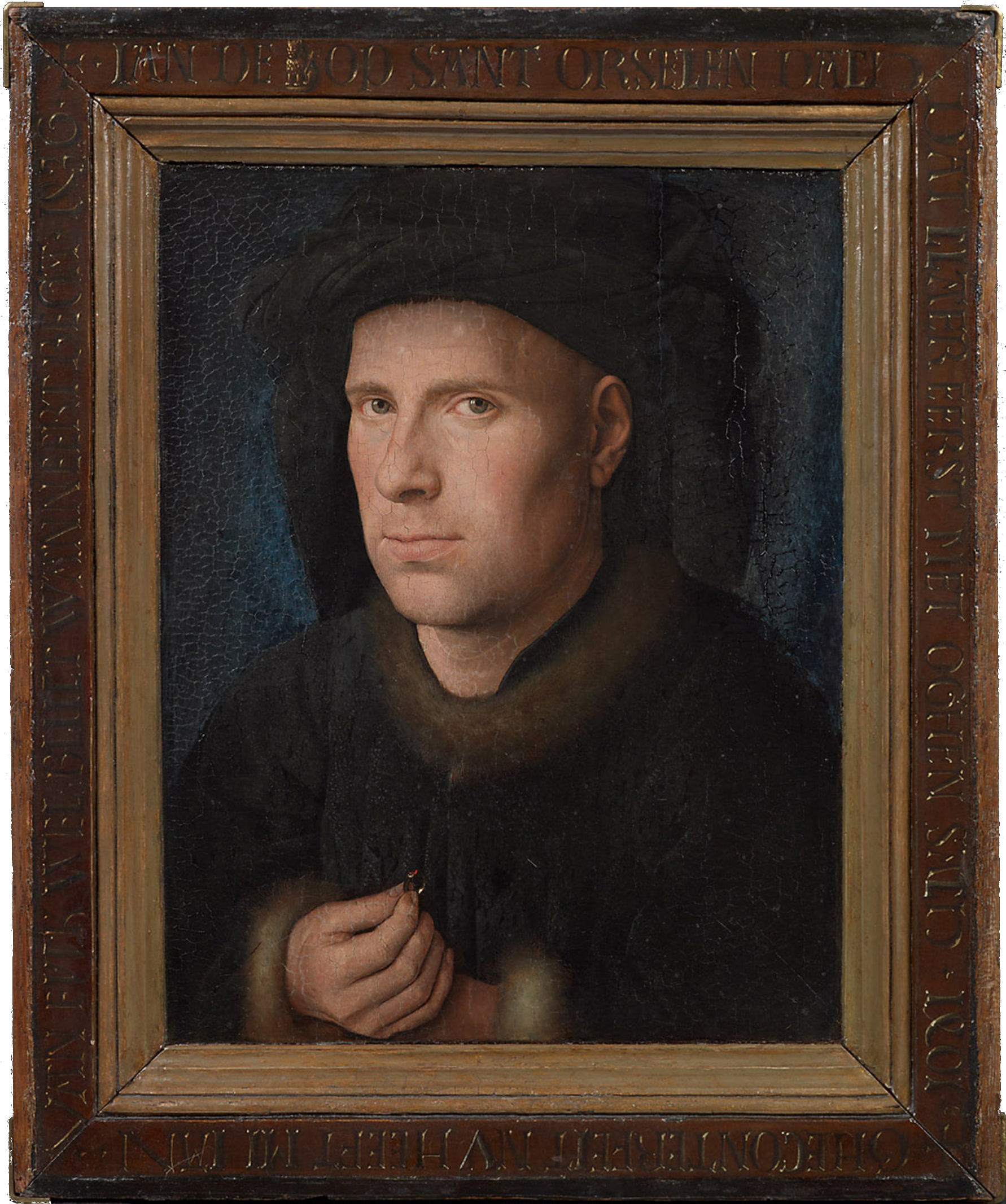
Looking at the face, hand and ring
The black headdress has an irregular outline, with folds that spread sideways before falling towards the shoulders. Against the dark ground, parts of its contour are easier to follow than others. The face consequently feels more firmly lit than the surrounding clothes. A broad area of forehead gives way to smaller transitions around the eyes, nose and mouth. The features have differences of angle and emphasis; this is no symmetrical diagram of a head.
Look first at the nearer cheek, then at the shadow beside the nose and the darker side of the jaw. Those passages turn the face without requiring a conspicuous outline. The lips are held together, with a small light catching the lower part. The eyes establish contact while the shoulders remain angled. A viewer meets a gaze rather than the blank side of a person absorbed in his own task.
Below, the pale fur interrupts the darkness with a different texture. Individual marks and irregular edges suggest softness, whereas the black fabric gathers into broader folds. The hand introduces another sort of surface: flesh changes direction around the knuckles and fingertips, then closes around a hard, bright object. That movement from cloth to fur to skin to metal concentrates several kinds of looking within a very small area.
The ring's opening remains legible despite its size. A reddish centre catches attention above the fingers. Its colour can be described, but the painting does not supply a gemmological identification. Calling the stone a ruby, or matching the painted ring with an actual surviving jewellery piece, would require evidence beyond its painted appearance. The same distinction applies to the sitter's expression: a firm mouth is visible, but confidence, severity or affection cannot be measured from it.
Why the whole frame matters
The museum lists measurements of 24.6 by 19.2 centimetres, a panel extent of 33 by 27.5 centimetres, and 37 by 31.5 by 3.5 centimetres including the outer framing. These refer to different extents, not conflicting estimates of one rectangle. The surround occupies a substantial part of this intimate object.[1]
A KIK-IRPA study of Netherlandish frames places Jan de Leeuw among examples with a semi-integral construction. The long sides are worked with the panel, while separate transverse mouldings complete the surround. The study also discusses the approximately Bruges-foot width shared with certain other Eyckian panels. Such measurements illuminate workshop practice; they do not establish that these pictures came from one tree or were ordered together.[4]
The painted finish adds another layer. The brown inscription band appears to carry worked metal lettering, while the inner mouldings introduce gilded and marbled effects. These are representations on a wooden object, not evidence that the entire frame is bronze. In this particular portrait, the simulated material makes an apt companion to the real profession of the man inside it.[4]
Follow a letter around a corner and the border changes function. It first looks like the edge of the picture, then becomes a surface that must be read. The face draws the eye inward; the inscription sends it along the perimeter. Neither activity replaces the other. The museum's 2024 account of visual illusion uses this portrait to show how Van Eyck could make the frame part of the picture's message.[12]
A name written with a lion
The frame identifies Jan de Leeuw, whose surname means lion, by placing a small lion after the written name Jan de. This is a rebus: an image supplies a word. The creature belongs to the sentence, making a verbal and visual identification coincide.[2]
The first statement records that Jan first saw daylight on Saint Ursula's Day in 1401. The feast falls on 21 October. The second names Jan van Eyck and gives 1436 as the year in which he began the likeness. The wording therefore provides a birth date and an act of portrayal, rather than a complete account of the commission. During 1436 the sitter would have been thirty-four before 21 October and thirty-five afterwards; the year alone cannot establish a birthday sitting.[2]
The two Jans meet in the inscription as sitter and painter, while its first-person phrasing lets the object introduce itself. Guy Bauman's Metropolitan Museum discussion connects that voice with the outward gaze and repeated idea of seeing: the words recall the man's first sight of the world while his painted eyes meet ours.[2]
This remains effective even for someone unable to read the complete Middle Dutch text. The lion, dates, changes in letter treatment and surrounding sequence advertise that the border contains information. A modern cropped image removes that invitation. Seeing the whole frame restores the passage between likeness and language, even before a translation has been supplied.
Two dates hidden in plain sight
The inscription contains a further exercise in attentive reading. A chronogram uses letters with Roman numerical values to encode a year. Hugh Hudson's detailed examination explains how the apparently raised letters yield 1401 in the birth statement and 1436 in the statement about the portrait. The argument depends on how the letters are painted, rather than simply selecting every possible numeral in the words.[3]
Letters that seem raised receive light and cast shadows differently from those that seem cut into the surface. The lion and the written dates participate in the same illusion. Hudson also explains how the forms of Y and W can contribute I and two Vs respectively. The combination of typography, light and arithmetic makes the proposed reading specific to this painted inscription.[3]
That precision matters because the frame has encouraged less convincing numerical solutions. Bauman proposed a further chronogram giving the sitter's age as thirty-five. Hudson rejects that calculation because it leaves out numerically significant letters without a comparable visual reason. The attractive idea of a portrait made for a thirty-fifth birthday therefore remains an interpretation, not something established by the frame.[2][3]
A chronogram here does not reveal a previously unknown birth year: the Arabic numerals already state it. Instead, the inscription asks a reader to arrive at the same information through a second route. The pleasure lies in recognition and confirmation. The device also prolongs the encounter. A face that takes a moment to register belongs to an object that can occupy a reader much longer.
What can the ring mean?
The Kunsthistorisches Museum interprets the displayed ring in relation to de Leeuw's professional skill. That reading has a firm starting point: the sitter is identified as a Bruges goldsmith. The image nevertheless stops short of showing him making anything. It presents a finished small object, with the hand positioned so that a viewer can recognise its form.[1]
Watch: Jan van Eyck in context
Choose a Smarthistory close reading of the Arnolfini Portrait or the closed and opened Ghent Altarpiece.
Jan van Eyck, The Arnolfini Portrait
Look closely at the room, mirror and gestures in the London double portrait.
Watch on YouTubeThis restraint is important to the composition. A workbench would introduce another setting and another activity. Here the hand directs attention to the ring while the eyes keep attention on the man. Jewellery serves as a compact sign of work without turning the portrait into a demonstration of a manufacturing process. The same smallness that makes it easy to overlook also makes the painter's ability to render it especially noticeable.
Till-Holger Borchert discusses the gesture in relation to portrait formulas associated with courtship, while stressing that de Leeuw was already married and had children. A literal marriage proposal does not follow from the presence of a ring. Borchert also considers memorial associations and private use. These are possibilities for understanding the portrait's function, rather than documents identifying its original location or recipient.[5]
The painted ring cannot settle who commissioned the portrait, who paid for it, or whether it represents a specific order. Nor does it prove that the sitter and painter were close friends. We can see why a goldsmith might value such an image: it connects his appearance with an object of skilled manufacture. Turning that visual relationship into a detailed story about a wife, customer or personal gift would add a narrative the surviving evidence has not supplied.
The goldsmith in Bruges records
De Leeuw's professional standing can be investigated independently of his painted appearance. Leo van Puyvelde's discussion records his participation in the goldsmiths' governing committees in 1430–31 and 1435–36, followed by service as dean in 1441. The portrait thus belongs within a documented career, rather than providing the sole evidence that he practised the trade.[6]
Silke Muylaert's study of the Bruges goldsmith guild explains the character of that evidence. Complete medieval membership lists do not survive; annual returns of governing committees and civic or ducal accounts have to be used together. Her wider research includes material preserved in the Archives départementales du Nord in Lille, alongside Bruges records. These sources expose professional activity through particular administrative occasions rather than a continuous biography.[7]
Muylaert's later article also finds no evident family successors in the trade for several prominent goldsmiths, including Jan de Leeuw. That observation concerns identifiable guild careers, not the absence of children. It can therefore coexist with the historical evidence that the sitter had a family. A portrait identifies an individual unusually clearly, while records of his profession preserve a much less complete picture of his household.[5][7]
Such distinctions prevent the painting from being made to illustrate every surviving occurrence of a familiar name. The frame supplies an unusually strong anchor: its Jan de Leeuw was born in 1401. An archival entry assigned to someone of that name before his birth must belong elsewhere, however convenient it might seem for extending his career.
Silver prizes, not a prize-winning house
A specific civic payment adds substance to the professional record. In her Ghent University thesis, Muylaert transcribes an account for 1454–55 in which Jan de Leeuw the silversmith was paid thirty-six shillings groot for prizes awarded to those who best celebrated and illuminated a ceremonial entry. Her discussion identifies these as silver prizes supplied for the city's festivities.[8]
An older French account by Hippolyte Fierens-Gevaert instead presented the episode as a prize won by de Leeuw's own decorated house. The difference is consequential: the account quoted in the later archival research pays the craftsman for supplying the prizes. It does not identify his house as the winning display. The documented episode concerns paid work for civic celebration, rather than an anecdote proving his domestic magnificence.[8][10]
The thesis's compiled names also need care. Its Jan de Leeuw entry aggregates mentions extending back to 1398, before this sitter was born. That alone shows why the entire list cannot be assigned to the man in the painting. A further entry concerning a fine is only tentatively identified by the researcher. Neither should be converted into a secure episode in the sitter's life.[8]
The useful result is modest but concrete. De Leeuw's trade could involve objects made for public ceremony as well as the sort of personal jewellery he displays. The payment helps widen our understanding of his working world without identifying the painted ring as one of those prizes or pretending that the portrait records the later civic commission.
Dutch verse and a painter's social world
The inscription's language offers another clue to the audience it could address. Van Puyvelde treats it as ordinary written Dutch of its period. That cautions against reading every unusual spelling as a record of Van Eyck's own spoken dialect. It also distinguishes the portrait's vernacular voice from the Latin used around the portrait of Margaret van Eyck.[6]
Borchert relates its verbal ingenuity to the literary culture of Bruges, including the developing chambers of rhetoric. The city's Holy Ghost chamber had been founded in 1428. Such a context helps explain why a rhyme, a rebus and an elaborate inscription might interest a sophisticated audience. It does not make either Jan a documented member of the chamber.[5]
Language here operates at several speeds. The dates are immediately recognisable; the name takes a small act of substitution; the verse needs reading; the chronograms need sustained inspection. The portrait can therefore reward a first glance and a more learned return. Its ambitions are concentrated on a single named life, expressed through the cooperation of words, objects and paint.
From an unknown early home to Vienna
The owning museum documents the painting in its gallery by 1783. This establishes a point in the work's recorded history, not an uninterrupted chain of ownership from fifteenth-century Bruges. The original destination and early owners remain unknown.[1]
W. H. James Weale's 1912 catalogue identifies its appearance in Christian von Mechel's 1783 gallery catalogue and records its removal to Paris by the French in 1809, followed by return in 1815. These later movements belong to the history of the collection and the Napoleonic wars. They do not explain how the panel first left the sitter's circle.[9]
Historical criticism supplies a different kind of afterlife. Weale reports an early twentieth-century challenge to the painting's authenticity and its rejection by Wilhelm von Bode. The current Vienna record catalogues it straightforwardly as Jan van Eyck. An old controversy should be understood as part of the work's reception, rather than restated as if the museum presently considers the picture a doubtful copy.[1][9]
Changes in interpretation are especially visible around the ring. Weale already rejected an imagined bridal-gift occasion because the sitter had long been married. The story's persistence shows how readily an easily recognised object can generate an appealing biography. Returning to the frame, civic documents and the actual limits of provenance produces a more interesting person than that invented occasion.[9]
Close looking and the limits of technical evidence
The Royal Institute for Cultural Heritage's BALaT record brings together historical photographic witnesses and a reference to a 2016 scientific-imaging file associated with Christina Currie. Its two listed historical photographs have no capture dates supplied in the record. The research-file entry is evidence that imaging documentation exists; it is not itself a published technical account explaining what that examination found.[11]
That distinction leaves room for careful visual description. The face's fine transitions, the alternating textures of fur and cloth, and the frame's opposing light effects can all be inspected in a good colour reproduction. Claims about hidden drawing, changes beneath the surface, identified pigments or an exact sequence of restoration require the relevant examination results. They cannot be recovered simply by enlarging a photograph.
Surface wear and cracks also belong to an object's accumulated condition. They should not automatically be read as intentional painted devices comparable to the fictive lettering. In the whole view, compare the letters' orderly highlights with irregular disruptions crossing other areas. The different patterns ask different questions: one concerns an artist's construction of an illusion, the other the physical life of the support and its paint.
A distinctive place among Van Eyck's portraits
Set beside the Léal Souvenir portrait, Jan de Leeuw demonstrates how inscriptions can inform and puzzle in different proportions. The London work's prominent writing has not secured its sitter's name. Here a rebus that initially seems playful makes an already readable identity more memorable. Difficulty of reading does not necessarily mean uncertainty of identification.
The Man in a Red Chaperon offers a different comparison. Both pictures direct concentrated attention towards a face within an inscribed surround, but de Leeuw's hand introduces a second focus. Follow the diagonal from his eyes to the ring, then look out towards the lettering. His profession, personal chronology and the painter's act of making a likeness occupy distinct areas of the same small object.
Those comparisons also explain why the original border deserves prominent display. The portrait's recognisable face is only part of its achievement. A complete view lets the viewer alternate between flesh, jewellery and fictive metal; between looking at a living presence and reading the dates that place that presence in time. Each return adds something without requiring an invented personality or lost commission story.
The National Gallery has announced Jan de Leeuw among the loans for Van Eyck: The Portraits, scheduled for 21 November 2026 to 11 April 2027. As of 29 October, that is a forthcoming opportunity to compare the work with other surviving portraits, rather than an exhibition already seen. Its particular contribution will remain the same: an exceptionally close association between a named craftsman, a displayed object and a frame that makes both looking and reading integral to the likeness.[13]
Related reading


Discussion
What do you notice in Portrait of the Goldsmith Jan de Leeuw? Share a close observation or a source that adds useful context.
Join the Conversation
Keep observations specific and evidence clear.
References
- Kunsthistorisches Museum Vienna, “The Goldsmith Jan de Leeuw,” GG 946, current object record, measurements and inscription. View Source
- Guy Bauman, Early Flemish Portraits 1425–1525, The Metropolitan Museum of Art Bulletin 43, no. 4 (Spring 1986), pp. 35–36; age-chronogram proposal distinguished from later criticism. View Source
- Hugh Hudson, “The Chronograms in the Inscription of Jan van Eyck's Portrait of Jan de Leeuw,” Oud Holland 116, no. 2 (2003), pp. 96–99. View Source
- Hélène Verougstraete, Frames and Supports in 15th- and 16th-century Southern Netherlandish Painting, KIK-IRPA (2015), especially pp. 236–243. View Source
- Till-Holger Borchert, “Form and Function of Van Eyck's Portraiture,” in Vision and Material: Interaction between Art and Science in Jan van Eyck's Time (KVAB Press, 2012), pp. 212–233, especially pp. 220–221. View Source
- Leo van Puyvelde, “De taal van Jan van Eyck,” Verslagen en mededelingen van de Koninklijke Vlaamse Academie voor Taal- en Letterkunde (1955), especially pp. 215–216. View Source
- Silke Muylaert, “The Accessibility of the Late Medieval Goldsmith Guild of Bruges,” TSEG 16, no. 2 (2019), pp. 47–70, especially pp. 47–52 and 59–60. View Source
- Silke Muylaert, De Brugse goud- en zilversmeden in de late middeleeuwen: een prosopografische studie, Ghent University master's thesis (2011–12), main text p. 24 and appended names list, K–Z, pp. 12–13, including transcription of the 1454–55 account. View Source
- W. H. James Weale, The Van Eycks and Their Art (1912), pp. 127–129; historical catalogue and reception, distinguished from current technical findings. View Source
- Hippolyte Fierens-Gevaert, La Renaissance septentrionale et les premiers maîtres des Flandres (1905), p. 150; historical account of the 1455 episode, corrected against the account transcription. View Source
- KIK-IRPA, BALaT, Jan de Leeuw portrait, object 40004088: photographic and scientific-imaging metadata. View Source
- Kunsthistorisches Museum, “Visual Pleasure and Sensory Illusion” (2024), section on Jan de Leeuw and the painted frame. View Source
- The National Gallery, “Van Eyck: The Portraits,” exhibition announcement for 21 November 2026–11 April 2027. View Source


 Jan van Eyck.jpg)
 Jan van Eyck.jpg)


