


 Buy Art Prints Now
from Amazon
* As an Amazon Associate, and partner with Google Adsense and Ezoic, I earn from qualifying purchases.
 by Tom Gurney
Tom Gurney BSc (Hons) is an art history expert with over 20 years experience
Page Created on June 19, 2020 / Page Updated on November 1, 2026
Email: tomgurney1@gmail.com / Phone: +44 7429 011000
Prophet Zechariah and the Angel Gabriel: reading the left wing
The prophet Zechariah appears directly above Gabriel on the far-left wing of the closed Ghent Altarpiece. The cathedral pairs them: an Old Testament witness occupies the curved compartment, while the messenger begins the Annunciation below. They share a shutter, but the painting does not depict Gabriel visiting this prophet. Their relationship is between a written promise and the event Christians understood as its fulfilment.[1]
The full wing makes that distinction clear. Zechariah bends over a large book beneath a sweeping scroll; Gabriel turns towards someone beyond the right edge of his own compartment. One figure points into writing, while the other speaks across a room. The stacked arrangement gives the viewer two routes through the scene: downward from prophecy to announcement, and outward towards Mary on the opposite wing.
At a Glance
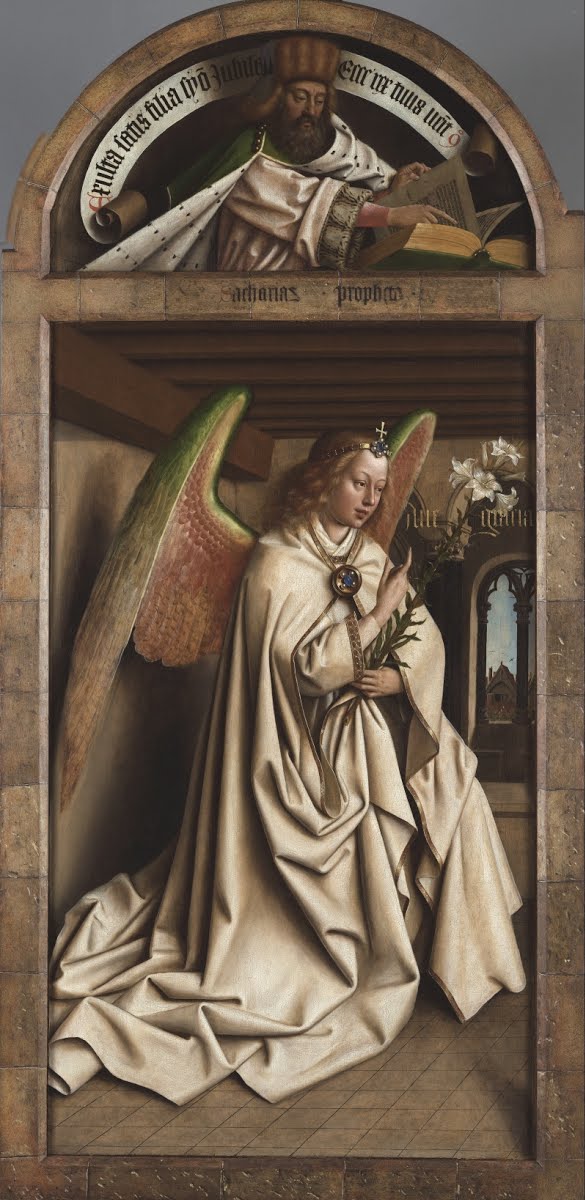
Details from Prophet Zechariah and the Angel Gabriel: reading the left wing
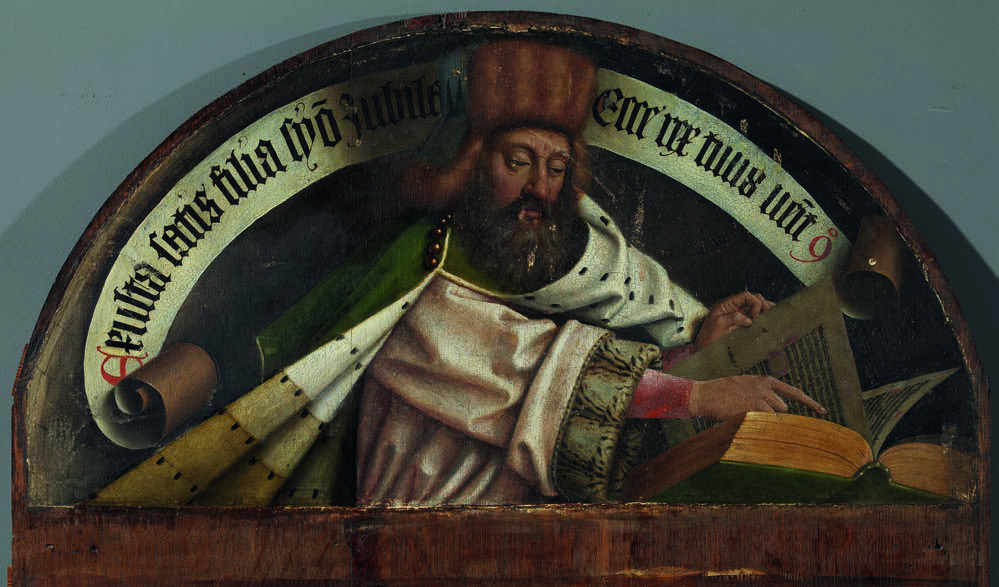
Inspect Zechariah during cleaning
Zechariah during cleaning: colour changes in the cloak. KIK-IRPA (2020), p. 121, figure 4a.10. © KIK-IRPA. Unmodified image.
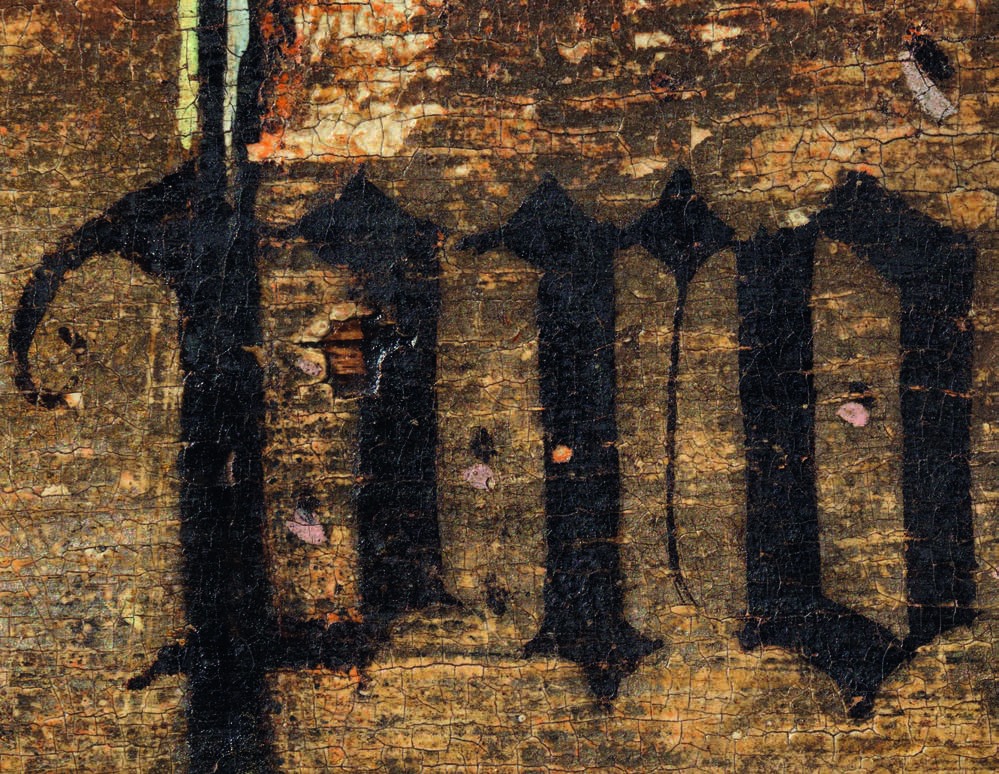
Magnify the prophet’s frame inscription
Frame inscription and painted stone joint. KIK-IRPA (2020), p. 300, figure 6.20. © KIK-IRPA. Unmodified image.
Which Zechariah is represented?
The similar names can cause a substantial misunderstanding. Luke’s first chapter describes Gabriel appearing to a priest named Zechariah at the incense altar, announcing that Elizabeth will bear John the Baptist. Later in the chapter, Gabriel goes to Mary at Nazareth to announce Jesus’s birth. Those are two different encounters. The prophet identified above the Ghent angel is not the priest in the first episode. Reading the title as a single meeting would combine people and events that the altarpiece keeps distinct.[2]
Luke’s account of the announcement to Mary also gives the child a royal significance: Gabriel speaks of David’s throne and a kingdom without end. That context helps explain why a prophecy concerning a coming king could appear above the messenger. It does not require a literal throne, donkey or city gate in the room where Mary receives him.[2]
There is a further distinction between the painted identity and the history of a biblical text. The USCCB’s introduction explains that the Book of Zechariah is generally understood as composite, with chapters 1–8 and 9–14 associated with different phases of prophetic writing. The painting presents a named scriptural authority; it does not settle the authorship or precise dating of every passage in the book bearing that name.[3]
A king’s arrival on a curved scroll
The identifying words are Sacharias propheta. KIK-IRPA transcribes the banderole as an abbreviated passage from Zechariah 9:9, calling Zion to rejoice because her king is coming. Its study places the frame lettering within the oldest detected decorative layers. Painted accents around a fictive stone joint interact with the letters, supporting their integration into the frame’s design.[4]
The biblical passage continues beyond the shortened wording displayed here. Zechariah 9:9 describes a just, saving king arriving humbly on a donkey; the following verse envisages the removal of war chariots and the proclamation of peace. The USCCB’s notes connect this text with the Gospel accounts of Jesus’s entry into Jerusalem. The verse consequently carries a wider Christian history than the birth announcement alone. On this wing, an excerpt is brought into the Annunciation’s setting rather than the whole chapter being illustrated literally.[5]
The difference between excerpt and complete passage is visible. The scroll turns around the prophet, with rolled ends and stretches of lettering following the arch. The text is given a conspicuous physical shape. Below it, the book has weight and thickness, its upright leaf held open above the ledge. These are two presentations of written authority: a readable proclamation around the figure and a volume being handled within the scene.
His hands bridge those forms of evidence. One steadies the lifted page; the other extends towards the book. The pose makes him an active reader rather than a passive label beneath a quotation. His eyes descend towards the volume. Gabriel’s face below turns sideways into the larger room, so the two figures direct attention differently even though both participate in the exterior’s announcement.
Fur, cloth and the reader’s body
Zechariah’s broad cap covers the top and sides of his head. His beard gathers below a strongly modelled face. Against the green outer cloth, a pale fur lining marked with dark spots runs across his shoulders. The light garment beneath spreads in broad folds over the torso. Small fastenings near the shoulder and patterned cuffs distinguish particular parts of the clothing from the much larger masses of colour.
Weale’s 1912 description identifies an ermine-lined mantle, a loose-sleeved garment, shoulder buttons and a fur cap with a falling side piece. He describes the prophet lifting a leaf and indicating a passage in a large open volume. His record helps separate the components of this elaborate costume. Its judgements about the man’s forceful character remain an earlier writer’s interpretation of the face, rather than biographical evidence about a sitter.[6]
The costume gives the figure considerable breadth within a shallow space. The pale lining crosses the chest diagonally, while the book extends in another direction along the ledge. Above both, the banderole completes a larger curve. Those movements keep the half-length body from looking like a small standing figure simply cut off at the waist. It belongs to a deliberately compressed arrangement of head, hands, clothing and text.
Watch: Jan van Eyck in context
Choose a Smarthistory close reading of the Arnolfini Portrait or the closed and opened Ghent Altarpiece.
Van Eyck, Ghent Altarpiece (1 of 2)
Explore the Annunciation, donors and painted sculpture on the closed altarpiece.
Watch on YouTubeTwo compartments, one moving wing
Lukas–Art in Flanders publishes the complete surface under the Archangel Gabriel title, dated 1432. Its restored-exterior feature locates Zechariah above the angel, notes the Latin identifying name and describes the recovered imitation of stone over silver leaf on the original frames. The surround is therefore part of the painted illusion as well as the object’s construction. Cropping away the prophet or the horizontal frame removes part of the wing’s organisation.[7]
The broad division beneath Zechariah acts as a visual threshold. Above it, his book rests close to the front edge. Below it, a ceiling, wall, openings and tiled floor create a deeper-looking interior around Gabriel. The prophet’s curved upper space and the angel’s tall compartment are not made to look like two identical rooms. Their contrast gives the figure above the status of a witness commenting on the event below.
Across the closed altarpiece, Gabriel’s greeting leads towards Mary, with the street prospect and washing alcove between them. Micah occupies the corresponding upper position at the far right. The cathedral’s arrangement thus pairs the outer biblical prophets with the outer participants in the Annunciation, while the two sibyls sit between the prophetic ends. These are relationships across the object, not a claim that all its figures inhabit the same moment or room.[1]
Gabriel’s raised hand, lily and words belong to his direct address to Mary. Their close reading is developed on the separate Angel Annunciate page. Here their importance is directional: the lower figure opens the composition towards its absent listener. His mantle spreads across the foreground, yet his message travels beyond the wing’s edge. Zechariah’s written promise and Gabriel’s spoken announcement are aligned without becoming one continuous conversation.
What the surface reveals about making
The scientific volume records a pinkish preparation layer visible in a loss in Zechariah’s paint. It also identifies finger marks near the beard and green drapery, made while blending fresh colour. These are evidence of working procedures, not a forensic identification of one brother. Conservators also left the prophet’s green drapery where evidence for removing suspected later paint was insufficient.[4]
The treatment image records colour changes during cleaning; the lettering detail shows the relationship between a painted stone joint and the inscription.[4]
A revealing treatment decision concerned the relationship between Zechariah and the neighbouring Erythraean Sibyl. The Dutch report notes that the red glaze uncovered on the Sibyl was less discoloured than the prophet’s exposed garment. Conservators retained and thinned some remaining varnish on the Sibyl to preserve the tonal relationship. Treatment was judged across adjoining passages, rather than assuming that the same removal depth would give the most coherent result everywhere.[8]
The same report describes later paint concealing parts of the low wall and ceiling beams in Gabriel’s compartment, along with shadows on the wall and tiled floor. These changes matter to the full wing because architecture and illumination help establish the angel’s place beneath the prophet. Recovering a shadow can change perceived depth without altering the represented episode or introducing a new figure.[8]
Prophetic figures in other collections
A comparison from France places the older witness within a broader artistic tradition. The institution responsible for the Chartreuse site in Dijon identifies Zechariah among the six Old Testament prophets of Claus Sluter’s Well of Moses, made in 1395–1406. The example predates the Ghent Altarpiece and demonstrates the prominence given to such figures in Burgundian religious art. It does not establish that Van Eyck copied a particular face, gesture or garment from that monument.[9]
In the Netherlands, the Rijksmuseum records a different image of Zacharias: Cornelis Galle’s 1613 engraving after Jan van der Straet, published in Antwerp. The prophet holds a book within an oval accompanied by Latin lettering. Its series title identifies Old Testament prophets, making the scriptural role explicit. This later print is useful as a comparison for book and identifying text; it cannot supply the source of the much earlier Ghent composition.[10]
The Metropolitan Museum’s Rosselli engraving of Zechariah, dated 1480–90 and related to Baldini, belongs to a series of twenty-four prophets and twelve sibyls. That record illustrates a wider Christian practice of placing the two kinds of prophetic witnesses within one visual undertaking. Ghent’s four upper witnesses form their own smaller selection. The later Italian series provides context for the combination, without proving an identical programme or a connection between workshops.[11]
These comparisons identify different levels of similarity. A recurring prophet, a book, a name and a place among other witnesses can belong to a shared tradition. They do not automatically establish direct copying. The strongest explanation of this particular wing still begins with the things physically joined here: Zechariah’s scroll and book, the frame beneath him, and Gabriel’s announcement in the lower space.
Authorship and the act of opening
The cathedral dates the commission’s installation in the Vijd chapel to 6 May 1432. Its account of the frame quatrain credits Hubert with beginning the undertaking and Jan with completing it, while acknowledging that the division of work remains unresolved. Neither the prophet’s aged face nor Gabriel’s younger one justifies assigning them to different brothers. Differences in subject and scale have to be distinguished from evidence of different painters.[12]
The usual closed position made the exterior an important face of the commission. On Sundays and feast days, opening disclosed the interior’s very different assembly. The guide’s account of that use gives Zechariah’s expectation an operating context: his presence was encountered before the inner revelation became visible. It does not mean that each narrow shutter independently explains the whole altarpiece.[1]
Begin with the prophet’s pointing hand, then follow the banderole and read the identifying frame. Move downward to Gabriel’s face and the direction of his greeting. Finally, look across to Mary’s reply. The sequence preserves what makes the pair distinctive: a reader above a speaker, written expectation above an unfolding announcement, and separate spaces coordinated through one hinged work.
Related reading


Discussion
What do you notice in Prophet Zechariah and the Angel Gabriel: reading the left wing? Share a close observation or a source that adds useful context.
Join the Conversation
Keep observations specific and evidence clear.
References
- Saint Bavo’s Cathedral, panel guide, closed exterior, section I and general introduction. View Source
- USCCB, Luke 1:5–38, the two announcements by Gabriel. View Source
- USCCB, introduction to the Book of Zechariah, composite structure. View Source
- KIK-IRPA, The Ghent Altarpiece: Research and Conservation of the Exterior (2020), pp. 121, 138, 220–21, 231, 298–300 and 373–75. View Source
- USCCB, Zechariah 9:9–10 and notes. View Source
- W. H. James Weale, The Van Eycks and Their Art (1912), p. 52. View Source
- Lukas–Art in Flanders, The real Van Eyck revealed, Zechariah and the exterior frames. View Source
- KIK-IRPA, Behandelingsverslag Lam Gods, Fase 1: 2012–2016, pp. 50–51. View Source
- Centre Hospitalier La Chartreuse, Dijon, Le Puits de Moïse. View Source
- Rijksmuseum, Zacharias, Cornelis Galle I after Jan van der Straet, 1613, RP-P-1906-2200. View Source
- Metropolitan Museum of Art, Francesco Rosselli after Baldini, The Prophet Zecheriah, 1480–90, 29.16.28. View Source
- Saint Bavo’s Cathedral, The Ghent Altarpiece, installation and frame attribution. View Source

 Jan van Eyck.jpg)
 Jan van Eyck.jpg)


