Jan van Eyck.jpg) Buy Art Prints Now
from Amazon
* As an Amazon Associate, and partner with Google Adsense and Ezoic, I earn from qualifying purchases.
 by Tom Gurney
Tom Gurney BSc (Hons) is an art history expert with over 20 years experience
Page Created on June 19, 2020 / Page Updated on November 1, 2026
Email: tomgurney1@gmail.com / Phone: +44 7429 011000
Saint Francis Receiving the Stigmata: the Philadelphia painting
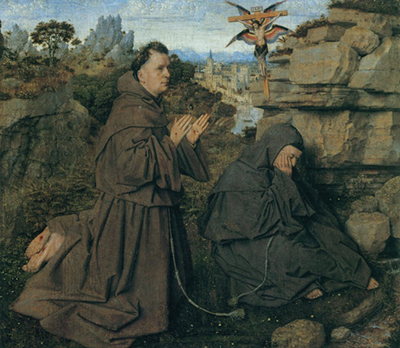
The Philadelphia Museum of Art owns a Saint Francis Receiving the Stigmata small enough to hold near one's face. Its scene extends only 12.7 × 14.6 centimetres in the museum's scholarly catalogue, yet it contains a kneeling saint, a winged apparition, a companion, complicated rocks, water, horses and a distant walled town. The museum dates it 1430–32 and credits Jan van Eyck. It is painted in oil on vellum mounted on a wood panel—a support unlike that of the larger, closely related painting in Turin. Those material facts make this a distinct object, not merely a reduced illustration of its Italian counterpart. [1][2]
The two paintings share a remarkable design, and their authorship and order have long been debated. This page starts with what is specific to Philadelphia: how its details make a tiny picture absorbingly readable, why its vellum and painted border recall books of prayer, and how it moved through documented collections. The relationship to the Turin Saint Francis matters, but neither version can be made into proof of the other's full history. [1][2]
At a Glance
 in Detail Jan van Eyck.jpg)
The wounds in a landscape
Francis's vision is the event that holds the packed scene together. According to the Franciscan accounts summarized in the Philadelphia catalogue, the saint was praying on Mount Alverna in 1224 when a six-winged seraph appeared. Later retellings described the figure as Christ-like and crucified. As Francis contemplated the apparition, he received the stigmata: wounds corresponding to those of the crucified Christ. The painting turns those narrative stages into one visible encounter. The heavenly figure hovers above while Francis kneels among rocks below. [1][2]
At this scale, the evidence of the wounds demands deliberate looking. Christopher D. M. Atkins, author of the museum's 2018 scholarly entry, notes that all four nail wounds on Francis's hands and feet can be seen. The fifth wound, at his torso, is hidden by the habit. The saint's feet are turned so that their soles face the viewer enough to reveal the marks. This small adjustment matters: the subject is not indicated by a title alone. The artist made the bodily consequence of the vision visible despite the confined format. [2]
Francis is not alone. Brother Leo occupies the scene beside him, while the rock and distant settlement make the event feel situated in a broader world. Philadelphia's current account describes a Netherlandish city in the distance, far from the legendary wilderness. That geographical mixture need not be resolved into an exact map. It lets a viewer understand the miracle as a spiritual event with a horizon stretching beyond the mountain. The location associated with Francis supplies the sacred story; the observed-looking town gives the miniature landscape an everyday human reach. [1]
The rocky foreground holds one especially easy-to-miss detail. At the lower right, Atkins identifies water flowing out of the stone. In the saint's legend, Francis could draw water from a rock, recalling Moses. A viewer who sees only a rocky background misses a second narrative thread tucked into it. The water is not necessary to identify the main apparition, but it rewards the sort of patient viewing the painting's size encourages. Its presence also shows how a landscape detail can carry devotional meaning rather than serve only as technical display. [2]
The town contains details that reward the same scrutiny. Atkins observes that the horses before its walls are more fully modelled in Philadelphia than the corresponding small forms in the Turin version. This is a comparative observation, not a simple quality contest. It asks why a smaller surface should contain some passages that are more resolved than those on a larger related panel. Far-off figures and animals become useful evidence for how the design was repeated and revised; they are also part of the picture's unusual sense of depth. [2]
Why vellum and a red border matter
Vellum is prepared animal skin, familiar as a support for manuscript pages. Philadelphia's painting combines it with oil colour and a wood panel beneath. The wood makes a sturdy object; the vellum provides a different painting surface from Turin's directly painted panel. Atkins says the exact construction sequence is unknown, though the vellum must have been attached early in the picture's life. A claim that it was cut out of an illustrated book would go beyond the evidence. The support instead places a small painted panel near the material world of book illumination. [2]
The painted edge has a more complicated history than the phrase “original red border” suggests. In her 1997 conservation report, Marigene Butler distinguishes early gold leaf and dark red glazing from subsequent border schemes. The upper and left edges created a shaded effect related to illuminated manuscripts. The presently visible orange-red border contains later layers. A photograph of a red margin should therefore not be taken as a transparent record of one untouched fifteenth-century frame. [8]
The distinction changes how the picture should be imagined. A narrow edge can give an image depth, set it apart from its surroundings and suggest a precious object. It also belongs to the painting's physical history. Looking at the margin means asking which surface is being seen, as well as how it relates to the enclosed scene. The cropped reproduction above helps inspect the composition, but does not document the complete surviving edge.
The analogy is suggestive but limited. Atkins compared the border's proportions with Eyckian illuminations in the Turin–Milan Hours, while explicitly declining to argue that the Philadelphia painting was ever a page in a manuscript or necessarily designed for insertion into one. That caution preserves the difference between a formal resemblance and a documented original function. Oil on vellum mounted to wood was a viable way to make an independent picture. The border and support show contact with illuminated-book practices, not a known missing book from which the image was removed. [2]
Its size strengthens a different possibility. A person could hold it or place it nearby for private prayer, returning to the wounds, seraph, water and city rather than absorbing the whole view at once. The museum suggests it was a portable, personal devotional picture and may have travelled with an early owner, perhaps even on a pilgrimage to Jerusalem. These are plausible uses inferred from material and scale. No surviving early label on the panel records a pilgrim, and no document proves its first place of use. The physical invitation to close looking is real; a particular owner's journey remains conjectural. [1][2]
What the wood can and cannot date
The panel under the vellum has supplied a scientific clue. Atkins reports Peter Klein's dendrochronological work, based on the comparison of tree-growth rings. The central board preserves growth rings ending in 1307, but the tree lived considerably longer: matching timber in other paintings supplies the later part of its growth history. The last visible ring in this one small board must not be confused with the year the tree was cut down. [2]
Atkins gives 1392 as the earliest felling date and 1396–98 as a more probable range. His account derives 1408 as an earliest plausible painting date after allowing for timber preparation and transport. These estimates constrain what is possible; they do not date the saint's painted face to 1408. Nor does the age of a support establish how soon the vellum was attached to it. The museum's 1430–32 dating combines the material findings with stylistic and historical reasoning. [2]
The catalogue also reports that the wood came from the same tree as supports used for two portraits associated with Van Eyck, of Baudouin de Lannoy and Giovanni di Nicolao Arnolfini. Shared timber can support a connection to a workshop's supplies; it cannot by itself say who applied paint to the vellum, or that all three pictures were made at the same moment. A plank may be stored and used later than another from the same tree. This is why material evidence can narrow possibilities without settling artist, date or purpose in one step. [2]
Watch: Jan van Eyck in context
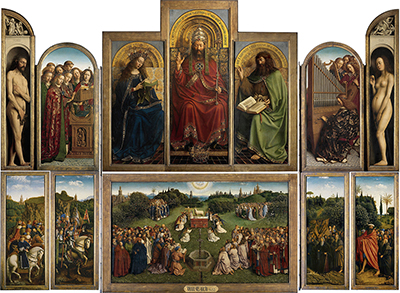
Choose a Smarthistory close reading of the Arnolfini Portrait or the closed and opened Ghent Altarpiece.
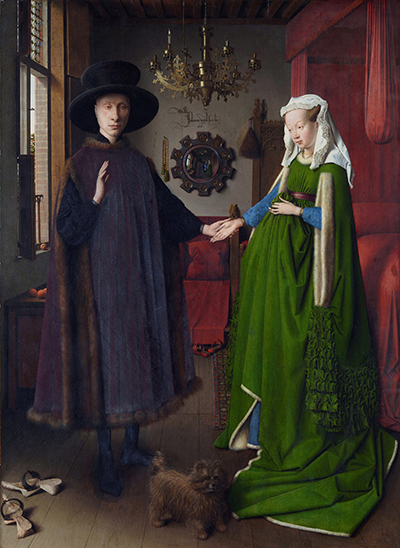
Jan van Eyck, The Arnolfini Portrait
Look closely at the room, mirror and gestures in the London double portrait.
Watch on YouTubeAtkins considers whether Van Eyck's travel to Portugal in 1428–30 could help explain the unusually detailed rocks. Some geological forms represented here are not local to Bruges, and the painter might have encountered them on that journey. This remains a proposed route from observation to painting, not a signed itinerary attached to the picture. The rocks' specificity is visible; the exact place where the design was conceived is not. Treating a convincing rock as proof that the panel itself went to Portugal would collapse three separate questions: what the painter saw, when the image was made, and where the finished object travelled. [2]
Close to Turin, but which came first?
The Philadelphia and Turin paintings were shown together in 1997–98, in Turin, London and Philadelphia. The Philadelphia Museum's exhibition record describes this as a gathering of two nearly identical Saint Francis images, organized with the Galleria Sabauda and London's National Gallery. The chance to study them side by side followed years of technical work and sharpened debate over whether one, both or neither should be credited directly to Jan. Their closeness in composition remained unmistakable; the explanation of that closeness did not become unanimous. [2][3]
Atkins reports that the 1997 research team, using X-radiography, infrared reflectography, paint samples and examination of the surface, accepted both as autograph paintings. He also records scholars who remained unconvinced. His own discussion suggests Philadelphia may have come first, partly because distant horses and figures are more fully worked out here than in Turin, and partly because the vellum support might represent an earlier experiment before the design was repainted directly on panel. Those are arguments from the surviving objects, not dated statements by the painter. [2]
Another official account runs the sequence the other way: Italy's national collection record places Turin first, treating the smaller Philadelphia image as an autograph repetition. Its language also invokes the Van Eyck workshop. The conflict is useful to state plainly. “First version” can refer to a proposed order of these two surviving paintings, whereas the original invention of the design could have involved a drawing or another model that is not preserved. Neither museum's label supplies a dated workshop record of the transfer. [4]
The underdrawing issue is particularly easy to oversimplify. Drawn revisions have been found beneath Turin's paint. Atkins says no underdrawing has been detected in Philadelphia, but that absence of detection does not prove no planning lines were used: vellum may have required a different drawing material. Conversely, Turin's revised lines need not prove that Jan himself painted every visible passage above them. A preparatory trace is evidence of a working process, not a complete roster of hands. [2]
KIK-IRPA later photographed the two objects with a standardized method so that specialists could compare them at the same level of detail. Its report emphasizes exceptionally close correspondences even in small paint touches. That closeness makes a loose, memory-based copy seem less likely; it does not settle who transferred the design or how many people took part. The paintings guide separates autograph, workshop and later versions for this reason. A pair can be intimately related without fitting a simple one-word relationship. [5]
Cleaning, colour and a changing surface
Roger Fry treated the painting in 1906, after Johnson's purchase. Butler's report traces an added upper section and overpaint that had enlarged the sky. Her own 1983–89 campaign removed discoloured coatings and old restorations. This history matters when comparing photographs: the composition's proportions and legibility had been altered. [2][8]
Butler found a thin coloured priming beneath the image. Pigment examination identified natural ultramarine in the seraph's wing and an organic red lake in the wounds; the copper-containing greens had browned. These findings connect minute physical marks with the appearance of the vision, the body and the landscape. The darkened foliage cannot simply be treated as an exact record of the artist's original colour balance. [8]
Close looking is therefore helped by technical evidence. A dark tree may owe its present effect partly to the passage of time; a small red mark can be deliberately chosen to distinguish wounded flesh; a bright blue feather can carry a material intensity disproportionate to its area. The picture's precision is made from paint with its own properties and history. Its apparent immediacy comes to us through that material object, which has aged and been treated.
What the 2026 test adds
A study published in 2026 by Till-Holger Borchert, Alessandra Conti, Batu Arda Düzgün and Carina Popovici tests image classification against conservation history. Philadelphia produces positive model scores of roughly 24–33 percent, depending on the training set, with little difference when selected restored areas are digitally excluded. The authors discuss its unusual parchment-on-panel structure. These conditional results challenge an attribution; they neither measure the proportion painted by Jan nor replace the museum's current maker credit. [1][6]
This is one contribution to a longer debate. Image analysis, tree rings, underdrawing and close examination address different aspects of the object. A shared timber source can connect supplies without identifying a brushstroke. A low classifier score can identify a poor match to its training examples without naming another painter. A convincing account needs to explain the evidence together. The Turin page considers the different effects of restoration on that companion painting's tests.
A traceable route into Johnson's collection
The earliest secure collecting sequence presented in the Philadelphia scholarly apparatus begins with a private collection in Lisbon. By 1843, the painting was in the collection of William à Court, Lord Heytesbury, who had served as British envoy to Portugal. An 1843 inventory said it came from a physician in Lisbon, according to the catalogue's provenance note. London dealers Gooden and Fox acquired it in November 1894; John G. Johnson bought it the following month. These are recorded stages of ownership, unlike the proposed fifteenth-century pilgrimage. [2]
Johnson bequeathed his collection to the City of Philadelphia in 1917. The painting belongs to the John G. Johnson Collection at the Philadelphia Museum of Art, but the dates need care: 1917 is the bequest, while the collection was moved from Johnson's house to the museum in 1933, according to the museum's own history of the gift. The painting's modern identity as a museum masterpiece thus grew from a private collection and civic gift, not an uninterrupted series of known owners reaching back to Van Eyck. [2][7]
An earlier family document supplies context rather than secure provenance. The 1470 testament of Bruges merchant Anselm Adornes envisages two Saint Francis pictures by Jan for his daughters, with donor likenesses on shutters. The document cannot identify Philadelphia through dimensions, support or its painted border. Noël Geirnaert's Dutch archival reassessment further distinguishes the intended bequest from what happened afterwards: the daughters named in 1470 did not receive the pictures, and the donor portraits were probably never made. The longer transmission history is discussed with Turin; for Philadelphia, the essential point is that an attractive possible connection does not establish a first owner. [2][9]
Another early notice broadens the story without closing that gap. Atkins cites the 1448 will of the Valencian painter Joan Reixac, which describes a painted Saint Francis by Van Eyck. A related mid-fifteenth-century image in Spain and later Italian pictures suggest that elements of the composition travelled beyond Bruges. But a mention of a Van Eyck Saint Francis in Valencia does not identify the Philadelphia vellum picture, and similarity of rocks in a later painting does not prove that an artist saw this specific object. Designs can circulate through drawings, replicas and intermediate works. The documentary and visual evidence tells us the composition had reach; the exact vehicle of its spread remains open. [2]
The uncertainty leaves a productive distinction. We know this small painting travelled from Lisbon through an English collection to Johnson. We know images of Saint Francis credited to Van Eyck circulated in fifteenth-century written testimony. The missing link between those two forms of evidence cannot be filled with the attractive story of a pilgrim carrying this exact panel to Jerusalem. The museum itself presents early travel as a possibility. That is enough to make travel part of the question without converting it into provenance. [1][2][6]
Exhibitions and the miniature landscape
The painting's modern travels have changed the comparisons available to viewers. The 1997–98 exhibition placed it beside Turin in Italy, Britain and the United States. It was also studied in connection with the 2020 Ghent exhibition. Belgium's KIK-IRPA subsequently made standardised photographs available through Closer to Van Eyck, extending access to features that a small printed reproduction could barely distinguish. Its BALaT record identifies the scientific-imaging file while also retaining a broader dating and workshop terminology than Philadelphia's own catalogue. Those records serve different purposes and should be read with their institutional context intact. [1][3][5][11]
French curators returned to its landscape in the Louvre's 2024 exhibition, Revoir Van Eyck. The museum's presentation explicitly compares the Philadelphia Saint Francis with the Rolin Madonna, placing small-scale landscape painting within a wider discussion of attention, prayer and manuscript illumination. Seen in that setting, the little Saint Francis becomes useful beyond the question of which of two near-identical versions came first. It shows how an extensive world can be made available to an individual looking closely at a small surface. [10]
A way to look closely
Start with Francis's feet. The turn of the soles makes a small wound legible and connects body to vision. Find the water issuing from the rocks, then let the eye move to the distant horses and walls. Finally, return to the red border. It is the device that holds this elaborate world within a picture a viewer could bring near and examine, while reminding us that an image can resemble a manuscript illumination without ever having been a manuscript leaf. [2]
The Philadelphia Saint Francis rewards study under more than one attribution scenario. Its museum credits Jan, its companion in Turin shares the design, and specialists continue to test how support, conservation and workshop practice affect claims about hands and sequence. A clear reading keeps three matters separate: what the painting depicts, what its materials and documented history establish, and what is still inferred. That separation makes the tiny picture more vivid, not less. [1][2][5][6]
Related reading
 Jan van Eyck.jpg)
Discussion
What do you notice in Saint Francis Receiving the Stigmata: the Philadelphia painting? Share a close observation or a source that adds useful context.
Join the Conversation
Keep observations specific and evidence clear.
References
- Philadelphia Museum of Art, “Saint Francis of Assisi Receiving the Stigmata,” object 102076, current object introduction and date. View Source
- Christopher D. M. Atkins, “Saint Francis of Assisi Receiving the Stigmata,” The John G. Johnson Collection: A History and Selected Works, 2018, cat. 314; entry, notes and scholarly apparatus, PDF pp. 259–284. View Source
- Philadelphia Museum of Art, “Recognizing Van Eyck,” exhibition record and 1997–98 itinerary. View Source
- Italian Ministry of Culture, national catalogue record 0100350981, “Stimmate di San Francesco,” alternative version sequence; indexed institutional text consulted. View Source
- KIK-IRPA, “À chaque détail, un pur émerveillement ! Van Eyck en ligne et à BOZAR,” 19 February 2021, standardised comparative imaging. View Source
- Till-Holger Borchert, Alessandra Conti, Batu Arda Düzgün and Carina Popovici, “Integrating Art Historical Knowledge into AI-Based Authorship Detection in Jan van Eyck's Saint Francis Receiving the Stigmata,” Kunstgeschichte, 2026, especially pp. 13–17. View Source
- Philadelphia Museum of Art, “Old Masters Now: Celebrating the Johnson Collection,” 2017, history of the bequest and 1933 transfer. View Source
- Marigene H. Butler, “An Investigation of the Philadelphia Saint Francis Receiving the Stigmata,” pp. 29–46, and Peter Klein, “Dendrochronological Analyses of the Two Panels,” pp. 47–50, in Jan van Eyck: Two Paintings of Saint Francis Receiving the Stigmata, Philadelphia Museum of Art, 1997. View Source
- Noël Geirnaert, “Het testament van Anselm Adornes (1470),” section II of “Putten uit honderd jaar Biekorf,” Biekorf 101, 2001, pp. 102–105. View Source
- Musée du Louvre, “Revoir Van Eyck,” French exhibition presentation, 20 March–17 June 2024, especially the landscape comparison. View Source
- KIK-IRPA, BALaT object 40003478, “Stigmatisation de saint François d'Assise,” comparative documentation and imaging-file record. View Source
 Jan van Eyck.jpg)