


 Buy Art Prints Now
from Amazon
* As an Amazon Associate, and partner with Google Adsense and Ezoic, I earn from qualifying purchases.
 by Tom Gurney
Tom Gurney BSc (Hons) is an art history expert with over 20 years experience
Page Created on June 19, 2020 / Page Updated on November 1, 2026
Email: tomgurney1@gmail.com / Phone: +44 7429 011000
Virgin Annunciate: Mary’s reply and painted book at Ghent
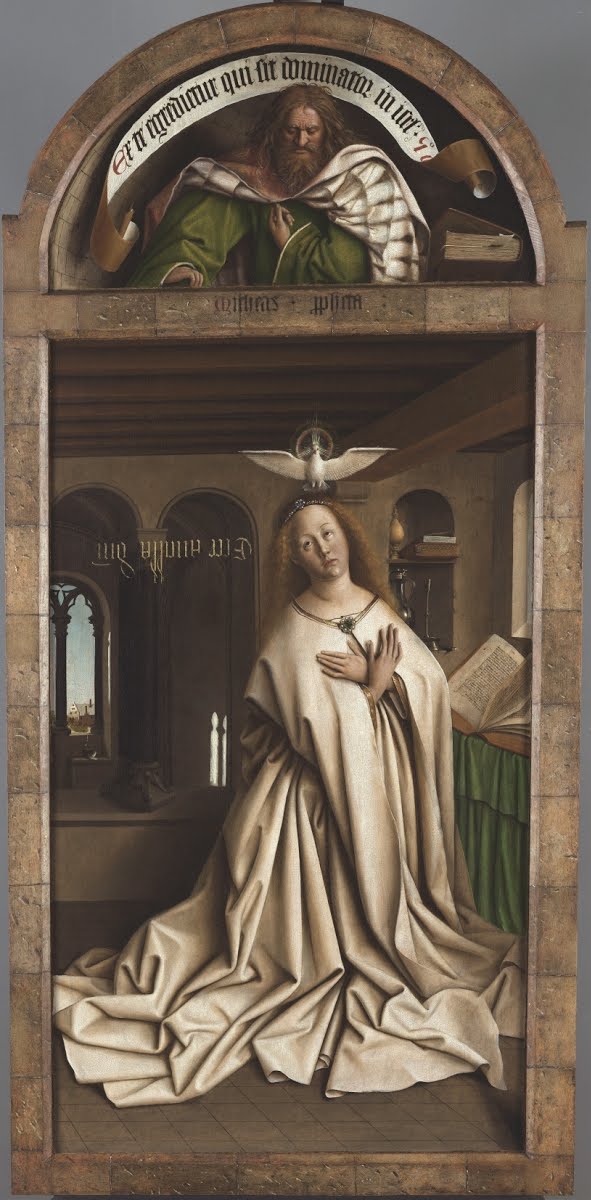
Mary kneels at the right of the Ghent Altarpiece’s closed Annunciation, her hands crossed before her chest and her gaze raised. Her reply is written in gold beside her head, with its orientation turned away from normal reading by a spectator. Saint Bavo’s Cathedral explains the reversed lettering as readable from heaven. The words make acceptance an explicit part of the scene rather than leaving the viewer to infer it solely from a gesture.[1]
This Mary receives the message delivered by Gabriel at the other end of the room. She differs from the crowned Virgin enthroned inside the altarpiece, although both belong to the same ensemble. The exterior figure is also accompanied by a remarkably detailed book. Its tiny painted letters have become the subject of imaging research, adding a second kind of text to a panel already concerned with spoken words.
At a Glance
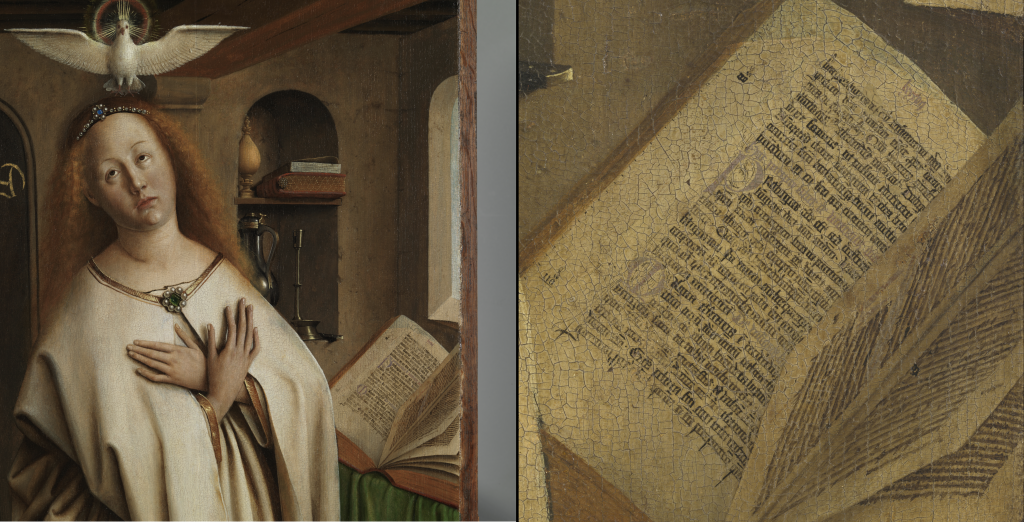
Details from Virgin Annunciate: Mary’s reply and painted book at Ghent
Find the book beside Mary
Context at left; enlarged painted page at right. Published research figure 6a. Ghent University GAIM (2021), © Aleksandra Pižurica. Unmodified publisher figure.
Research comparison: cracks and virtual filling
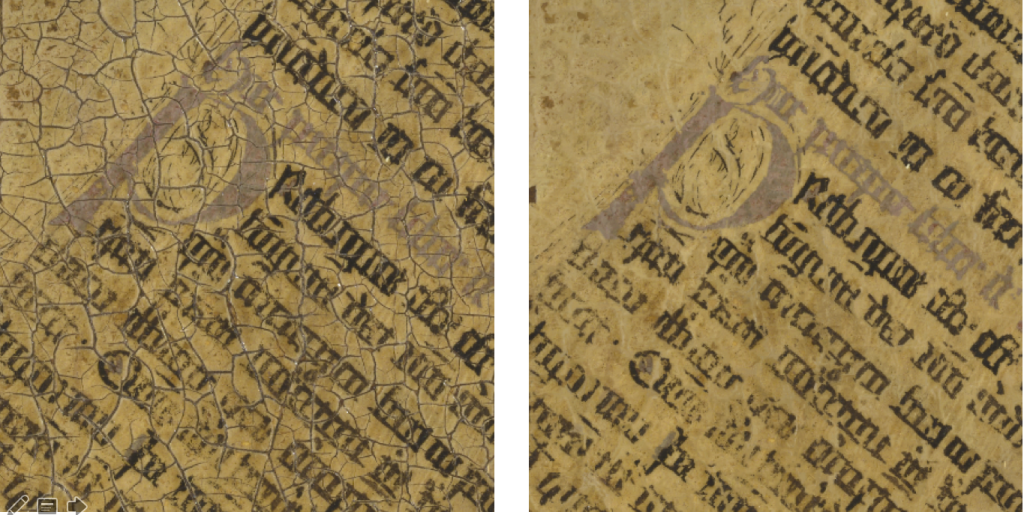
Left: recorded cracked surface. Right: digitally filled research image. Figure 6b; not physical conservation or a certain transcription. Ghent University GAIM (2021), © Aleksandra Pižurica. Unmodified publisher figure.
From the hands to the book
The published restored view places Mary’s two hands against the broad pale surface of her mantle. One extends almost horizontally across the chest; the other rises beside it. The fingers remain separate rather than joining in a conventional palm-to-palm prayer pose. Their unequal directions give a small movement to an otherwise composed body. The head tilts away from the open pages at the right, and the eyes look upwards.
A jewel gathers the garment below the neck. A narrow border follows its opening before disappearing into deeper folds. The expanse of pale cloth is not a flat white shape: shadows beneath the arms, long vertical troughs and angular folds spread towards the floor. At the lower edge, the material overlaps itself repeatedly. Her knees are concealed, so the drapery establishes the kneeling figure’s scale and position without exposing the underlying legs.
The open book rests to the right, its pages angled towards the spectator. Their dark script contrasts with a warm, light-coloured ground. Beneath them, green fabric descends in folds from the reading furniture. The green marks a different surface beside the mantle, while the book’s diagonal edges introduce a smaller, sharply defined shape. An upright page and a spreading garment ask the viewer to look at different scales.
Above Mary, a dove extends its wings almost horizontally. Its body is close to the ceiling beam, its head surrounded by rays. The bird establishes another vertical connection: lifted eyes below, dove above. To the left, the reversed gold words occupy the darker architecture. Mary’s figure is consequently surrounded by distinct signs of communication—gesture, lettering, book and bird—without their being compressed into one object or inscription.
The reply in Scripture
In Luke 1, Mary’s answer comes after a question and an explanation. Gabriel has announced the child’s birth; Mary asks how this will happen, and the angel speaks of the Holy Spirit and God’s power. She then identifies herself as the Lord’s servant and accepts what has been announced. The painted response selects that answering moment from a conversation, rather than depicting every stage of hesitation, explanation and assent simultaneously.[2]
The Gospel passage does not specify an open book, a crossed-hands pose or this furnished chamber. Those are ways in which the painters made Mary’s reception visible. Her response can be related to Luke without treating every detail of the room as a literal inventory supplied by the biblical narrative. The distinction allows the panel’s particular visual choices to remain meaningful.[2]
Words directed beyond the angel
Stéphane Lojkine’s French study draws attention to Mary’s upward eyes, crossed hands and lettering moving in the opposite direction from ordinary reading. He understands the scene through the difference between what the closed exterior announces and what opening the altarpiece reveals. His reading emphasises that Mary does not simply look back at Gabriel. Her response belongs to an exchange that also concerns a divine presence, represented above her by the dove.[3]
That interpretation helps articulate what can be seen without making the panel a diagram of one modern theory. The physical inscriptions and gestures are evidence; a full account of how every original worshipper understood them is not preserved. The unusual lettering nevertheless prevents Mary from becoming merely a passive counterpart. Her words are given a visible location and direction within the encounter.
Weale’s 1912 account describes her turning from a book at a draped prayer desk, her hands crossed on her breast, and the dove overhead. He records the brief reply as Ecce ancilla Dni, with an abbreviation of the final Latin word. He also distinguishes floating speech from writing on scrolls. His description offers a useful historical witness, although judgments about the colour and condition must be read in light of later conservation.[4]
A prayer book made of paint
Lukas–Art in Flanders calls this image The Virgin in prayer and describes Mary lifting her eyes from her prayer book when Gabriel brings his message. Its complete colour view includes Micah in the compartment above. The prophet, Mary and book thus belong to a larger shutter, but the open volume beside her is a separate object within the painted room. It is not the prophet’s book carried down into her scene.[5]
Watch: Jan van Eyck in context
Choose a Smarthistory close reading of the Arnolfini Portrait or the closed and opened Ghent Altarpiece.
Van Eyck, Ghent Altarpiece (1 of 2)
Explore the Annunciation, donors and painted sculpture on the closed altarpiece.
Watch on YouTubeThe visible page has the organisation of writing: lines, letter groups and a decorated initial. Age cracks cut across those marks, sometimes following shapes that can resemble the strokes of letters. At ordinary viewing distance the page can register simply as a text. In the published enlargement, however, it becomes possible to ask what was written and how much of it remains reliably legible. Painting has supplied more detail than recognition of a generic book would require.
Why the cracks complicate reading
Aleksandra Pižurica and her co-authors devote a section of their 2015 research paper to this exact book. They explain that cracks vary considerably in width and can be difficult to distinguish from letter strokes. Light-coloured areas around damaged paint also make neighbouring pixels unreliable. A digital procedure that fills a crack using only its immediate surroundings may therefore replace part of a letter as well as the damage.[6]
Their improved method considers a wider context and the direction in which visible structures continue. The authors report better preservation of letter forms than with an earlier procedure, while explicitly presenting the results as improvements in a difficult research problem. Their illustrations compare alternative processed images. They do not turn missing paint into newly recovered physical lettering, and the method itself is not a transcription or an identification of the text.[6]
A 2021 account hosted by Ghent University shows the book in context and a comparison before and after virtual crack filling. The discussion arose from a technical art-history series organised by the Rijksmuseum, CWI in Amsterdam and Ca’ Foscari in Venice. It explains the processed image as a tool for investigating whether the page contains real text rather than merely calligraphic marks. The pair reproduced here is a research comparison, not a before-and-after record of physical treatment.[7]
How certain is the Aquinas identification?
The City of Ghent’s walking guide reports that the book contains an adaptation of a text by Thomas Aquinas. This is more specific than calling it a prayer book or assuming it is the Bible. The guide’s statement is valuable evidence of how the finding has been communicated publicly. Its brief entry, however, does not provide a full transcription and line-by-line comparison with the proposed source.[8]
The original 2013 study by Bruno Cornelis and his co-authors supplies the basis for that proposal. It reports additional readable word groups after digital processing and a revised reading of a numeral as 62 rather than 7. The authors relate the fragments to Aquinas but explicitly say the text cannot be read in full. Their figure caption estimates the pictured book’s actual length at about twelve centimetres and a page’s width at seven. The scale explains why photographic enlargement matters: substantial research concerns lettering painted within an exceptionally small area.[14]
Nigel Mestach’s 2022 master’s dissertation gives a more qualified account. Introducing this book as an imaging case study, he describes its script as a form of blackletter and says the passage was most likely derived from the Summa Theologica. He presents only part of the mystery as solved. This is a student research account, not a new critical edition of the inscription, but its caution matters when placed beside the municipal guide’s more categorical wording.[9]
The defensible description is consequently a reported Aquinas connection whose exact wording should not be invented from a processed picture. The identification of a source, the reading of individual letters and the algorithm’s reconstruction are related tasks, not interchangeable proofs. A viewer can take the book’s textual detail seriously while leaving uncertain letters and the precise relationship to a proposed passage open to further specialist study.
Different treatment decisions within one garment
KIK-IRPA’s Dutch treatment report explains that later paint on the right side of Mary’s white garment altered the folds but was left in place. No separating varnish could be identified, the layers were difficult to distinguish and safe removal could not be assured. White lead in both levels complicated the analysis. The present robe therefore cannot be described as if every later addition had been removed to expose a uniformly untouched original.[10]
The same report distinguishes the green drapery of the prayer desk. Its overpaint covered an earlier, brighter and more softly folded green arrangement. Dark passages in the architectural recess had their own local interventions. These separate findings resist a simple story in which the entire panel was treated identically. The material evidence follows particular surfaces and paint layers, even when those surfaces sit only a short distance apart.[10]
What a sixteenth-century copy contributes
The 2020 conservation volume explains how the prayer desk became an important chronological witness. Its green drapery remained visually inconsistent after other major overpaints had been removed, prompting further analysis. The study identified complete repainting, and comparison showed that Michiel Coxcie’s copy of 1557–1558 already reproduced the later folds and coloured fringes. That provides evidence that this intervention preceded his copy.[11]
It does not prove that Coxcie himself repainted the original. A copy can record an altered appearance without its maker being responsible for the alteration. Here it helps separate a familiar historical image from earlier surviving handling. The restored desk fabric and the deliberately retained later paint on parts of Mary’s robe are different outcomes of the same careful investigation, not contradictory claims about the treatment.[11]
Light and the room around her
The MSK’s French exhibition guide identifies several contributions to the Annunciation’s lighting, including a window beside Mary and the illusion of shadows cast by the real picture frames into the depicted room. It relates the illumination to the original Vijd chapel. The account helps explain why the domestic scene can seem to occupy a space contiguous with the viewer’s, although it remains a constructed painting across wooden sections.[12]
In Mary’s compartment, the contrast between the pale garment and the darker wall gives the head and hands clarity. The small objects in the recess behind her and the narrow outlook beyond the architecture continue the room’s detail without competing in scale with the figure. These surroundings make her raised gaze conspicuous: the image offers things to read and inspect, yet her attention has moved above and away from them.
The cathedral places the completed altarpiece in 1432 and retains the distinction between Hubert beginning it and Jan completing it. Their precise individual contributions remain unresolved. Neither the book’s proposed literary source nor a technical finding about one green fold identifies the painter of every passage. Mary’s image belongs to that shared undertaking while rewarding examination as a particular figure, with a particular reply and a remarkably demanding painted text.[13]
Related reading


Discussion
What do you notice in Virgin Annunciate: Mary’s reply and painted book at Ghent? Share a close observation or a source that adds useful context.
Join the Conversation
Keep observations specific and evidence clear.
References
- Saint Bavo’s Cathedral, English panel guide, Micah and Mary, reply and reversed lettering. View Source
- United States Conference of Catholic Bishops, Luke 1:26–38, especially Mary’s question and reply. View Source
- Stéphane Lojkine, Iconologie de la fable mystique. Le retable de Gand à la lumière du De icona de Nicolas de Cues, 2016, section on the closed polyptych; Aix-Marseille University text. View Source
- W. H. James Weale, The Van Eycks and Their Art, 1912, p. 51. View Source
- Lukas–Art in Flanders, The Ghent Altarpiece: The Virgin in prayer, object record and published colour view. View Source
- Aleksandra Pižurica and co-authors, Digital Image Processing of the Ghent Altarpiece: Supporting the painting’s study and conservation treatment, IEEE Signal Processing Magazine 32, no. 4, 2015, pp. 112–122, section IV. View Source
- Ghent University GAIM, A beautiful blog published about our work on the Ghent Altarpiece!, 7 June 2021, technical art-history session account and figures 6a–6b. View Source
- City of Ghent, OMG! Van Eyck walking guide, Het Pand entry and reported Aquinas connection. View Source
- Nigel Mestach, U-Net Architecture for the Detection of Cracks in Panel Paintings, Ghent University master’s dissertation, 2022, p. 52. View Source
- KIK-IRPA, Behandelingsverslag Lam Gods, Fase 1: 2012–2016, p. 62, Virgin’s garment, architecture and prayer desk. View Source
- Bart Fransen and Cyriel Stroo, editors, The Ghent Altarpiece: Research and Conservation of the Exterior, KIK-IRPA, 2020, p. 151, prayer desk and dating overpaint. View Source
- MSK Ghent, Van Eyck: Une Révolution optique, French visitor guide, 2020, p. 54. View Source
- Saint Bavo’s Cathedral, The Ghent Altarpiece, 1432 completion and division of hands. View Source
- Bruno Cornelis and co-authors, Crack detection and inpainting for virtual restoration of paintings: The case of the Ghent Altarpiece, Signal Processing 93, 2013, pp. 605–619, section 4 and figure 24; author copy at Duke University. View Source

 Jan van Eyck.jpg)
 Jan van Eyck.jpg)


