


 by Tom Gurney
Tom Gurney BSc (Hons) is an art history expert with over 20 years experience
Published on June 19, 2020 / Updated on November 29, 2026
Email: tomgurney1@gmail.com / Phone: +44 7429 011000
The Crucifixion with the Virgin and Saints: Introduction
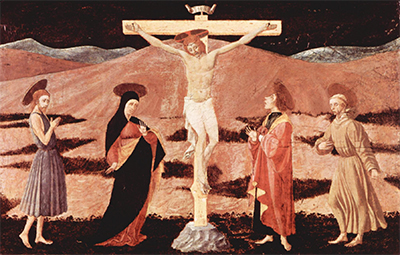
A golden cross stands out against a dark sky. Below it, four figures have come to a halt on bare, reddish ground. The woman nearest the cross on the left draws a hand towards her shoulder. Opposite her a man in red lifts his face. Farther out, two barefoot saints turn inwards. The space between them is as striking as their gestures. Each has a clear outline and room to stand apart, although they have all gathered around the same cross. The Museo Nacional Thyssen-Bornemisza in Madrid catalogues this tempera panel by Paolo Uccello to about 1460–65. It measures 45 by 67 centimetres. [1]
At a Glance
- DateAbout 1460–65
- Medium and sizeTempera on panel, 45 × 67 cm
- CollectionMuseo Nacional Thyssen-Bornemisza, Madrid, inv. 411 (1930.118)
Contents
- The four figures beneath the cross
- The cross and the empty hills
- A possible place beneath an altarpiece
- An attribution reconsidered
- A different Crucifixion in New York
- Annotated details
The four figures beneath the cross
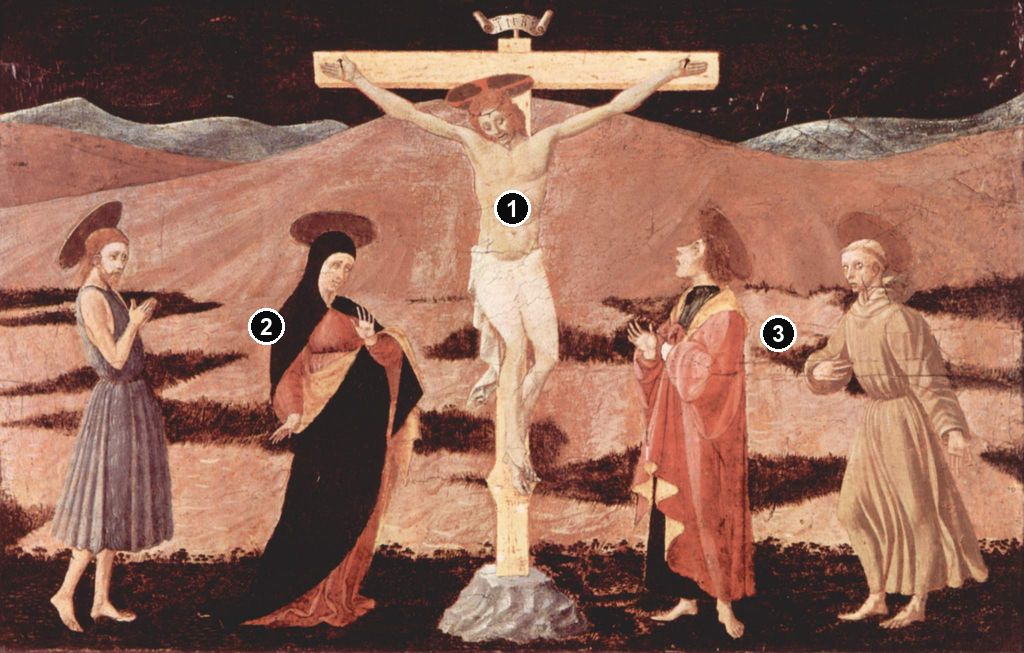
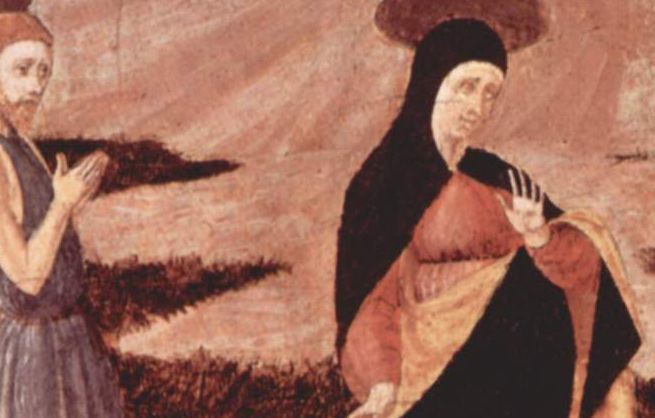
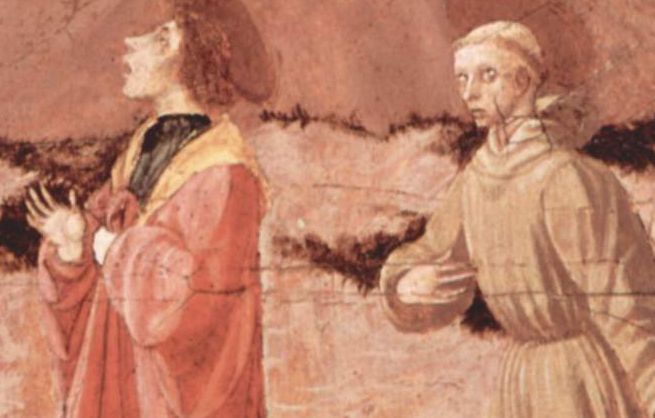
The museum identifies the standing figures as Saint John the Baptist, the Virgin Mary, Saint John the Evangelist and Saint Francis of Assisi, reading from left to right. The Baptist’s bare arms emerge from a short blue-grey garment whose folds hang in narrow pleats. His hands come together near his chest. Mary’s dark mantle sweeps down over a red dress and turns at the hem into a long curve. Where she draws the mantle aside, its yellow lining catches the light. Across from her, the Evangelist wears a red cloak with flashes of yellow at the shoulder and down the opening. Saint Francis, at the far right, wears a plain habit gathered at the waist and holds one hand near his chest while the other hangs open. [1] [2]
Watch what happens at the centre when you follow the two red garments. Mary’s head tips to one side and her eyes appear lowered. The Evangelist raises his chin and looks towards Christ. Their hands rise to roughly the same height, but the gestures lead in different directions. His lifted face follows the length of the cross. The long dark sweep of Mary’s mantle draws the eye back down to the ground. Even the figures at the edges vary the rhythm. The Baptist’s narrow silhouette and close-set hands give him a stillness that the broad folds and parted arms of Francis gently disturb. The repeated shapes set up the balance, and the differences give each figure a distinct way of attending to Christ. [1]
The group brings several periods of sacred history together. John’s Gospel places Jesus’ mother and the beloved disciple at the cross. The disciple is traditionally identified as John the Evangelist. The Baptist was executed before the Crucifixion, and Francis lived in the thirteenth century. In the account of Francis receiving the stigmata, Christ’s wounds are impressed upon the saint’s body. That association gives Francis a particular place in an image of the Passion. As a later follower placed beside the Virgin and the Evangelist, he can also suggest how someone far removed from the event might approach it in prayer. [3] [4] [5]
The cross and the empty hills
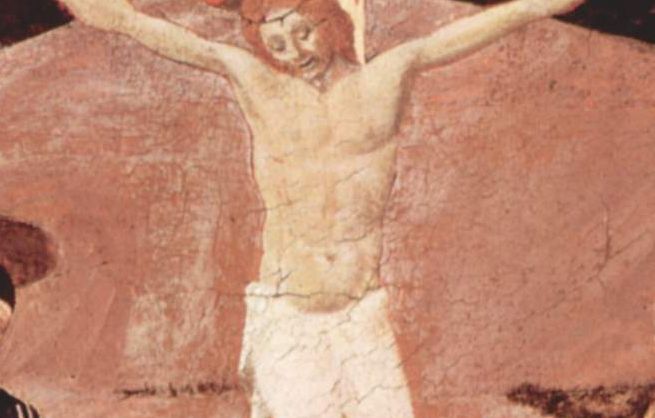
The cross holds the composition together. Its foot sits on a low, faceted grey rock at the centre of the lower edge. The upright climbs in a nearly unbroken line, and the beam stretches across the dark sky. A small scroll above it curls up at both ends. Christ’s arms angle gently down from the ends of the beam, his head drops towards one shoulder, and his legs bend over the line of the post. Look closely at the pale cloth around his hips. A loose strip hangs beside one leg and turns out at the end. The art historian Luciano Berti drew attention to that fold when tracing the lingering taste for animated drapery in Florentine Crucifixion paintings. He found a comparable hanging fold in Uccello’s Thebaid. [1] [6]
Depth comes in bands. Dark tufts of vegetation break up the reddish ground, some extending almost sideways behind the saints. Farther back, a bare hill rises behind Christ and falls away towards the edges. Cooler grey-blue ridges show beyond it, on either side of the cross. The uneven hills make a wide, shallow echo of the lifted arms. Their slopes open up space beyond the mourners, while the strips of dark growth keep pulling the eye sideways again. The people remain near the front of the panel, each with a clear stretch of ground around their feet. [1]
The sky is dark enough to make the cross seem especially bright. It may recall Matthew’s account of darkness falling across the land during the Crucifixion. The earth beneath it remains legible. You can still trace the far ridges, see where the red cloth gathers around the Evangelist’s knee and make out the fingers of Francis’s lowered hand. The darkness therefore makes a difference both to the story we may read into the picture and to how quickly we see its central form. Uccello lets the eye take in the cross at once, then gives it smaller details to discover at the pace of the figures below. [1] [7]
Annotated Details from The Crucifixion with the Virgin and Saints
The numbered points identify visible features discussed in this article. Return from each detail to the numbered overview. The Crucifixion with the Virgin and Saints, Museo Nacional Thyssen-Bornemisza 411 (1930.118). Image source. Public domain.
Details from THE CRUCIFIXION WITH THE VIRGIN AND SAINTS
Compare the cropped details with the source images above. Notice how their colours, shapes and positions contribute to the larger compositions.
Christ and the high cross
The pale figure and cross stand out against the dark sky and bare hills. The cross divides the gathering into two groups without cutting off the colours across the landscape.
The Virgin and the Baptist
The figures to the left remain separated from each other by a narrow stretch of ground. Their dress and gestures establish different responses to the central cross.
The Evangelist and Saint Francis
The two figures at the right look inward. The bright garment beside the cross stands apart from the quieter colour of the saint’s habit at the edge.
A possible place beneath an altarpiece
The Thyssen panel’s breadth and its subject have led to the suggestion that it was the central scene of a predella, the painted base beneath an altarpiece. The cross would have given such a base a strong centre. The two figures on either side, already staggered across a low strip of ground, would have helped carry the eye along the horizontal band. The original setting remains unknown. No companion scenes have been identified, and the altarpiece and its intended destination are undocumented. [1]
One comparison is the predella from the oratory of the Annunziata at Avane, now in the Museo di San Marco in Florence. Its main painting, an Annunciation, was stolen in 1897. The surviving base shows the dead Christ between the Virgin and the Evangelist, each enclosed in a roundel against gold. A recorded inscription supplies a date of 1452 and names its patron, Antonio di Piero di Giovanni del Golea. The Avane predella has itself been attributed to both Uccello and Alesso Baldovinetti. It shows how the Virgin and the Evangelist could accompany an image of Christ’s suffering below a larger scene, and how much an inscription can recover about a commission. The Madrid painting has a continuous landscape and a different arrangement of figures. Its patron and setting remain unknown. [1] [8] [9]
An attribution reconsidered
Raimond van Marle published the panel as Uccello’s in 1928. The archival notes of the art historian Everett Fahy record alternative attributions. Bernard Berenson assigned it to the Master of the Carrand Triptych, while John Pope-Hennessy placed it with the Master of the Karlsruhe Nativity in 1950. The latter name came from a nocturnal Adoration in Karlsruhe. Scholars had used that picture to group works they thought might be by a single artist close to Uccello. Burton Fredericksen returned the Lugano picture to Uccello in his 1974 study of paintings associated with Giovanni di Francesco. The Kunsthalle Karlsruhe now catalogues its own panel under Uccello’s name. The Madrid museum likewise retains the attribution to Uccello and follows Miklós Boskovits’s dating of about 1460–65, based in part on a comparison with Avane. Lorenzo Sbaraglio also places the picture in Uccello’s later activity, allowing that it might belong to the second half of the 1450s. [1] [10] [11] [12] [13]
The painting’s movements through collections are easier to trace than its first home. The Fondazione Federico Zeri records it on the Florentine art market, in the Gnecco collection in Genoa in 1927 and with Jacques Goudstikker in Amsterdam in 1928. It appeared as catalogue number 331 when Heinrich Thyssen-Bornemisza’s Rohoncz Castle Collection was shown at Munich’s Neue Pinakothek in 1930. Samuel Guyer later described seeing the Crucifixion among the Italian paintings at the Villa Favorita in Lugano. It travelled to Florence for the 1954 exhibition Mostra di quattro maestri del primo Rinascimento at Palazzo Strozzi. Decades later the Thyssen collection came to Madrid under a loan agreement with Spain. The museum opened in 1992 and the Spanish state acquired the collection in 1993. The panel is part of the permanent collection, inventory 411 (1930.118). [1] [10] [14] [15] [16] [17]
A different Crucifixion in New York
Uccello’s Crucifixion at the Metropolitan Museum of Art offers a glimpse of how the subject could be adapted to private prayer. It is a portable triptych with a gold ground and an inscribed figure of a kneeling nun, Sister Felicity, at the foot of the cross. The Met considers that she may be Felicita di Francesco Casavecchia, who joined the Brigitine order in January 1455. That possibility supports the museum’s date of probably the mid-1450s and its reading of the work as a picture for prayer in her cell at Santa Maria del Paradiso near Florence. On its wings are small scenes including the Annunciation and Saint Bridget of Sweden. The inscription connects the figure at the cross to a likely historical viewer. In Madrid the four standing figures are identified by their place in Christian tradition. Spread out beneath the cross, they offer the viewer four different gestures with which to begin looking. [1] [12] [18] [19]
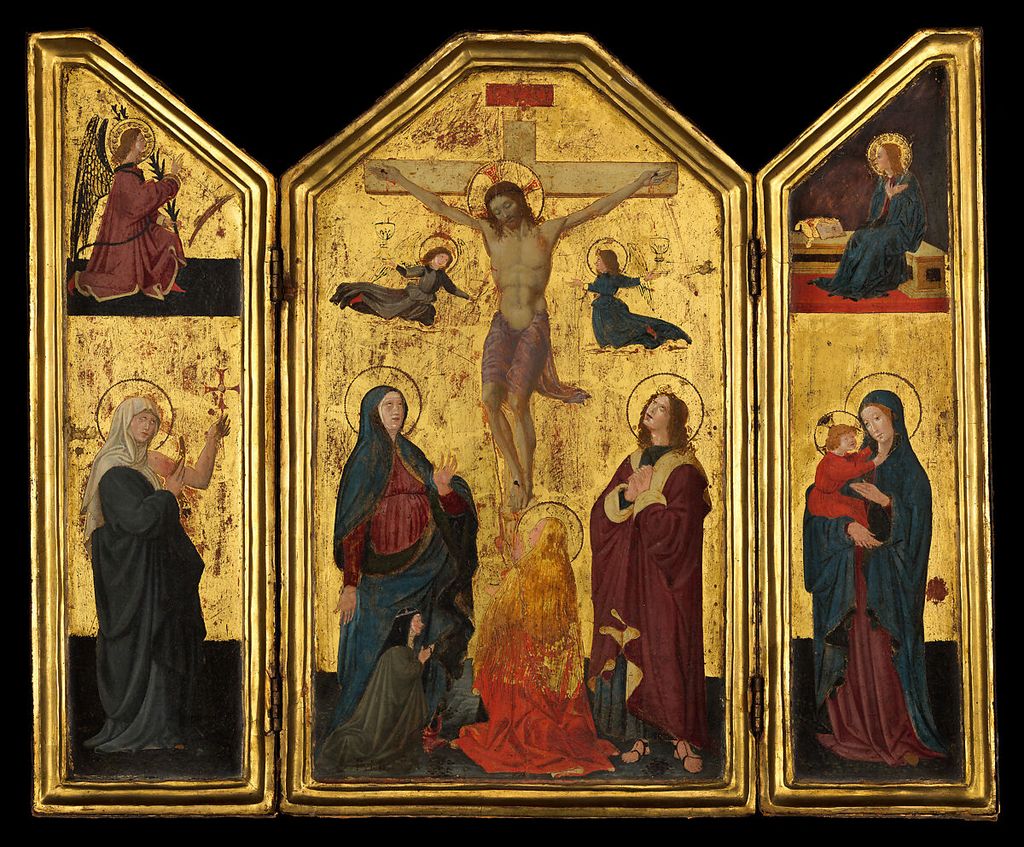
Uccello’s portable Crucifixion triptych, with Sister Felicity kneeling beneath the cross. Image source. CC0 / Public domain.
Artworks directory
Browse paintings, drawings, stained-glass designs and other objects connected with Uccello. Cycles and their surviving components may have separate entries. The collection or catalogue’s wording is retained where a date, attribution or subject is debated.
| Name | Date | Medium, attribution and collection |
|---|---|---|
| Niccolò da Tolentino at the Battle of San Romano · London | Probably c.1438–40 | Tempera and oil on wood, with metallic decoration · National Gallery Catalogue. |
| Bernardino della Carda Unhorsed · Florence | c.1435–40 | Tempera on panel · Uffizi Galleries Catalogue. |
| The Counterattack of Micheletto da Cotignola · Paris | 1450–75 in the Louvre catalogue | Tempera (possibly) on wood · Musée du Louvre Catalogue. |
| The Hunt in the Forest | c.1465–70 | Tempera and oil with traces of gold on panel · Ashmolean Catalogue. |
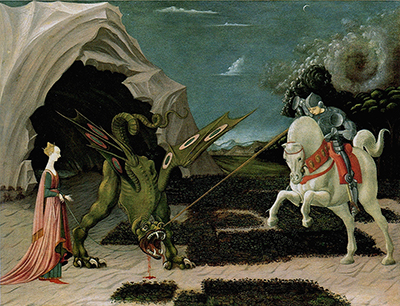
| Saint George and the Dragon · London | c.1470 | Oil on canvas · National Gallery Catalogue. |
| Saint George Slaying the Dragon · Melbourne | c.1430 | Oil, tempera and silver leaf on wood · National Gallery of Victoria Catalogue. |
| Saint George and the Dragon · Paris | 1430–35 in the museum catalogue | Painted wood panel · Musée Jacquemart-André Catalogue. |
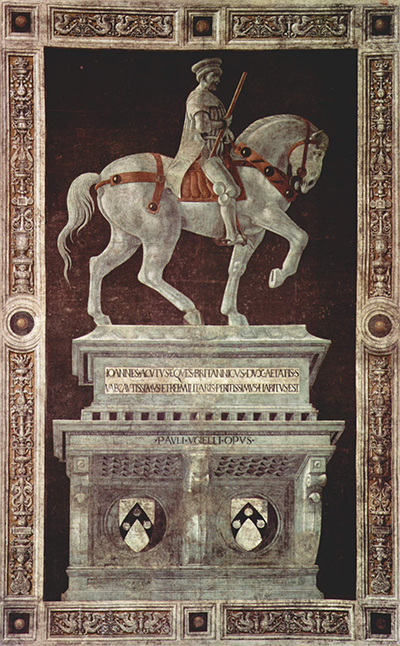
| Equestrian Monument to John Hawkwood | 1436 | Transferred wall painting · Florence Cathedral Catalogue. |
| Study for the John Hawkwood Monument | 1436 | Study on prepared paper · Uffizi Catalogue. |
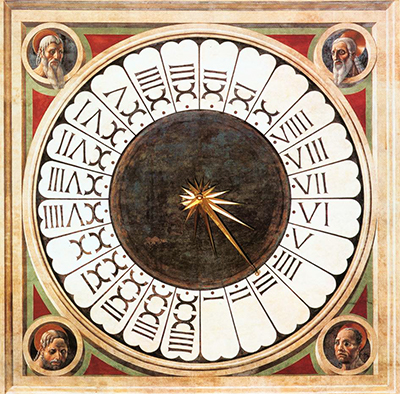
| Monumental Clock Face | 1443 | Painted dial · Florence Cathedral Catalogue. |
| Resurrection of Christ | 1443–44 | Stained glass · Uccello design · Florence Cathedral Catalogue. |
| Nativity | 1440s | Stained glass · Uccello design · Florence Cathedral Catalogue. |
| Creation of the Animals and Creation of Adam | Third to fourth decade of the 15th century | Detached fresco · Green Cloister, Santa Maria Novella Catalogue. |
| Creation of Eve and the Fall | Third to fourth decade of the 15th century | Detached fresco · Green Cloister, Santa Maria Novella Catalogue. |
| Flood and Recession of the Waters | 15th century; dating debated | Detached fresco · Green Cloister, Santa Maria Novella Catalogue. |
| Sacrifice and Drunkenness of Noah | 15th century; dating debated | Detached fresco · Green Cloister, Santa Maria Novella Catalogue. |
| Stories of the Virgin and Saint Stephen · Assunta Chapel | 1430s, with later completion | Fresco cycle · Paolo Uccello and Andrea di Giusto · Prato Cathedral Catalogue. |
| Blessed Jacopone da Todi | 1436 in the diocesan museum | Detached fresco · Museo dell’Opera del Duomo, Prato Catalogue. |
| Adoration of the Child · Bologna | 1430s; inscription incomplete | Detached fresco · San Martino Maggiore, Bologna Catalogue. |
| Adoration of the Christ Child · Karlsruhe | c.1436 | Painted panel · Attribution to Uccello · Staatliche Kunsthalle Karlsruhe Catalogue. |
| Annunciation · Oxford | Early 15th century | Tempera and gilding on panel · Ashmolean Catalogue. |
| Allegory of Monastic Life (Thebaid) | c.1460–65 | Tempera on canvas · Galleria dell’Accademia, Florence Catalogue. |
| Miracle of the Profaned Host | 1467–68 | Tempera on wood · Galleria Nazionale delle Marche, Urbino Catalogue. |
| Triumphal Entry into Rome of Titus and Vespasian(?) | c.1430–35 | Tempera, gold and silver on panel · Yale University Art Gallery Catalogue. |
| Crucifixion with the Virgin and Saints | c.1460–65 | Painted panel · Museo Nacional Thyssen-Bornemisza Catalogue. |
| The Crucifixion · Met triptych | Probably mid-1450s | Tempera on wood with gold ground · Metropolitan Museum of Art Catalogue. |
| Perspective Study of a Chalice | 1450–75 | Pen, ink and stylus on paper · Attributed to Uccello · Uffizi Catalogue. |
| Study of a Mazzocchio | 15th century | Perspective study · Attributed to Uccello · Uffizi Catalogue. |
| Mazzocchio Seen in Perspective | Uncertain | Drawing · Attribution debated · Musée du Louvre Catalogue. |
| Head of a Man in Profile | 15th century | Pen, ink and wash · Musée du Louvre Catalogue. |
| Five Masters of the Florentine Renaissance | 1500–50 | Oil on wood · Anonymous Florentine school · Musée du Louvre Catalogue. |
| Madonna and Child from the Del Beccuto House | 15th century | Detached fresco · Museo di San Marco, Florence Catalogue. |
| Man of Sorrows with the Virgin and Saint John · Avane Predella | 15th century | Predella · Museo di San Marco, Florence Catalogue. |
| Calling of Saint Paul the Hermit · San Miniato | After 1447 to c.1454 in state catalogue | Sinopia · Attributed to Uccello or collaborator Catalogue. |
| The host changes hands · Urbino predella, scene 1 | 1467–68 | Tempera on wood · Component of DE 231 · Galleria Nazionale delle Marche Catalogue. |
| The figures at the door · Urbino predella, scene 2 | 1467–68 | Tempera on wood · Component of DE 231 · Galleria Nazionale delle Marche Catalogue. |
| The procession approaches the altar · Urbino predella, scene 3 | 1467–68 | Tempera on wood · Component of DE 231 · Galleria Nazionale delle Marche Catalogue. |
| The condemned woman and the ladders · Urbino predella, scene 4 | 1467–68 | Tempera on wood · Component of DE 231 · Galleria Nazionale delle Marche Catalogue. |
| Persecution of the family · Urbino predella, scene 5 | 1467–68 | Tempera on wood · Component of DE 231 · Galleria Nazionale delle Marche Catalogue. |
| Angels and demons at the bier · Urbino predella, scene 6 | 1467–68 | Tempera on wood · Component of DE 231 · Galleria Nazionale delle Marche Catalogue. |
| Birth of the Virgin · Prato Cathedral | 1430s; dating debated | Fresco · Assunta Chapel, Prato Cathedral Catalogue. |
| Presentation of the Virgin · Prato Cathedral | 1430s; dating debated | Fresco · Assunta Chapel, Prato Cathedral Catalogue. |
Discussion
Look again at the images and ideas explored in The Crucifixion with the Virgin and Saints. These editorial prompts invite your observations.
Reader Insights
Which of the four figures makes you pause longest before your eyes return to the cross?
How does the dark sky change where you look first and how you read the faces below?
Join the Conversation
Share a detail, comparison or question about The Crucifixion with the Virgin and Saints below.
References
- Mar Borobia, Museo Nacional Thyssen-Bornemisza, The Crucifixion with the Virgin, Saint John the Baptist, Saint John the Evangelist and Saint Francis, inv. 411 (1930.118), catalogue and collection photograph. View source.
- Mar Borobia, Museo Nacional Thyssen-Bornemisza, La Crucifixión con la Virgen, los santos Juanes y san Francisco, Spanish collection entry. View source.
- United States Conference of Catholic Bishops, John 19:25–27. View source.
- United States Conference of Catholic Bishops, Mark 6:17–29. View source.
- National Gallery, London, Saint Francis of Assisi, glossary. View source.
- Luciano Berti, Un foglio miniato dell’Angelico, Bollettino d’Arte, series IV, 1962, note 3. View source.
- The Holy See, Matthew 27:45, New American Bible. View source.
- Catalogo Generale dei Beni Culturali, Cristo in pietà tra la Madonna e San Giovanni Evangelista, Avane predella, no. 0900284584. View source.
- Annamaria Bernacchioni, Paolo Uccello e il Valdarno, exhibition catalogue, pp. 16–18. View source.
- Fondazione Federico Zeri, Cristo crocifisso con la Madonna, san Giovanni Evangelista, san Giovanni Battista e san Francesco d’Assisi, catalogue entry 13598 and Everett Fahy’s notes on the reverse of photograph 406474. View source.
- Staatliche Kunsthalle Karlsruhe, Adoration of the Christ Child with Saint Jerome, Saint Mary Magdalene, and Saint Eustace, catalogue and attribution history. View source.
- Lorenzo Sbaraglio, Paolo di Dono, detto Paolo Uccello, Dizionario Biografico degli Italiani, vol. 81, 2014. View source.
- Burton B. Fredericksen, Giovanni di Francesco and the Master of Pratovecchio, J. Paul Getty Museum, 1974, appendix entry 17. View source.
- Museo Nacional Thyssen-Bornemisza, History of the Collection I, early collecting and the 1930 Munich exhibition. View source.
- Samuel Guyer, Die Sammlung Schloß Rohoncz in Castagnola bei Lugano, Schweizer Monatshefte, vol. 29, no. 12, 1949–50, pp. 762–763. View source.
- Institut national d’histoire de l’art, Mostra di quattro maestri del primo Rinascimento, record for the Palazzo Strozzi exhibition and catalogue, 1954. View source.
- Museo Nacional Thyssen-Bornemisza, History of the Collection II, Madrid loan and purchase. View source.
- Metropolitan Museum of Art, The Crucifixion, acc. 1997.117.9, current catalogue. View source.
- Metropolitan Museum of Art, Recent Acquisitions, A Selection, 1996–1997, The Metropolitan Museum of Art Bulletin, vol. 55, no. 2, 1997, entry for The Crucifixion (triptych). View source.
More PAOLO UCCELLO Artworks

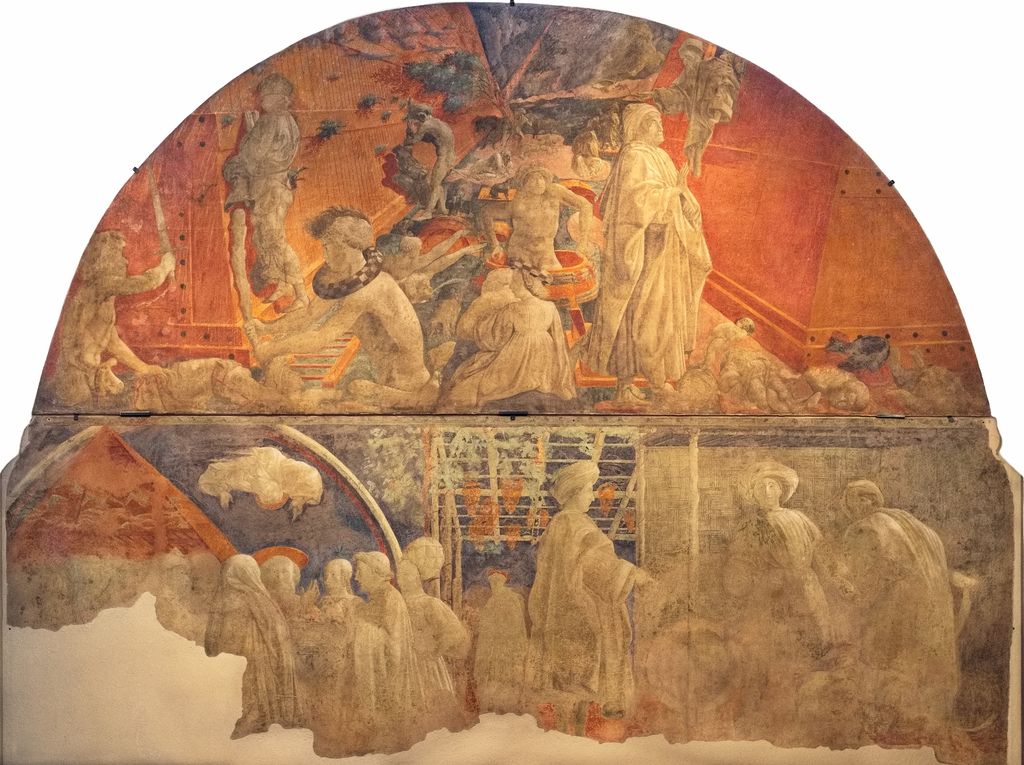
Noah and the Flood
The Flood and Recession of the Waters above the lower episodes from Noah’s story, Santa Maria Novella. Photograph by Armin Kleiner. Image source. CC BY-SA 4.0. Resized for the web. This derivative is available under the same licence.
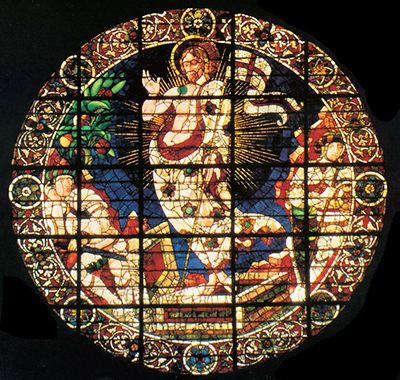
The Resurrection of Christ Stained Glass Window
The Resurrection window in Florence Cathedral, designed by Paolo Uccello and made by Bernardo di Francesco. Photograph by Sailko. Image source. CC BY 3.0. Resized for the web.