by Tom Gurney
Tom Gurney BSc (Hons) is an art history expert with over 20 years experience
Published on June 19, 2020 / Updated on November 5, 2026
Email: tomgurney1@gmail.com / Phone: +44 7429 011000
Paolo Uccello Drawings
A cup rises from a broad foot, its bowl and stem woven out of fine brown lines. You can see through it: the curves continue across the object, describing surfaces that would disappear behind an opaque vessel. This famous drawing in the Uffizi is often reproduced as an emblem of Paolo Uccello’s fascination with perspective. Its authorship, however, requires care. Palazzo Strozzi’s exhibition The Springtime of the Renaissance catalogued the sheet, inventory 1758 A, as attributed to Uccello. It is a compelling introduction to the problems associated with his drawings, rather than a securely signed declaration of his method. [1]
The surviving material brings together several kinds of looking. There are geometric studies traditionally connected with his name, a working design for the painted monument to John Hawkwood, and figure drawings whose attribution has changed as scholars reassessed them. These sheets deserve to be encountered individually. A drawing associated with Uccello may illuminate his artistic world even when its maker remains uncertain; a drawing tied to a specific commission can tell us something more direct about the process of making a picture. [2]
At a Glance
Contents
A vessel built from lines
The Uffizi sheet is usually called a study for a chalice, although its elaborate swelling form can also suggest an ornamental vase. The Strozzi checklist identifies brown pen and ink and stylus on white paper, gives its dimensions as 349 by 243 millimetres, and dates it to 1450–1475. Those are the exhibition’s catalogue particulars, including its qualified attribution. They should travel with the image whenever it is reproduced. [1]
Start at the base and follow the drawing upwards. The wide foot contracts into a narrow stem, which flares again beneath the rounded bowl. Across those changes of shape, repeated horizontal divisions meet upright and slanting lines. At the widest points, the little compartments open into broad facets; near the narrow neck they crowd together. The eye receives two impressions at once: a vessel with weight and volume, and a delicate structure whose substance seems to be the drawing itself.
The upper rim is especially revealing. Its near and far edges are both visible, while lines run across the opening and down into the body. What a finished painting might conceal remains available for inspection. The sheet asks us to imagine how the whole form occupies space, including parts hidden from ordinary sight. This is why it feels so different from a simple outline drawing of a cup: its internal relationships carry as much information as its silhouette.
It is tempting to treat such complexity as a personal signature. Yet a difficult perspective exercise could be studied, copied or developed by more than one artist. The Louvre’s discussion of a related mazzocchio makes clear that a connection with Uccello’s painted forms does not settle the authorship of a drawing. The vessel’s fascination survives that caution. We can admire the extraordinary coordination of its lines without pretending that the page settles its own authorship. [2]
Explore the perspective chalice
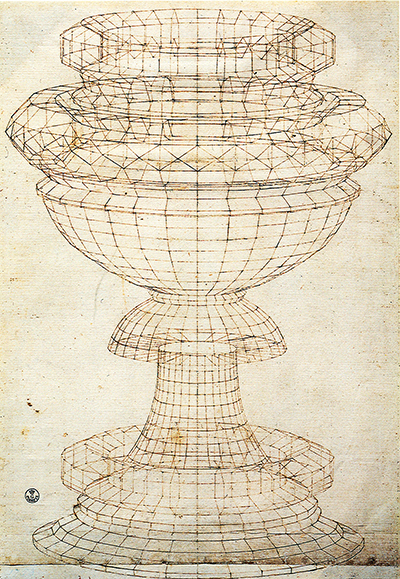
Study for a chalice (attributed to Uccello)
Uffizi 1758 A; the exhibition checklist records 1450–75 and a qualified attribution.
The mazzocchio: a hat becomes a problem in space
A mazzocchio was the framework of a male headdress, covered in cloth. Stripped of its covering and represented as a ring of regular facets, it offered an exacting perspective exercise. The Louvre’s Mazzocchio Seen in Perspective, inventory INV 1970, presents such a form as a substantial object resting on a surface. Its catalogue places it beside the Uffizi studies numbered 1756 A and 1757 A. [2]
In the Louvre drawing, the near edge forms a broad, low wall. The opening behind it reveals a darker interior, while the upper surface slopes away through a succession of angled compartments. Unlike the chalice, the ring is supported by shading and a dark surrounding field. Its volume is not only calculated through lines; it is made legible through the difference between illuminated and shadowed planes. Following a single facet around the curve helps explain why a modest piece of headwear could become such an absorbing subject.
The attribution history is less orderly than the object. The Louvre records Mina Gregori’s interpretation as a sixteenth-century derivation, Degenhart and Schmitt’s proposal of a pupil or collaborator, and John Pope-Hennessy’s acceptance of it as an original. Its commentary also incorporates Thomas Bohl’s 2023 assessment that the attribution remains uncertain. Bohl raises the possibility of a connection with wood inlay, where convincing representations of complex objects were a valued skill. The sheet thus belongs to a wider culture of perspective even when its connection to Uccello’s own hand is disputed. [2]
A working drawing for John Hawkwood
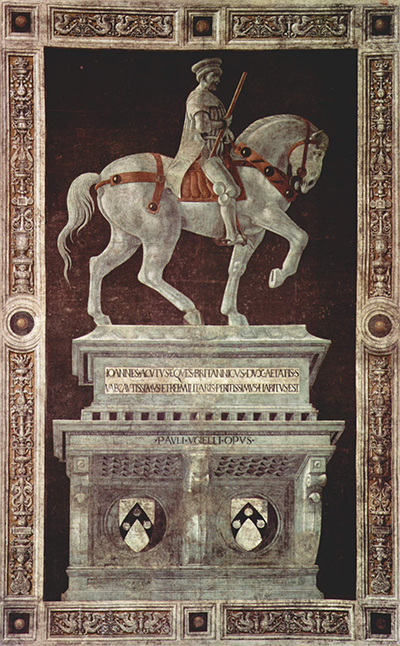
The study for Uccello’s monument to the English commander John Hawkwood offers a different point of entry. The Uffizi’s institutional list identifies inventory 31 F as a study for the equestrian fresco and dates it to 1436. It describes prepared paper, white heightening and an incised grid, with a question mark attached to the identification of silverpoint. That small qualification matters: even a museum’s technical description can preserve uncertainty about a particular instrument. [3]
In the reproduced sheet, horse and rider rise above a substantial sarcophagus. The animal’s profile makes its body readable almost immediately, but the base beneath it turns towards us. Fine divisions across the support remind us that the image had a practical destination beyond the paper. A small design had to become a monumental presence high on the cathedral wall. Here drawing connects the intimate scale of the hand to the public scale of architecture.
Hugh Hudson discusses the sheet in his study of the commission and its political setting. Drawing on Lorenza Melli’s technical investigation, he describes alterations to the rider’s costume and posture, the reins, a rear hoof and the sarcophagus. Melli’s findings, as reported by Hudson, reveal a revised design rather than a single untouched conception. The grid was a means of enlarging the composition; Hudson also notes complications in its alignment across the sheet. [4]
These changes make the drawing particularly rewarding. A geometry exercise explores how an object can be represented; a revised commission drawing also negotiates what the finished work should become. Adjusting a rider’s position changes the relation between human and animal. Altering the base changes how a spectator imagines looking upwards. The sheet brings questions of pictorial construction into contact with decisions about a commemorative image, giving us a more varied understanding of Uccello’s practice than the vessel alone can supply. [4]
Faces as well as geometry
A small profile in the Louvre interrupts the familiar image of Uccello as an artist concerned only with mathematical forms. Head of a Man, in Profile to the Left, Wearing a Headdress, RF 730, measures just 88 by 83 millimetres. The museum records brown pen and ink with brown and pink washes. Its catalogue currently assigns it to Uccello following Degenhart and Schmitt, while retaining earlier proposals for other artists or anonymous hands. [5]
Look at the sharp turn from forehead to nose, the narrow mouth and the short strokes beneath the chin. The cap rises high above the head, but its broad, quiet surface directs attention back to the face. Pink colour gathers around the cheek, while darker marks beneath the cheekbone and beside the eye give the profile a physical presence. The drawing has a delicacy quite unlike the vessel’s mesh of intersecting lines.
Its history also demonstrates why an old name on a mount is not enough to close an attribution question. The Louvre connects it with a group of sheets that passed through Vasari’s and Mariette’s collections, and documents twentieth-century disagreements about its author and date. The mount and inscriptions are part of the drawing’s collecting history. They help explain how it was understood and valued, but require comparison with other evidence. Keeping that distinction in view allows the face to remain a vivid object rather than reducing it to a label. [5]
From a drawn structure to a painted world
Uccello’s paintings provide a broader setting for these studies, without proving that every associated sheet is his. The National Gallery describes his art as a combination of decorative effects and a profound interest in linear perspective. That combination is essential: the construction of depth did not displace his delight in colour, pattern and unusual shapes. [6]
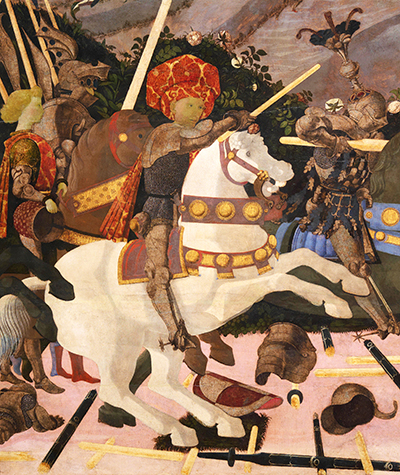
In the London Battle of San Romano, broken lances lie across the foreground in a conspicuous arrangement of receding lines. Pieces of armour turn at different angles, while the hedge interrupts the view beyond the fighting. The Gallery’s account stresses both the perspective experiments and their irregularities. These are pictorial choices within a crowded, glittering battle scene, rather than a demonstration that follows one unbroken mathematical system. [7]
The comparison helps us see what changes between a drawing and a painting. In the vessel, the construction remains exposed throughout; in the battle, the spectator discovers spatial relationships among weapons, bodies, horses and ground. Lines participate in a story. The fascination lies in watching forms become convincing while retaining an emphatic pattern on the surface. Studying the drawings alongside the paintings therefore sharpens our attention to both, even where a direct preparatory relationship cannot be established. [6] [7]
Uccello’s drawings are most rewarding when we resist asking one celebrated image to stand for everything. The chalice opens a world of intricate spatial invention. The Hawkwood study shows planning and revision for a particular monument. The profile reminds us of the patient observation of a face. Together, with their differing degrees of attributional confidence, they offer a richer encounter with the artistic questions gathered around his name. [1] [3] [5]
Artworks directory
Selected drawings and a painting used for comparison. Attributions differ in confidence: the chalice is attributed in a 2013 exhibition checklist, and the Louvre mazzocchio remains uncertain. Technical and authorship qualifications are retained; a dash means no date is supplied here. This is not a complete catalogue.
| Name | Date | Medium |
|---|---|---|
| Study for a chalice (attributed to Uccello) | 1450–75 | Drawing |
| Study for a mazzocchio (attributed to Uccello) | — | Drawing |
| Mazzocchio seen in perspective (attribution uncertain) | — | Drawing |
| Study for the John Hawkwood monument | 1436 | Drawing |
| Head of a man in profile (Louvre attribution to Uccello) | — | Drawing |
| The Battle of San Romano (London) | — | Painting |
Frequently Asked Questions
Its authorship is qualified. The Palazzo Strozzi exhibition checklist identifies the Uffizi sheet 1758 A as attributed to Uccello. It should not be presented as an undisputed autograph drawing. [1]
It is the framework of a type of male headdress. Its faceted ring form became a demanding subject for perspective studies, including drawings associated with Uccello. [2]
Discussion
Follow the vessel’s intersecting lines, then compare mathematical construction with the practical design for a painted monument.
Reader Insights
Where is the vessel’s volume easiest to imagine?
How does a working grid differ from a perspective exercise?
What remains rewarding when authorship is uncertain?
Join the Conversation
Share a detail, comparison or question about Paolo Uccello Drawings below.
References
- Palazzo Strozzi, La Primavera del Rinascimento: La scultura e le arti a Firenze 1400–1460, 2013 exhibition press dossier, section 7, checklist entries 7.10–7.11: Studio per un calice, Uffizi 1758 A, and Studio per un mazzocchio, 1757 A. Italian; both listed as attributed. Official exhibition dossier. View source.Splash image: Study for a chalice, Uffizi 1758 A, 1450–75. Attributed to Paolo Uccello in the 2013 Palazzo Strozzi exhibition checklist.
- Musée du Louvre, Mazzocchio vu en perspective, INV 1970, recto, attribution history and commentary incorporating Thomas Bohl’s 2023 assessment. French. Louvre collection record and images. View source.
- Gallerie degli Uffizi, Opere inamovibili, official institutional list, p. 7, entry for Studio per l’affresco col monumento equestre a Giovanni Acuto, 31 F. Italian. Uffizi institutional object list. View source.
- Hugh Hudson, “The Politics of War: Paolo Uccello’s Equestrian Monument for Sir John Hawkwood in the Cathedral of Florence,” Parergon 23.2 (2006), especially pp. 7 and 19–20, fig. 2 and notes 13, 56–57. Includes discussion of Lorenza Melli’s investigations, cited here through Hudson. Full article in the University of Western Australia repository. View source.
- Musée du Louvre, Département des Arts graphiques, Tête d’homme, vue de profil vers la gauche, coiffé, RF 730, recto; record updated 24 September 2024. French; attribution discussion cites Degenhart and Schmitt, Corpus der italienischen Zeichnungen 1300–1450, 1968, no. 301. Louvre drawing record and bibliography. View source.
- National Gallery, London, Paolo Uccello, artist collection essay. Uccello’s perspective and decorative style. View source.
- National Gallery, London, The Battle of San Romano, NG583, collection description and “In-depth” account. Painting record and discussion of perspective. View source.