 by Tom Gurney
Tom Gurney BSc (Hons) is an art history expert with over 20 years experience
Published on June 19, 2020 / Updated on September 28, 2026
Email: tomgurney1@gmail.com / Phone: +44 7429 011000
About the painting
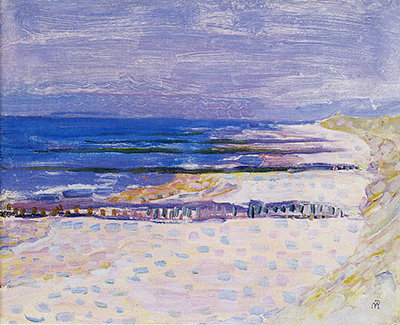
A pale beach opens across the foreground of Piet Mondrian's Beach with Five Piers at Domburg. Beyond it, dark narrow breakwaters cut across bands of blue water, while a low coast bends away on the right. The sky is lilac and gray-blue. Small touches of pink, cream and blue make the sand shimmer without turning the scene into a detailed map of the shoreline. Mondrian made the painting in 1909, during the years when Domburg's sea and dunes offered him a recurring subject.[1][3]
RKD catalogues this work as A697. It is now in the Museum of Fine Arts, Boston, accession 2023.654, received through a 2023 gift of Maria and Conrad Janis by and through the Janis Living Trust. The museum describes its medium as oil on canvas on board. A 2022 exhibition record gives the dimensions as 33 × 41.9 cm and calls the backing cardboard. The museum's recent acquisition matters for identifying the picture's present home: an older RKD line still lists Pace Gallery, a previous art dealer location.[1][2][3]
At a glance
- ArtistPiet Mondrian (Piet Mondriaan, 1872–1944)
- TitleBeach with Five Piers at Domburg
- Date1909
- MediumOil on canvas mounted on board; a 2022 exhibition record specifies cardboard
- Dimensions33 × 41.9 cm (height × width)
- CollectionMuseum of Fine Arts, Boston
- MFA accession2023.654
- CreditGift of Maria and Conrad Janis by and through the Janis Living Trust
- Catalogue raisonnéJoosten A697[1][2][3]
Where the Domburg beach sits in Mondrian's career
Contents
- What can you see on the beach?
- Why did Mondrian paint the Domburg coast?
- Is it oil on canvas or cardboard?
- How is it different from the other Domburg pier paintings?
- Where is Beach with Five Piers at Domburg now?
What can you see on the beach?
The horizon runs across the painting's upper half, separating a low, coloured sky from the sea. Below it, several dark bands reach into the water. They narrow and break as the shore recedes to the right. The title calls them piers; an exhibition guide describes the local forms more specifically as breakwaters projecting into the sea. In the image, they work as repeated horizontal interruptions to the water's surface.[4]
 The Red Tree Piet Mondrian.jpg)
The beach takes up much of the lower part. Its pale ground is covered in short marks of blue, pink, lavender and yellow. Some resemble patches of light on sand; others simply remain visible strokes. Their uneven spacing prevents this large area from becoming blank. The marks also draw attention to the painting's surface: Mondrian lets the viewer see how small pieces of colour build a broad stretch of beach.
At the far right, the land rises and curves around the bay. Light sandy and yellow strokes mark that edge. The curve leads the eye away from the foreground toward a distant part of the coast, where water, shore and sky come closer together. The left side, by contrast, opens toward the sea. This difference between the bounded right edge and the open left gives the small painting a sense of depth.
The sky is relatively quiet in shape but rich in tone. Fine horizontal strokes move through lilac, blue and gray. Their direction echoes the sea bands below. Mondrian does not need sharply drawn clouds to make the upper part of the picture active. The repeating sideways movement links sky, water, breakwaters and beach while each area retains a different density of marks.
It can be tempting to count five separate structures in a small reproduction. Some bars merge with the shoreline or seem partly submerged, and their distance makes them less distinct. The title supplies the count; the image's strongest visible feature is their recurrence. They form intervals across the water, giving the eye a series of stops before it reaches the bend of the coast.
Why did Mondrian paint the Domburg coast?
Kunstsammlung Nordrhein-Westfalen's guide records that Mondrian repeatedly spent time at Domburg on the Walcheren peninsula from 1908 onward. He painted its dunes, sea and built landmarks. The guide describes his brightening palette and increasingly visible brushwork in this period. The beach picture fits that setting: the North Sea landscape is recognizable, yet its colours and strokes are prominent enough to become subjects of attention in their own right.[3]
Fondation Beyeler's guide points to Domburg's distinctive breakwaters extending horizontally into the sea and uses Beach with Five Piers as an example. These shore structures gave Mondrian a repeated form within an otherwise shifting view of water and light. Their nearly parallel reaches can be followed from one part of the painting to another. The forms are specific to the coast, yet the repetition gives the picture a strong arrangement that can be appreciated without knowing the exact beach access point.[4]
The sea and sand are also organised by horizontal bands. The sea darkens in some strips and lightens in others; the beach is pale but interrupted by scattered touches. Rather than smoothing every mark into a continuous illusion, Mondrian keeps parts of the painting visibly made from strokes. The K20 exhibition guide discusses similar colour and brushwork experiments in his Domburg views. That broader context helps explain the painting's vividness without assigning a fixed technical recipe to every mark.[3]
Mondrian's interest in this landscape does not make the work a simple travel souvenir. Its right-hand coast, low horizon and recurring breakwaters are selected and arranged in a compact format. The repeated side-to-side movement is as important to the experience as the named place. At the same time, the beach remains a beach: the painting's structure emerges from what he chose to show, not from erasing the seascape.
Watch: Piet Mondrian
See his studio, the move toward geometric abstraction and the rhythms of his New York paintings.
Piet Mondrian: Abstract Painting as We Know It
Curator Michael White explores the paintings and Mondrian’s studio as an abstract space.
Watch on YouTubeIs it oil on canvas or cardboard?
The MFA describes the work as oil on canvas on board. The K20 exhibition guide and Fondation Beyeler's work list use the more specific wording oil on canvas on cardboard, both giving 33 × 41.9 cm. These descriptions agree that Mondrian painted on canvas which was mounted on a firm backing. They differ in how precisely they name that backing. Calling it merely “oil on canvas” would leave out a recorded part of the object's construction.[2][3][4]
The work is modest in size, a little wider than it is tall. That shape suits a view where the coast and breakwaters stretch sideways. The pale beach feels expansive within the picture, even though the physical support is only about forty-two centimetres across. Its short, separate strokes are easier to notice in a close view of the original than in a small online image; the main composition remains readable at both scales.
The source of the painting's current collection is documented. The MFA's 2023 acquisitions report names the Janis Living Trust gift and accession 2023.654. RKD's A697 catalogue entry still names Pace Gallery and inventory 36274. Those records reflect different points in the painting's history, and the later museum acquisition supplies the current collection identification. A reader should not infer that Pace Gallery and the MFA own the painting at the same time.[1][2]
How is it different from the other Domburg pier paintings?
RKD catalogues A698, Beach with three or four piers at Domburg, and A699, Beach with one pier at Domburg, as separate 1909 works. Their titles refer to the same coastal motif, but the catalogue gives them their own entries and different collection lines. A697's pale foreground, lilac sky, right-hand dune and pattern of breakwaters identify the MFA picture. The other two should not inherit its MFA accession, Janis gift or dimensions merely because all three show piers at Domburg.[1]
RKD also lists A700, View from the Dunes with Beach and Piers, Domburg, at MoMA. Again the subject is related, but the title describes another view and RKD assigns another catalogue number. Comparing the works can show how Mondrian changed his viewpoint and the balance of beach, water and sky. The comparison works best when each picture is identified by its actual image and record first.[1]
Across these related subjects, Beach with Five Piers has a particularly strong meeting of broad colour bands and many short beach marks. The dark shore structures punctuate the water, while the land at right draws the view into depth. Its value is not only that it belongs to a sequence. The painting gives a vivid account of how repeated coastal forms can organise a fleeting scene.
Where is Beach with Five Piers at Domburg now?
The painting belongs to the Museum of Fine Arts, Boston, accession 2023.654. The museum's 2023 acquisitions account documents the gift and links to its collection record. It was featured in the MFA's Mondrian: Foundations exhibition, but an exhibition listing does not establish today's display. Check the museum's current information before a visit focused on this particular work.[2]
The painting remains compelling because its brushmarks describe a place and create a rhythm at the same time. A viewer can follow the breakwaters toward the horizon, then return to the scattered colour on the beach. Mondrian makes a small stretch of coast feel broad, bright and carefully held together.
Mondrian artworks directory
Frequently asked questions
When was Beach with Five Piers at Domburg painted?
What is its medium and size?
Does the title refer to five sea structures?
Is this the same as Beach with One Pier?
No. RKD gives the one-pier painting its own catalogue number, A699. The five-piers work is A697.[1]
Which museum owns it?
The Museum of Fine Arts, Boston received it in a 2023 Janis Living Trust gift and records it as 2023.654.[2]
Discussion
Which dark breakwater draws your eye first across the water?
Reader Insights
Follow the bend of the coast at right. How does it change the sense of distance?
Which colours in the beach marks become clearer after a second look?
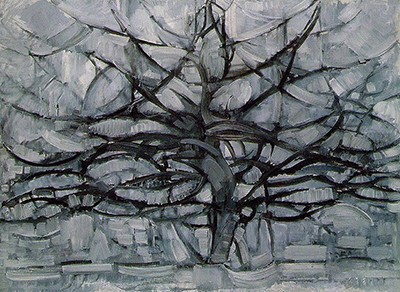
How do the repeated piers differ from the spreading branches in Mondrian’s tree works?
Join the Conversation
Share what you notice in this painting below.
References
- RKD – Netherlands Institute for Art History, Mondrian catalogue raisonné, Zeeland 1909–11 seascapes, A697 and neighbouring pier works. View source.
- Museum of Fine Arts, Boston, 2023 acquisitions account for Beach with Five Piers at Domburg, accession 2023.654. View source.
- Kunstsammlung Nordrhein-Westfalen, Mondrian — Evolution, 1908–11 chapter and A697 object caption. View source.
- Fondation Beyeler, Mondrian Evolution room guide, Domburg breakwaters and 1909 A697 work. View source.
- Lead image credit. Piet Mondrian, Beach with Five Piers at Domburg, 1909. Museum of Fine Arts, Boston, accession 2023.654.