by Tom Gurney
Tom Gurney BSc (Hons) is an art history expert with over 20 years experience
Published on June 19, 2020 / Updated on September 28, 2026
Email: tomgurney1@gmail.com / Phone: +44 7429 011000
About the painting
A dark gray-blue sky presses down over the sea in Piet Mondrian's Beach with Three or Four Piers at Domburg. Bands of surf move toward a low, pale beach, while a steep dune climbs the right side of the painting. The coast is recognizable, yet the surface is full of short, separate strokes. Blues, grays, creams and yellow-greens give the small scene a restless movement that a simple outline could not capture. Mondrian painted it in 1909, during his repeated visits to the Dutch seaside town of Domburg.[1][3]
The work is A698 in the Mondrian catalogue raisonné. The Kröller-Müller Museum identifies it as oil on canvas, 33 × 43.2 cm, accession KM 108.956. Its museum history also lists the painting among works donated in the early 1990s. RKD's online A698 entry still says “private collection”; that older line should not obscure the museum's own object record and history. This is a different painting from the five-piers work now at the Museum of Fine Arts, Boston, and from Mondrian's Beach with One Pier at Domburg.[1][2][4]
At a glance
Where the Domburg beach sits in Mondrian's career
Contents
- What does the painting show?
- Why did Mondrian return to Domburg?
- Why does the title say three or four piers?
- Is the painting in a private collection or a museum?
- What makes this Domburg scene distinctive?
What does the painting show?
The picture opens with a broad sky. It is not an empty flat gray: cooler blue and violet notes break through its darker surface. The horizon sits low enough to make the sky substantial, but the shore below has its own weight. Across the water, Mondrian sets a dark blue band behind lighter strips of surf. Their horizontal movement leads the eye from the open left side toward the dune at right.
 The Red Tree Piet Mondrian.jpg)
Several dark, narrow forms interrupt the surf. The title calls them three or four piers, an uncertainty that invites careful looking rather than an insistence on a fixed count. In Domburg these projections functioned as breakwaters. The painting renders them through dark horizontal strokes that meet the lighter water at irregular intervals. Some seem partly lost in the breaking waves. The structures are modest, but their repeated direction gives the water a pattern.[1][5]
A pale area of beach occupies the lower left and centre. Mondrian does not smooth its colours into an even sandy surface. Short strokes and thin bands of cream, gray-blue and yellow make the foreground lively. In one place the marks seem to track the wash of water; elsewhere they sit more openly as paint. This mixture of description and visible brushwork is central to the scene's effect. The shore feels broad although the canvas is only a little over forty centimetres wide.
The dune is the painting's most forceful shape. It rises diagonally from the lower centre toward the upper right, cutting across the horizontal sea and sky. Yellow and pale green marks catch its slope. The contrast of diagonal land and lateral water makes a compact composition feel spacious. If the eye follows the surf toward the right, the dune blocks that movement and returns attention to the foreground.
No figures or beach buildings are needed to locate the scene. Sea, shore, breakwaters and dune carry the image. The absence of small narrative incidents also allows the viewer to notice Mondrian's choices of direction and colour. The painting is a view of a place, but its strongest experience comes from how its broad areas meet.
Why did Mondrian return to Domburg?
Mondrian visited Domburg on the Walcheren peninsula repeatedly from 1908. Kunstsammlung Nordrhein-Westfalen's account of these years names the dunes, sea, Domburg church tower and nearby Westkapelle lighthouse among his subjects. It describes his colours as moving away from naturalistic observation and his paint as increasingly visible in parallel strokes. Beach with Three or Four Piers belongs to that period of intense looking at a small number of coastal forms.[3]
The same guide places Mondrian among artists he knew at Domburg, including Jacoba van Heemskerck and Jan Toorop. This context matters because the coast was more than a convenient view during a holiday. Mondrian returned to its distinctive shapes and light while testing how colour and brushwork could carry the picture. The dark sky here need not tell us a precise hour or weather event. It works against the pale surf and bright dune in the painting itself.[3]
The breakwaters offered a regular element amid changing water. Fondation Beyeler's guide describes Domburg's characteristic structures as extending horizontally into the sea. In this painting, their dark lines recur through a field of strokes that never settles into a strict pattern. The coastline therefore gives Mondrian both a repeatable form and a changing surface around it. The result is a seascape whose structure is easy to follow without losing the particular feel of waves and sand.[5]
It would be too simple to call this an abstract painting in the later grid sense. The sea and dune remain plainly visible. Yet Mondrian is already selecting strong directions, broad zones and deliberate colour relationships. The horizontal bands and diagonal rise of land are not an imposed diagram; they emerge from the beach he chose to paint. That tension makes the work rewarding to view alongside both his earlier landscapes and later compositions.
Watch: Piet Mondrian
See his studio, the move toward geometric abstraction and the rhythms of his New York paintings.
Piet Mondrian: Abstract Painting as We Know It
Curator Michael White explores the paintings and Mondrian’s studio as an abstract space.
Watch on YouTubeWhy does the title say three or four piers?
The wording comes from the catalogued title, Beach with three or four piers at Domburg. RKD lists it as A698, between A697 Beach with Five Piers at Domburg and A699 Beach with One Pier at Domburg. The count is deliberately uncertain in the title. Narrow structures are difficult to isolate where their dark marks blend with the surf. Rather than promising an exact number visible from every reproduction, the title identifies this particular variant of Mondrian's Domburg beach motif.[1]
The five-piers painting, A697, has a broad pale foreground, lilac sky and a low right-hand bend of coast. Its current museum record is at the Museum of Fine Arts, Boston. A698's higher gray-blue sky, clearer surf bands and steep dune at right give it a distinct composition. The one-pier painting, A699, has an even more open pale beach and a single dark reach by the water. Similar titles therefore describe related subjects, not interchangeable records.[1]
Another nearby work, A700, is titled View from the Dunes with Beach and Piers, Domburg and belongs to MoMA. Its viewpoint and catalogue number are different again. Looking across these pictures can reveal Mondrian's repeated interest in the meeting of land and sea. It should not lead to borrowing one work's dimensions, owner or medium for another. The separate catalogue entries and images provide the needed anchors.[1]
Is the painting in a private collection or a museum?
The Kröller-Müller Museum's object record names Beach with Three or Four Piers at Domburg as KM 108.956, oil on canvas, 33 × 43.2 cm. The museum's history names it among works donated by supporters in the early 1990s. These museum sources support identifying the painting with the Kröller-Müller collection. RKD's online A698 list, however, retains a private collection line. The records appear to reflect different states of information; neither should be silently merged with the other.[1][2][4]
The museum's listed size should also be kept specific to this work. It gives 33 × 43.2 cm. Some other records use slightly different rounded measurements, but the museum's own number and support description are the clearest reference for the object as catalogued there. A697's canvas-on-board description and MFA accession belong only to the five-piers painting.[2]
For a visit, use the museum's current collection information and museum history as starting points. An object in a museum collection is not necessarily on display on a given day. Even if the object page is temporarily unavailable, its catalogue number KM 108.956 is a precise way to identify the painting.
What makes this Domburg scene distinctive?
The high dune is the clearest immediate difference. It tilts upward against almost everything else in the painting, giving a diagonal answer to the sea's repeated horizontal lines. The dark sky makes the strips of surf glow more brightly, and the small breakwater marks keep the water from becoming an undifferentiated band. These relationships can be read quickly, then followed more slowly through the separate strokes.
Mondrian's handling is neither a detailed survey of the beach nor a smooth atmospheric wash. The marks remain visible while the coast remains legible. A viewer can start with the dune's large slope, move outward through the waves, and then return to the fine colour changes of the sand. The painting holds those scales of attention together. That is why this small 1909 seascape stands on its own among the several Domburg pier pictures.
Mondrian artworks directory
Frequently asked questions
When did Mondrian paint Beach with Three or Four Piers at Domburg?
What is it made of?
The museum records oil on canvas and measures the work 33 × 43.2 cm.[2]
Why is the number of piers uncertain?
The catalogued title says “three or four”. Several dark projections blend with the surf in the painting, so the title preserves that uncertainty.[1]
Is it the same painting as Beach with Five Piers?
No. The three-or-four-piers work is A698. The five-piers painting is A697, a separate image and object.[1]
Where is it held?
Discussion
Where does the pale surf first catch your eye?
Reader Insights
Follow the rising dune at right. Where does it interrupt the sea bands?
Which small colour marks become clearer in the dune after a second look?
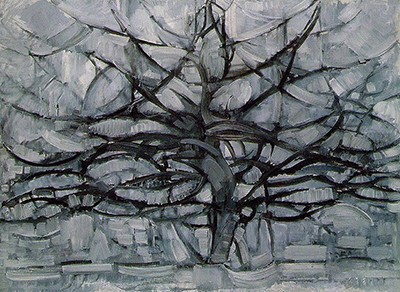
How do the repeated piers differ from the spreading branches in Mondrian’s tree works?
Join the Conversation
Share what you notice in this painting below.
References
- RKD – Netherlands Institute for Art History, Mondrian catalogue raisonné, Zeeland seascapes A697–A700. View source.
- Kröller-Müller Museum, Beach with Three or Four Piers at Domburg, object KM 108.956, medium and dimensions. View source.
- Kunstsammlung Nordrhein-Westfalen, Mondrian — Evolution, 1908–11 chapter on Domburg. View source.
- Kröller-Müller Museum, museum history timeline, early-1990s gifts including Mondrian's beach painting. View source.
- Fondation Beyeler, Mondrian Evolution room guide describing Domburg's breakwaters. View source.
- Lead image credit. Piet Mondrian, Beach with Three or Four Piers at Domburg, 1909. Kröller-Müller Museum, KM 108.956.