by Tom Gurney
Tom Gurney BSc (Hons) is an art history expert with over 20 years experience
Published on June 19, 2020 / Updated on September 28, 2026
Email: tomgurney1@gmail.com / Phone: +44 7429 011000
About the painting
A dark windmill stands against a yellow-brown sky in Piet Mondrian's Broekzijder Mill in the Evening. Its blades cross above a low bank, while broken light runs across the water below. The small wheel at the mill's left and the dark bridge-like line beneath it make this a particular riverside structure, not a generic windmill silhouette. Mondrian painted the scene around 1906, when mills and the landscape along the River Gein near Amsterdam were recurring subjects.[1][4]
RKD catalogues this painting as A401 and lists it in a private collection. A record for RKD's reproduction gives oil on canvas and 35 × 50 cm. Those details identify this specific work, which should not be confused with MoMA's earlier, cropped Truncated View of the Broekzijder Mill or the separate 1905 Broekzijder painting at Museum Kunst der Westküste. The shared mill name can conceal substantial differences in image, date, support and collection.[1][2][3][5]
At a glance
- ArtistPiet Mondrian (Piet Mondriaan, 1872–1944)
- TitleBroekzijder Mill in the Evening
- Datec. 1906, according to RKD
- MediumOil on canvas, according to the RKD-sourced Commons record
- Dimensions35 × 50 cm (height × width), according to that record
- Collection linePrivate collection, as listed by RKD
- Catalogue raisonnéJoosten A401[1][2]
Where this Gein windmill sits in Mondrian's career
Oostzijdse Mill in Moonlight
c. 1907Evening: The Red Tree
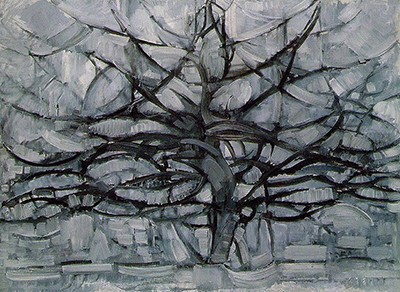
1908–10Gray Tree
1911Contents
- What does the painting show?
- Which mill did Mondrian paint?
- How does light shape the evening view?
- How is this different from the other Broekzijder paintings?
- Where is Broekzijder Mill in the Evening now?
What does the painting show?
The mill is slightly left of centre. Its tower is a heavy, dark shape, and its four blades cut different angles across the luminous sky. One rises steeply toward the upper edge; another descends toward the right. The blades are neither perfectly sharp nor lost in darkness. They remain legible as parts of a working structure while also giving the picture its most dramatic lines.
 The Red Tree Piet Mondrian.jpg)
The sky takes up more than half the composition. Yellow and muted brownish-green colour spread across it in broad horizontal passages. The area behind the blades glows more strongly than the darker clouded sections. Mondrian does not need a sharply defined sun to make the brightness felt. The contrast between sky and mill is enough to turn the building into a powerful silhouette. This is an evening scene by title and atmosphere, though the image does not establish an exact hour or a single weather event.[1]
A low bank and a narrow crossing run beneath the mill. Near its left side is a small wheel-like feature, faint but visible in the light. These details help ground the silhouette in a place. They also keep the picture from being only a study of a dark shape against bright colour. The mill sits in a wider landscape whose low edge nearly divides the illuminated sky from the water.
Below that line, the river is dark and reflective. Short yellow and pale strokes appear on its surface, broken by longer dark bands. The reflection does not become a mirror copy of the whole mill. Instead, Mondrian uses scattered light to keep the lower portion alive. The viewer's eye can move down from the brightly lit sky, through the mill's mass, and into the rippling foreground. That vertical movement answers the painting's broad horizontal spread.
The picture is compact, yet its arrangement feels expansive. The sky opens around the blades; the low bank stretches sideways; the water gives another band below. Mondrian's visible marks prevent any one area from becoming a smooth backdrop. The painting is an observed landscape, and its construction through contrasts of light, dark, horizontal and diagonal movement is clear on close inspection.
Which mill did Mondrian paint?
The Broekzijder mill stood by the River Gein near Amsterdam. Mondrian repeatedly painted mills in and around this landscape in the early 1900s. An essay accompanying a different Broekzijder painting at Christie's identifies the Gein setting and notes Mondrian's interest in horizontal compositions. That essay is useful context for the motif, but its lot is not A401 and its object details must not be transferred to this painting.[4]
RKD's catalogue makes the distinction visible. It places A401, Broekzijder mill in the evening, among Gein landscapes and then lists many Oostzijdse mill views from A402 onward. The Oostzijdse mill is a different structure in Mondrian's work, despite the similar sound of the names and the fact that both appear in Gein-area paintings. The familiar title Oostzijdse Mill in the Evening belongs to a separate Kunstmuseum Den Haag work, not to this silhouetted Broekzijder A401.[1][6]
Even within the Broekzijder group, Mondrian changed viewpoint and framing. MoMA's Truncated View of the Broekzijder Mill on the Gein, Wings Facing West is dated c. 1902–03 or earlier and records a more tightly cropped, different painting. Museum Kunst der Westküste identifies another Broekzijder Mill on the Gein as a 1905 work. The repeated building made several paintings possible; the dark evening sky and reflected water distinguish the A401 image shown here.[3][5]
Watch: Piet Mondrian
See his studio, the move toward geometric abstraction and the rhythms of his New York paintings.
Piet Mondrian: Abstract Painting as We Know It
Curator Michael White explores the paintings and Mondrian’s studio as an abstract space.
Watch on YouTubeHow does light shape the evening view?
The strongest light is behind and beside the mill. That placement lets Mondrian describe its outline without filling its tower with architectural detail. The blades become a set of dark accents across warm colour. The sky's irregular yellow and brown tones create a sense of changing illumination. It is easy to imagine a setting sun beyond the picture, but the painting's visible evidence is the glow itself, not a depicted solar disk.
Light also reappears in the water as short separate marks. They pull a trace of the sky into the foreground without making the reflection literal. Between the two bright zones lies the bank, mill and crossing, all much darker. This band anchors the image. If it were removed, the painting would become a study of sky and water; with it, the view remains the mill on the Gein.
The blade diagonals interrupt the sky's mostly horizontal handling. The tower then brings the eye down to the dark bank. These directions are important to the experience of the work, but they are not proof that Mondrian had already conceived the strict geometric language of his later abstract compositions. Christie's account of a related mill picture likewise cautions against reading the mature style straight back into these early landscapes. Here, the lines arise from a real structure and its setting.[4]
Colour and form work together. The subdued palette makes the yellow light more conspicuous, while the almost black mill provides a firm shape that can hold the eye against the broad sky. Mondrian does not depend on fine detail to make the place recognizable. He chooses a few strong relationships and allows the brushwork in sky and water to remain visible.
How is this different from the other Broekzijder paintings?
MoMA's earlier A341 Truncated View of the Broekzijder Mill on the Gein, Wings Facing West is in its collection as object 243.1950. The museum dates it c. 1902–03 or earlier and calls its medium oil on canvas mounted on cardboard, measuring 30.2 × 38.1 cm. These numbers and that support refer to MoMA's cropped picture. They do not describe A401, whose RKD-sourced record gives a different size and oil on canvas.[3][2]
Museum Kunst der Westküste's 1905 The Broekzijder Mill on the Gein is another separate painting. Its museum record gives oil on canvas mounted on wooden panel, 34.5 × 46.5 cm, inventory 1 MON 01. That museum acquired its work in 2011. None of those particulars makes the museum the holder of A401. Comparing these records shows how a common subject can lead to confusion when the catalogue number and actual image are ignored.[5]
The A401 image can be recognized through the dark full mill against a warm evening sky, a low landscape strip and broken reflections across the foreground water. MoMA's title stresses a truncated view; the other museum's 1905 work has its own record and provenance. For A401, the most dependable identity anchors remain RKD's catalogue number, title and matched reproduction.[1][2]
Where is Broekzijder Mill in the Evening now?
RKD lists private collection for A401. Its public catalogue entry does not identify a museum holding or provide a current display notice. That means a reader should not infer that the painting is on view at MoMA, Museum Kunst der Westküste or Kunstmuseum Den Haag because those institutions hold other Mondrian mill paintings. Their records are useful for comparison, not evidence of A401's present location.[1][3][5]
The painting's own value is clear without a museum address. The mill's dark tower and blades give the bright sky an unmistakable centre, while the water carries that light into the foreground. Mondrian makes an ordinary riverside building hold the scene together through a few strong contrasts. Looking slowly at the small wheel, crossing and reflected strokes reveals how specific the view remains beneath its broad shapes.
Mondrian artworks directory
Frequently asked questions
When was Broekzijder Mill in the Evening painted?
RKD dates A401 to c. 1906.[1]
What are its medium and dimensions?
The Commons object record sourced to RKDimages gives oil on canvas and 35 × 50 cm. These figures are attributed to that record, rather than to a museum's catalogue entry.[2]
Is it MoMA's Broekzijder Mill painting?
Is the Oostzijdse Mill the same building?
Which collection holds A401?
RKD's public A401 line says private collection. It does not give a current public display location.[1]
Discussion
Does the bright sky or dark windmill hold your eye first?
Reader Insights
Follow one mill blade from the sky toward the tower. Where does your eye stop?
Which light marks in the water become clearer after a second look?
How does this evening mill differ from Mondrian’s later tree paintings?
Join the Conversation
Share what you notice in this painting below.
References
- RKD – Netherlands Institute for Art History, Mondrian catalogue raisonné, Gein landscapes A397–A497, including A401. View source.
- Wikimedia Commons, RKD-sourced A401 file record, RKDimages 266556, medium and dimensions. View source.
- The Museum of Modern Art, Truncated View of the Broekzijder Mill on the Gein, Wings Facing West, object 243.1950. View source.
- Christie's, 2006 lot essay for a different Broekzijder mill painting, with Gein and motif context. View source.
- Museum Kunst der Westküste, The Broekzijder Mill on the Gein, 1905, inventory 1 MON 01. View source.
- Kunstmuseum Den Haag, Oostzijdse Mill in the Evening, separate Oostzijdse subject. View source.
- Lead image credit. Piet Mondrian, Broekzijder Mill in the Evening, c. 1906, RKD A401; RKD lists a private collection.