by Tom Gurney
Tom Gurney BSc (Hons) is an art history expert with over 20 years experience
Published on June 19, 2020 / Updated on September 28, 2026
Email: tomgurney1@gmail.com / Phone: +44 7429 011000
About the painting
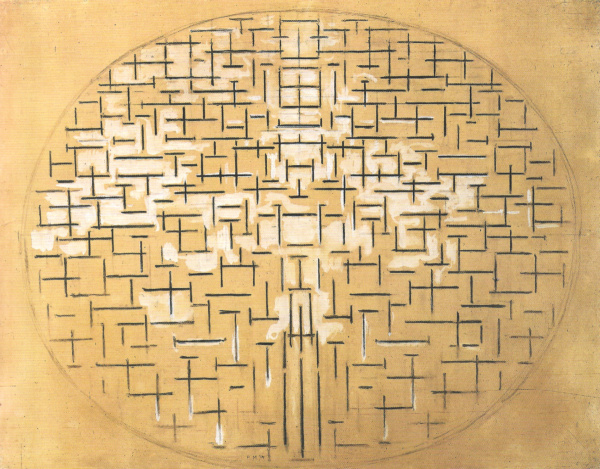
In Composition in Oval with Color Planes 1, Piet Mondrian gathers short black horizontals and verticals with pale blue, pink, yellow and ochre areas inside a tall oval. The surrounding grey field makes that boundary unusually clear: the coloured structure is concentrated within it, but some marks press close to the edge. The Museum of Modern Art dates the painting to 1914, identifies it as oil on canvas, and gives its size as 107.6 × 78.8 cm. It entered MoMA in 1950 as object 14.1950; RKD catalogues it as B53. The image on this page matches MoMA's reproduction of that work.[1][2][3]
At a glance
The 1914 oval composition among Mondrian's early abstractions
Contents
- What does the oval contain?
- What was its connection to demolished Paris buildings?
- Why combine a curved boundary with straight lines?
- Is the date 1914 or 1919?
- How did the painting reach MoMA?
- Is it the same painting as Composition in Oval with Color Planes 2?
What does the oval contain?
The work is portrait-shaped. A thin, dark outline describes an oval that rises almost to the canvas's top and narrows toward the bottom. Inside it, straight marks build a dense network, but they do not form a uniform grid. Some black strokes extend only a short distance; others cross several coloured or pale areas. A vertical may meet a horizontal decisively, stop just short of it, or resume after a gap. The eye can follow these partial routes without finding a single central point or an obvious top-to-bottom reading order.
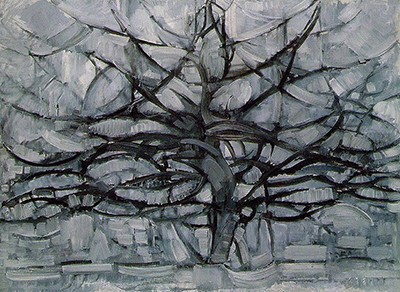
 The Red Tree Piet Mondrian.jpg)
The upper part contains a cluster of blue and pink fields among thin black divisions. Near the centre, a pale area is cut by stronger horizontal bars, while smaller yellow and ochre patches punctuate its edges. Lower down, blue and pink return in vertical and horizontal rectangles. Several colours reach toward the curved boundary, where they are cropped or softened by the surrounding grey. The palette is much more subdued than the brilliant primary-colour fields of Mondrian's later compositions. This is a visual observation from the image, not a claim about the original pigments or their present condition.
The outer grey matters as much as the coloured interior. It separates the oval from the corners of the rectangular support and makes the network appear gathered into one bounded image. Within the oval, the pale ground is not simply empty; it gives the dark strokes and coloured planes different amounts of breathing room. The small blue and pink fields can seem to advance, while grey and cream areas settle behind them. Those effects are easiest to see by moving between the centre and the narrow zones at the curved edge.
An oval is a striking container for Mondrian's straight lines. The boundary does not repeat the geometry inside it. Instead, the curve limits a set of horizontal and vertical relationships that might otherwise appear to continue indefinitely. It is tempting to call the interior a finished architectural plan, but the stops, overlaps and unequal spacing resist such a literal reading. The painting takes cues from an observed city and reorganises them on a flat surface.[1]
What was its connection to demolished Paris buildings?
MoMA's gallery text states that the composition's geometry is directly based on sketches of partially demolished buildings Mondrian saw in Paris. Exposed floors, chimneys and patches of wallpaper made their internal divisions visible. Mondrian arrived in Paris from the Netherlands in 1912, and MoMA places this painting two years into that first Paris period. These facts provide a concrete source for its intersecting bars and panels, rather than leaving the painting as a purely imagined pattern.[1]
RKD identifies a separate Side façade: study for composition in oval with color planes 1, B52, as a work on which this B53 painting is based. The related study strengthens the architectural connection, but it is a different object and should not inherit MoMA's size or collection details. The relationship also does not mean that every visible blue or pink rectangle in the finished canvas can be labelled as a particular chimney, floor or scrap of wallpaper. The museum names the type of observed scene; the painting transforms its fragments into a new arrangement.[2][4]
The balance between observation and abstraction is part of what makes the canvas compelling. A viewer may read a black vertical as the edge of a wall, then see it as a line that organises several unrelated coloured fields. A short horizontal can suggest an exposed floor without having to depict an actual building at a known address. MoMA also connects Mondrian's horizontal and vertical lines to his belief in an underlying order. That interpretive statement is attributable to the museum; it should not be turned into a claim that the picture contains a fixed code or an exact mathematical diagram.[1]
Why combine a curved boundary with straight lines?
The oval encloses a complex field that could otherwise spill across the rectangular canvas. It gives a single silhouette to many small divisions. Against the grey outside, the interior seems lighter and busier. The inner verticals and horizontals cut across one another at different distances, and the curved edge prevents most of them from becoming long, uninterrupted rules. Their lengths depend partly on where they meet the oval.
This contrast also changes how the colours register. A pale blue patch near the top is not equivalent to one at the bottom, even if the hues look similar in reproduction: one is surrounded by a tight scaffold of lines, while the other meets larger white and grey intervals. Pink appears in both narrow columns and wider blocks. Ochre and yellow are smaller accents that make the blues and pinks feel less uniform. The effect is neither a strict checkerboard nor a collection of free-floating rectangles like Composition in Colour A of 1917. In B53, the curved boundary and the dense internal structure hold the colours together.
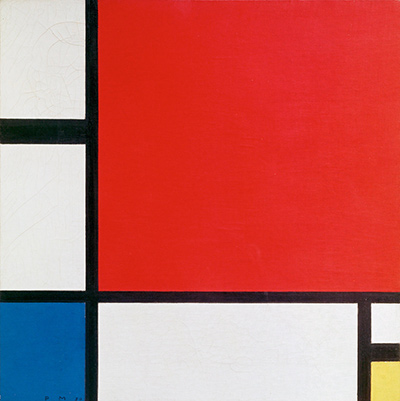
Mondrian's later work is often introduced through continuous black grids and strong primary colours. This painting demonstrates that his path to those forms involved other solutions. An oval, muted colour, irregular spacing and suggestions of built space coexist here. The artwork can be understood as a complete 1914 painting in its own right, without treating every difference from a 1930 canvas as a deficiency.
Watch: Piet Mondrian
See his studio, the move toward geometric abstraction and the rhythms of his New York paintings.
Piet Mondrian: Abstract Painting as We Know It
Curator Michael White explores the paintings and Mondrian’s studio as an abstract space.
Watch on YouTubeIs the date 1914 or 1919?
MoMA and RKD date the painting to 1914. RKD also records the word “MONDRIAN” signed within the oval at lower left and notes the 1998 catalogue raisonné's view that the artist signed it in July 1919. A later signature date does not change the painting's accepted creation date. The record supports saying that the work was made in 1914 and signed later, with the signature timing attributed to the catalogue rather than inferred from the image alone.[1][2]
Titles have also varied. RKD's exhibition and literature entries include Color Planes in Oval, Color Squares in Oval and other translated descriptions, sometimes with uncertain historical dates. The present MoMA title and RKD catalogue number identify the painting clearly. Those historical variants help explain why older books and show catalogues may discuss the same canvas under a different name; they are not evidence that its object identity or accepted date has changed.[2]
How did the painting reach MoMA?
MoMA's provenance starts with Mondrian, then records Sal Slijper of Blaricum purchasing the painting from him in 1919. Slijper held it until 1949. The Sidney Janis Gallery in New York handled it from 1949 to 1950, and MoMA purchased it from the gallery in 1950 with the Stephen C. Clark Fund. RKD lists the same broad sequence and links the painting to MoMA object 14.1950.[1][2]
The painting had a public history before MoMA acquired it. RKD lists a 1920 Brighton exhibition of modern Dutch art in which the painting was lent by Slijper. It later appeared in Mondrian exhibitions and in MoMA's 1995–96 retrospective. Such records document where it was shown at specific times; they should not be taken as a statement that it is permanently displayed in New York. MoMA currently marks Composition in Oval with Color Planes 1 as not on view.[2][1]
Is it the same painting as Composition in Oval with Color Planes 2?
No. The neighbouring Composition in Oval with Color Planes 2 is also dated 1914, but belongs to Kunstmuseum Den Haag, where it is object 0334318. Its museum gives 113 × 84.5 cm; RKD catalogues it as B55. The Hague painting has a related façade study, B54. By contrast, this New York painting is B53, 107.6 × 78.8 cm, and linked by RKD to B52. The numbered titles refer to separate canvases and separate studies.[3][5]
Kunstmuseum Den Haag likewise discusses exposed Paris façades in relation to its second oval composition. That shared subject makes comparison worthwhile, but it is also a reason to keep collection facts precise. MoMA's provenance and display status belong to B53; the Kunstmuseum's dimensions, bequest and interpretive details for B55 belong to the other painting.[1][5]
Mondrian artworks directory
Frequently asked questions
When did Mondrian make Composition in Oval with Color Planes 1?
What is its material and size?
Where is the original painting?
It belongs to the Museum of Modern Art, New York, as object 14.1950. MoMA currently labels it not on view.[1]
What inspired its lines and colour planes?
How is it different from Composition in Oval with Color Planes 2?
Discussion
Does the curved oval edge or the dense straight-lined centre first hold your attention?
Reader Insights
Follow one black vertical through the oval. Where does it end or change direction?
Which pale area best separates the blue and pink planes?
How does this dense oval differ from the floating colour fields in Composition in Colour A?
Join the Conversation
Share what you notice in this painting below.
References
- Museum of Modern Art, Composition in Oval with Color Planes 1, collection record 14.1950, including 2012 gallery text, object facts, provenance and display status. View source.
- RKD – Netherlands Institute for Art History, Composition in oval with color planes 1, object record 271081, including date, signature, artistic relation, provenance and exhibitions. View source.
- RKD, Mondrian catalogue raisonné, Paris 1912–14, B52–B55 and adjacent works. View source.
- RKD, Side façade: study for composition in oval with color planes 1, B52 object record. View source.
- Kunstmuseum Den Haag, Composition in Oval with Color Planes 2, collection record 0334318. View source.
- Lead image credit. Piet Mondrian, Composition in Oval with Color Planes 1, 1914, oil on canvas, 107.6 × 78.8 cm, RKD B53; MoMA 14.1950.