 by Tom Gurney
Tom Gurney BSc (Hons) is an art history expert with over 20 years experience
Published on June 19, 2020 / Updated on September 28, 2026
Email: tomgurney1@gmail.com / Phone: +44 7429 011000
About the painting
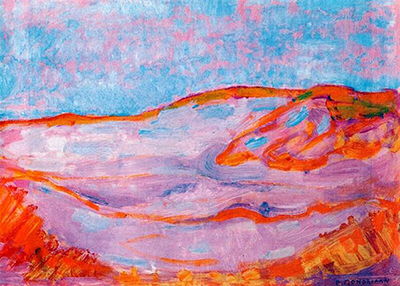
Piet Mondrian's Dune IV is a small, intensely coloured study of the Zeeland dunes. Orange and red strokes trace the sandbanks around a pink and violet hollow, while the sky is blue with broken pink marks. Its colours are deliberately more forceful than a literal record of sand and light. Kunstmuseum Den Haag dates the work to 1909 and records it as oil on cardboard, 33 × 46 cm, object 0334302, from the Salomon B. Slijper bequest. The RKD catalogue calls the same object Dune sketch in orange, pink and blue, number A707. Both names refer to the painting pictured on this page.[1][2][3]
At a glance
- ArtistPiet Mondrian (Piet Mondriaan, 1872–1944)
- TitleDune IV (Duin IV); also catalogued as Dune Sketch in Orange, Pink and Blue
- Date1909
- MediumOil on cardboard
- Dimensions33 cm high × 46 cm wide
- CollectionKunstmuseum Den Haag, The Hague; Salomon B. Slijper bequest
- Museum object number0334302
- Catalogue numberRKD A707[1][2][3]
Dune IV among Mondrian's Zeeland landscapes
Dune IV (A707)
1909Contents
- What does Dune IV show?
- Why are its colours so vivid?
- Is Dune IV the same as the larger Dune Landscape?
- What do the museum and catalogue records establish?
What does Dune IV show?
The image opens onto a low, open stretch of dunes. A ridge runs along the middle distance from the left edge toward the right. The right-hand rise is marked by a cluster of orange, scarlet and purple strokes; the left foreground has a similarly warm bank. Between them is a broad pale area, painted with pink, lilac and blue. The land is recognisable, but it does not have the measured contours of a survey. Mondrian makes the slopes from quick changes in direction and colour.
 The Red Tree Piet Mondrian.jpg)
The upper half is an expanse of saturated blue. Small pink and blue marks interrupt it, suggesting an unsettled light rather than one smoothly blended atmosphere. At the horizon a thin warm strip separates sky from dunes. The eye moves between this nearly level line and the diagonal strokes that describe the foreground. The landscape therefore has two rhythms: a long, quiet horizontal and short, insistent marks across the sand.
Look particularly at the dune on the right. Warm orange and red strokes define its crest, but blue and purple patches cross through them. In the foreground, the same cool colours appear between warm marks. Mondrian does not confine a single colour to a single object. He makes the colours interact across the whole surface, so that a blue mark in the sand answers the blue sky and a red edge at the horizon answers the foreground.
The word “sketch” in RKD's title need not make the work seem unfinished or unimportant. At 33 × 46 cm, the cardboard support is modest, and the paint is visibly direct. Yet the image has a clear structure: two enclosing banks, an open centre, a low ridge and a broad sky. The study format lets Mondrian test how far strong colour and abbreviated strokes can carry a coastal subject.[1][2]
Why are its colours so vivid?
Mondrian was repeatedly in Domburg, on the Zeeland coast, from 1908. Kunstsammlung Nordrhein-Westfalen describes his fascination with its light and the subjects he returned to: dunes, sea, church tower and lighthouse. It places Dune IV among his 1909 coastal paintings and notes the influence of post-Impressionist and Fauvist approaches: parallel brushstrokes and colours that depart from natural appearances. Those points provide historical context for the vivid pink, blue and orange seen here.[3]
Kunstmuseum Den Haag's account of the Zeeland period says Jan Toorop drew Mondrian's attention to Domburg and that the artistic circle there pursued new ways to portray light. The sea coast offered changeable skies and pale sand, which could be translated into several contrasting colour relationships. In Dune IV, the blue upper field makes the warm ridge seem brighter. Pink in the sky reappears in the hollow below, tying the two large halves together.[4]
It would be too simple to call the painting a realistic view with unusual colours laid over it. The brushstrokes also reshape what we see. A dune crest that might have been smoothly modelled becomes a sequence of sharp colour accents. The sand hollow is not a carefully shaded recess; it is a shifting patchwork that holds the space open. The painting asks viewers to sense light and terrain through rhythm as much as through descriptive detail.
These choices belong to Mondrian's early experiment with landscape. They are distinct from the later black lines and rectangular primary-colour fields for which he is famous. The 1909 picture still depends on the particular experience of dunes and sky, even as its colour and marks move away from conventional naturalism.
Watch: Piet Mondrian
See his studio, the move toward geometric abstraction and the rhythms of his New York paintings.
Piet Mondrian: Abstract Painting as We Know It
Curator Michael White explores the paintings and Mondrian’s studio as an abstract space.
Watch on YouTubeIs Dune IV the same as the larger Dune Landscape?
No. The site's Duinlandschap (Dune Landscape) is a 1911 oil on canvas, 141 × 239 cm, museum object 0334307, RKD B1. Dune IV is this 1909 oil on cardboard, 33 × 46 cm, museum object 0334302, RKD A707. The broad B1 canvas and small A707 study share a coastal subject and a Slijper bequest credit, but their dates, materials, sizes and images establish two separate works.[1][2][5]
RKD's Zeeland sequence includes still more distinct dune paintings. Dune Sketch in Bright Stripes A701 is also dated 1909 and has its own page. Nearby entries include pointillist dune studies and Dunes near Domburg. Titles can look interchangeable when translated or shortened, so the museum number and RKD catalogue number are especially useful. The exact match for the present image is 0334302 / A707.[2]
The comparison helps explain why Mondrian returned to the dunes. A small study such as Dune IV can pursue one set of colour tensions very directly. The later, much wider Dune Landscape spreads banks, sky and distant sea across a monumental format. Seeing both makes variation in scale and composition concrete rather than treating every dune picture as one step in a single, inevitable march to abstraction.
What do the museum and catalogue records establish?
The museum's Dune IV record is the firm basis for its title, 1909 date, oil on cardboard medium, 33 × 46 cm size, 0334302 object number and Salomon B. Slijper bequest. RKD's title Dune sketch in orange, pink and blue is another catalogue name for object 0334302, not a separate painting. Kunstsammlung Nordrhein-Westfalen explicitly joins the two names as Dune IV [Dune Sketch in Orange, Pink, and Blue] and gives the same date, size, material and Hague collection.[1][2][3]
The museum record confirms collection ownership, not where the picture hangs on any given day. It also does not identify a precise dune, time of day or weather event. Describing the marks on the pictured surface is useful close looking; assigning each mark to a named coastal location would exceed the published object evidence. The work is best understood here as one documented member of Mondrian's 1909 Domburg group.
Mondrian artworks directory
Frequently asked questions
When was Dune IV painted?
Where is the original painting?
It is in the Kunstmuseum Den Haag collection as object 0334302, credited to the Salomon B. Slijper bequest. Check with the museum for current display information.[1]
What is Dune IV painted on?
It is oil on cardboard, measuring 33 cm high by 46 cm wide.[1]
What does A707 mean?
A707 is the work's entry in RKD's Mondrian catalogue. RKD lists it as Dune sketch in orange, pink and blue and links it to the museum's 0334302 object number.[2]
Is Dune IV an abstract painting?
The dunes and sky remain recognisable. Its intense colour and abbreviated parallel marks move away from literal description, making it an experimental landscape of Mondrian's Zeeland period.[3]
Discussion
Which warm dune bank first catches your eye?
Reader Insights
Follow the low ridge from left to right. Where does your eye stop?
Which blue mark in the sand most strongly answers the sky?
How does this small A707 study differ from the large 1911 B1 canvas?
Join the Conversation
Share what you notice in this painting below.
References
- Kunstmuseum Den Haag, collection record for Dune IV, 1909, oil on cardboard, 33 × 46 cm, object 0334302, Salomon B. Slijper bequest. View source.
- RKD – Netherlands Institute for Art History, digital Mondrian catalogue, Zeeland coastal sequence, Dune sketch in orange, pink and blue A707, object 0334302, and adjacent distinct dune works. View source.
- Kunstsammlung Nordrhein-Westfalen, Dunes, the Sea, and Towers, identifying Dune IV [Dune Sketch in Orange, Pink, and Blue] and explaining Mondrian's Domburg colour and brushwork. View source.
- Kunstmuseum Den Haag, The Light of Zeeland, on Mondrian and the Domburg artistic circle. View source.
- Kunstmuseum Den Haag, separate collection record for Dune Landscape, 1911, oil on canvas, 141 × 239 cm, object 0334307. View source.
- Lead image credit. Piet Mondrian, Dune IV (Duin IV), 1909, oil on cardboard, 33 × 46 cm, RKD A707; Kunstmuseum Den Haag 0334302, Salomon B. Slijper bequest.