by Tom Gurney
Tom Gurney BSc (Hons) is an art history expert with over 20 years experience
Published on June 19, 2020 / Updated on September 28, 2026
Email: tomgurney1@gmail.com / Phone: +44 7429 011000
About the painting
Five dark trees stand between an amber sky and their wavering reflections in Piet Mondrian's Five Tree Silhouettes along the Gein with Moon. A small pale moon hangs low between the trunks. The painting's narrow bank divides an orderly row above from broken shapes in the water below. It is also known by the museum title Trees on the Gein: Moonrise (Bomen aan het Gein: opkomende maan). Kunstmuseum Den Haag dates the oil-on-canvas work to 1907–08, measures it at 79 × 92.5 cm, and records it as object 0333253. The RKD catalogue gives it number A660. The existing image on this page shows that five-tree, moonrise composition.[1][2][3]
At a glance
- ArtistPiet Mondrian (Piet Mondriaan, 1872–1944)
- TitlesFive Tree Silhouettes along the Gein with Moon (RKD); Trees on the Gein: Moonrise (Kunstmuseum Den Haag)
- Date1907–08
- MediumOil on canvas
- Dimensions79 cm high × 92.5 cm wide
- CollectionKunstmuseum Den Haag, The Hague
- Museum object number0333253
- Catalogue numberRKD A660[1][2]
Moonrise in Mondrian's early landscape sequence
Oostzijdse Mill by Moonlight
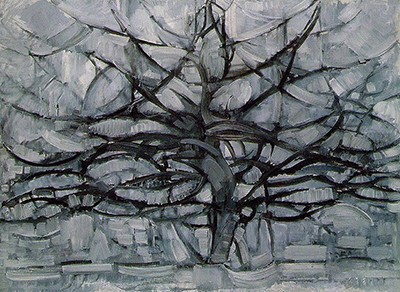
c. 1903Five Tree Silhouettes (A660)
1907–08Gray Tree (B4)
1911Contents
- What does the painting show?
- Why the Gein, moon and reflections?
- How does the related drawing differ?
- How does A660 fit among Mondrian's other tree landscapes?
What does the painting show?
Five main tree forms rise from the far bank. Their trunks are thin and dark, but their crowns are irregular masses of leaf and branch. The first tree at left spreads low and wide; the second is taller and more upright; the middle group thickens into an almost continuous shape; the right tree opens again into separate lobes. Looking across the row, the eye moves through alternating density and space rather than seeing five identical silhouettes.
The small moon glows near the centre, low in the warm sky and partly enclosed by the trees. Around it, ochre, brown, gold and dark green tones blend into a red-brown atmosphere. The moon is not the brightest possible white disc; it is a restrained accent. That restraint helps the eye stay with the tree forms and with the surface of the water. The light seems to emerge from within the painting's muted colours rather than flood the landscape from outside.
A narrow, almost level strip marks the far bank. It supplies a firm horizontal against the vertical trunks. Below it, the trees reappear as fractured dark marks in the foreground water. The reflected forms are shorter, displaced and broken by horizontal strokes. A trunk that is easy to follow above the bank may dissolve into several pieces below. The image thus repeats its motif without making a perfectly symmetrical mirror.
The foreground occupies a substantial portion of the canvas. Its dark red-brown and green paint keeps the eye close to the surface, while the reflections open a second, uncertain depth. Kunstsammlung Nordrhein-Westfalen notes that Mondrian often painted the small Gein river near Amsterdam and moved the horizon high in some works, leaving room to explore the relation of motif, painted surface and space. This painting makes that concern visible: the trees form a row, but their doubled shapes give the lower part an active life of its own.[3]
The original is 79 × 92.5 cm. That scale is large enough for the five silhouettes and their reflections to register as a sustained arrangement rather than a quick notation. The published online image can show the design, though the subtle differences among warm dark colours are likely easier to see in front of the canvas.[1]
Why the Gein, moon and reflections?
The Gein is a small river near Amsterdam. Mondrian returned to its flat banks, trees, buildings and water in many early landscapes. A river scene let him divide the picture into visible land and a second image in reflection. That doubling creates a natural way to compare vertical trunks with horizontal ripples, still shapes with moving ones, and firm outlines with dissolved marks.[3]
Kunstmuseum Den Haag's account places the painting among Mondrian's evening and night landscapes after 1906. It describes his interest in weak contrasts and low light, as well as the quiet, contemplative effect of the scene. The museum calls attention to the red-brown result of combining golden yellow, green, brown and black. Those observations fit the image's subdued range: even the moon is absorbed into the surrounding colour instead of being isolated by stark contrast.[1]
The title “Moonrise” is useful because it tells us to look at the low moon, but the picture does not depend on a precise clock time. Its mood comes from relations among dark trees, warm sky, narrow bank and unstable reflections. An exact date, tree species or named position on the river is not established in the public museum record. The subject is specific enough to be a Gein landscape without turning the picture into a topographical survey.
The painting also sits before Mondrian's later non-representational compositions. It is possible to notice emphatic verticals and horizontals here, but the branches remain organic and the reflected forms irregular. The balance of directions emerges from river and trees. Reading the early work on its own terms is more helpful than claiming the moon or every trunk secretly predicts a later grid.
Watch: Piet Mondrian
See his studio, the move toward geometric abstraction and the rhythms of his New York paintings.
Piet Mondrian: Abstract Painting as We Know It
Curator Michael White explores the paintings and Mondrian’s studio as an abstract space.
Watch on YouTubeHow does the related drawing differ?
RKD places A659, Study for Five Trees along the Gein with Moon, immediately before the painting A660. The drawing is at Kunstmuseum Den Haag as object 0320943; the painting is 0333253. They share a motif, yet the catalogue assigns separate entries and museum numbers. The page's image is the oil painting, not the drawing.[2]
Kunstmuseum Den Haag describes a charcoal version of the scene. In its account, the drawing gives greater emphasis to the play of lines, whereas the painting pursues light, colour and atmosphere. The museum also says Mondrian regarded the charcoal work as an independent picture rather than merely a subordinate preparatory step. RKD's word “study” in A659 is a catalogue title; it should not erase that museum interpretation.[1][2]
This comparison sharpens what the painting accomplishes. The silhouettes could be described almost entirely through contour, but Mondrian lets gold and reddish-brown colour permeate them. The narrow bank remains a line, while the reflections soften into patches. Colour and low light alter the same five-tree structure that a charcoal medium might make more linear.
How does A660 fit among Mondrian's other tree landscapes?
RKD's neighbouring entries include A658, Row of Eleven Poplars in Red, Yellow, Blue and Green of 1908, and A661, Single Tree Silhouette, circa 1908. These are separate works with different tree counts and compositions. The nearby entries show that Mondrian was repeatedly testing trees as a motif, sometimes as a group and sometimes as an individual form. The five-tree moonrise belongs to that investigation, but its low moon and water reflections give it its own subject and structure.[2]
Kunstsammlung Nordrhein-Westfalen identifies this painting as Trees on the Gein: Moonrise [Five Tree Silhouettes along the Gein with Moon] and gives the same 1907–08 date, 79 × 92.5 cm size and Hague collection. That explicit pairing confirms that the two English titles name one object. It also connects the painting to Mondrian's broader Gein scenes and his interest in river reflections.[3]
The museum object number is especially helpful where titles vary. 0333253 / A660 identifies the oil canvas shown here. 0320943 / A659 identifies the related drawing. Keeping those records separate gives readers a reliable path through the artist's early tree work without confusing paintings, drawings or later abstract tree compositions.
Mondrian artworks directory
Frequently asked questions
When did Mondrian paint Five Tree Silhouettes along the Gein with Moon?
Where is the original painting?
It belongs to Kunstmuseum Den Haag, object 0333253. The collection record does not establish whether it is currently on public display.[1]
How large is it, and what is it made of?
The original is oil on canvas, 79 cm high by 92.5 cm wide.[1]
Is Trees on the Gein: Moonrise a different painting?
Is the charcoal study shown here?
No. The related A659 drawing is museum object 0320943. This page shows the A660 oil painting, object 0333253.[2]
Discussion
Which tree silhouette first holds your eye against the warm sky?
Reader Insights
Follow one trunk down to its reflection. Where does its form break?
Which dark reflection most strongly changes the scene above it?
How might the A659 charcoal drawing differ from this coloured A660 painting?
Join the Conversation
Share what you notice in this painting below.
References
- Kunstmuseum Den Haag, collection record for Trees on the Gein: Moonrise, 1907–08, oil on canvas, 79 × 92.5 cm, object 0333253, with account of its colour, low light and related charcoal work. View source.
- RKD – Netherlands Institute for Art History, digital Mondrian catalogue, Amsterdam landscapes A648–A673, listing A659 drawing (0320943) and A660 painting (0333253) as distinct works. View source.
- Kunstsammlung Nordrhein-Westfalen, The Hague School in Mondrian Evolution, identifying Trees on the Gein: Moonrise [Five Tree Silhouettes along the Gein with Moon] and discussing Gein reflections. View source.
- Lead image credit. Piet Mondrian, Five Tree Silhouettes along the Gein with Moon, 1907–08, oil on canvas, 79 × 92.5 cm, RKD A660; Kunstmuseum Den Haag 0333253.
 The Red Tree Piet Mondrian.jpg)