 by Tom Gurney
Tom Gurney BSc (Hons) is an art history expert with over 20 years experience
Published on June 19, 2020 / Updated on September 28, 2026
Email: tomgurney1@gmail.com / Phone: +44 7429 011000
About the painting
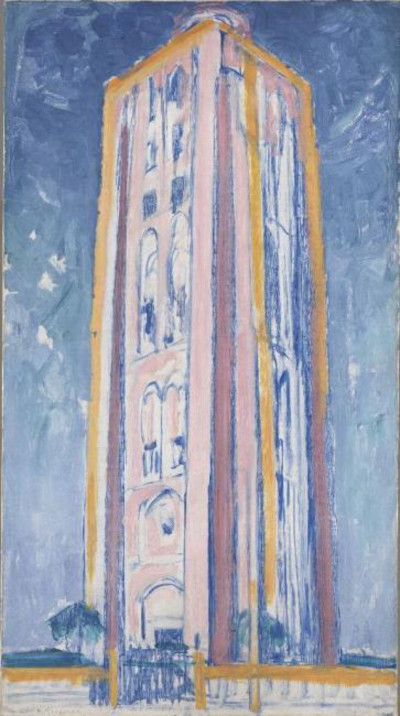
A tall, pale lighthouse stands against a deep blue sky in Piet Mondrian's Lighthouse at Westkapelle in Orange, Pink, Purple and Blue. Orange edges and long pink, purple and blue strokes bring the tower forward while making its masonry shimmer. This image is A687 in RKD's catalogue, connected to Kunstmuseum Den Haag object 0334301. The museum dates it 1910, lists oil on canvas, and gives its imposing size as 135 × 75 cm. RKD uses the colour-qualified title and the cautious date circa 1910. These identifiers separate this large canvas from several smaller paintings of the same tower.[1][2]
At a glance
- ArtistPiet Mondrian (Piet Mondriaan, 1872–1944)
- Catalogue titleLighthouse at Westkapelle in Orange, Pink, Purple and Blue
- Catalogue numberRKD / Welsh A687
- Museum titleLighthouse at Westkapelle
- Museum object numberKunstmuseum Den Haag 0334301
- Datecirca 1910 in RKD; 1910 in the museum record
- MediumOil on canvas
- Dimensions135 cm high × 75 cm wide
- Collection creditKunstmuseum Den Haag, bequest of Salomon B. Slijper[1][2]
The Westkapelle lighthouse sequence
With Clouds (A682)
1908–09In Brown (A683)
1909In Pink (A684)
1909Multicolour (A687)
c. 1910Contents
- What does the painting show?
- Why this Westkapelle tower?
- How does A687 compare with the other lighthouse works?
What does the painting show?
The tower occupies nearly the entire height of the long canvas. It rises from a narrow strip of land at the bottom and reaches the upper edge, leaving blue sky on either side. Mondrian's viewpoint is low and close. The facade narrows toward the top, enhancing the sense of height. Its central corner divides two visible faces, each marked by long window openings and architectural bands.
 The Red Tree Piet Mondrian.jpg)
The tower is not painted as one solid brown mass. A warm orange outline traces parts of its silhouette. Pale pink and lilac spread across the front, interrupted by blue and purple vertical strokes. The sky ranges from dark blue near the upper corners to paler blue lower down. Small scattered light marks cross it. These colours make the structure readable but also prevent the eye from treating it as an exact architectural diagram.
At the base, thin horizontal bands of yellow, blue and pale tones indicate ground and nearby low forms. They give the large vertical body a visible point of contact. Above them, repeated upright strokes lead the eye from base to crown. The painting's extreme vertical format is central to its effect: 135 cm high, it is three times the height of the smaller 45 cm brown A683 canvas. That contrast is an object-level fact, not merely a difference between online reproductions.[2][3]
The picture combines recognizable architecture with energetic colour. Doors and window openings remain visible, yet their lines are interrupted and partly absorbed by strokes of blue, pink and purple. We can describe that tension without assigning an exact time of day, claiming a particular lighting condition, or treating each colour as a fixed symbol. The reproduced painting supports visual observation; the cited catalogue sources do not record a specific sky or weather event.
Why this Westkapelle tower?
The structure was a lighthouse when Mondrian painted it, but the Mondrian Route, developed with Kunstmuseum Den Haag and RKD, explains that it had first been built as a late fifteenth-century church tower. That earlier purpose helps account for its tall masonry walls and repeated arched details. It was an unusually strong architectural subject for Mondrian's close, upward view.[4]
Mondrian returned to the Westkapelle lighthouse between 1908 and 1910. The Mondrian Route counts five paintings and a drawing, and describes the different ways he handled the same form: short dabs in one work, longer sketchy strokes in another, and combinations of vertical and short marks elsewhere. Repetition let him change colour, surface and scale while keeping a familiar tower. The route also notes that Mondrian sometimes continued Zeeland paintings after returning to Amsterdam, but it does not prove exactly where or when A687 was completed.[4]
Kunstmuseum Den Haag's By the Sea account places Mondrian's Zeeland visits alongside those of Jan Toorop and Jacoba van Heemskerck. The coastal setting supplied dunes, sea views, church towers and lighthouses. Those surroundings are useful context for the work; the painting itself sets aside most of the wider landscape to concentrate on one vertical structure. Its subject remains specific even as colour and long strokes take on a force of their own.[5]
Watch: Piet Mondrian
See his studio, the move toward geometric abstraction and the rhythms of his New York paintings.
Piet Mondrian: Abstract Painting as We Know It
Curator Michael White explores the paintings and Mondrian’s studio as an abstract space.
Watch on YouTubeHow does A687 compare with the other lighthouse works?
RKD's sequence contains several separate Westkapelle objects. A682, Lighthouse at Westkapelle with Clouds, is tied to museum 0334285. A683, in Brown, is 0334300. A684, in Pink, is 0334295. A686 is a drawing. A687 is the large multicolour 0334301 canvas shown here. RKD's list also gives A685, Summer Morning, between the smaller paintings and the drawing; Welsh's catalogue inventory associates that work with an orange Westkapelle lighthouse title. These are catalogue distinctions, not interchangeable alternative titles for one object.[1][6]
The brown A683 page covers an oil-on-canvas 45 × 35.5 cm painting. The pink A684 page covers a 39 × 29.5 cm oil-on-cardboard painting. The clouded A682 page covers a 71 × 52 cm oil canvas. A687 is larger than each and pushes the tower more forcefully into the canvas's tall space. Different reproductions can hide these differences in physical scale; the museum numbers and materials restore them.[1][2][3][7][8]
Fondation Beyeler included A687 and the clouded A682 in its 2022 Mondrian Evolution exhibition list under “Vertical compositions.” The list uses the museum's shorter title and gives the long colour title in brackets for A687. It confirms 1910, oil on canvas, 135 × 75 cm, Kunstmuseum Den Haag and the Slijper bequest. This independent exhibition record strengthens the crosswalk between the colourful site image and the museum's more generic Lighthouse at Westkapelle title.[3]
How has its date and style been discussed in Dutch scholarship?
In Moderne kunst in Nederland 1900–1914, A. B. Loosjes-Terpstra illustrated a Vuurtoren bij Westkapelle measuring 135 × 75 cm—the dimensions of A687—and proposed 1909 for it. Her argument connected the painting to a Westkapelle lighthouse drawing that a contemporary witness associated with Mondrian's 1909 stay in Domburg. This is a historical dating proposal, not a reason to silently replace the current museum's 1910 or RKD's circa 1910. The agreement in dimensions is what makes the older discussion relevant to this particular canvas rather than to every lighthouse picture.[9][10]
Loosjes-Terpstra also singled out this large version's compressed depth: the bright pink, purple, yellow and white tower presses against a densely painted blue sky, while its heavy buttresses are simplified and verticals strengthen the building's structure. She suggested that Mondrian may have responded to Jan Toorop's 1907 drawing Godsvertrouwen, which also includes the Westkapelle tower. The proposed influence is her interpretation; the visible difference in handling between the two artists, and between A687's long marks and A684's smaller dots, can be examined without treating that interpretation as proven.[9]
Mondrian artworks directory
Frequently asked questions
When did Mondrian paint the multicolour lighthouse?
Where is the original?
It belongs to Kunstmuseum Den Haag and is object 0334301, credited to the Salomon B. Slijper bequest.[2]
How large is it?
Is the brown lighthouse the same painting?
Was the structure originally a church tower?
Yes. The Mondrian Route identifies the lighthouse as a former late fifteenth-century church tower.[4]
Discussion
Which coloured edge of the tower first draws your eye?
Reader Insights
Follow the long vertical strokes up the tower. Where does your eye stop?
How does the deep blue sky change the pale tower?
How does this large A687 canvas differ from the small brown A683?
Join the Conversation
Share what you notice in this painting below.
References
- RKD – Netherlands Institute for Art History, Mondrian digital catalogue, “City scapes (A677–A692),” including A682–A687 and A687's link to museum object 0334301. View source.
- Kunstmuseum Den Haag, collection record, Lighthouse at Westkapelle, object 0334301: 1910, oil on canvas, 135 × 75 cm, Slijper bequest. View source.
- Fondation Beyeler, Mondrian Evolution (2022), list of works, “Vertical compositions,” giving A687's long title in brackets, medium, size, collection and credit. View source.
- Mondrian Route, “Westkapelle lighthouse,” developed with Kunstmuseum Den Haag and RKD; former church tower, series and brushwork. View source.
- Kunstmuseum Den Haag, “By the Sea,” Zeeland exhibition context. View source.
- Robert P. Welsh archive at RKD, catalogue inventory listing A685 Summer Morning with the alternate orange lighthouse title and A687 as the multicolour work. View source.
- Kunstmuseum Den Haag, collection record for brown version, object 0334300, 45 × 35.5 cm oil on canvas. View source.
- Kunstmuseum Den Haag, collection record for pink version, object 0334295, 39 × 29.5 cm oil on cardboard; clouded version object 0334285 is separately recorded in the museum catalogue. View source.
- A. B. Loosjes-Terpstra, Moderne kunst in Nederland 1900–1914, “Het werk,” pp. 77–78, discussing and proposing a 1909 date for the large Vuurtoren bij Westkapelle and describing its formal treatment. View source.
- A. B. Loosjes-Terpstra, Moderne kunst in Nederland 1900–1914, list of illustrations, no. 76, identifying that lighthouse painting as oil, 135 × 75 cm, then in the Gemeentemuseum, The Hague. View source.
- Lead image credit. Piet Mondrian, Lighthouse at Westkapelle in Orange, Pink, Purple and Blue, c. 1910, RKD A687, oil on canvas, 135 × 75 cm; Kunstmuseum Den Haag 0334301, Slijper bequest.