 by Tom Gurney
Tom Gurney BSc (Hons) is an art history expert with over 20 years experience
Published on June 19, 2020 / Updated on September 28, 2026
Email: tomgurney1@gmail.com / Phone: +44 7429 011000
About the painting
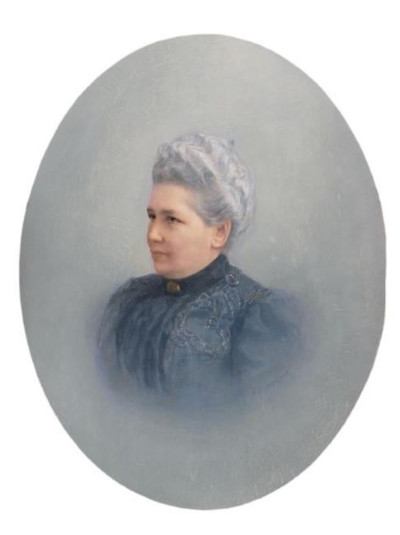
Piet Mondrian's Portrait of Louise Charlotte Mathilde van den Bosch presents an older woman against a pale, softly bounded oval. Her light hair and face emerge above a dark high-necked dress; little in the background competes with her likeness. RKD identifies the sitter as Louise Charlotte Mathilde van den Bosch (1843–1907) and catalogues the work as A272. Simonis & Buunk uses her married name, Mrs L.C.M. Rijnen-van den Bosch, for the same portrait. The painting is the companion to the separate portrait of Carolus Marinus Johannes Willem van Rijnen, A271.[1][2][3]
At a glance
- ArtistPiet Mondrian (Piet Mondriaan, 1872–1944)
- SitterLouise Charlotte Mathilde van den Bosch (1843–1907), also recorded as Mrs L.C.M. Rijnen-van den Bosch
- Catalogue numberRKD / Welsh A272
- DateDisputed. RKD proposes circa 1900–1905 with a question mark; Simonis & Buunk reports a 1914–15 dating attributed to Joosten
- MediumOil on panel
- Dimensions49.1 × 38.7 cm (height × width), according to Simonis & Buunk
- Related workPortrait of Carolus Marinus Johannes Willem van Rijnen, A271
- Recorded locationRKD lists Simonis & Buunk, Ede; the dealer labels its object record “previously for sale”[1][2]
The paired Van Rijnen portraits
Carolus van Rijnen (A271)
date disputedLouise van den Bosch (A272)
date disputedContents
- What does the portrait show?
- Who was Louise Charlotte Mathilde van den Bosch?
- When was the painting made?
- How does A272 relate to A271?
What does the portrait show?
Louise is shown from the upper body upward, her head turned slightly toward the viewer's left. Pale hair is swept up from the forehead. The skin tones are gently modelled, while the dark dress absorbs much of the light below the neck. Its close collar and fine decoration over the upper body add small points of detail. The background is a grey oval that lightens near the figure and softens toward its edges. There is no room or landscape to locate the sitter in a particular place.
 The Red Tree Piet Mondrian.jpg)
The oval is a frame within the rectangular panel. It concentrates attention on the face and gives the composition a settled, formal quality. Mondrian varies the surface within this limited structure: the contours of the shoulders recede, while the face and hair remain legible. The dress's small lighter accents prevent the lower section from becoming a single undifferentiated dark shape. These observations come from the existing image; a reproduction cannot settle questions about the panel's precise colour or paint texture.
The likeness belongs to Mondrian's early figurative practice. Viewers who know the later grids may recognise his control of a few large areas of tone, but the purpose here is a named person's image. It would be misleading to read the grey oval as a literal precursor to a particular abstract composition. The portrait can be understood on its own terms: face, dress and background are arranged to hold attention on the sitter.
Who was Louise Charlotte Mathilde van den Bosch?
RKD supplies her full name and lifespan, 1843–1907. Simonis & Buunk's title, Portrait of Mrs. L.C.M. Rijnen-van den Bosch, supplies the married-name form. Its companion record names C.M.J.W. Rijnen, whose full name and 1832–1903 lifespan are supplied by RKD. Together the catalogue sequence and the dealer's description of the man's painting “with pendant” identify the portraits as related works.[1][2][3]
The sources reviewed here do not establish Louise's occupation, the circumstances of her acquaintance with Mondrian or whether she sat for him. Nor does her expression provide dependable biographical information. Her two surname forms are useful because a reader may encounter one in the RKD catalogue and the other in a dealer or exhibition record. They should lead to this same A272 painting, rather than to a second work.
The dealer's provenance names Mrs J.C.C.L. Visser-Rijnen as the probable commissioner and says the work passed by inheritance to a former private owner in the Netherlands. The word “probable” matters: the record does not document a certain commission or explain how the sitter was represented to Mondrian. Its literature list identifies Welsh's catalogue raisonné entry as A272, providing a second route from the dealer's married-name title to the catalogue number.[2]
Watch: Piet Mondrian
See his studio, the move toward geometric abstraction and the rhythms of his New York paintings.
Piet Mondrian: Abstract Painting as We Know It
Curator Michael White explores the paintings and Mondrian’s studio as an abstract space.
Watch on YouTubeWhen was the painting made?
The public records disagree. RKD gives circa 1900–1905?, retaining a question mark. Simonis & Buunk states 1914–15 according to Joosten. The dealer's A272 page does not reproduce the argument behind that later estimate. These dates should remain attributed rather than fused into a false single year. The early estimate belongs to the period in which RKD groups the A270–A277 portraits, but a catalogue section heading alone cannot resolve an individual object's chronology.[1][2]
The sitter's death in 1907 changes how the two datings would be understood. If the RKD estimate is right, Louise was alive when the portrait was made. If the later estimate is right, it was painted after her death. Neither record identifies a preparatory photograph or proves that she posed. A viewer should therefore resist claiming a live sitting or a posthumous commission as settled fact.[1][2]
The companion A271 portrait also has disputed dating. Its sitter died in 1903; the separate Van Rijnen page explains RKD's tentative early range and the later scholarly datings reported by the dealer. The two pictures' relationship is well supported, but it does not make either proposed date certain.
How does A272 relate to A271?
RKD lists the Van Rijnen likeness as A271 and Louise's as A272. Simonis & Buunk calls the man's portrait a work made with a pendant, and the dealer's title for A272 uses her married name. That is a stronger basis for pairing them than their adjacent numbers alone. Each remains a distinct painting with a distinct sitter.[1][2][3]
Their formats are close without being identical. The dealer gives Louise's panel as 49.1 × 38.7 cm and Carolus's as 49.6 × 39.1 cm. Both portraits use a pale oval, a darker surrounding area and formal dark clothing. His white hair, beard and bow tie differ from her swept-up hair and high-necked dress. Placing the two local articles together lets readers compare Mondrian's treatment of each face while keeping the measurements and dates tied to the right object.[2][3]
The dealer records several past museum loans for A272, including the Mondriaanhuis in Amersfoort and Villa Mondriaan in Winterswijk. These are dated exhibition records, not a statement that the panel is currently on view. RKD's location line still names the Ede dealer, while the dealer describes the painting as previously for sale. Neither public page establishes a current public display or a named present owner.[1][2]
Mondrian artworks directory
Frequently asked questions
Who is the woman in this portrait?
When did Mondrian paint her portrait?
What material and size does the dealer record?
Simonis & Buunk records oil on panel, measuring 49.1 × 38.7 cm.[2]
Is it the pendant to Carolus van Rijnen's portrait?
Where can I see the original?
Discussion
Which feature of Louise first draws your eye?
Reader Insights
Follow the grey oval toward the face. Where does your eye stop?
How do the small dress details change the dark lower half?
How does this A272 portrait compare with the separate A271 pendant?
Join the Conversation
Share what you notice in this painting below.
References
- RKD – Netherlands Institute for Art History, digital Mondrian catalogue, “Portraits (A270–A277),” including A271 and A272 names, dates and recorded locations. View source.
- Simonis & Buunk, object record for Portrait of Mrs. L.C.M. Rijnen-van den Bosch, with medium, measurements, Joosten dating, provenance, literature and exhibition loans. View source.
- Simonis & Buunk, object record for Portret van C.M.J.W. Rijnen tezamen met pendant, identifying the related portrait and its separate size and dating. View source.
- Lead image credit. Piet Mondrian, Portrait of Louise Charlotte Mathilde van den Bosch, RKD A272. Date disputed; oil on panel, 49.1 × 38.7 cm in the Simonis & Buunk record.