 by Tom Gurney
Tom Gurney BSc (Hons) is an art history expert with over 20 years experience
Published on June 19, 2020 / Updated on September 28, 2026
Email: tomgurney1@gmail.com / Phone: +44 7429 011000
About the painting
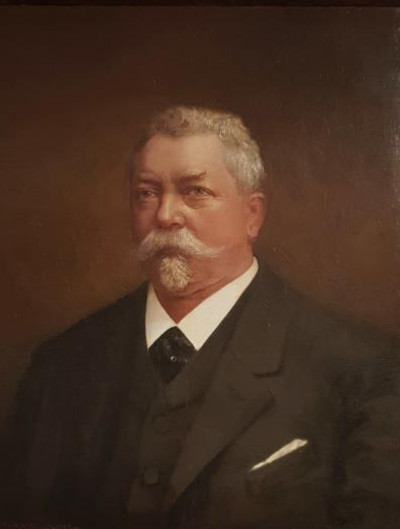
Piet Mondrian's Portrait of Ludwig Wilhelm Schöffer shows a white-haired, moustached man in a dark formal suit against a warm brown ground. His face receives the strongest light, while the jacket descends into shadow. RKD identifies the sitter as Ludwig Wilhelm Schöffer (1831–1904), catalogues the painting as A274, and dates it circa 1905. If that estimate is correct, Mondrian made the likeness after Schöffer died. The public catalogue does not say who commissioned it or what visual source the painter used.[1]
At a glance
- ArtistPiet Mondrian (Piet Mondriaan, 1872–1944)
- SitterLudwig Wilhelm Schöffer (1831–1904)
- Catalogue numberRKD / Welsh A274
- DateCirca 1905, according to RKD
- Recorded collectionPrivate collection in RKD's catalogue
- Medium and dimensionsNot verified by the cited public object record; no size or material is asserted
- Biographical sourceThe Hesse state monument register's history of Schöffer's Villa Witu estate in Gelnhausen[1][2]
A274 among Mondrian's early portraits
Carolus van Rijnen (A271)
c. 1900–05?Contents
- What does the portrait show?
- Who was Ludwig Wilhelm Schöffer?
- When and how was A274 made?
- Where is the painting now?
What does the portrait show?
Schöffer appears from the upper body upward. Short pale hair, a broad white moustache and a small pointed beard define the face. A white collar and dark tie stand out above a black waistcoat and jacket. A light pocket square interrupts the jacket on the viewer's right. Mondrian sets these details against a brown field that is lighter around the head and darker toward the edges.
 The Red Tree Piet Mondrian.jpg)
The figure is substantial but not crowded by objects. There is no desk, landscape or inscription explaining Schöffer's career. Mondrian lets dress and pose carry the formality of the portrait while reserving the closest modelling for the face. The head turns a little toward the viewer's left; the eyes do not become a reliable guide to the sitter's thoughts or character. It is a painted likeness, not a biographical document in itself.
The white collar forms a sharp visual bridge between the face and the deep black of the suit. Below it, the waistcoat buttons make a quieter vertical rhythm. The pocket square offers a second pale accent on the lower right. These small contrasts keep the dark mass of clothing from flattening out in the existing reproduction. The brown background does its own work: by avoiding a strong border around the shoulders, it helps the face remain the clearest element.
This portrait belongs to a very different side of Mondrian's practice from the abstract grids for which he is now famous. The sitter is particular and recognisable, and the arrangement is restrained. That does not make it a simple prelude to abstraction. A reader can appreciate the careful tonal choices without projecting meanings from later paintings back onto this person's likeness.
Who was Ludwig Wilhelm Schöffer?
The Hessian state monument register identifies Schöffer as a prosperous merchant who returned from Rotterdam to Gelnhausen, his home town. It says he was elected to the Rotterdam Chamber of Commerce in 1862 and became a Dutch citizen in 1866. From 1875, he lived permanently in Gelnhausen with his wife Julie. These details help explain his cross-border life, though the cited record does not explain how he or his family came into contact with Mondrian.[2]
Near his brother Konrad Heinrich, Schöffer built Villa Witu on former vineyard land west of town. The heritage record describes its Palladian design and its landscaped park, developed with gardener Franz Hohm senior. The account survives because the former gardener's house and associated structures were placed on Hesse's monument list. Villa Witu itself was later demolished. The estate history supplies documented context for the sitter's resources and residence; it does not prove that the villa appeared in Mondrian's working process or that the portrait once hung there.[2]
The sitter's dates in that German heritage record match RKD's 1831–1904 lifespan. The two sources therefore identify the same named person, while serving different purposes: RKD records the painting, and the monument register records a historic property connected to Schöffer. The painting contains no visible clue to his Dutch citizenship, mercantile career or Gelnhausen residence. Those facts need their own source rather than an interpretation of the clothing.[1][2]
Watch: Piet Mondrian
See his studio, the move toward geometric abstraction and the rhythms of his New York paintings.
Piet Mondrian: Abstract Painting as We Know It
Curator Michael White explores the paintings and Mondrian’s studio as an abstract space.
Watch on YouTubeWhen and how was A274 made?
RKD's catalogue line gives circa 1905. Because Schöffer died in 1904, a date around 1905 would make the work a posthumous portrait. “Circa” also signals an estimate rather than a precise dated inscription. Nothing in the cited records establishes that the painter met the sitter; they do not identify a preparatory photograph, earlier portrait, family commission or payment.[1]
RKD lists A274 among portraits from Mondrian's Amsterdam-period catalogue section. The nearby entries include the Van Rijnen couple, Jan Coenraad de Ruyter de Wildt and the young Hulshoff Pol brothers. That sequence shows Mondrian was making portraits of different sitters around these years. Catalogue adjacency, however, does not establish that the works shared a commissioner, technique or exhibition history.[1]
The date also changes the way one might read the apparently direct gaze. A formal portrait can appear as though the sitter was in the room with the painter, even when it is made after death. For A274, the RKD dates make a live sitting at the proposed time impossible. The painting itself cannot tell us which earlier source supplied the face. Keeping that gap visible is more useful than filling it with an attractive but undocumented story.
Where is the painting now?
RKD gives private collection for A274. It does not name the owner or offer a public gallery location in the cited catalogue line. A visitor should therefore not assume that the painting is on display. The image on this page provides a way to study its composition, but it is not evidence of the original's present whereabouts.[1]
No verified medium or dimensions appear in the public sources used here. Other early Mondrian portraits have their own panel or canvas measurements, but transferring a size from a nearby catalogue number would confuse separate objects. The same caution applies to provenance: Schöffer's documented Villa Witu home does not establish a documented route from his family to the current private collection.
The portrait's upright rectangular format suits its arrangement: the light face occupies the upper centre, with the dark suit spreading across the lower half. The soft brown backdrop keeps the concentration on the sitter's features, while the bright pocket square draws the eye back through the darker clothing.
Mondrian artworks directory
Frequently asked questions
Who is the man in Mondrian's portrait?
When did Mondrian paint him?
RKD dates the portrait circa 1905. Since Schöffer died in 1904, that estimate makes the painting posthumous.[1]
Did Schöffer sit for Mondrian?
The cited records do not document a sitting. A live sitting in circa 1905 would conflict with the sitter's 1904 death; the source for Mondrian's likeness is not established.[1]
Was Schöffer Dutch or German?
The Hessian heritage record says he came from Gelnhausen, worked in Rotterdam, acquired Dutch citizenship in 1866, and lived back in Gelnhausen from 1875. Those stages explain why a single nationality label would oversimplify his life.[2]
Where can I see the original painting?
RKD lists a private collection, with no named current owner or public display location in its catalogue line.[1]
Discussion
Which feature of the sitter first draws your eye?
Reader Insights
Follow the white collar toward the face. Where does your eye stop?
How does the pocket square interrupt the dark suit?
How does this A274 portrait differ from the nearby A271 portrait?
Join the Conversation
Share what you notice in this painting below.
References
- RKD – Netherlands Institute for Art History, digital Mondrian catalogue, “Portraits (A270–A277),” A274 Portrait of Ludwig Wilhelm Schöffer (1831–1904), circa 1905, private collection. View source.
- Landesamt für Denkmalpflege Hessen, Hesse state monument register, former gardener's house of Villa Witu, Gelnhausen, with Schöffer's Rotterdam career, Dutch citizenship, return to Gelnhausen and estate history. View source.
- Lead image credit. Piet Mondrian, Portrait of Ludwig Wilhelm Schöffer, c. 1905, RKD A274. Private collection in RKD’s catalogue.