 by Tom Gurney
Tom Gurney BSc (Hons) is an art history expert with over 20 years experience
Published on June 19, 2020 / Updated on September 29, 2026
Email: tomgurney1@gmail.com / Phone: +44 7429 011000
About the painting
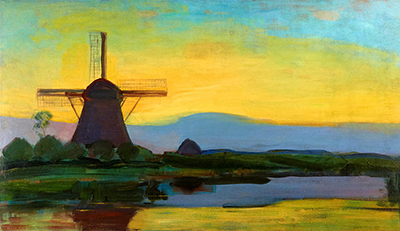
A low dark mill stands against a sky that seems to take over the whole painting. Bands of yellow-green light, blue and purple cloud stretch across the long canvas, while water catches their colour below. Piet Mondrian's Oostzijdse Mill with Extended Blue, Yellow and Purple Sky is the work catalogued by RKD as A411. Kunstmuseum Den Haag owns it as 0334233 and uses the Dutch display title Oostzijdse molen bij avond (“Oostzijdse Mill in the Evening”). The museum dates it about 1907–08, lists oil on canvas, and measures it 67.5 × 117.5 cm. These identities refer to one painting, not two separate evening views.[1][2]
At a glance
- ArtistPiet Mondrian (Piet Mondriaan, 1872–1944)
- RKD titleOostzijdse Mill with Extended Blue, Yellow and Purple Sky
- Museum titleOostzijdse molen bij avond (“Oostzijdse Mill in the Evening”)
- DateAbout 1907–08; RKD specifies c. 1907–early 1908
- Catalogue numberRKD A411
- MediumOil on canvas
- Dimensions67.5 × 117.5 cm (height × width) in the current Kunstmuseum object record
- CollectionKunstmuseum Den Haag, The Hague; object 0334233, from the Salomon B. Slijper bequest[1][2]
Four views of the Oostzijdse Mill
Moonlit Gein (A411b)
c. 1903Moonlight (A420)
c. 1907Extended sky (A411)
1907–08Panoramic sunset (A418)
1907–08Contents
- What does the extended sky show?
- Why are there two titles for this painting?
- How did Mondrian simplify the Gein landscape?
- Which Oostzijdse Mill paintings are different?
- Where is the original?
What does the extended sky show?
The unusually wide canvas gives more space to sky than to the mill itself. The windmill's crisp dark contour rises near the left side; adjoining buildings and banks make a low horizontal zone beneath it. Yellow-green light spreads behind the silhouette, with strips of purple-blue and clear blue cloud. In the foreground, water reflects portions of this colour. The Kunstmuseum describes the elements—mill, outbuildings, dikes, clouds and evening sky—as large summarised shapes rather than detailed representations.[1]
 The Red Tree Piet Mondrian.jpg)
The painting's long format matters. At 117.5 cm across but only 67.5 cm high, it allows the sky to extend laterally in both directions. The mill anchors that expanse without filling it. Dark banks create an almost continuous strip across the middle. Water at the bottom returns some of the sky's light, setting up a loose exchange between above and below. The image remains a landscape, yet its power lies in large zones of colour and the balance of a vertical silhouette against horizontal bands.
The museum emphasises that Mondrian's use of deep, sparkling colour is deliberate. The yellow-green atmosphere and blue-purple cloud are not simply neutral transcriptions of weather. They make the evening feel more intense while retaining recognisable elements of the Gein landscape. A photograph might document a windmill's precise machinery; this painting asks how light and colour can make the site emotionally and visually concentrated.[1]
Why are there two titles for this painting?
RKD's long English title is descriptive: it differentiates this painting from a run of other Oostzijdse Mill pictures by specifying the extended blue, yellow and purple sky. Kunstmuseum Den Haag's current collection page calls the same object Oostzijdse molen bij avond. The decisive link is its inventory number 0334233, which appears in both records. RKD also supplies the older collection notation 75-1971. The route keeps the established English catalogue title while giving the museum title clearly in the article.[1][2]
Title variation is common when a painter repeats one motif many times. RKD separately lists A410, an Oostzijdse Mill with an extended light blue, yellow and violet sky, associated with a dealer in Ede. A one-word difference in the title can therefore point to another object. On this page, the museum accession and the visible composition matter more than a shortened caption such as “Windmill at Evening.”[2]
There is also a small measurement discrepancy among Kunstmuseum publications. Its current collection record gives 67.5 × 117.5 cm, while a 2017 exhibition page labels the work 76.5 × 117.5 cm. This article uses the current object record and does not silently combine the two figures. The discrepancy is a reason to retain the accession 0334233 as the primary identity anchor rather than relying on measurements alone.[1][3]
Watch: Piet Mondrian
See his studio, the move toward geometric abstraction and the rhythms of his New York paintings.
Piet Mondrian: Abstract Painting as We Know It
Curator Michael White explores the paintings and Mondrian’s studio as an abstract space.
Watch on YouTubeHow did Mondrian simplify the Gein landscape?
Kunstmuseum Den Haag describes this picture as part of the shift in Mondrian's work around 1907, when he brought line and colour into increasingly personal relationships. Its account says that the mill, adjoining structures, dikes, distant clouds and evening sky are painted in large generalising forms. He no longer needs to describe each roof tile, blade or ripple for the scene to remain legible.[1]
The painting makes this process visible. From a distance, the banks and buildings can read as a dark horizontal barrier. The windmill becomes a sharp upright marker. The colourful sky and water are broad fields rather than inventories of meteorological detail. On closer inspection, however, the forms retain enough differences to identify the place. This is a useful stage in Mondrian's development, but it is not yet one of his later nonrepresentational grids. The Gein mill, sunset and reflections are still part of the work's subject.
The museum connects the work to Mondrian's wider movement from realistic landscape painting toward radical abstraction. That longer trajectory helps explain why A411 matters, but the canvas should also be read on its own terms: it is an energetic evening painting, with a carefully adjusted colour structure and a particular Dutch site.[1]
Which Oostzijdse Mill paintings are different?
The Rijksmuseum's A411b, Oostzijdse Mill along the River Gein by Moonlight, is a smaller c. 1903 painting with a centred mill, a small moon and a river bend. The resemblance of “A411” and “A411b” catalogue numbers does not make them versions of one canvas. The Rijksmuseum work has a separate accession, SK-A-4987, and a different viewpoint and date.[2][4]
Kunstmuseum Den Haag also owns Oostzijdse Mill in Moonlight, A420 / 0332363, dated about 1907. That painting is wider than it is tall but has a much darker night setting and a prominent warm moon. Conservators found an orange ground beneath A420; that technical discovery cannot be assigned to A411 without separate examination. The two canvases illustrate how changing the light changed Mondrian's whole arrangement of the same mill.[2][5][6]
The privately held A418 is another panoramic sunset with bright reflected colours, catalogued 1907–08. It places greater emphasis on the mill and its reflection than this Hague painting's expansive blue-yellow-purple sky. Comparing the exact images, rather than reading only similar long titles, is the safest way to navigate the series.[2]
Where is the original?
The painting belongs to Kunstmuseum Den Haag in The Hague. The museum credits it to the Salomon B. Slijper bequest, an important source of its Mondrian holdings. Its object page gives the dimensions, medium, date and accession but does not guarantee that A411 is continuously displayed. Check the museum's current programme before visiting for this particular work.[1]
The image already on this local page shows the same extended sky and left-side windmill described by the museum and RKD, so it has been retained. The descriptive article rests on the museum's record and the visible painting; an optional image upgrade is unnecessary for the page to identify the correct work.
Mondrian artworks directory
Frequently asked questions
When was the painting made?
Is “Oostzijdse molen bij avond” the same work?
How large is it?
Is it the moonlit painting A420?
Discussion
How does the mill anchor the extended sky?
Reader Insights
Where do sky colours return in the water?
How does A411 differ from the museum’s darker A420?
How does A411 differ from the museum’s darker A420?
Join the Conversation
Share what you notice in this painting below.
References
- Kunstmuseum Den Haag, official record and interpretation for Oostzijdse molen bij avond, 0334233, c. 1907–08, oil on canvas, 67.5 × 117.5 cm. View source.
- RKD – Netherlands Institute for Art History, Mondrian catalogue of Gein landscapes, A410–A420; A411 held by Kunstmuseum Den Haag as 75-1971 / 0334233. View source.
- Kunstmuseum Den Haag, 2017 exhibition page carrying a conflicting 76.5 cm height for this painting. View source.
- Rijksmuseum, separate A411b moonlit Gein painting, SK-A-4987. View source.
- Kunstmuseum Den Haag, separate A420 moonlight painting, 0332363. View source.
- Kunstmuseum Den Haag, conservation publication describing the orange ground of A420. View source.
- Lead image credit. Piet Mondrian, Oostzijdse Mill with Extended Blue, Yellow and Purple Sky (Oostzijdse molen bij avond), c. 1907–08, oil on canvas, 67.5 × 117.5 cm in the current museum record, Kunstmuseum Den Haag, 0334233, RKD A411.