 by Tom Gurney
Tom Gurney BSc (Hons) is an art history expert with over 20 years experience
Published on June 19, 2020 / Updated on September 29, 2026
Email: tomgurney1@gmail.com / Phone: +44 7429 011000
About the painting
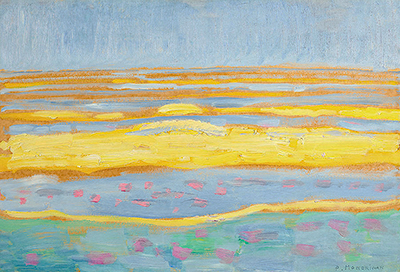
Blue and yellow bands run across the water in Piet Mondrian's Seascape. The picture is a small coastal study, yet its broad horizontal divisions make the sea seem open and expansive. This particular work is RKD A695, painted in 1909 and held by Kunstmuseum Den Haag under object number 0334290. These identifiers matter: Mondrian painted several Zeeland sea views that year, and short titles such as Seascape and Sea after sunset can easily be confused.[1][2]
At a glance
Three distinct 1909 sea views
Contents
- What can you see inSeascape?
- Where and when was it made?
- How does it relate to Mondrian's other sea paintings?
- Why are the colours so pronounced?
- The support and the painted light
What can you see in Seascape?
The horizon sits within a sequence of horizontal areas. Cool blue extends across the upper part of the painting. Below, pale yellow and deeper blue marks alternate over the water. The foreground has shorter strokes and shifting colours rather than a sharply drawn shoreline. No boat, building or figure interrupts the open view. Mondrian gives the viewer light, colour and distance as the main events.
 The Red Tree Piet Mondrian.jpg)
The yellow strokes are especially striking. They are not a single solid strip painted over a blue sea. Their edges break, and blue remains visible around them. That broken surface can suggest light scattered over water. At the same time, it asks us to notice the paint marks as marks. This double effect, a recognizable coast and an arrangement of colour, helps explain the painting's place among Mondrian's experiments around 1909.
Look also at the differences between the wide middle and the busier lower edge. The composition is horizontal overall, but it is not mechanically regular. Some colour passages open out, while others are interrupted by short touches. The small cardboard support contains a scene that seems much larger than its 34.5 × 50.5 cm dimensions.[2]
Where and when was it made?
RKD dates A695 to 1909 and identifies it as the Hague museum's 0334290. Kunstmuseum Den Haag gives the same date, medium, size and object number. The museum's exhibition By the Sea places Mondrian's coastal studies in the context of his visits to Domburg in Zeeland: he first went there in 1908 and returned in 1909. Domburg attracted artists interested in the distinctive light of the coast, including Jan Toorop and Jacoba van Heemskerck.[1][2][3]
That regional context is well supported, but it does not fix a precise beach, hour or day for this particular painting. Nor does the painting itself identify one. Its lack of topographical detail lets the horizon and changing light carry the view. The museum records the support as cardboard, so descriptions of this object as an oil canvas are inaccurate.[2]
The museum also records the bequest of Salomon B. Slijper. Slijper's name links the painting to the collection history through which many Mondrian works reached The Hague, but the object record does not by itself establish when he first acquired this one. The documented bequest is the claim that can be made securely here.[2]
Watch: Piet Mondrian
See his studio, the move toward geometric abstraction and the rhythms of his New York paintings.
Piet Mondrian: Abstract Painting as We Know It
Curator Michael White explores the paintings and Mondrian’s studio as an abstract space.
Watch on YouTubeHow does it relate to Mondrian's other sea paintings?
The neighbouring Sea Toward Sunset is A694, also made in 1909 and also in Kunstmuseum Den Haag, but it is a distinct 41 × 76 cm oil-on-cardboard work, object 0334289. Its violet sky and dark central water contrast with the cooler blue upper field and vivid yellow strips in A695. The two formats also differ: A694 is unusually wide, while this Seascape has a less elongated rectangle.[1][2][4]
There is another naming trap. RKD lists A693 as Sea after sunset, in the same museum under 0333679. The museum currently titles A694 Sea after sunset on its English object page. A title alone is therefore inadequate for matching a reproduction to an original. For this page, the combined RKD number A695, museum number 0334290, dimensions and picture itself identify the intended work.[1][4]
The larger series includes beach, pier and dune pictures. The RKD catalogue places A695 beside other 1909 seascapes, while the museum's By the Sea account describes Mondrian's sustained attention to the visual and emotional experience of the coast. A695 should be read within that experiment, without treating every coastal painting as an interchangeable illustration of one scene.[1][3]
Why are the colours so pronounced?
The sea need not be rendered as a uniform blue surface. Mondrian's yellows can register brightness and reflection; his blues give depth and coolness. The small touches at the lower edge complicate the broad bands above them. This is a visual reading of the painting, rather than a claim about a specific weather condition that the records do not document.
The work also predates Mondrian's famous nonrepresentational grids. It is tempting to regard its horizontals only as a rehearsal for later abstraction. The 1909 picture deserves to be seen first as a sea study: bands of sky, water and shore are still tied to a viewed landscape. The move toward simpler structure can be observed within that subject, rather than imposed on it as a fixed destination.
The support and the painted light
The Hague museum records oil on cardboard, a modest support for a painting that describes a wide expanse. That contrast is worth remembering when viewing the work on a screen. The sea is not rendered through a long, continuous brush line alone. Shorter yellow and blue touches change density as they approach the viewer, while the horizon steadies the view. From farther away these marks merge into bands of reflected light; from close up they remain separate decisions in paint.[2]
This is also why the work should not be reduced to a preliminary diagram of later horizontal lines. Its subject is still a particular experience of shore, air and water. The effect of light depends on variations and broken edges that a later strict rectangle would handle differently. The formal connection is illuminating, but the 1909 seascape deserves attention as a resolved coastal painting in its own right.
Mondrian artworks directory
Frequently asked questions
Which Mondrian Seascape is shown here?
What is the painting made of?
The museum lists oil on cardboard, measuring 34.5 × 50.5 cm.[2]
Is it the same as Sea Toward Sunset ?
Why is Domburg relevant?
Kunstmuseum Den Haag places Mondrian's 1909 sea and dune work in the context of his visits to that Zeeland coastal town and its artist circle.[3]
Discussion
Where does yellow seem to register light on the water?
Reader Insights
How do the foreground marks differ from the broader bands?
What changes beside the wider A694 view?
What changes beside the wider A694 view?
Join the Conversation
Share what you notice in this painting below.
References
- RKD – Netherlands Institute for Art History, Mondrian catalogue section on 1909 seascapes, listing A693, A694 and A695 with Hague object numbers. View source.
- Kunstmuseum Den Haag, official Seascape object record, 0334290, 1909, oil on cardboard, 34.5 × 50.5 cm. View source.
- Kunstmuseum Den Haag, By the Sea, exhibition account of Mondrian's Zeeland visits and the coastal artist circle. View source.
- Kunstmuseum Den Haag, official Sea after sunset object record for the distinct 0334289. View source.
- Lead image credit. Piet Mondrian, Seascape, 1909, oil on cardboard, 34.5 × 50.5 cm, Kunstmuseum Den Haag, 0334290, RKD A695.