by Tom Gurney
Tom Gurney BSc (Hons) is an art history expert with over 20 years experience
Published on June 19, 2020 / Updated on September 29, 2026
Email: tomgurney1@gmail.com / Phone: +44 7429 011000
About the painting
Black verticals and horizontals divide a tall canvas into many unequal fields. Small red, blue and yellow accents punctuate the structure, especially toward its edges and lower area. Piet Mondrian's Trafalgar Square is RKD B294/B322, a painting begun in the London years and dated 1939–43. It belongs to The Museum of Modern Art, object 510.1964. MoMA's date follows “39–43” inscribed on the original stretcher, evidence that Mondrian revisited the work after moving to New York.[1][2]
At a glance
Mondrian across periods
Contents
- What makes the arrangement lively?
- Why does the date span four years?
- How does it relate to later New York work?
- What happened after Mondrian's death?
- What the title does and does not locate
- A painting made across cities
What makes the arrangement lively?
The broad black structure is not a uniform grid. Lines have different intervals, leaving narrow strips beside more open white rectangles. At several crossings, black thickens into a block that acts almost like another colour area. MoMA's gallery text notes this particularly at the lower right. Smaller coloured planes interrupt the black and white field, and their positions pull attention in several directions at once.[2]
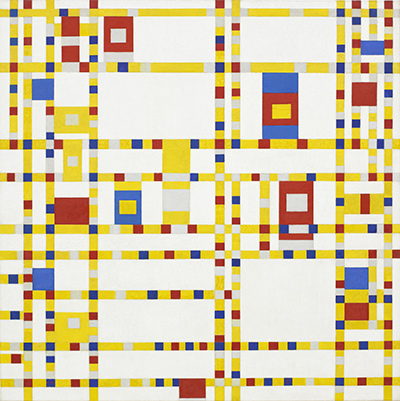
The canvas is large: nearly a metre and a half high. A narrow reproduction can make the coloured parts look tiny, but on the full painting their relation to the black lines is more physical. The eye alternates between following a long vertical, stopping at a horizontal crossing and finding a small bright rectangle. The rhythm is deliberate, not evenly repeated.
Despite its title, the picture is not a mapped overhead plan of London's square. MoMA describes it as the first of Mondrian's paintings titled after places in cities that sheltered him during the war. The name brings a real location and period into the work, while the visual design remains an abstract arrangement of lines and coloured planes.[2]
Why does the date span four years?
Mondrian left Paris for London in September 1938 as war threatened Europe. He began Trafalgar Square there. He then moved to New York in 1940. The “39–43” inscription on its stretcher is MoMA's reason for understanding the canvas as one he returned to after that move. The dates are therefore not an uncertain guess about a single sitting; they refer to work across a changed period and location.[2]
RKD catalogues the painting as a later second state, B294/B322, rather than as two separate canvases. The combined number records the work's changing form. A reader should not mistake B294 and B322 for two museum objects or count the London and New York stages as different paintings.[1]
How does it relate to later New York work?
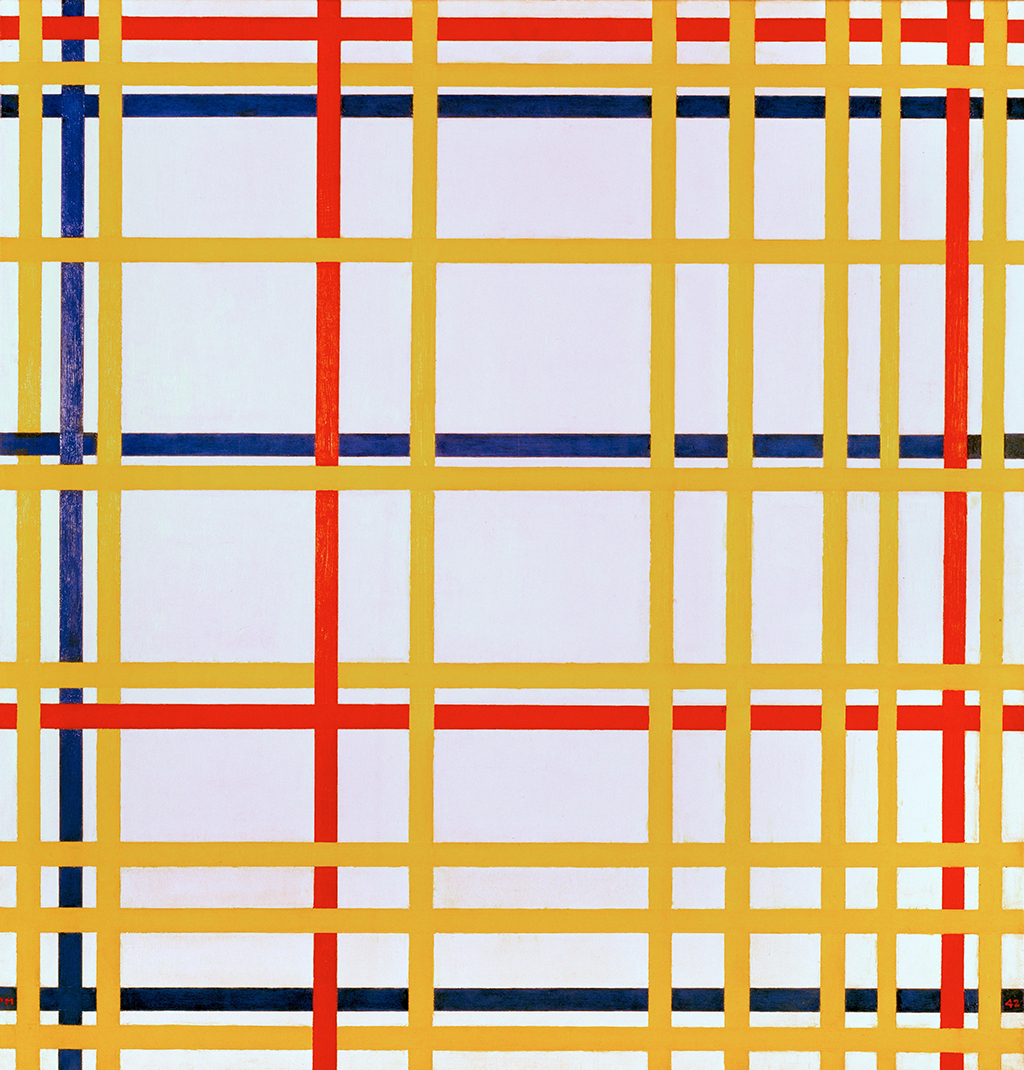
The picture still uses black lines to organise the white surface. In Broadway Boogie Woogie, Mondrian later built a denser network of coloured bands and small blocks. Trafalgar Square helps explain the passage between those approaches: its black framework remains strong, yet the small colour accents and changing intervals make the surface increasingly animated.
That relationship is visible without claiming that the painting encodes a literal city street plan. The square's name, the recorded movement from London to New York and the changing line rhythm give a historically grounded way to discuss it. The painting's individual balances still need to be read on their own terms.
Watch: Piet Mondrian
See his studio, the move toward geometric abstraction and the rhythms of his New York paintings.
Piet Mondrian: Abstract Painting as We Know It
Curator Michael White explores the paintings and Mondrian’s studio as an abstract space.
Watch on YouTubeWhat happened after Mondrian's death?
MoMA's provenance records the artist, then Harry Holtzman in the Mondrian estate in 1944. It later passed through John L. Senior Jr. and Sidney Janis to William and Margaret Burden, who gave it to MoMA in 1964. The museum also lists numerous earlier exhibitions. This documented chain is more informative than saying only that the painting is “in New York.” MoMA currently marks it not on view, a display status that can change.[2]
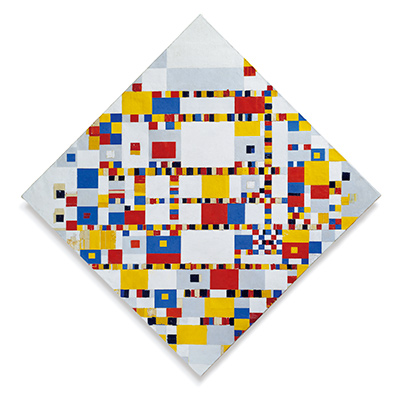
One of those early public appearances can be named. MoMA's March 1945 Mondrian memorial exhibition checklist listed Trafalgar Square as catalogue 50, dated 1939–43, with Harry Holtzman as lender. It appeared in the same checklist as Broadway Boogie Woogie and the unfinished Victory Boogie Woogie. This near-contemporary record confirms that the London title and extended date were being used soon after Mondrian's death and shows the work entering an early overview of his career before its later purchase and gift history.[3]
What the title does and does not locate
Mondrian began this work in London after leaving Paris in 1938. The title names a London landmark, but MoMA does not describe the canvas as a street plan or a view of Nelson's Column. Its fragmented rhythm and small colour accents are abstract. The place name locates an episode in Mondrian's life and the work's history; it does not require every bar to correspond to a particular road or building.[2]
The span of dates also changes how to look at it. MoMA interprets the stretcher inscription “39–43” as evidence that Mondrian returned to a canvas begun in London after moving to New York in 1940. The picture can therefore be read as a painting carried across places and revised, not as a single frozen London impression. Its still-visible black framework and coloured interruptions offer a useful comparison with Broadway Boogie Woogie, where the late rhythm is expressed with a different density and handling of coloured units.[2]
A painting made across cities
The 1939–43 span is unusually informative because it crosses Mondrian's move from London to New York. It makes sense to consider the composition in relation to both periods, while stopping short of assigning individual coloured blocks to literal city features. The title memorialises Trafalgar Square, and the stretcher inscription informs MoMA's dating. Neither turns the abstract arrangement into a coded map. The visible work gives evidence for repeated decisions about line and coloured interruptions; its documented travels give those decisions a historical setting.[2]
Mondrian artworks directory
Frequently asked questions
Where is Trafalgar Square ?
It is MoMA 510.1964 in New York.[2]
Why are there two RKD numbers?
B294/B322 records earlier and later states of the same painting, not two separate Trafalgar Square canvases.[1]
When was it made?
MoMA dates it 1939–43, supported by the “39–43” inscription on the original stretcher.[2]
Discussion
Where does black behave as a filled area?
Reader Insights
How do small colour accents change the rhythm?
What does the 1939–43 date reveal?
What does the 1939–43 date reveal?
Join the Conversation
Share what you notice in this painting below.
References
- RKD – Netherlands Institute for Art History, New York catalogue, B294/B322 second state, Trafalgar Square. View source.
- The Museum of Modern Art, official Trafalgar Square record, 510.1964, dates, material, gallery text and provenance. View source.
- The Museum of Modern Art, “Mondrian Memorial Exhibit,” press release and checklist, 19 March 1945, item 50, listing the painting's date and Harry Holtzman's loan. View source.
- Lead image credit. Piet Mondrian, Trafalgar Square, 1939–43, oil on canvas, 145.2 × 120 cm, MoMA 510.1964, RKD B294/B322.
 The Red Tree Piet Mondrian.jpg)