 by Tom Gurney
Tom Gurney BSc (Hons) is an art history expert with over 20 years experience
Published on June 19, 2020 / Updated on September 29, 2026
Email: tomgurney1@gmail.com / Phone: +44 7429 011000
About the painting
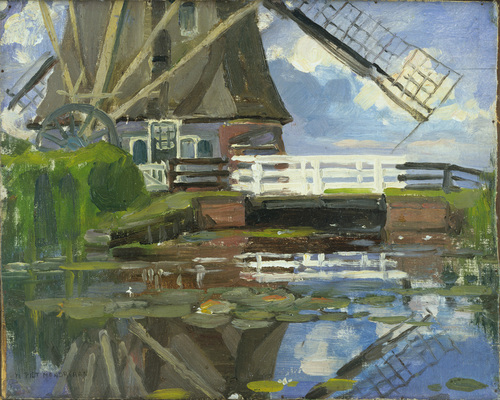
The sails of a windmill reach beyond the edges of a small horizontal picture. Mondrian's Truncated View of the Broekzijder Mill on the Gein, Wings Facing West is RKD A341, held by The Museum of Modern Art as 243.1950. MoMA dates it c. 1902–03 or earlier and identifies its support as oil on canvas mounted on cardboard, 30.2 × 38.1 cm. The unusually close framing gives this early mill study a different emphasis from the wider Gein river scenes on other pages.[1][2]
At a glance
- ArtistPiet Mondrian (1872–1944)
- Full titleTruncated View of the Broekzijder Mill on the Gein, Wings Facing West
- Catalogue numberRKD A341
- Datec. 1902–03 or earlier
- MediumOil on canvas mounted on cardboard
- Dimensions30.2 × 38.1 cm
- CollectionThe Museum of Modern Art, New York
- Object number243.1950; purchased in June 1950[1][2]
Mondrian across periods
Contents
- Why is the mill “truncated”?
- Which Broekzijder mill picture is this?
- How did it enter MoMA?
- Cropping as a choice
- Why the object record is useful
- The small format's effect
Why is the mill “truncated”?
The word describes the composition's cropping. The mill is seen at close range, and its sails cannot be contained within the rectangular edge. The dark structure dominates the small canvas. It is not a panorama of river, bank and sky with a distant windmill as one element. The viewer must imagine the continuation of the sails and surrounding landscape outside the picture.
 The Red Tree Piet Mondrian.jpg)
That cropping makes a familiar building feel almost monumental. Mondrian draws attention to the turning shape and dark mass rather than giving a complete topographical view. The river Gein remains part of the title and setting, but the picture is governed by the mill itself. A close look at the image also shows that its edges are not geometrically exact: the paint retains the softness of an observed outdoor study.
The modest dimensions matter. At 30.2 × 38.1 cm, the work asks a small surface to hold a large subject. MoMA describes it as oil on canvas mounted on cardboard, rather than oil directly on cardboard. That distinction is easy to lose in a shortened caption and should be preserved.[2]
Which Broekzijder mill picture is this?
RKD places A341 beside A341a, another Truncated View of the Broekzijder Mill on the Gein, c. 1902–03?, recorded in a private collection. The MoMA picture adds “Wings Facing West” to its title and has inventory 243.1950. These details separate the page's image from the nearby catalogue entry. Shortening both to “Broekzijder Mill” would obscure that distinction.[1][2]
The Broekzijder mill should also not be confused with Mondrian's Oostzijdse Mill subjects. The Oostzijdse Mill in Moonlight and other Gein paintings on this site have their own catalogue numbers and viewpoints. This page describes the MoMA A341 object rather than treating all mills along the river as one motif.
How did it enter MoMA?
MoMA's provenance notes a private collection in Canada, then Arthur Rothmann Fine Arts in New York acting as agent, before MoMA bought the work in June 1950. The museum marks the provenance as ongoing research. The public sequence is useful, but it does not establish every earlier owner or the painting's whereabouts immediately after Mondrian made it.[2]
The museum also records that the painting appeared in its 1964 Art in a Changing World: 1884–1964 display. A historical installation photograph is evidence of exhibition, not proof that the painting is currently on view; MoMA's present object page says not on view. The page can therefore give a meaningful collection history without making a permanent-display promise.[2]
Watch: Piet Mondrian
See his studio, the move toward geometric abstraction and the rhythms of his New York paintings.
Piet Mondrian: Abstract Painting as We Know It
Curator Michael White explores the paintings and Mondrian’s studio as an abstract space.
Watch on YouTubeCropping as a choice
The close view gives the sails more reach than the small canvas can contain. A conventional landscape might pull back to show the mill, river and sky in one complete setting. Mondrian instead lets the subject exceed the edge. That visual decision makes the viewer conscious of a viewpoint: the mill is encountered from nearby, not surveyed as a distant landmark. The effect is forceful even though the medium remains observational and the paint edges are soft.
The term “truncated” should not suggest that a larger original canvas was physically cut down. In the museum title it describes the pictured view. The recorded support is oil on canvas mounted on cardboard, 30.2 by 38.1 centimetres; nothing in the cited object record establishes a later trimming event. Keeping image crop and object history separate avoids turning a descriptive title into an unsupported conservation claim.[2]
Why the object record is useful
This painting sits close to A341a in RKD's catalogue, while other Gein pages cover the Oostzijdse mill. A short search caption can omit the wing orientation and make several works seem identical. MoMA's accession 243.1950, its support description and the fuller title “Wings Facing West” make A341 identifiable. The museum's provenance begins with a documented Canadian private collection before the 1950 purchase; the early decades remain a gap. That is a meaningful history, even without a continuous list of owners back to Mondrian's studio.[1][2]
The small format's effect
The painting is wider than high, yet the sails and dark mill structure make it feel compressed. Their apparent extension beyond the frame gives the nearby subject more presence than a distant mill would have at the same physical size. The roughly 38-centimetre width matters here: the work asks the eye to infer more landscape than the support contains. That is a different kind of observation from Mondrian's wider river scenes, where bank, reflection and sky can all occupy more of the picture.[2]
Mondrian artworks directory
Frequently asked questions
What is the RKD number?
The MoMA Wings Facing West picture is A341; A341a is a separate related work.[1]
When was it painted?
MoMA gives c. 1902–03 or earlier. The qualifying words matter because the exact date is unresolved.[2]
What is it painted on?
Oil on canvas mounted on cardboard, measuring 30.2 × 38.1 cm.[2]
Is it currently on display?
MoMA's object record currently says not on view; display status can change.[2]
Discussion
What does the close crop leave outside the image?
Reader Insights
How does the small format alter the mill’s scale?
How does A341 differ from other Gein windmills?
How does A341 differ from other Gein windmills?
Join the Conversation
Share what you notice in this painting below.
References
- RKD – Netherlands Institute for Art History, Amsterdam landscape catalogue, A341 and related A341a. View source.
- The Museum of Modern Art, official object 243.1950, material, dimensions, title, provenance and display record. View source.
- Lead image credit. Piet Mondrian, Truncated View of the Broekzijder Mill on the Gein, Wings Facing West, c. 1902–03 or earlier, oil on canvas mounted on cardboard, 30.2 × 38.1 cm, MoMA 243.1950, RKD A341.