 by Tom Gurney
Tom Gurney BSc (Hons) is an art history expert with over 20 years experience
Published on June 19, 2020 / Updated on September 29, 2026
Email: tomgurney1@gmail.com / Phone: +44 7429 011000
About the painting
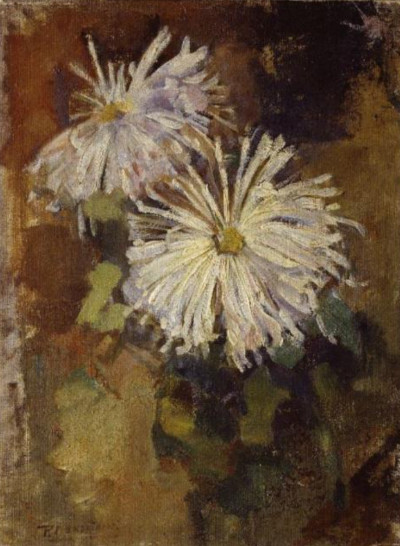
Two pale, spiky flower heads emerge from a dark, warm ground. The upper bloom is looser and smaller; the lower one opens more fully toward the viewer. This is Mondrian's Two Chrysanthemum Blossoms, RKD A106, in Kunstmuseum Den Haag as 0334265. The museum dates it 1899–1900 and records an unusual support: oil on canvas on cardboard. RKD adds a parenthetical “later?” to its date, so the precise moment of execution remains a catalogue question.[1][2]
At a glance
- ArtistPiet Mondrian (1872–1944)
- TitleTwo Chrysanthemum Blossoms; museum title Two Chrysanthemums
- Catalogue numberRKD A106
- Datec. 1899–1900 in the museum; RKD appends “later?”
- MediumOil on canvas on cardboard
- Dimensions45 × 33.5 cm
- CollectionKunstmuseum Den Haag
- Object number0334265; bequest of Salomon B. Slijper[1][2]
Mondrian across periods
Contents
- What makes this flower study distinctive?
- Which work is this in the catalogue?
- Why did Mondrian return to flowers?
- Petals, darkness and distance
- The limits of a short title
- What the two heads make possible
What makes this flower study distinctive?
The two blooms are not identical repetitions. One is high and ragged, while the other opens broadly and directs its light petals outward. The stems and leaves dissolve into the lower darkness. Mondrian concentrates the strongest contrast in the heads themselves: cool off-white petals stand against browns, reds and deep olive tones. This lets the flowers appear luminous without requiring an artificial spotlight or sharply outlined contours.
 The Red Tree Piet Mondrian.jpg)
The picture's small size changes the way it works. At 45 × 33.5 cm, it invites close attention to individual strokes. The pale petals are built from many directional marks; they do not form a single flat white shape. Between the two heads, small darker gaps help give each blossom its own position. Yet the shared vertical arrangement holds them together as one plant study.[2]
There is no elaborate vase or setting to distract from the blooms. Unlike Yellow Chrysanthemums in a Ginger Pot, this picture is not organised around a strongly visible coloured vessel. The interest lies in the two flower heads and in how their petal structures catch light.
Which work is this in the catalogue?
RKD lists A106, Two chrysanthemum blossoms, in the Amsterdam still-life section and connects it to The Hague inventory T107-1971 / 0334265. The collecting museum's title is Two Chrysanthemums and its public record supplies the material, dimensions and bequest. These two records refer to the same object despite the slight title difference.[1][2]
The catalogue also lists a separate A107, Three chrysanthemum blossoms, with whereabouts unknown. Number of blooms, inventory and image should therefore be checked before reusing a generic chrysanthemum caption. This page concerns the two-flower Hague work alone.[1]
RKD's “later?” marker is a caution about dating, not a second title or a second painting. The museum gives the date range 1899–1900 without that extra qualification. Both formulations are recorded here, rather than silently turning an approximate date into a fixed year.[1][2]
Why did Mondrian return to flowers?
The RKD section shows that chrysanthemums were not an isolated subject for Mondrian. It lists still lifes of one, two and three blooms, and later catalogue sections contain still more flower studies. In this work he isolates the petal heads enough to examine their structure, while retaining the changing colours and soft atmosphere of a painted plant.
The museum record identifies a Salomon B. Slijper bequest. It does not document an exact acquisition date for Slijper in the short online entry, and this page does not invent one. The work's secure modern identity is the museum number and catalogue crosswalk. Its artistic interest can then be discussed through the surviving image itself.[2]
Watch: Piet Mondrian
See his studio, the move toward geometric abstraction and the rhythms of his New York paintings.
Piet Mondrian: Abstract Painting as We Know It
Curator Michael White explores the paintings and Mondrian’s studio as an abstract space.
Watch on YouTubePetals, darkness and distance
The bright parts are concentrated in two heads separated vertically. The lower bloom is fuller, while the upper bloom disperses into a looser edge. This prevents the subject from becoming a repeated motif. Dark gaps within and around the petals make the flowers feel three-dimensional without a sharply drawn outline. The supporting stems are subdued, so the strongest visual event occurs where petal strokes meet the warm background.
The material record explains why a small web image can be deceptive. Kunstmuseum Den Haag describes oil on canvas on cardboard, not a flat printed design. At 45 by 33.5 centimetres, the original invites a near view in which individual strokes and dark intervals become more evident. Its whites are made from varied marks against brown and red, rather than one uniform patch. This close handling is central to the painting's effect.[2]
The limits of a short title
RKD's A106 and the museum's 0334265 are the two-blossom work; A107 names a different three-blossom picture whose whereabouts RKD does not establish. A generic “Mondrian chrysanthemums” caption could easily swap them. The Hague collection number, count of flower heads and support are the relevant checks. The museum's 1899–1900 range and RKD's caution that the work may be later should both remain visible. That is a small but useful distinction between a museum label and a catalogue hypothesis.[1][2]
What the two heads make possible
The upper and lower blooms show the same kind of flower in two states of openness. Their difference lets Mondrian vary density: one head is a scatter of light petals, the other has a fuller outward push. The warm darkness around them is not empty space; it allows the smaller upper bloom to remain visible without competing with the lower one. A single cropped flower detail would miss the relationship that gives this modest work its structure.
Mondrian artworks directory
Frequently asked questions
Where is Two Chrysanthemum Blossoms ?
In Kunstmuseum Den Haag, object 0334265.[2]
What is its RKD number?
It is A106; A107 is a separate three-blossom picture.[1]
What is it painted on?
The museum records oil on canvas on cardboard, 45 × 33.5 cm.[2]
Discussion
How do the upper and lower blooms differ?
Reader Insights
Where do petals meet the dark background?
How is this distinct from the three-blossom A107?
How is this distinct from the three-blossom A107?
Join the Conversation
Share what you notice in this painting below.
References
- RKD – Netherlands Institute for Art History, Amsterdam still-life catalogue, A106 and neighbouring A107. View source.
- Kunstmuseum Den Haag, official Two Chrysanthemums record, 0334265, material, dimensions, date and bequest. View source.
- Lead image credit. Piet Mondrian, Two Chrysanthemum Blossoms (Two Chrysanthemums), c. 1899–1900, oil on canvas on cardboard, 45 × 33.5 cm, Kunstmuseum Den Haag, 0334265, RKD A106.