 by Tom Gurney
Tom Gurney BSc (Hons) is an art history expert with over 20 years experience
Published on June 19, 2020 / Updated on September 29, 2026
Email: tomgurney1@gmail.com / Phone: +44 7429 011000
About the painting
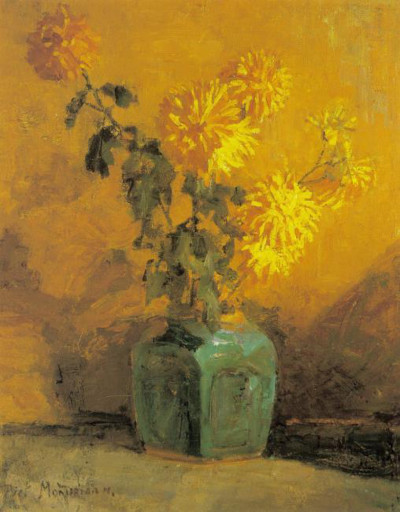
Yellow flower heads spread across a golden field above a small greenish pot. Mondrian's Yellow Chrysanthemums in a Ginger Pot is an early flower still life, catalogued RKD A101 and dated c. 1898. The RKD digital catalogue lists it with the Elkon Gallery in New York, an older recorded location that should not be read as a confirmed present owner. The painting is distinct from his later and much more angular Still Life with Gingerpot I: the repeated word gingerpot does not make the two works part of the same pair.[1]
At a glance
- ArtistPiet Mondrian (1872–1944)
- TitleYellow Chrysanthemums in a Ginger Pot
- Datec. 1898
- Catalogue numberRKD A101
- Recorded locationElkon Gallery, New York, in the RKD catalogue
- Current owner, medium and dimensionsnot established from the primary catalogue entry used here[1]
Mondrian across periods
Contents
- What can be seen?
- What is known about its early history?
- How does it differ from other Mondrian chrysanthemums?
- A crowded field of yellow
- What the early sale suggests
- A title with an ordinary object
What can be seen?
Several yellow chrysanthemums branch from the pot. Their heads are not rigid circles; short strokes make petals fan outward in different directions. The flower at the right seems to tip away from the central group. Leaves and stems occupy a darker middle area before converging at the vessel. The pot's green tone stands apart from the yellow and orange around it.
 The Red Tree Piet Mondrian.jpg)
The background is active. Mondrian does not place the bouquet against a plain neutral wall. Warm yellow and ochre paint extends behind the petals, so edges sometimes become difficult to locate. This closeness of flower and ground creates a sense of light surrounding the whole arrangement. The viewer has to distinguish the brightest petals by their direction and texture as much as by their colour.
The image also shows the vessel firmly placed on a low surface. It is a small anchor for a much more expansive upper half. The visual relation between dense pot and branching flower heads, rather than a carefully described room, governs the composition.
What is known about its early history?
The RKD's digital catalogue identifies A101 as Yellow chrysanthemums in a ginger pot, c. 1898. A scholarly book by Marty Bax, hosted in the RKD's archive, discusses a still life of chrysanthemums in a ginger pot dated 1898 that Maurits Barendrecht had bought by February 1899. This is valuable evidence for Mondrian's early circle of buyers. The short passage does not by itself document every later transfer of A101 or establish a current collection, so those details are left open.[1][2]
The historical note matters because this is a work from the beginning of Mondrian's professional life, not a later nostalgic flower picture. He was already selling such paintings before the century ended. Its warm, crowded colour makes that moment tangible, although no surviving source cited here names the exact room where the flowers were arranged.
How does it differ from other Mondrian chrysanthemums?
The RKD catalogue puts A101 near A102, Three chrysanthemum blossoms in a round pot, and A106, Two chrysanthemum blossoms. The similar subject can tempt a caption writer to treat them as one picture. Their catalogue numbers and images show separate works. A101 has several yellow heads and a greenish ginger pot against a bright golden ground. A106, now in Kunstmuseum Den Haag, has two pale heads against a much darker field.[1][3]
Mondrian returned repeatedly to flowers, sometimes isolating a single bloom. This picture instead makes the group and its vessel the subject. Each flower head has an individual direction, while the branching stems keep the ensemble connected. It is a richer early still life than a generic label such as “yellow flowers” would suggest.
Watch: Piet Mondrian
See his studio, the move toward geometric abstraction and the rhythms of his New York paintings.
Piet Mondrian: Abstract Painting as We Know It
Curator Michael White explores the paintings and Mondrian’s studio as an abstract space.
Watch on YouTubeA crowded field of yellow
The flowers and surrounding ground share warm hues, so the bouquet cannot be understood through colour contrast alone. Direction and texture separate it from its setting: petals radiate outwards in short strokes, while the background is broader and less floral. The greenish pot gathers the stems at the bottom and supplies the clearest compact mass. The upper flowers spread well beyond it, making a small vessel support a much wider arrangement.
This is different from the later blue-pot still lifes. In Gingerpot I, Mondrian works with a busy studio and a more firmly described table; Gingerpot II fractures that setting into Cubist planes. A101 is an earlier flower painting whose ginger pot is a container for branching chrysanthemums, not the central blue object of a two-painting Cubist comparison. The shared word in their titles should not collapse their histories.
What the early sale suggests
The RKD-hosted Bax study reports a chrysanthemum-and-gingerpot still life bought by Maurits Barendrecht by February 1899. That provides useful evidence that paintings of this kind were part of Mondrian's early professional circulation. It does not give a complete chain of ownership for A101, and the RKD's Elkon Gallery entry should not be converted into a current location. The article can say something substantial about the early context while leaving the later route of the physical canvas unclaimed.[1][2]
A title with an ordinary object
The ginger pot grounds the bouquet, but the flowers dominate the canvas. That relation distinguishes A101 from a picture centred on a decorated vessel. The pot's green tone also gives the warm yellow field a cool point of resistance. The painting's main movement runs outward through stems and petals, not inward toward a tabletop arrangement. These visual details are more reliable than a generic “gingerpot” keyword when separating it from Mondrian's later still lifes.[1]
Mondrian artworks directory
Frequently asked questions
What is the catalogue number?
Yellow Chrysanthemums in a Ginger Pot is RKD A101.[1]
When was it made?
Where is it now?
RKD lists the Elkon Gallery, New York. That catalogue location is not enough to assert a current owner or display.[1]
Discussion
How do the yellow petals separate from the golden background?
Reader Insights
What role does the small green pot play?
How does this early ginger pot differ from the 1911 still life?
How does this early ginger pot differ from the 1911 still life?
Join the Conversation
Share what you notice in this painting below.
References
- RKD – Netherlands Institute for Art History, Amsterdam still-life catalogue, A101, c. 1898, Elkon Gallery listing; neighbouring chrysanthemum works. View source.
- Marty Bax, RKD archive, Mondrian's Passions, discussion of Maurits Barendrecht's purchase of an 1898 chrysanthemum still life in a ginger pot by February 1899. View source.
- Kunstmuseum Den Haag, official Two Chrysanthemums record for the distinct 0334265. View source.
- Lead image credit. Piet Mondrian, Yellow Chrysanthemums in a Ginger Pot, c. 1898, RKD A101; Elkon Gallery recorded in the RKD catalogue.