


 by Tom Gurney
Tom Gurney BSc (Hons) is an art history expert with over 20 years experience
Published on June 19, 2020 / Updated on August 16, 2026
Email: tomgurney1@gmail.com / Phone: +44 7429 011000
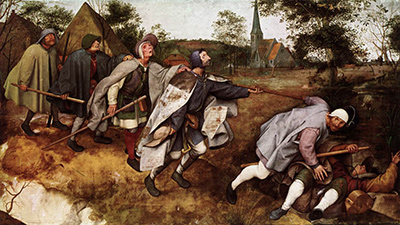
The Blind Leading the Blind was painted in distemper on linen canvas by Pieter Bruegel the Elder in 1568, just a year before his death.
It is a representation of the Biblical parable from the Gospel of Matthew 15:14: "Let them alone: they be blind leaders of the blind. And if the blind lead the blind, both shall fall into the ditch."
In this case, Bruegel's depiction is very literal, as the leader of a procession of six blind men has fallen into a ditch and seems sure to drag his fellows down with him.
This piece is widely considered a masterwork for its acute attention to detail and deliberate diagonal composition, which emphasises the confusion and loss of balance of the blind men. It is also an archetypal Bruegel piece as it depicts both a bible verse and subjects with disabilities.
In this piece the blind men are affected by a variety of afflictions, such as ocular globe atrophy, removed eyes and corneal leukoma.
Though, unlike many of his other late works, The Blind Leading the Blind does not include peasants, the sombre colour palette and subject matter is in keeping with this period in the lead up to Bruegel's death in 1569.
Bruegel's son, Pieter Bruegel the Younger, later produced a larger copy of this painting, as he did many of his father's works.
It has also been alluded to by poets, including Charles Baudelaire and William Carlos Williams, and in the novel The Parable of the Blind by German author Gert Hoffman. The piece is now owned by the Museo di Capodimonte in Naples.
Discussion
What feels most revealing about Pieter Bruegel the Elder: the village detail, the landscape setting, the moral wit, or the way everyday life becomes a complete world?
Reader Insights
Begin with one small action in a Bruegel scene, then follow how it connects to the surrounding figures, setting and rhythm of the whole image.
Connect the work to Northern Renaissance visual culture, printmaking, proverb traditions and Bruegel's interest in rural and urban life.
Which detail changes the interpretation most once you know the subject, date, proverb source or present collection?
Join the Conversation
Have a thought or observation about Pieter Bruegel the Elder? Share it below. Thoughtful responses may be added to this section as the Bruegel pages develop.