


 by Tom Gurney
Tom Gurney BSc (Hons) is an art history expert with over 20 years experience
Published on June 19, 2020 / Updated on August 9, 2026
Email: tomgurney1@gmail.com / Phone: +44 7429 011000
The Abduction of Ganymede: Introduction
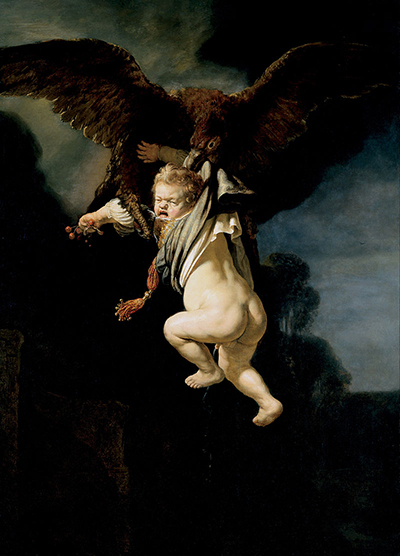
Rembrandt's The Abduction of Ganymede is one of the strangest mythological paintings of the Dutch Golden Age. The old story says that Ganymede was carried away by Zeus, or Jupiter, in the form of an eagle. Many artists treated that moment as a graceful ascent: a beautiful youth lifted toward the gods. Rembrandt does almost the opposite. His Ganymede is a frightened child, twisting in the air, crying out as the eagle grips him and carries him upward.
That change gives the painting its force. It is not a polished classical fantasy. It is an abduction made physical, awkward and uncomfortable. Rembrandt turns mythology into a scene of weight, fear, flailing limbs, rumpled clothing and sudden shock. The result can feel comic at first, but the comedy is uneasy. The picture makes the viewer ask why a story so often beautified in art looks so distressing when treated as an event happening to a small child.
The painting is held by the Gemaldegalerie Alte Meister in Dresden, part of the Staatliche Kunstsammlungen Dresden. Collection and database records identify it with the German title Ganymed in den Fangen des Adlers, inventory 1558, painted by Rembrandt in 1635. The medium is oil on canvas. Published records disagree on the dimensions: Deutsche Digitale Bibliothek gives 171 x 130 cm, while the SKD Rembrandt Database project and Google Arts & Culture / SKD partner data give 177 x 129 cm. That discrepancy should be kept visible rather than smoothed away.
At a Glance
- ArtistRembrandt van Rijn.
- TitleThe Abduction of Ganymede.
- German source titleGanymed in den Fangen des Adlers.
- Date1635.
- Mediumoil on canvas.
- CollectionStaatliche Kunstsammlungen Dresden, Gemaldegalerie Alte Meister.
- Inventory1558.
- Dimensionssources differ; DDB gives 171 x 130 cm, while SKD project and Google Arts/SKD partner data give 177 x 129 cm.
- SubjectGanymede carried away by Zeus/Jupiter in the form of an eagle.
Contents
- Introduction
- At a Glance
- Who Was Ganymede?
- A Myth Turned Into A Child's Fright
- The Eagle
- Comic, Violent And Uncomfortable
- Rembrandt's 1635 Amsterdam Moment
- Against Classical Grace
- Costume, Body And The Everyday
- Dresden And The Object Record
Who Was Ganymede?
Ganymede comes from classical mythology. He was a Trojan prince famed for beauty, and the god Zeus, known in Roman tradition as Jupiter, carried him away in the form of an eagle. In the divine household he became cupbearer to the gods. The story was repeated in Greek and Roman literature, and it became a long-lived subject in European art.
Because the myth involves beauty, divine desire and abduction, it has always required careful handling. Earlier and later artists often showed Ganymede as an adolescent or idealised youth. The scene could become a display of elegant anatomy, airborne movement and antique grace. The violence of being seized could be softened by style.
Rembrandt refuses that softening. His Ganymede is not a heroic or eroticised youth. He is a child caught in the middle of fear. His mouth opens, his arms lift, his body twists, and his clothing bunches around him. The eagle is not a decorative emblem of Jupiter. It is a powerful bird carrying a body that does not consent to being carried.
This is why the painting feels so modern in its discomfort. Rembrandt has not erased the myth, but he has changed the viewer's relation to it. Instead of admiring a beautiful ascent, we are made to notice panic. The subject is still mythological, yet the emotional register is immediate and human.
A Myth Turned Into A Child's Fright
The central shock of the painting is Rembrandt's decision to make Ganymede very young. That decision changes almost everything. A youth carried to Olympus can be imagined as part of a classical world of gods, beauty and power. A crying child in the claws of an eagle makes the same story feel abrupt and troubling.
Rembrandt does not hide the child's vulnerability. The figure is lifted high, but not gracefully. The body is heavy, pulled upward against its will. The child's face is not composed. The gesture is not noble. The painting's energy comes from resistance: the instinctive reaction of a small body suddenly taken from the ground.
The clothing matters. Instead of a timeless nude or idealised antique drapery, Ganymede appears in contemporary-looking dress, rich fabric and small details that bring him nearer to Rembrandt's own world. This makes the myth less remote. The child does not seem like a distant character from a marble past. He seems present, dressed, startled and physically real.
The same is true of the held or scattered objects often noticed in images and descriptions of the painting, including fruit-like details associated with the child's everyday world. Such details make the abduction feel interrupted rather than staged. The child has not prepared for a divine transformation. He has been snatched out of ordinary life.
That interruption is the heart of the picture. Rembrandt's art often finds drama in the moment when an inherited story becomes a human event. In The Abduction of Ganymede, the event is not made beautiful first. It is made bodily first.
The Eagle
The eagle is the form taken by Zeus or Jupiter, but Rembrandt paints it with a blunt physical force. The bird dominates the upper part of the action. Its wings, claws and dark mass carry the scene upward, while the child's body pulls the viewer back toward weight and fear.
In many versions of the myth, the eagle can look almost heraldic: a noble bird performing a divine task. Rembrandt's eagle is more troubling. It is a carrier, a predator and an emblem all at once. The viewer knows the mythological identity, but the immediate impression is still of a bird seizing a child.
This tension between symbol and event is crucial. If the eagle is read only as Jupiter, the painting becomes a mythological diagram. If it is read only as an animal, the classical subject disappears. Rembrandt's power lies in keeping both readings alive. The bird is a god in disguise, but it behaves as an animal with claws, wings and force.
The eagle also creates the painting's vertical drama. The movement is upward, but not uplifting in the emotional sense. The child's fear works against the direction of the flight. The painting is full of contradiction: ascent and terror, myth and accident, divine power and human smallness.
Comic, Violent And Uncomfortable
The Abduction of Ganymede is often described as surprising because it seems to mix comedy and violence. That mixture needs careful language. The painting is not funny in a light or harmless way. It can look comic because Rembrandt exaggerates the child's awkward movement, alarmed expression and bodily helplessness. Yet the subject remains an abduction.
The discomfort is part of the work. Rembrandt makes the viewer feel the gap between inherited myth and lived fear. A story that could be decorated as divine desire becomes a moment of distress. The child's body is not arranged for admiration. It is caught mid-reaction.
This does not mean Rembrandt is simply condemning the myth in a modern moral sense. Seventeenth-century viewers could have enjoyed the audacity, physical humour and anti-classical wit of the image. They may have recognised that Rembrandt was pushing against refined mythological convention. The painting likely carried a kind of visual joke: what if Ganymede's abduction looked less like elegant poetry and more like a child being hauled into the sky?
But the joke is sharp. It depends on the very thing that makes the scene troubling. Rembrandt's humour often has an edge because it returns idealised subjects to bodily experience. Here, the body is small, frightened and undignified. The myth loses its smooth surface.
The painting resists a single label. It is comic, but not merely comic. It is violent, but not only violent. It is mythological, but not comfortably classical. Its meaning lives in the pressure between those terms.
Rembrandt's 1635 Amsterdam Moment
The date 1635 places The Abduction of Ganymede in Rembrandt's early Amsterdam maturity. He had moved beyond his Leiden beginnings and was building a reputation through portraits, group portraits, biblical subjects, mythological scenes and ambitious history paintings. This was the period of strong gesture, rich costume, theatrical lighting and bold experiments in scale.
The painting belongs near works such as Belshazzar's Feast, The Blinding of Samson, Danae and Flora, though each does something different. Belshazzar's Feast turns a biblical banquet into panic before divine writing. The Blinding of Samson pushes Old Testament violence to a monumental extreme. Danae makes mythological encounter intimate and warm. Flora turns identity into costume and poetic role. The Abduction of Ganymede adds another possibility: mythology as abrupt physical shock.
This variety matters because Rembrandt is sometimes remembered mainly through late self-portraits, civic portraits and biblical compassion. The 1630s remind us that he was also a theatrical painter of action, costume and spectacle. He could take an inherited subject and make it startlingly immediate.
Yet his theatricality is not empty show. Even at its most dramatic, Rembrandt's art usually returns to human response. Belshazzar recoils. Samson suffers. Danae reaches toward an unseen arrival. Flora inhabits a role. Ganymede cries out. Gesture and expression are not accessories; they are the place where the story becomes real.
Against Classical Grace
One way to understand the painting is to see it as an argument against classical grace. Rembrandt knew how to make figures beautiful when he wanted to, but he was often more interested in presence than perfection. He gave bodies weight, faces irregularity, gestures interruption and costumes a life of their own.
In The Abduction of Ganymede, that anti-idealising instinct becomes almost defiant. The story could have invited a smooth nude body, elegant diagonal movement and an elevated mood. Instead, Rembrandt gives us a clothed child, exposed panic and a flight that feels forced rather than graceful.
This does not make the painting clumsy. It is a deliberate rejection of one kind of beauty in favour of another kind of truth. Rembrandt's truth is not documentary realism; he is still painting a god in the form of an eagle. But he makes the impossible event answer to real bodily feeling. What would abduction look like if the body resisted it? What would a myth feel like before it became poetry?
The painting's originality lies there. It does not politely illustrate Ganymede. It reimagines the emotional premise of the subject. The viewer is not invited to admire the god's power from a safe distance. The viewer is made to feel how strange that power looks when it takes hold of a child.
Costume, Body And The Everyday
Costume is one of the ways Rembrandt brings the myth close. Ganymede's clothing does not belong to a pure antique world. It has the thick, tangible quality of Rembrandt's studio imagination, where fabrics, props and historical roles often mingle. The costume helps turn the myth into theatre, but it also makes the child seem specific and vulnerable.
This is a familiar Rembrandt strategy. In Flora, costume allows a woman to become a goddess or pastoral figure without losing human presence. In Danae, textiles turn a classical myth into an enclosed chamber drama. In The Abduction of Ganymede, clothing makes the child's ordinary body more visible. The story is ancient, but the scene feels close enough to be unsettling.
The body is equally important. Rembrandt does not present Ganymede as a clean line or an ideal contour. The child has weight. The limbs do not make a graceful pattern. The mouth, hands and lifted arms carry the event more strongly than any symbol could. This is Rembrandt's narrative intelligence at work: he lets the body register what the story means.
The result is a mythological painting that feels almost domestic in its detail and almost brutal in its action. The child's clothes and smallness pull the subject toward everyday life. The eagle and sky pull it toward myth. The painting never lets those worlds settle into comfort.
Dresden And The Object Record
The Dresden location is essential to the painting's modern identity. The available collection records place the work in the Gemaldegalerie Alte Meister, part of the Staatliche Kunstsammlungen Dresden, with inventory number 1558. Deutsche Digitale Bibliothek gives the German title Ganymed in den Fangen des Adlers, identifies Rembrandt, dates the work to 1635 and records canvas as the support. The SKD Rembrandt Database project and Google Arts/SKD partner data support the 1635 Dresden identification and describe the medium as oil on canvas.
The dimension discrepancy should be treated as a normal scholarly caution, not as a reason to avoid the painting. Museum and database records sometimes preserve different measurement traditions, framed/unframed conventions, updated object data or legacy catalogue figures. In this case, the responsible wording is to state that published captures differ: 171 x 130 cm in DDB, against 177 x 129 cm in the SKD project and Google Arts/SKD partner route.
That caution is especially important because the direct SKD online collection page for object ID 372206 is not the only record through which the work is documented. For a reader, the main point is straightforward: this is the Dresden Ganymede, painted by Rembrandt in 1635, oil on canvas, inventory 1558, with dimensions that should be cited carefully.
Object facts may seem dry beside such an explosive image, but they protect the article. They prevent the painting from becoming a floating internet image detached from its collection, title history and source record. With a work as strange as this one, the anchor matters.
How To Look At The Painting
Begin with Ganymede's face. The open mouth and alarmed expression set the tone before the myth explains itself. Rembrandt wants the viewer to register fear immediately. This is not a calm child being translated into divine service. It is a child experiencing the shock of being carried away.
Then look at the arms and body. The movement is upward, but the body resists. The limbs and clothing create a sense of awkwardness rather than elegance. The figure does not cooperate with the composition as an idealised classical body might. The discomfort is visual before it is intellectual.
Next, look at the eagle. Try to see it both as Jupiter's form and as a physical bird. The painting becomes more powerful when those two readings remain in tension. The eagle is not merely an attribute, like a symbol placed beside a god. It is the force that makes the event happen.
Then notice the costume and small details. They make Ganymede seem closer to a child from Rembrandt's world than to a remote antique type. This is one reason the painting can feel startling even to viewers who know the myth. Rembrandt collapses the distance between classical story and ordinary vulnerability.
Finally, ask what kind of mythological painting this is. It does not flatter the god. It does not idealise the child. It does not let the abduction become only a beautiful upward movement. Instead, it holds together physical comedy, fear, power and discomfort. That mixture is exactly why the painting is unforgettable.
Why The Abduction Of Ganymede Matters
The Abduction of Ganymede matters because it shows Rembrandt at his most disruptive. He takes a famous myth and removes much of the elegance that art had attached to it. The old subject remains legible, but the emotional centre changes. Ganymede is not a beautiful youth ascending toward honour. He is a child in distress.
That change reveals a great deal about Rembrandt's imagination. He was not content to repeat inherited formulas. He asked what a subject would look like if it were made immediate, bodily and psychologically charged. In biblical scenes, that method could produce awe, mercy or inward grief. In mythological scenes, it could produce warmth, theatre or unease. Here it produces something almost unruly.
The painting also widens the picture of Rembrandt's mythological art. It belongs beside Danae and Flora as evidence that this part of his work was not one thing. He could paint myth as sensual chamber drama, poetic role or shocking abduction. He could use costume and light not to escape the human world, but to pull legendary subjects into it.
For modern viewers, the picture is valuable partly because it remains difficult. It does not let the myth become harmless. It does not let comedy erase fear. It does not let the child become an ideal. Rembrandt makes the abduction strange again, and that strangeness is the painting's enduring power.
Frequently Asked Questions About The Abduction of Ganymede
The painting is dated 1635 in the Dresden/SKD/DDB records used here.
The painting is oil on canvas. The dimensions require caution: Deutsche Digitale Bibliothek gives 171 x 130 cm, while the SKD Rembrandt Database project and Google Arts/SKD partner data give 177 x 129 cm.
The painting shows Ganymede from classical mythology being carried away by Zeus or Jupiter in the form of an eagle. Ganymede later became cupbearer to the gods.
That is the painting's most striking invention. Many artistic traditions showed Ganymede as an idealised youth. Rembrandt shows a frightened child, making the abduction feel physical, comic, violent and uncomfortable rather than graceful.
It has a sharp comic element, especially in the awkwardness of the child's body and expression, but it should not be treated as harmless comedy. The humour is uncomfortable because the subject is still an abduction.
It is important because it shows Rembrandt challenging classical idealisation. He turns a mythological subject into an immediate human event, using fear, costume, bodily weight and the eagle's force to make the old story strange again.
Discussion
What feels most important in The Abduction of Ganymede: Rembrandt's light, the figure's expression, the material surface, the historical source, or the way the work sits beside his other paintings and prints?
Reader Insights
Begin with one detail in The Abduction of Ganymede, then move outward to light, gesture, surface and the surrounding space.
Connect the work to Rembrandt's biography, workshop, medium and the museum record rather than reading it as an isolated image.
Which detail changes the interpretation most once you know the date, subject, attribution history or present collection?
Join the Conversation
Have a thought or observation about The Abduction of Ganymede? Share it below. Thoughtful responses may be added to this section as the Rembrandt pages develop.
References
- Deutsche Digitale Bibliothek, Ganymed in den Fangen des Adlers: https://www.deutsche-digitale-bibliothek.de/item/2BC4OYFBIJ75XYQ4RIYI6PGJZAWHA5NX
- Staatliche Kunstsammlungen Dresden, SKD online collection record, ID 372206: https://skd-online-collection.skd.museum/Details/Index/372206
- Google Arts & Culture / Staatliche Kunstsammlungen Dresden, The Abduction of Ganymede: https://artsandculture.google.com/asset/the-abduction-of-ganymede/2gGzDAOK1Yk7xg
- Staatliche Kunstsammlungen Dresden, Rembrandt Database project route: https://forschung.skd.museum/projekte/detail/inter-institutional-research-resource-on-paintings-by-rembrandt-rembrandt-database/
- Staatliche Kunstsammlungen Dresden, imprint and general site terms: https://www.skd.museum/impressum/
- British Museum, Ganymede-related collection object: https://www.britishmuseum.org/collection/object/P_1861-1109-263
- Eric Jan Sluijter, Rembrandt's Standard Bearer: On Costume, Comedy, and Self-Portrayal, circa 1627-1637, Journal of Historians of Netherlandish Art, 2024: https://jhna.org/articles/rembrandts-standard-bearer-costume-comedy-self-portrayal-1627-1637/
- Museum Rembrandthuis, collection overview: https://www.rembrandthuis.nl/en/find-out-more/collection/
- Museum Rembrandthuis, science portal: https://www.rembrandthuis.nl/en/find-out-more/science-portal/
 Rembrandt.jpg)