


 by Tom Gurney
Tom Gurney BSc (Hons) is an art history expert with over 20 years experience
Published on June 19, 2020 / Updated on August 9, 2026
Email: tomgurney1@gmail.com / Phone: +44 7429 011000
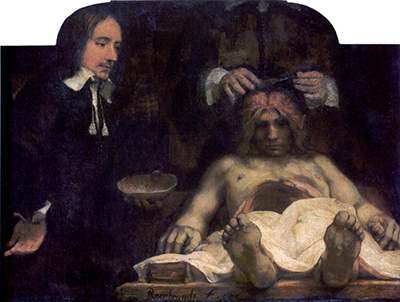
The Anatomy Lesson of Dr Deijman survives as a dramatic fragment of Rembrandt's 1656 surgeons' guild commission
It is specifically a brain dissection being carried out in this artwork and seems ideally suited to the artist's method of darkening almost all of a scene, other than the key focal point. In this case your eyes are drawn to the victim's skull as he lies motionless.
As Deijman completes the work, his assistant Gijsbert Calkonen stands to the left, holding the section of skull that had already been removed. The subject's feet are placed close to the viewer, making us feel closer to the activity.
Rembrandt's skills in depicting human flesh and faces more generally helps to hover the feet tantalisingly at us, helping us to imagine the sight and sounds of this morbid scene.
A further element of darkness to the atmosphere is that the subject lying down, a tailor by the name of Joris 'Black Jack' Fonteijn, was actually executed just several days prior. His permission for this anatomical examination was likely never requested nor given and the body of a convicted criminal was considered fair game for all manner of activities.
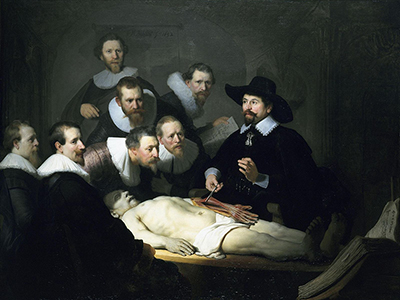
Very few famous artists would make use of such morbid scenes as these for their work but Rembrandt van Rijn himself also brought us The Anatomy Lesson of Dr Nicolaes Tulp which is considered one of his most famous paintings and is also featured in our Rembrandt paintings section.
Object Notes and Research Context
The painting was made in 1656 for the Amsterdam Surgeons' Guild and originally showed a larger group than the fragment that survives today. Dr Jan Deijman, appointed praelector anatomiae in 1653, performed the public anatomy lesson; his assistant Gijsbert Calkoen holds the removed crown of the skull, while the body on the table is usually identified as the executed criminal Joris Fonteijn, also known as Zwarte Jan.
Its present power depends partly on loss. A later fire reduced the composition, leaving the corpse seen in sharp foreshortening and the assistant at left, while Deijman's own head disappeared. That damage has made the remaining image feel almost modern in its blunt concentration: the body projects towards the viewer, the anatomy theatre is compressed, and the lesson becomes less a guild portrait than a confrontation with mortality, knowledge and spectacle.
The Anatomy Lesson of Dr Nicolaes Tulp is the natural comparison because the two commissions bracket different moments in Rembrandt's career. Tulp gave the young Amsterdam painter a breakthrough group portrait in 1632; Deijman shows a late Rembrandt using more radical perspective and darkness for a similar civic-medical subject.
The institutional setting matters. Anatomy lessons were public demonstrations, professional rituals and group-portrait opportunities for the Amsterdam surgeons. Rembrandt had already made that formula famous with Dr Nicolaes Tulp in 1632; by 1656, however, he was willing to make the body itself dominate the composition. The surviving fragment makes that daring more visible because so much of the surrounding guild portrait has disappeared.
The foreshortened corpse is central to the work's afterlife. Viewers often compare the pose to Mantegna's Dead Christ, but the Amsterdam context is different: this is an executed man turned into a lesson for surgeons and spectators. That tension between civic science and human remains gives the page a strong route into Rembrandt's late treatment of mortality.
The fragmentary condition should be made visible in captions as well as prose. Readers may wonder why the composition feels abruptly cropped or why Dr Deijman's face is absent; a clear note that the original surgeons' guild portrait was damaged by fire turns that apparent oddity into one of the work's central historical facts.
The surviving image is now held by the Amsterdam Museum, even though much public research around it appears through partner scholarship and exhibition writing. That collection context helps explain why the fragment appears so often in discussions of Rembrandt's Amsterdam.
Further Rembrandt Context
This shorter legacy page remains part of the Rembrandt archive. For fuller context, use the refreshed Rembrandt pages below, which explain the artist's biography, media, technique, attribution issues and major works in greater depth.
For secure object data, attribution and collection history, compare The Anatomy Lesson of Dr Deijman with the relevant museum or catalogue record before treating older page text as final.
 Rembrandt.jpg)
Discussion
What feels most useful when looking at The Anatomy Lesson of Dr Deijman: the subject, the handling of light, the medium, the attribution history, or its place within Rembrandt's wider painting output?
Reader Insights
Set this page beside the refreshed Rembrandt hubs before relying on older summaries alone.
Rembrandt pages often need museum records, catalogue history and attribution caution, especially where older sources use broader labels.
Which detail would you most want clarified next: date, medium, collection, attribution, subject, condition or comparison with another Rembrandt work?
Join the Conversation
Have a thought or observation about The Anatomy Lesson of Dr Deijman? Share it below. Thoughtful responses may be added as the Rembrandt archive continues to be reviewed.