


 by Tom Gurney
Tom Gurney BSc (Hons) is an art history expert with over 20 years experience
Published on June 19, 2020 / Updated on August 9, 2026
Email: tomgurney1@gmail.com / Phone: +44 7429 011000
Juno: Introduction
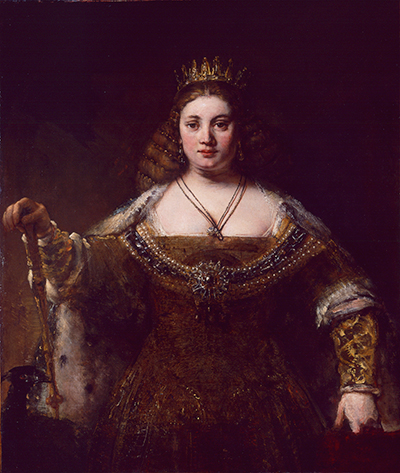
Rembrandt's Juno is one of his most imposing late mythological figures. It shows the Roman queen of the gods not in the middle of a story, but as a presence: frontal, richly dressed, crowned, jewelled and still. The painting belongs to the Hammer Museum in Los Angeles, where the current collection record identifies it as Juno, ca. 1662-65, oil on canvas, 50 x 48 3/4 in. (127 x 123.8 cm), accession AH.90.58.
The subject matters. Juno was the wife of Jupiter and the queenly goddess associated with marriage, wealth and authority. Rembrandt does not turn her into a cool antique statue. He makes her a large, weighty figure in paint, with a crown, pearls, a sceptre and the peacock that traditionally belongs to her. The result is less a narrative scene than a late exercise in grandeur: mythology made human, massive and strangely quiet.
Juno also helps widen the usual picture of Rembrandt's late career. The late Rembrandt is often approached through self-portraits, biblical scenes, portraits and works of inward feeling. This painting shows another side of the same period: the older artist still using classical identity, costume, surface and scale to create an image with the ambition of history painting.
At a Glance
- ArtistRembrandt van Rijn.
- TitleJuno.
- Dateca. 1662-65.
- Mediumoil on canvas.
- Dimensions50 x 48 3/4 in. (127 x 123.8 cm).
- CollectionHammer Museum, Los Angeles.
- Collection areaArmand Hammer Collection.
- Credit lineThe Armand Hammer Collection, Gift of the Armand Hammer Foundation. Hammer Museum, Los Angeles.
- Accession numberAH.90.58.
- Accession year1990.
- Copyright status on the Hammer Collections recordPublic Domain.
Contents
- Introduction
- At a Glance
- Who Is Juno?
- A Late Monumental Figure
- Crown, Sceptre, Peacock
- Costume And Painted Surface
- Juno And Rembrandt's Mythological Women
- Juno And History Painting
- How To Look At Juno
- Why Juno Matters
Who Is Juno?
Juno is the Roman counterpart of Hera, queen of the gods and wife of Jupiter. Her traditional associations include marriage, sovereignty, protection and wealth. In art, she can be recognised by signs of rank and by the peacock, whose brilliant plumage became one of her most familiar attributes.
Rembrandt's painting depends on that recognition, but it does not behave like a simple mythological illustration. There is no unfolding episode from classical literature. Juno does not stride into a council of gods, confront a rival or intervene in a story. She faces the viewer as a commanding image of queenly identity.
That makes the painting close to portraiture, even though it is not a conventional portrait. The figure is presented as if she were a sitter of rank, yet her crown, sceptre, jewels and peacock place her inside myth. Rembrandt had long been interested in figures who stand between person and role: saints, ancient philosophers, biblical characters, costumed women and imagined rulers. Juno belongs to that world of transformation.
The title gives the figure a classical name. The paint gives her physical force. Those two facts work together. The viewer recognises the goddess through attributes, but the painting's power comes from the way Rembrandt makes the role feel inhabited by a living presence.
A Late Monumental Figure
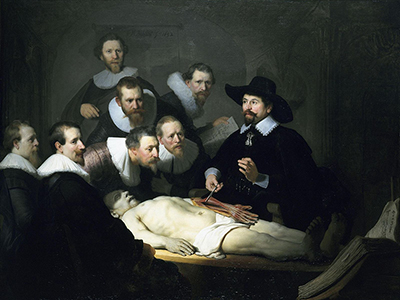
The date, ca. 1662-65, places Juno in Rembrandt's final decade. By then he had passed through financial collapse and changing professional circumstances, yet his late paintings often show remarkable concentration. Hammer programming around late Rembrandt places Juno near works such as The Syndics, Aristotle with a Bust of Homer and late portraits, and describes this period as one in which Rembrandt created imagined portraits of gods, saints and classical heroes.
That phrase is useful for Juno. The painting is not a crowded history painting in the manner of Belshazzar's Feast or The Blinding of Samson. It is not a mythological bedchamber like Danae. It is a single figure, almost square in format, built around stillness. Yet it carries the weight of history painting because the subject is classical, the scale is large and the figure is imagined as more than ordinary life.
The frontal pose is central. Juno does not turn away, bend into action or dissolve into surrounding darkness. She occupies the space directly. Her large eyes, the even light across her face and bodice, and the heavy costume create an effect of calm majesty. She appears fixed and ceremonial, but not empty. The stillness has pressure in it.
This is one of the qualities that separates late Rembrandt from a more decorative version of Baroque splendour. The crown, pearls, jewels and sceptre are brilliant, but the painting is not only about luxury. It is about what luxury looks like when filtered through age, shadow, mass and paint.
Crown, Sceptre, Peacock
The attributes in Juno are not incidental. The crown announces rank. The sceptre reinforces authority. Pearls, gold and the jewelled brooch build the language of wealth. The peacock, illuminated from behind with Juno's right arm and sceptre, identifies the goddess and adds a flash of mythological specificity.
Yet Rembrandt keeps these signs from becoming tidy emblems. They are absorbed into the painted surface. Light glitters from metal and jewels, but the surrounding tones are darker and heavier. The peacock is a marker of the goddess, but it is also a passage of light and texture. The sceptre is a symbol, but it also controls the vertical energy of the composition.
The face is especially important. The Rembrandt in Southern California description notes the dark underpaint left slightly visible around the eyes and strong white highlights at the forehead and nose. That detail helps explain why the head feels so alive. The face is not smoothed into ideal beauty. It is made from contrasts: darkness around the eyes, bright points of light, flesh tones, and the steady frontal gaze.
Juno's grandeur therefore comes from paint as much as iconography. A lesser image might simply list the goddess's attributes. Rembrandt makes the attributes serve a whole presence. Crown, jewels, sceptre and peacock create the queen, but the handling of light and surface makes her Rembrandt's Juno.
Costume And Painted Surface
Costume is one of the painting's main subjects. Juno's dress is not archaeological reconstruction. It is a studio invention of rank, weight and radiance. Rembrandt often used costume to move figures out of ordinary time. A turban, mantle, armour, chain, robe or crown could turn a person into a patriarch, saint, philosopher, monarch or mythological figure.
In Juno, costume does two jobs at once. It identifies the queenly role, and it gives Rembrandt a field for painting surface. The viewer can move from flesh to pearls, from gold to fabric, from shadowed passages to sharp highlights. These transitions matter because they make the figure feel physically present. She is not floating in abstract divinity. She is built from materials.
The painting's richness is also controlled. Juno does not sparkle evenly across the canvas. Light chooses where to land: on the face, bodice, arm, sceptre, peacock, crown and jewels. Darkness remains active around those points, giving the figure depth and gravity. The picture's grandeur depends on restraint as much as display.
This late surface belongs naturally beside Rembrandt's broader style and technique. His mature painting often uses thick accents, broken surfaces, warm shadows and concentrated highlights to make meaning. In Juno, those habits serve a mythological subject. The goddess is not made convincing by polished finish. She is made convincing by the pressure of paint.
Juno And Rembrandt's Mythological Women
Juno is especially useful when read beside Rembrandt's other female mythological and role images. Flora, painted in 1634 and now in the Hermitage, turns a woman in costume into the Roman goddess of flowers and spring, with the famous but cautious association with Saskia van Uylenburgh. Danae, also in the Hermitage, is a large mythological nude begun in 1636 and later reworked, built around a chamber, a bed, rich textiles and an unseen divine arrival.
Those earlier paintings belong to a more theatrical 1630s world. Flora is about role, costume, youth and spring. Danae is about myth entering an intimate room. Juno is different. It is later, more frontal and more queenly. The goddess does not receive a god, become spring or act within a dramatic event. She stands for authority itself.
That difference matters because it shows Rembrandt's range within classical subject matter. He did not use myth in only one way. It could become erotic encounter, poetic role, comic strangeness, noble stillness or monumental identity. The antique subject was not a fixed formula. It was a field in which Rembrandt could test scale, costume, body, paint and human presence.
Juno also pairs naturally with Minerva and Artemisia when considering Rembrandt's female figures of authority, learning, memory and classical identity. The exact subjects and histories differ, but the group helps readers see that Rembrandt's women are not all reducible to portraits, biblical nudes or domestic biography. Some of them are imagined presences shaped by myth, rank and historical role.
Juno And History Painting
History painting includes more than scenes of modern history. In Rembrandt's world it could include biblical, classical, mythological, allegorical and ancient subjects. Juno belongs to that wider tradition, even though it is not an action scene.
The painting's history-painting character comes from its subject and ambition. Juno is a classical deity, and Rembrandt paints her at a scale that asks to be taken seriously. She is not a decorative accessory or a small mythological cabinet picture. She is a large, commanding figure, close to the viewer and almost confrontational in her stillness.
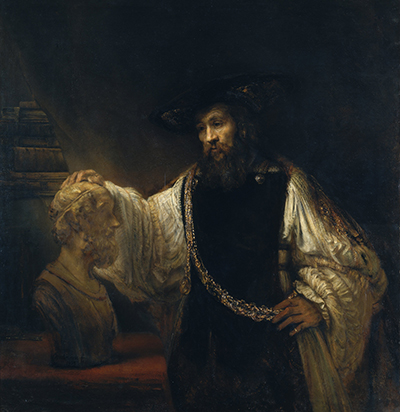
This is why the painting is a useful companion to Aristotle with a Bust of Homer. Both works show Rembrandt using ancient or classical identity to think about dignity, rank, fame and inward presence. Neither painting needs violent action to feel serious. Meaning is carried through pose, costume, light, touch and painted surface.
Juno also helps explain why Rembrandt's history painting cannot be limited to spectacle. The same artist who painted panic, violence and revelation could also make a history image out of frontal calm. Here the drama is not a sword raised, a miracle performed or a god descending in visible form. It is the drama of authority embodied in paint.
How To Look At Juno
Begin with the pose. Juno's body faces the viewer with unusual directness. The composition is almost ceremonial. That frontality gives the painting much of its power because it makes the goddess feel less like a character in a story and more like a sovereign presence.
Then look at the face. The eyes are widely spaced and steady, while the light across the forehead, nose and bodice keeps the head from sinking into darkness. Rembrandt's use of dark underpaint around the eyes gives the gaze weight. The face is not simply lit; it is constructed from light and shadow.
Next, follow the signs of rank. The crown, pearls, brooch, sceptre and peacock identify Juno and build her queenly status. They should be read as symbols, but also as paint. Notice how light catches some surfaces and leaves others subdued. The painting's splendour is selective, not uniform.
Finally, compare the effect with Danae and Flora. Danae reaches toward an unseen arrival. Flora inhabits a poetic springtime role. Juno faces outward in solemn authority. Seeing the differences helps clarify what Rembrandt achieved here. He did not repeat a formula for mythological women. He gave each subject a distinct emotional structure.
Why Juno Matters
Juno matters because it brings together late Rembrandt's seriousness, classical imagination and love of painted surface. It is a mythological image, but not a coldly learned one. It is a queenly figure, but not a conventional court portrait. It is richly dressed, but not merely decorative.
The painting also has a useful place in Rembrandt's larger story. It shows that his final decade was not limited to self-scrutiny or religious tenderness, important as those late themes are. He was still able to imagine ancient and mythological figures with scale and authority. He could make a goddess feel present without turning her into an academic ideal.
For readers moving through Rembrandt's paintings, Juno is a bridge. It connects the mythological world of Danae and Flora with the late gravity of works such as Aristotle with a Bust of Homer, The Syndics and the late portraits. It reminds us that Rembrandt's greatness lies not only in emotion, but in transformation: the way paint can turn costume into identity, attributes into presence and a classical goddess into a monumental human image.
Frequently Asked Questions About Juno
The Hammer Collections record dates Juno to ca. 1662-65, placing it in Rembrandt's late career.
Juno is the Roman queen of the gods and wife of Jupiter. She is associated with marriage, wealth and authority. In Rembrandt's painting, her crown, sceptre, jewels and peacock help identify her.
Juno is best understood as a mythological figure rather than a conventional portrait. It has portrait-like presence because the figure faces the viewer directly, but the attributes and title place her in classical mythology.
Juno is important because it shows Rembrandt using a late, monumental female figure to bring together classical subject matter, queenly costume, rich paint surface and the ambition of history painting.
Discussion
What feels most important in Juno: Rembrandt's light, the figure's expression, the material surface, the historical source, or the way the work sits beside his other paintings and prints?
Reader Insights
Begin with one detail in Juno, then move outward to light, gesture, surface and the surrounding space.
Connect the work to Rembrandt's biography, workshop, medium and the museum record rather than reading it as an isolated image.
Which detail changes the interpretation most once you know the date, subject, attribution history or present collection?
Join the Conversation
Have a thought or observation about Juno? Share it below. Thoughtful responses may be added to this section as the Rembrandt pages develop.
References
- Hammer Collections, Juno, AH.90.58: https://collections.hammer.ucla.edu/artwork/AH.90.58
- Rembrandt in Southern California, Juno: https://rembrandtinsocal.org/virtual-exhibition/juno/
- Hammer Museum, Rembrandt's Syndics, Aristotle, Juno, and Late Portraits, John Walsh program page, 2020: https://hammer.ucla.edu/programs-events/2020/rembrandts-syndics-aristotle-juno-and-late-portraits
- Metropolitan Museum of Art, Aristotle with a Bust of Homer, object 61.198: https://www.metmuseum.org/art/collection/search/437394
 Rembrandt.jpg)