


 by Tom Gurney
Tom Gurney BSc (Hons) is an art history expert with over 20 years experience
Published on June 19, 2020 / Updated on August 9, 2026
Email: tomgurney1@gmail.com / Phone: +44 7429 011000
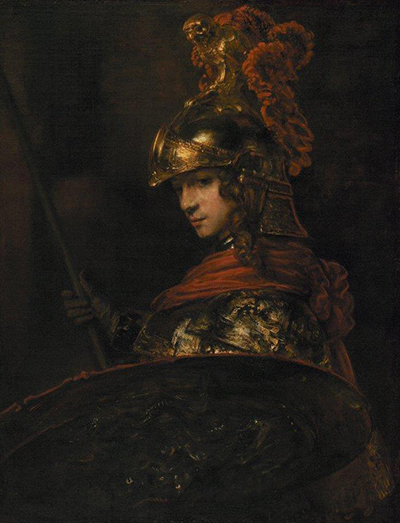
Pallas Athene is an attribution-sensitive late mythological painting associated with Rembrandt and his workshop
The reflections of light on the armour is beautiful and entirely typical of the work of Rembrandt. This was an artist who perfected light in his work in a way that perhaps had never been achieved before.
To see this artwork in its original form, you will need to head to the Museu Calouste Gulbenkian in Lisbon, though this institution also holds a fine collection of work from other famous names.
The painting was purchased from the Hermitage in St Petersburg, courtesy of art dealer Antikvariat. It has previously been in Russia for several centuries, including under the ownership of Tsarina Catharina II.
There has been some discussion that the painting may have come from a scene of the the marriage of Henriëtte Catharina van Oranje and Johan George II of Anhalt-Dessau. Having been completed so many centuries ago, it is unlikely that this theory will ever be proved or disproved conclusively.
Pallas Athene is believed to have been part of a three-part commission from Herman Becker. This has been discussed in the most comprehensive study of Rembrandt's work, namely the Corpus of Rembrandt Paintings which has published a full collection of the artist's work in oils. This publication is clear in its belief that Juno and Venus and Cupid joined this painting is a trinity of goddesses.
A series of prints from around a decade earlier were added to the collection of Herman Becker and he was immediately excited by the idea of combining these three mythological goddesses and surely was behind the decision for Rembrandt to put together a similar series, only in oils.
Object Notes and Research Context
The Lisbon painting is associated with the Calouste Gulbenkian Museum and is usually dated around 1655-57. Public collection and image records preserve a complex attribution history: some routes present it as by Rembrandt, while others qualify it as attributed to Rembrandt or Rembrandt and pupil. That variation should be visible to readers because it affects how confidently the work can be used as evidence of Rembrandt's late mythological production.
The traditional identification as Pallas Athene depends on armour, helmet and the martial-mythological vocabulary around the figure. Other subject suggestions and workshop questions have circulated, so iconography and authorship need to be framed separately: the subject may be debated without automatically settling who painted each part of the canvas.
The strongest contextual route is the proposed late goddess group with Juno and Venus and Cupid, connected in scholarship with Herman Becker's collection. Because Venus and Cupid is itself treated by the Louvre as after Rembrandt, that group is best treated as an important hypothesis, not a tidy set of three secure Rembrandt autographs.
The attribution warning should not prevent a useful discussion of iconography. Pallas Athene is recognised through martial attributes: helmet, armour and the goddess's association with wisdom and strategic war. Those attributes allow the page to explain the proposed subject while still separating subject identification from the question of how much of the painting belongs to Rembrandt's own hand.
The page can also explain why late mythological paintings are difficult. Rembrandt did not produce them in the same numbers as portraits, biblical subjects or prints, and some examples survive through old inventories, copies and shifting attributions. Pallas Athene therefore belongs near Venus and Cupid, Juno and the workshop-and-attribution discussion as a case study in cautious Rembrandt attribution.
Comparison with Juno or Venus and Cupid is useful when discussing late Rembrandt-related mythology and attribution history, but not as proof that all three works have equal autograph status.
Further Rembrandt Context
This shorter legacy page remains part of the Rembrandt archive. For fuller context, use the refreshed Rembrandt pages below, which explain the artist's biography, media, technique, attribution issues and major works in greater depth.
For secure object data, attribution and collection history, compare Pallas Athene with the relevant museum or catalogue record before treating older page text as final.
 Rembrandt.jpg)
Discussion
What feels most useful when looking at Pallas Athene: the subject, the handling of light, the medium, the attribution history, or its place within Rembrandt's wider painting output?
Reader Insights
Set this page beside the refreshed Rembrandt hubs before relying on older summaries alone.
Rembrandt pages often need museum records, catalogue history and attribution caution, especially where older sources use broader labels.
Which detail would you most want clarified next: date, medium, collection, attribution, subject, condition or comparison with another Rembrandt work?
Join the Conversation
Have a thought or observation about Pallas Athene? Share it below. Thoughtful responses may be added as the Rembrandt archive continues to be reviewed.